2024-2023

THE POWER OF COLLECTIVE ACTION (as exhibited in Solastalgia in the Marie Spence Flickinger Art Center.)
220” X 120” X 110” site-specific.
Five-channel video and eighteen watercolor monotypes.
Image by J. Eshelman
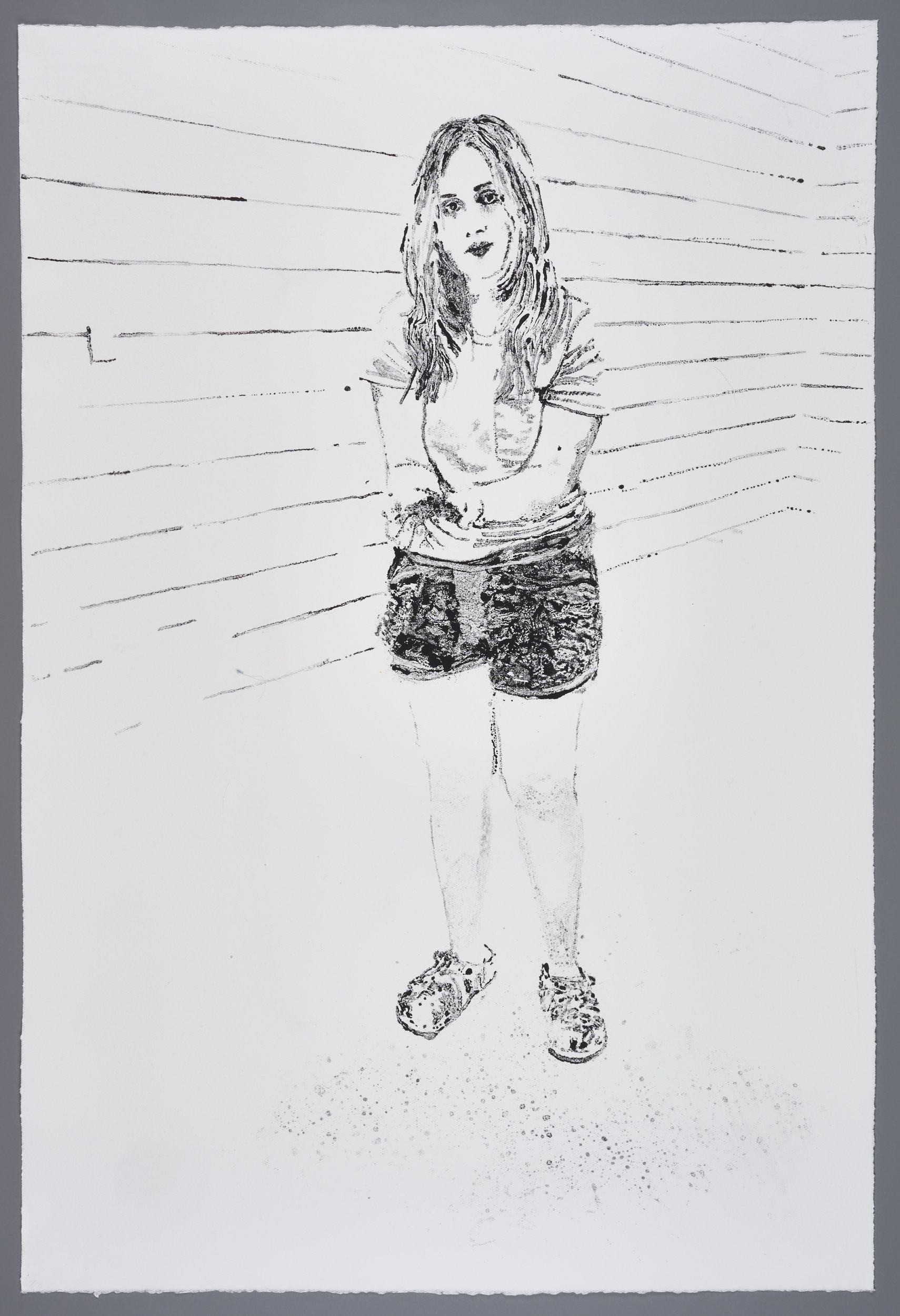
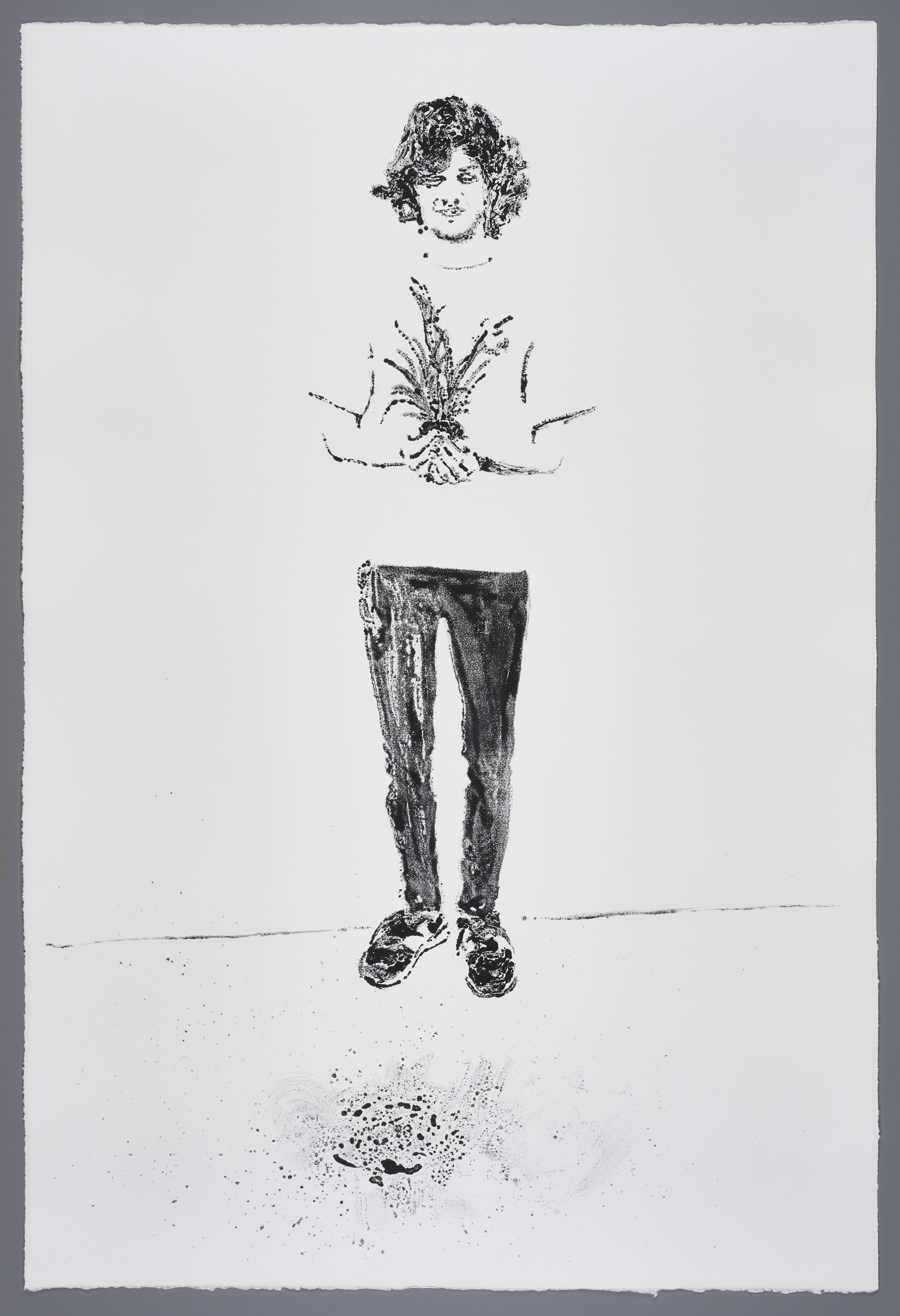
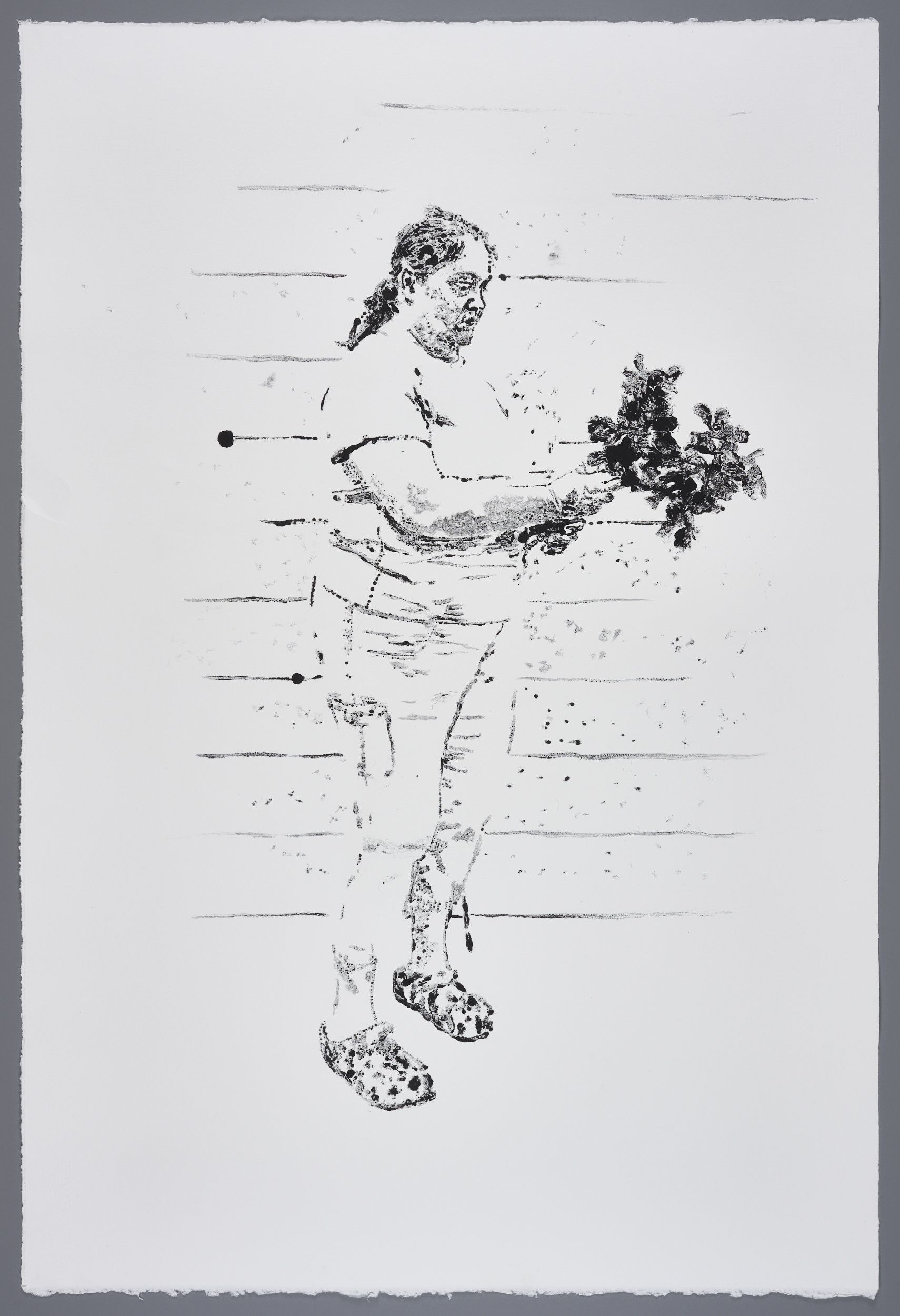
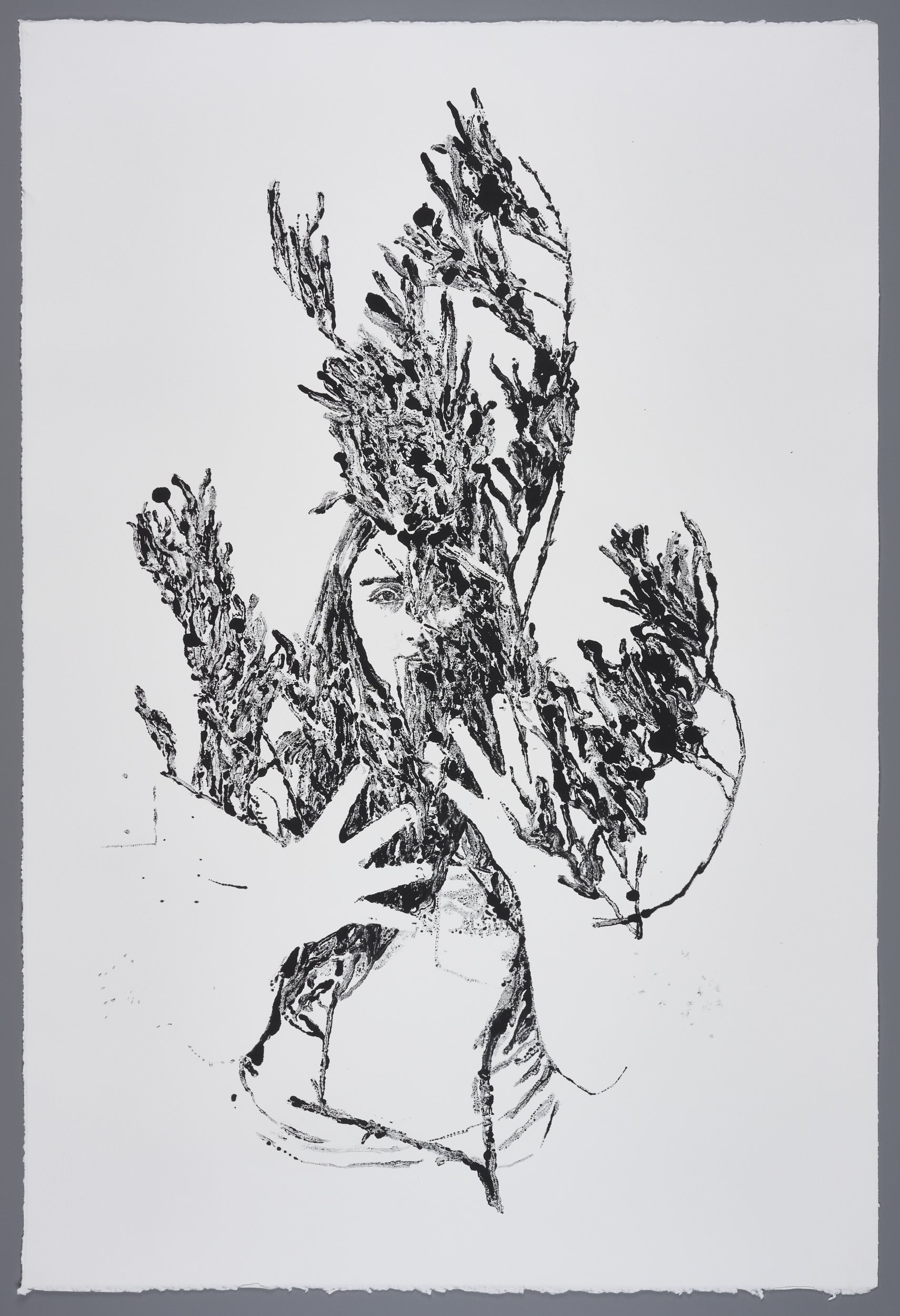
During my research for Solastalgia with faculty from San Jacinto College, I became aware of the students' eco-anxiety, emphasizing the social dimensions of ecological crises. This insight inspired me to create The Power of Collective Action, a multimedia immersive installation highlighting the significance of our united efforts and their broad ecological impact.
Through an eco-art soil workshop that taught students about the vital roles of living soil and native plant species in urban environments, along with a cell phone photo shoot, the students began to see themselves as active participants in healing the planet. They connected with the natural world and envisioned how they could reimagine urban landscapes using indigenous plants and soil to support the water table and enhance biodiversity—powerful tools for mitigating extreme weather patterns.
Using the photos as references, I created monotype portraits of the students interacting with indigenous plants, roots, and soil. In the installation, I layered these portraits with videos documenting the restored wildlife from ecological restorations and aquatic ecosystems that I installed into Houston’s urban landscape. The videos are projected across a corner in building-like silhouettes, illustrating the potential of urban landscapes to alleviate extreme weather.
Utilizing natural and human-made systems, The Power of Collective Action seeks to ignite a collective movement towards ecological stewardship and urban regeneration through social sculpture and the educational system. The video documentation of the exhibition can be seen here.
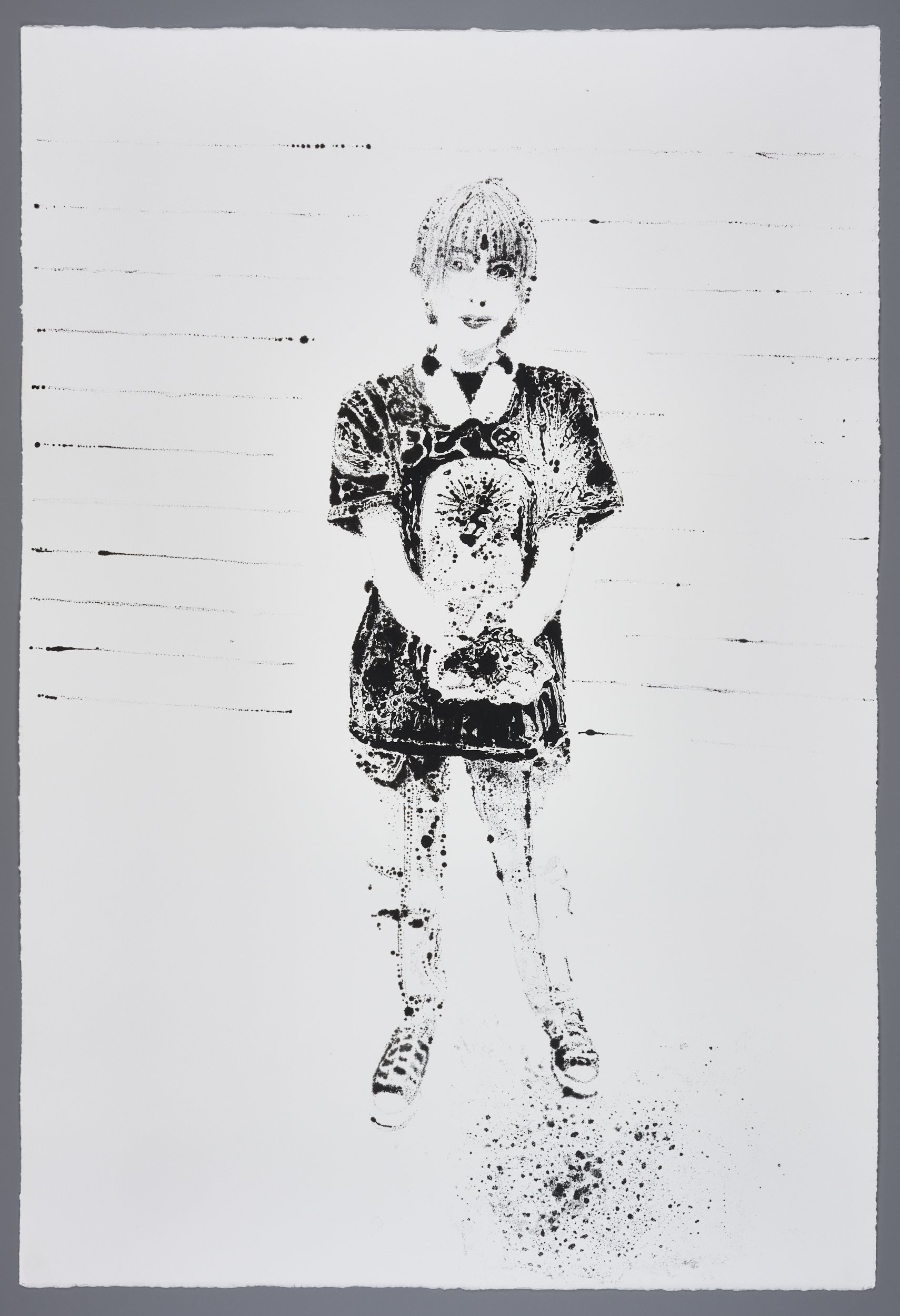
THE POWER OF COLLECTIVE ACTION detail 1
30” X 44”
watercolor monotype
image by J. Eshelman
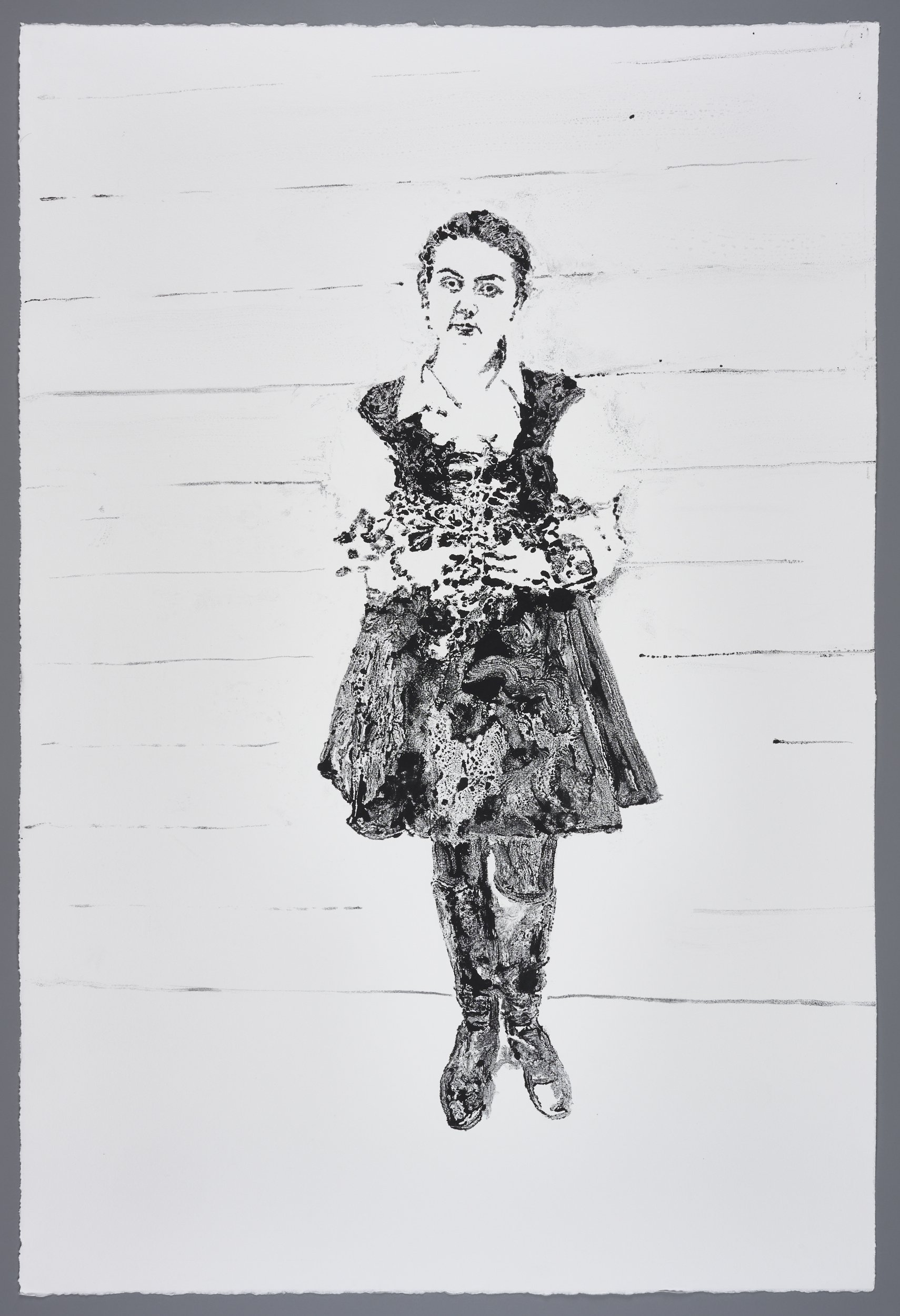
THE POWER OF COLLECTIVE ACTION detail
30” X 44”
watercolor monotype
image by J. Eshelman
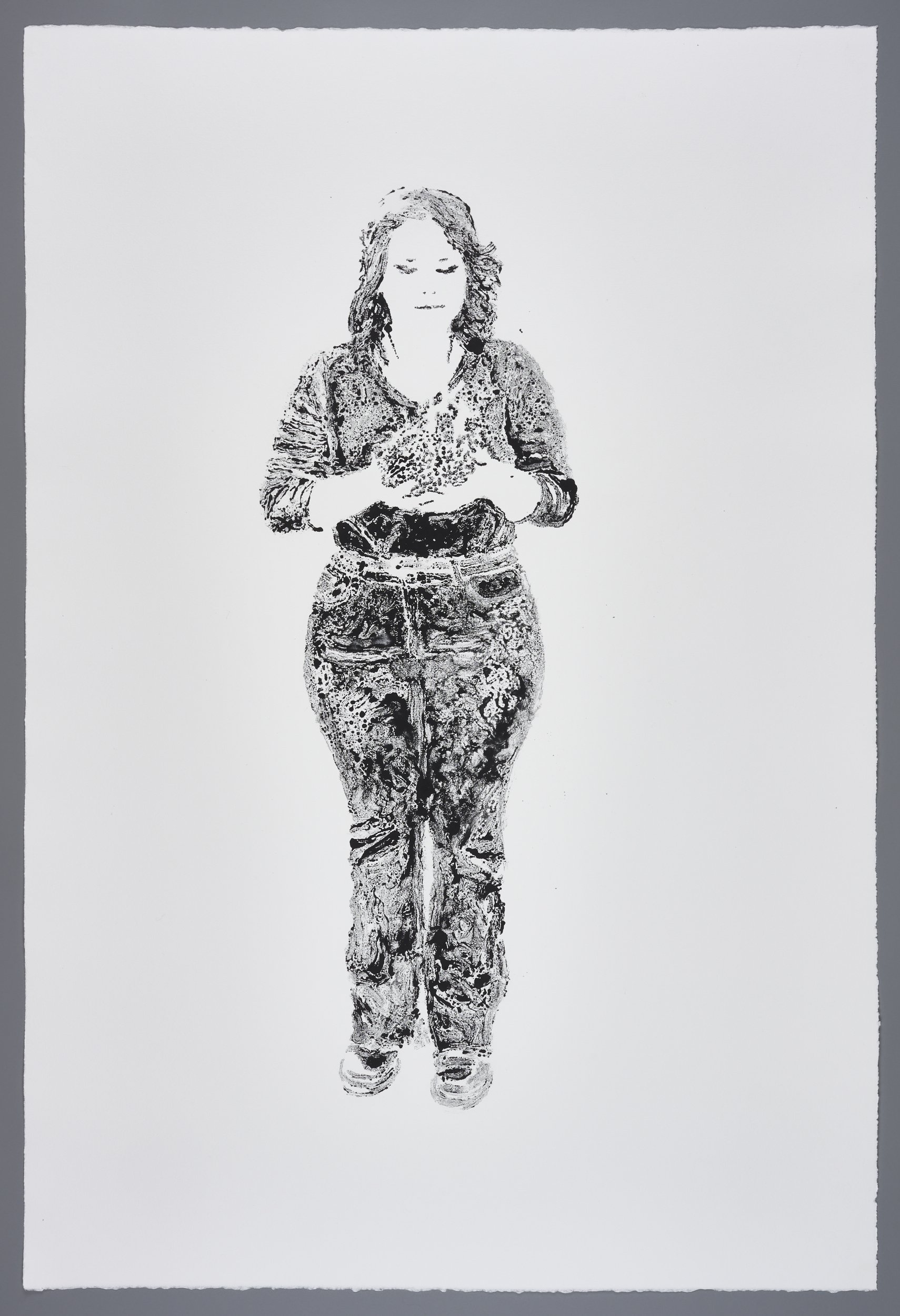
THE POWER OF COLLECTIVE ACTION detail
30” X 44”
watercolor monotype
image by J. Eshelman
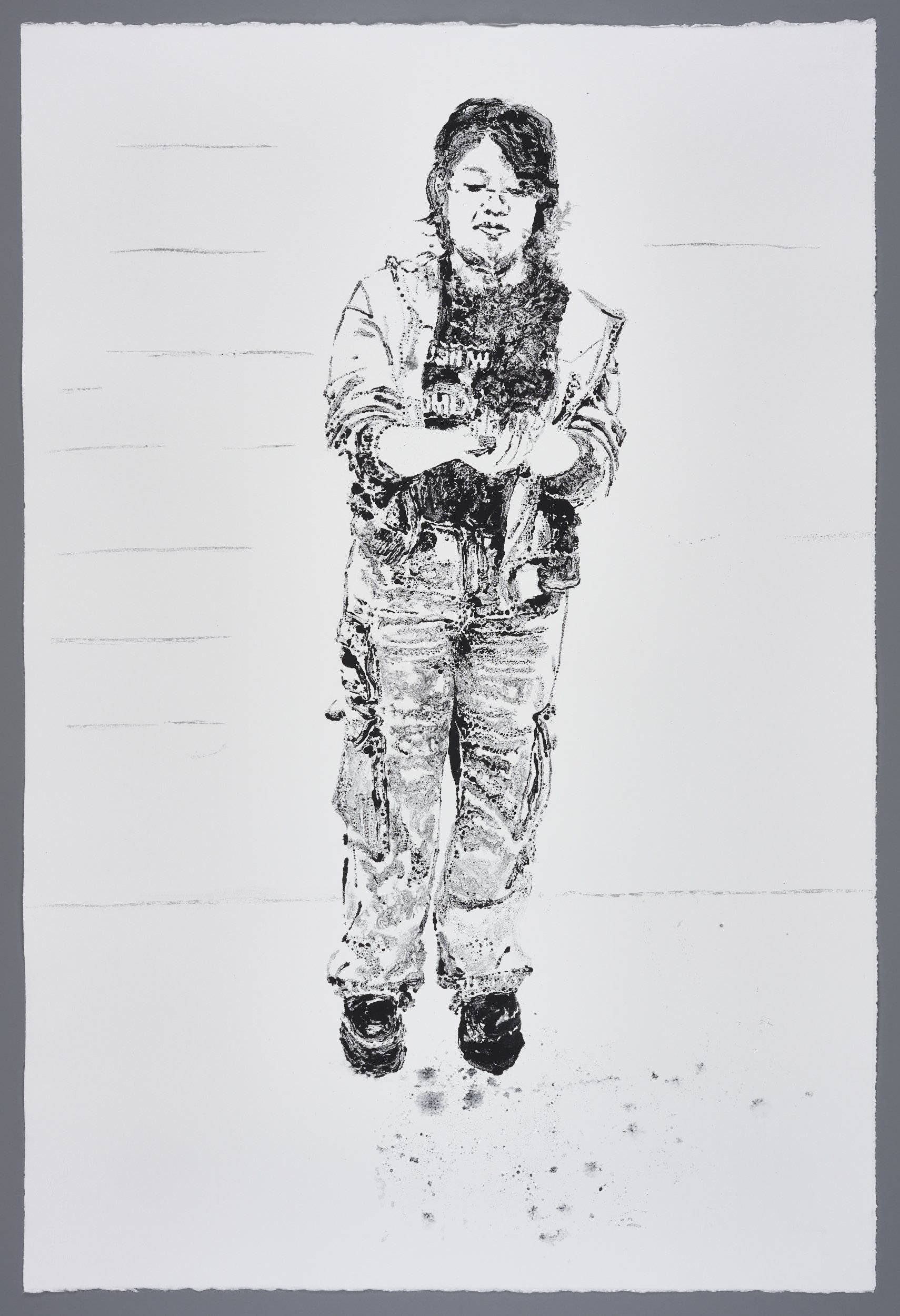
THE POWER OF COLLECTIVE ACTION detail 3
30” X 44”
watercolor monotype
image by J. Eshelman
THE POWER OF COLLECTIVE ACTION detail
30” X 44”
watercolor monotype
image by J. Eshelman
THE POWER OF COLLECTIVE ACTION detail 2
30” X 44”
watercolor monotype
image by J. Eshelman
THE POWER OF COLLECTIVE ACTION detail 4
30” X 44”
watercolor monotype
image by J. Eshelman
ONE
30” X 44”
watercolor monotype diptych
image by Jake Eshelman
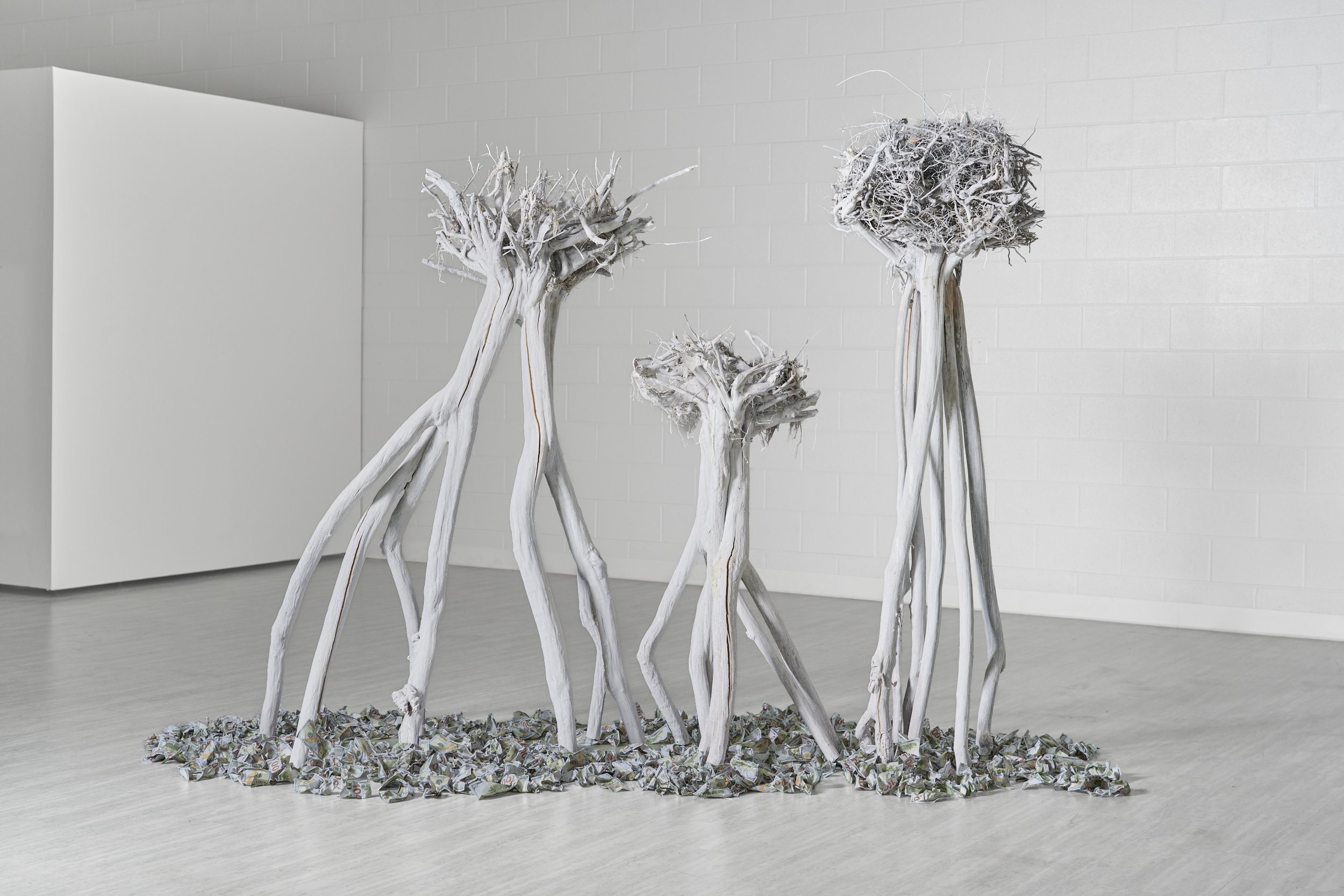
WE
6’4” X 8’ X 3’
Unearthed Crepe myrtle root balls, limbs, burlap, prop bank notes and paint.
Image by J. Eshelman
The inspiration for We arose from clearing a site of non-native plants for a living sculpture, where I unearthed three Crepe myrtle trees and examined their root systems. Notably, Crepe myrtles aren’t native to the area and do not support the ecosystem.
Standing upright on their sawed-off trunks, the roots took on an anthropomorphic quality, aligning with my exploration of humanity's connection to nature. Modern society often places humans above nature, a hierarchy my work challenges. In We, nature is elevated with human-like qualities, fostering a sense of connection and interdependence.
The trio’s placement—two tall figures flanking a smaller one—evokes care and relational dynamics. Crumpled banknotes surround the piece, like fallen leaves connecting living and economic systems.
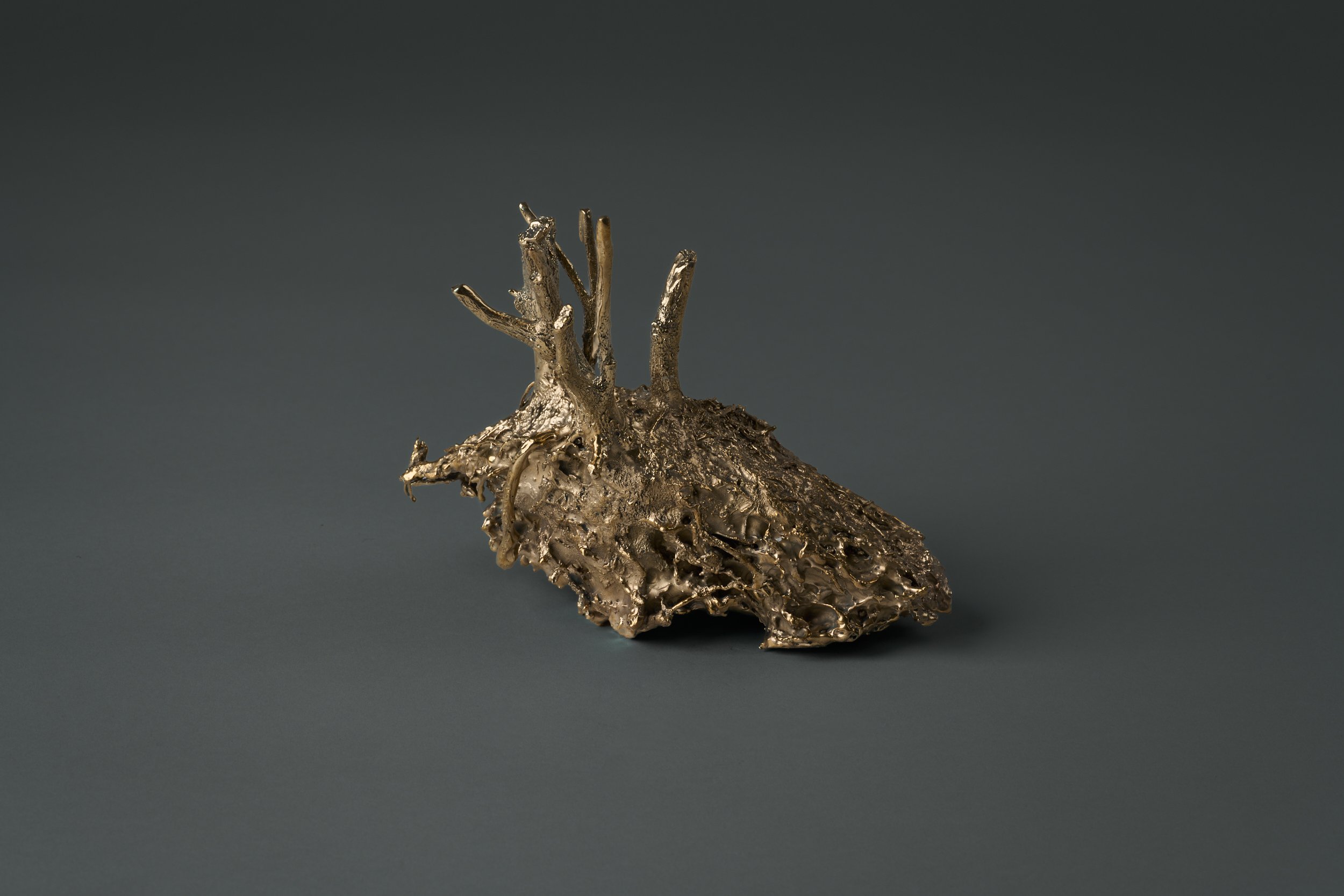
LIFEBLOOD
5.75 “ X 6” X 7”
bronze
image by J. Eshelman
This sculpture is inspired by the essential role roots play within the plant kingdom, which I parallel to the human heart and its critical function of circulating life-giving blood. Just as roots draw nutrients and water from the earth—similar to how our digestive systems process nourishment—the heart pumps lifeblood to sustain us. Through this work, I invite you to reflect on our fundamental interdependence with nature, emphasizing that we are not separate from it.
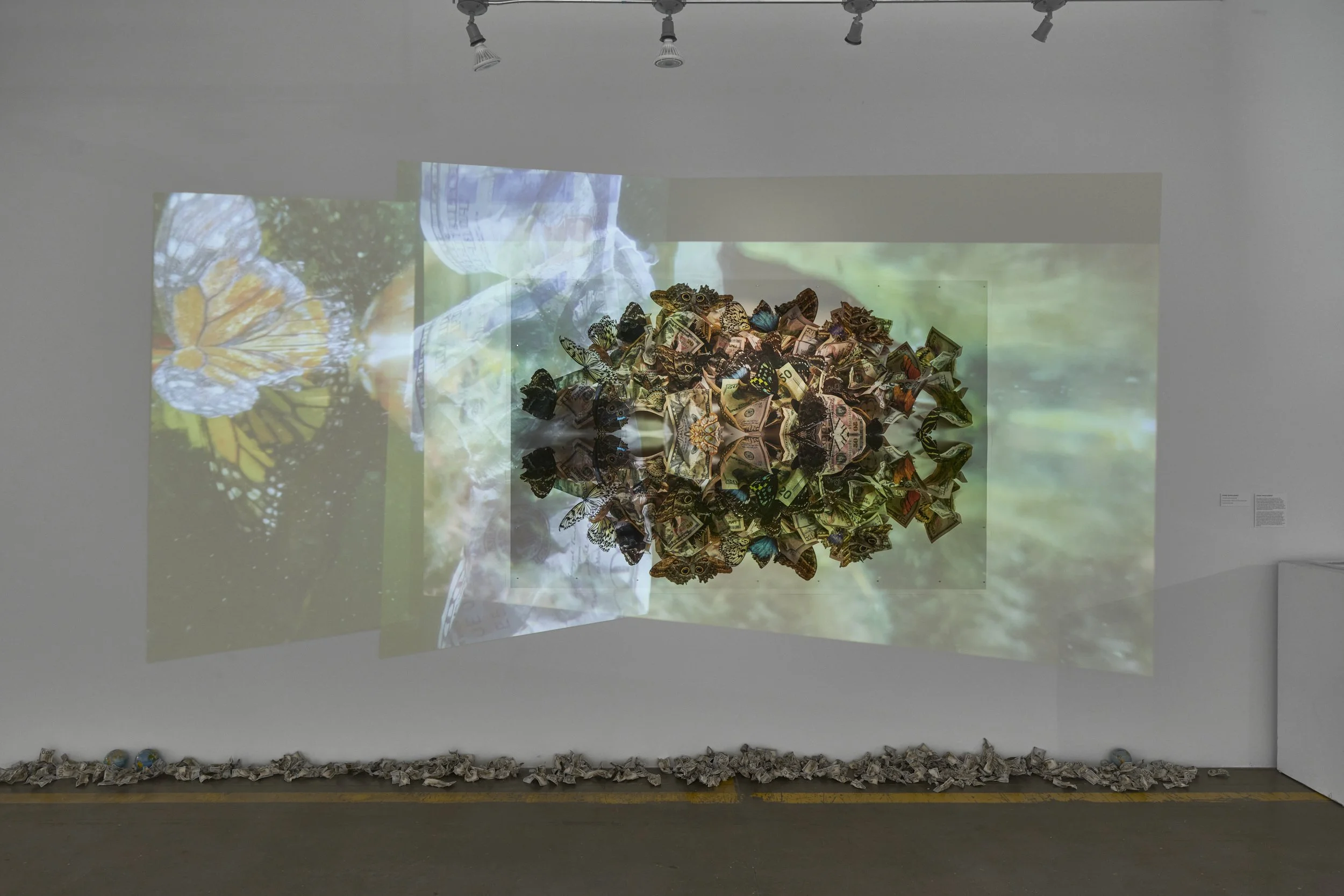
The Nature of Currency
64" x 97" archival pigment inkjet print on Epson Enhanced Matte Paper. 3 channel video, prop bills and vintage globe banks.
image by J. Eshelman
The inspiration for "The Nature of Currency" stemmed from a desire to initiate a symbiotic relationship between industrial growth and ecological conservation. Through fostering such relationships, we can transform Houston’s identity from a hub of chemical plants to a city celebrated for native plants and green energy initiatives. It is part a body of work I am developing Eco—systems.

RUMBLINGS
90" X 264"
watercolor monotypes
image by Nikki Evan
A rumbling in the distance is nature's way of alerting living creatures to their environment.
Rumblings is an ongoing project, a monumental collection of fifty 30" X 44" watercolor monotypes that draw attention to the 20,000 species of wild bees whose survival is at a critical juncture.
In these works, I carefully manipulate watercolor ink and oil into a chaos of minuscule paint particles. The materials are interconnected across the oversized monotypes, paralleling their magnetic attraction to golden dust and their corresponding fragility due to the chemicals that flood residential gardens and industrial agriculture.
The installation of Rumblings is a call to action to reduce pesticide usage, create habitats for nesting, and cultivate native indigenous plants.
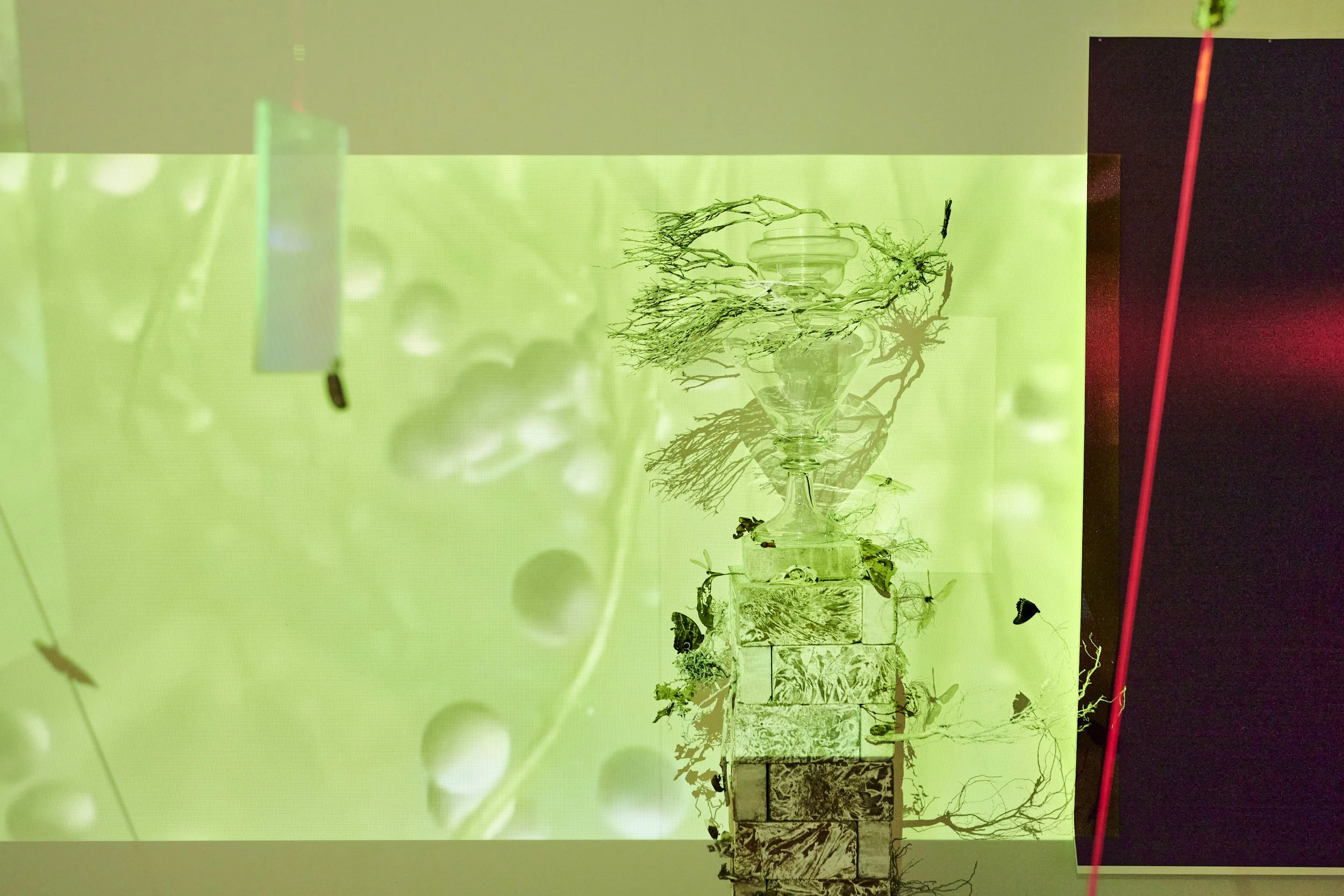
POTENTIA // ACTUALITAS
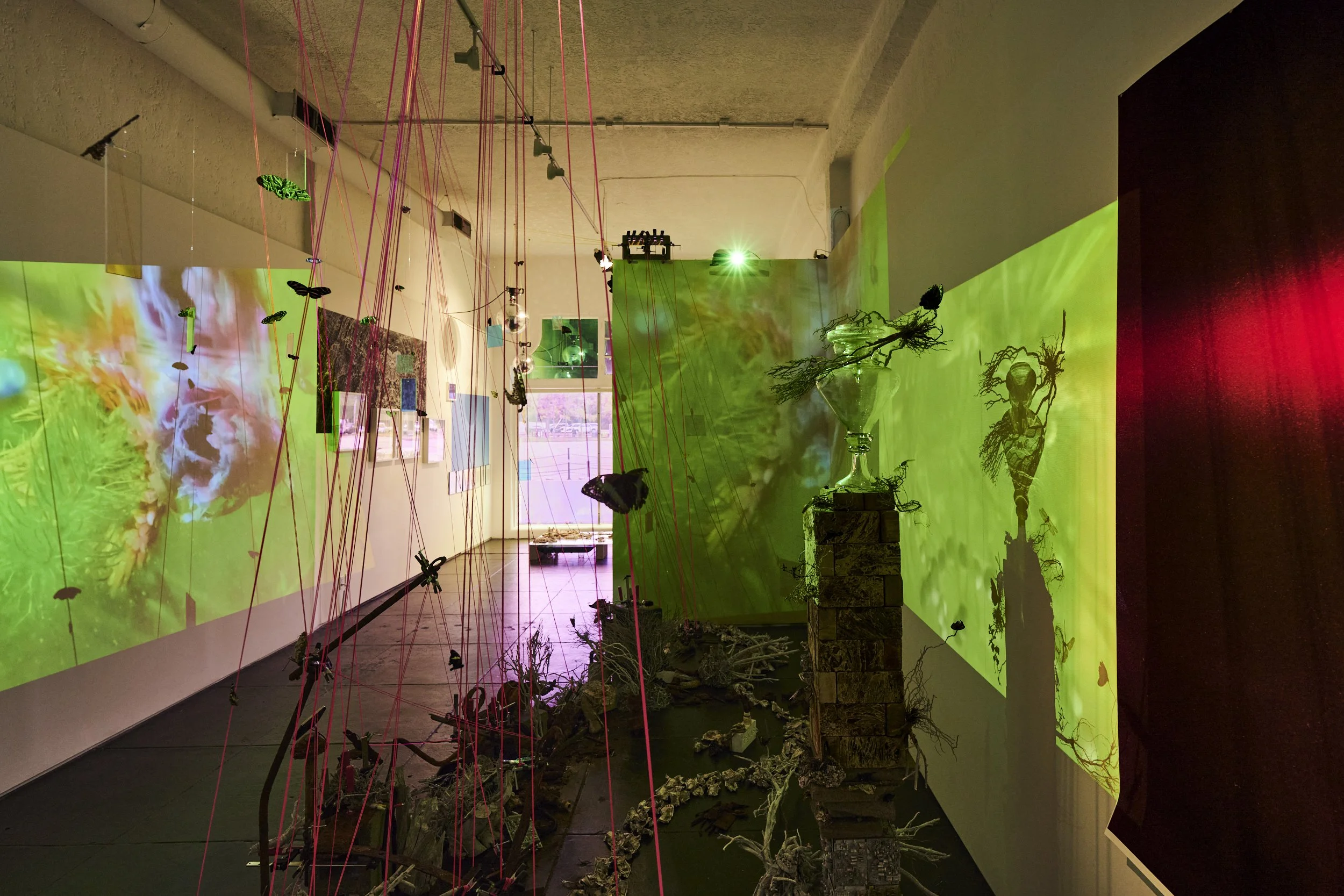
collaborative site-specific immersive installation
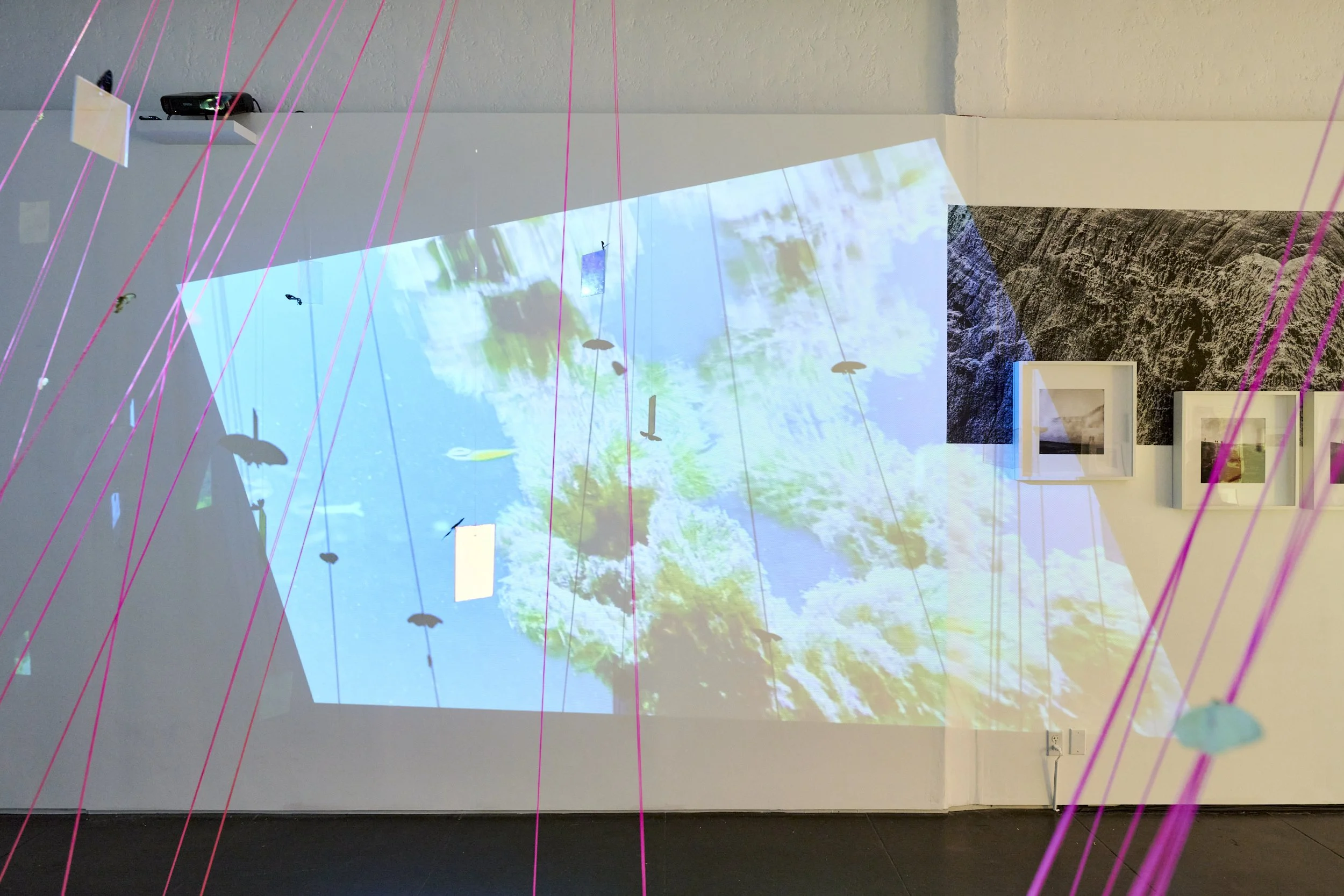
lens based: videos, three underwater videos, 12 videos documenting urban ecological restorations, 16 photographs documenting light.
string, clamps, acrylic, dichromatic film, large bills-prop, glass apothecary jar, paint. disco balls, fog.
found objects: passed insects, insect habitats, chrysalis, landscape and construction site materials, rusted and salt crystalized artifacts, sea shells, feathers, and a turkey skull.
images by Jake Eshelman
Potentia // Actualitas is a collaborative, immersive installation that explores the potential and actualized complexities of natural and human-made intelligence through lens-based media, found objects and ready-mades, in a site-specific installation. The lens-based works record iterations of light, space and water surrounding a central structure created from organic matter, rusted artifacts, glass, and construction materials. Running throughout is a neon line that connects these varying attributes into a systematic relationship. Together, Roykovich and Klement build a world that investigates the balance of opposing dichotomies and subsequent freedom from dualistic constraints. They advocate for a wild and intuitive response to a possible future of unbound potential.
POTENTIA
Potentia is an exploration into the possibilities that all entities possess. Using evolving personal systems, taking incremental steps, an environmental recollection merges with mystery through natural but intangible forces. As complexity develops into new hypotheses, imagination meets at the intersections of undefined futures, and a space is created that contains multitudes. We become scouts at the periphery of realization. –JR Roykovich
ACTUALITAS
Actualitas grew out of my ongoing exploration of water - its connection to natural systems, biodiversity, and the urban landscapes we have built over both. One thread leading to the next.
JR and I worked in the same space but at different hours — I installed in the morning, he came in the afternoon - for almost two weeks.
Our work is very different. What emerged between us was not compromise. It was what always happens at the border between two different systems: something neither of us could have made alone.
I find the most interesting things happen in the fringes. In the unexpected overlap. That is where Actualitas lives.
INTERDEPENDENCE
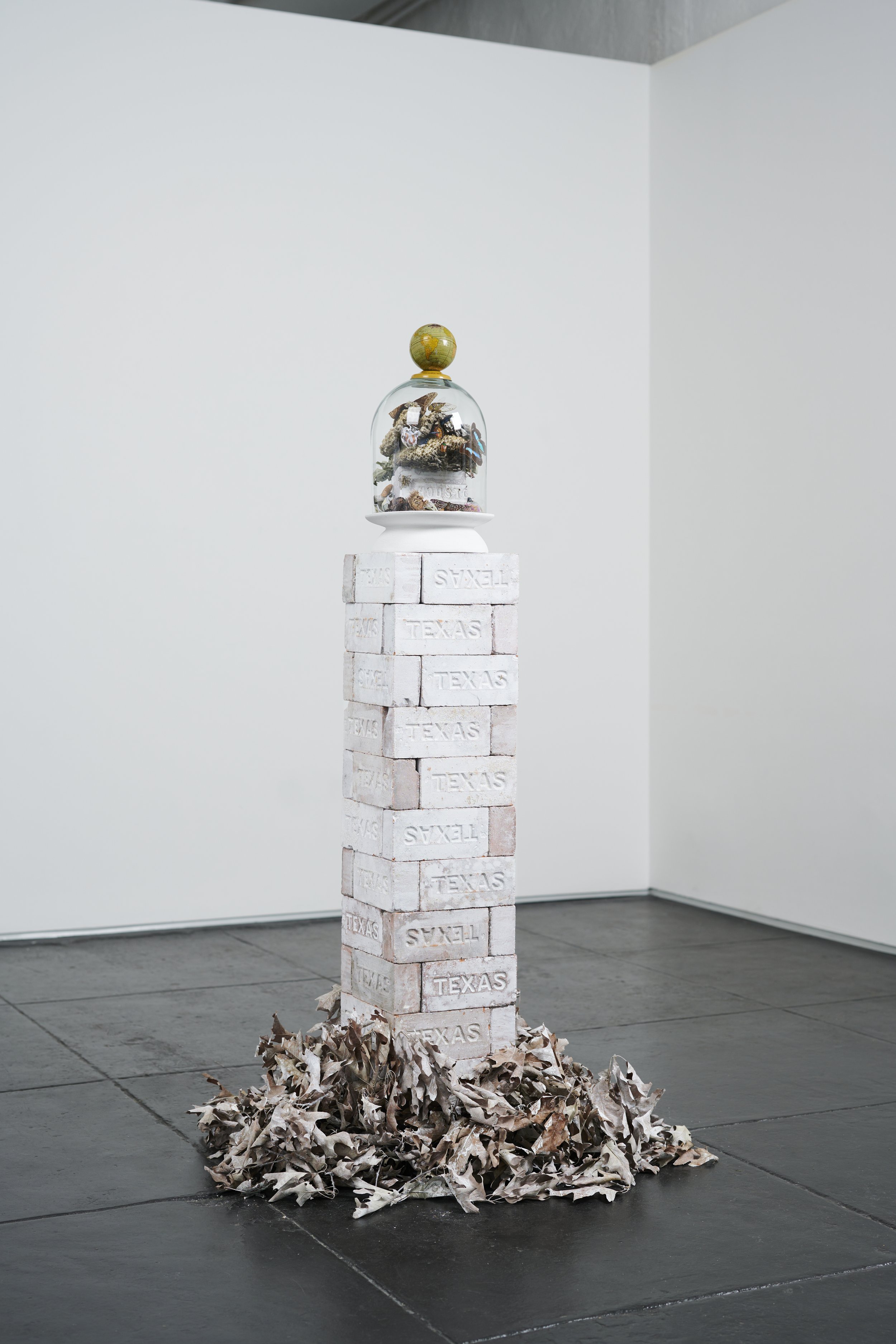
60” X 10.25” X 10.25”
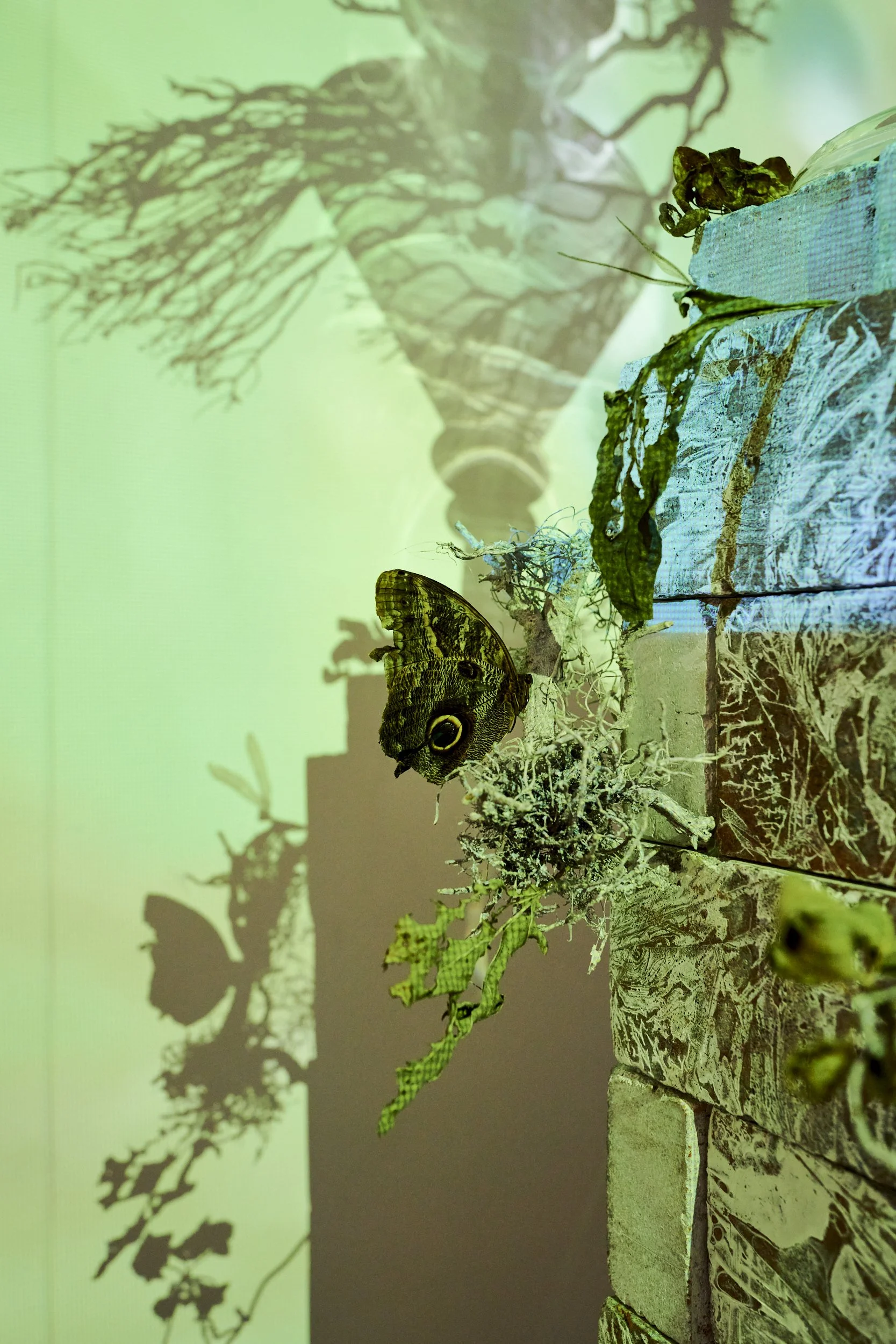
Texas Bricks, Paint, Plastic Dome and Base, Vintage Globe Bank, Prop $100 bills, Coins from a diversity of economies, Paper Wasp’s nest on Maple tree leaves, Seashell with barnacles, Red swamp crayfish, bird nest, feather of a Pileated Woodpecker, Blue jay feathers, Mantis, Cicada, Great Purple Hairstreak, Tropical Checkered Skipper, White Peacock, Red-spotted Admiral, Monarch, Red lacewing butterfly, June Beetle, Eastern Carpenter bee, Wolf Spider, Beebalm, Sacred Datura, Bundleflower and various dried leaves.
image by Jake Eshelman
Interdependence is built from a collection of TEXAS-stamped bricks washed with a white patina. Stacked in the form of a square skyscraper, it shoulders a transparent dome and base, crowned with a vintage Globe Bank finial.
Within the transparent dome is a still-life collection of intricately connected elements from natural and human-made systems. They wreath a "Houston" stamped brick fragment.
By using everyday materials that we typically associate with urban environments, the work conveys that the collective actions of Houstonians, living in a dense population center with a sprawling footprint and long growing seasons, have far-reaching implications for global economies. It is a reminder that our choices impact not just our immediate landscapes but global eco-systems as a whole.
This sculpture is not a warning. It presents a solution. I employ systems thinking to suggest that embracing economic systems is necessary to recover biodiversity. Economic systems dominate our culture and intimately impact natural systems. Houston's ecology and commerce can potentially create a new economy - an ecotourism industry. Houstonians can transform the negative impact of industrialization, commerce, and urbanization into a source of beauty, wonder, and economic growth by advocating for our natural habitats.
Interdependence invites us to rethink our individual relationship with the planet’s biodiversity, recognize the value of our natural heritage, and embrace the idea that supporting wildlife is a global responsibility dependent on a collection of individual acts.
INTERDEPENDENCE detail
detail
images by Jake Eshelman

BABY WHISPERER
30” X 44”
watercolor monotype
image by Carlos Ocando
Horses are indeed a marvel of sensitivity and emotional energy. Eight months pregnant, Alex, my daughter-in-law, visiting a stable where she used to ride horses, had a beautiful moment with Diva, one of the horses. Even though Alex had never ridden Diva, it was clear that Diva had been affected by her caretaker's recent pregnancy.
Recording this emotional connection, I carefully manipulated watercolor ink and coconut oil into a chaos of independent cells. The placement of these physically independent cells creates the visual representation of a cellular-level spiritual connection between the Baby Whisperer and the unborn child.
This moment is a reminder that all species deserve much more credit than we often give them.
It also underlines how crucial it is to build connections with all creatures to restore and maintain a healthy ecosystem.
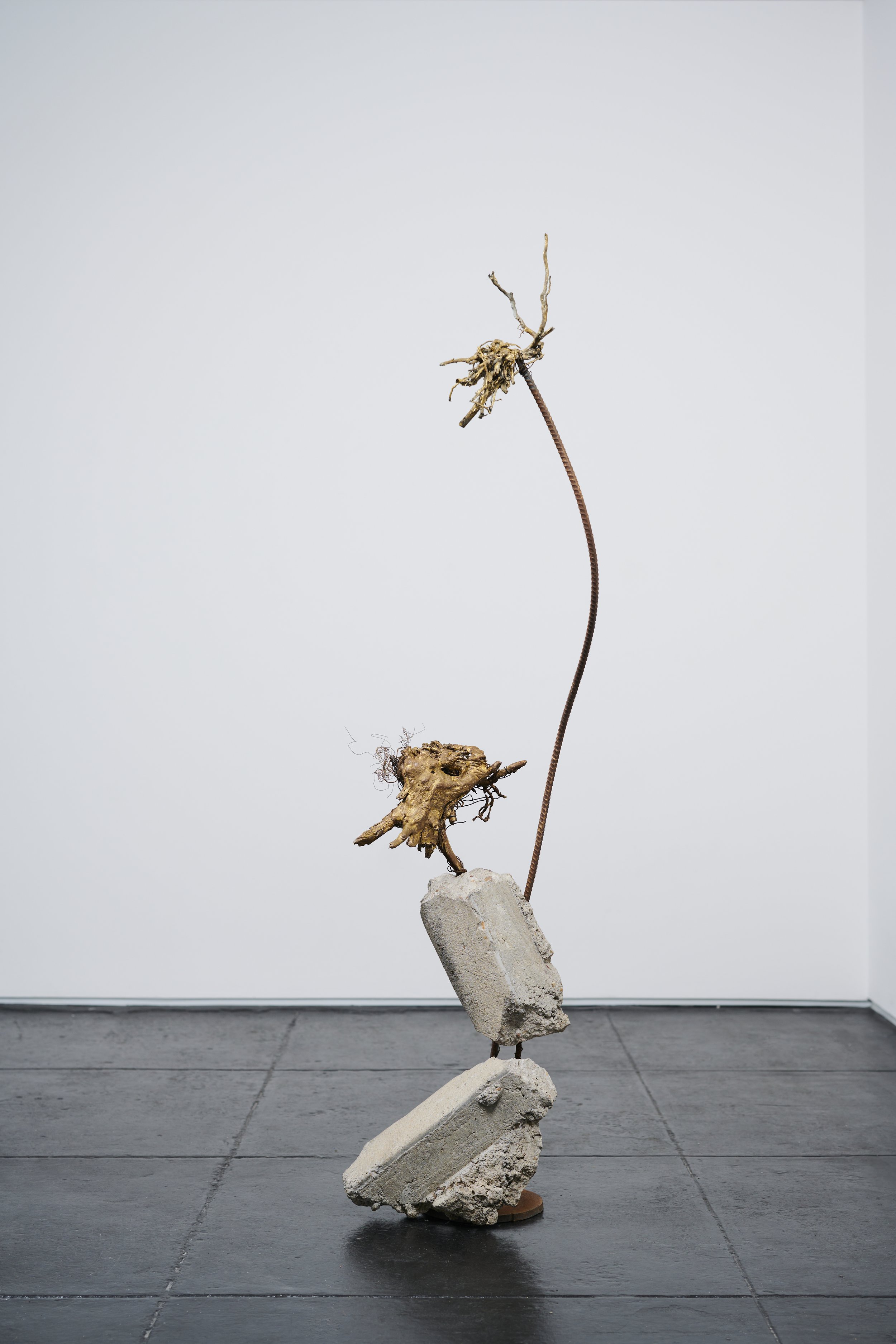
MOVING FORWARD
67” X 15” X 18”
Found object concrete and rebar curbing fragments, rusted steel, bronze, and gold leaf.
image by Jake Eshelman
Moving Forward consists of two rectangular concrete curb fragments and two cast bronze roots, the latter with gold-leaf patinas. These objects are tethered like irregular beads on a broken wire of rusty rebar falling to the ground.
The fractured concrete and the more extensive root land at the forefront in a forward strutting anthropomorphic structure. Growing behind the long-necked bird-like form, a stem of rebar twice the creature's height reaches for sunlight. The meandering stem is counterbalanced with the smaller root in a lyrical passed sunflower shape.
The weighted composition invites viewers to reimagine the relationship between our engineered landscapes and ecological systems to support wildlife as a means to forge a path toward a regenerative future.
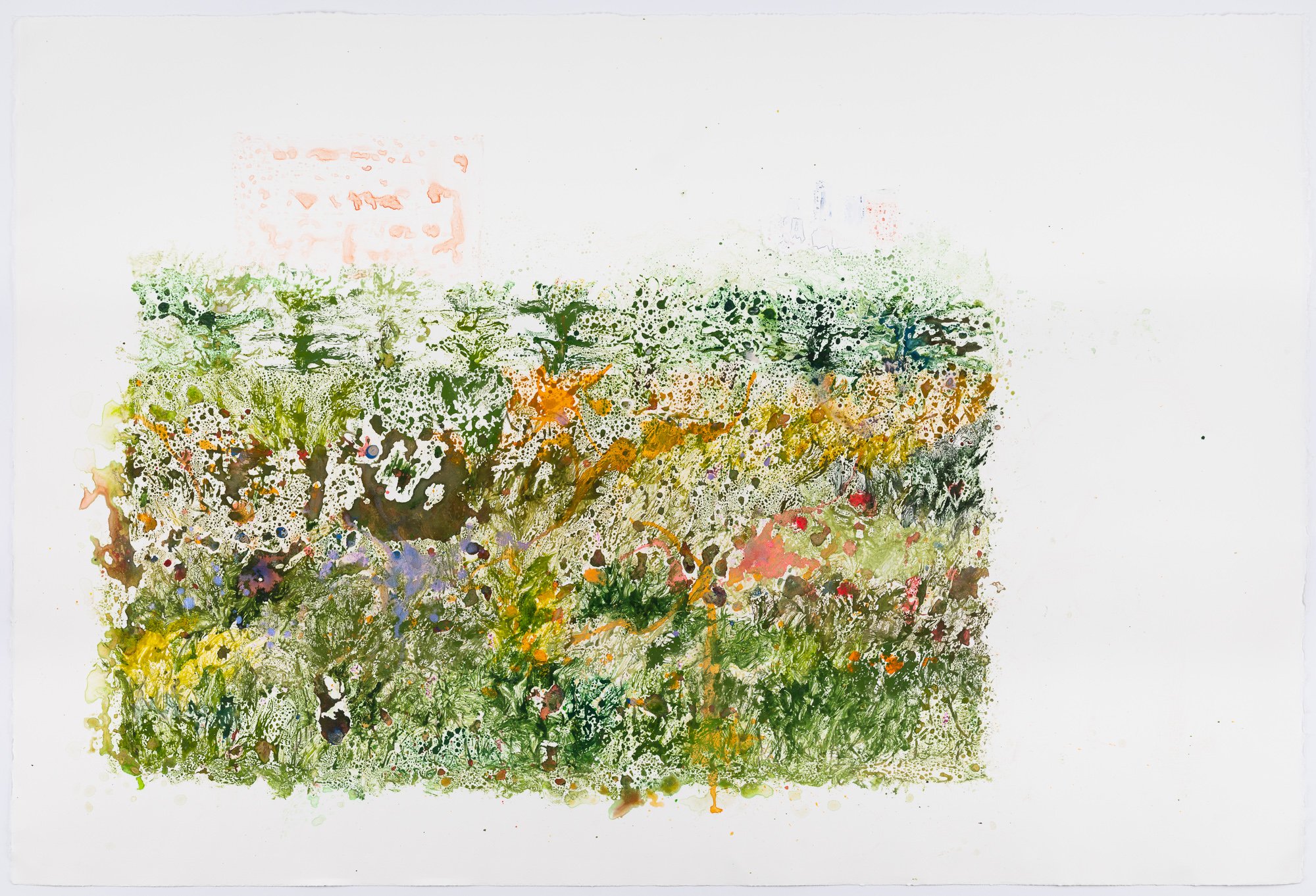
TOP OF MIND I
30" X 44"
watercolor monotype
These three pieces are sketches for future work. This is the north fence line sketch.
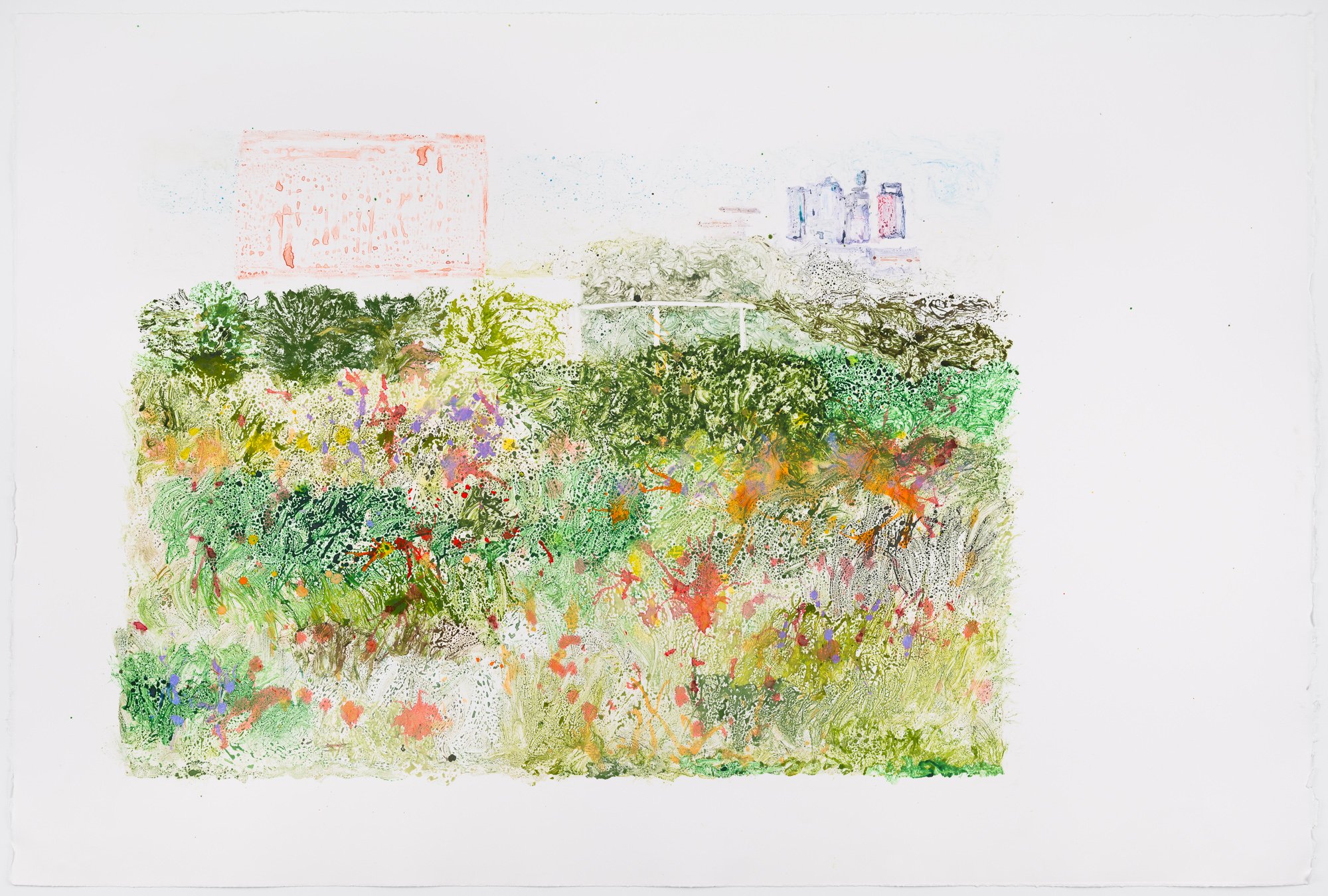
TOP OF MIND II
30" X 44"
watercolor monotype
sketch of the north fence line.
This is the second of three sketches of the proposed installation.
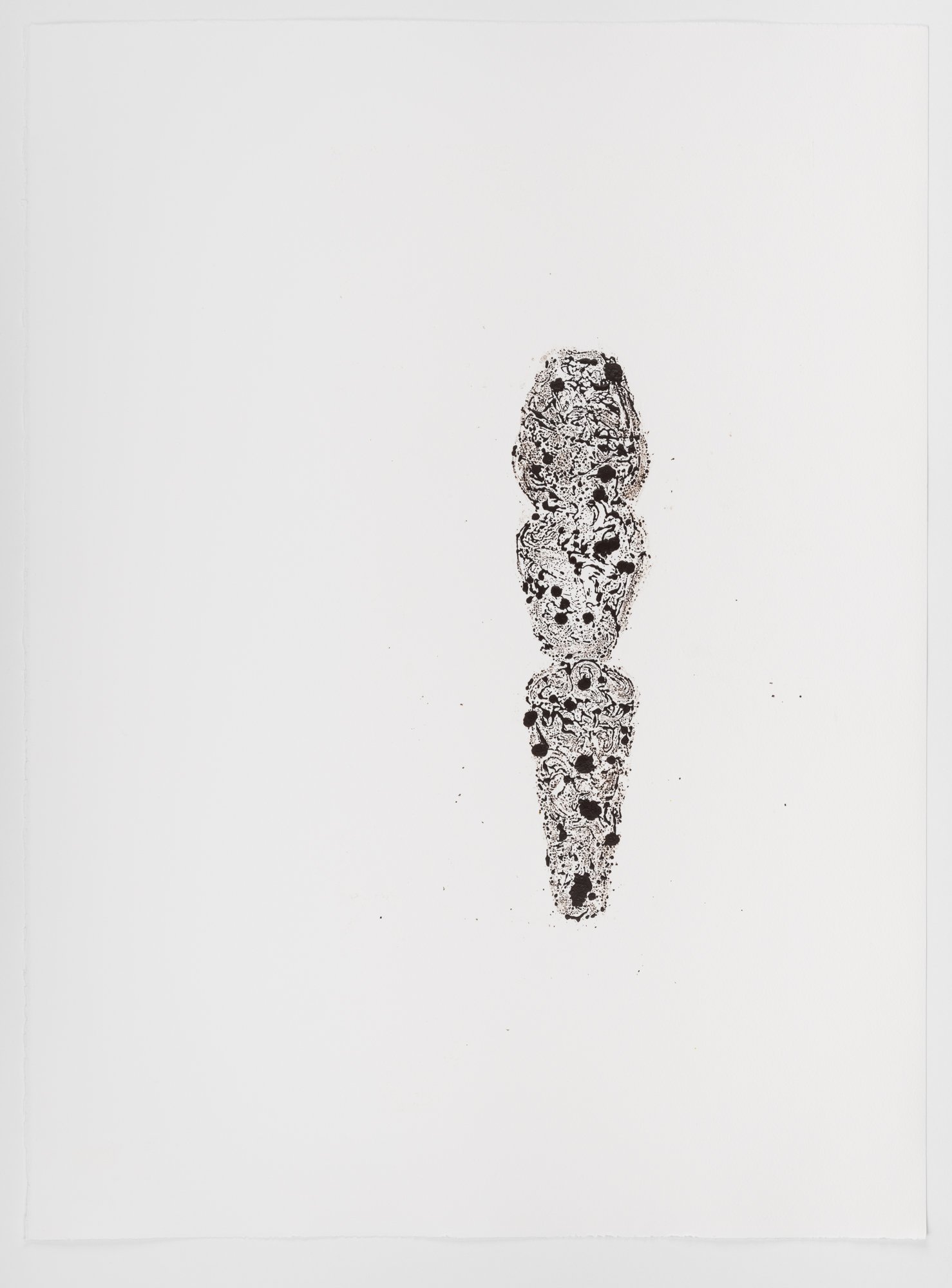
standingGROUND II
30" X 22"
watercolor monotype
image by Carlos Ocando
This body of work consists of 22 pieces. These 22 pieces are experiments with shapes for a proposed installation. An in-depth description can be found here.

WHISPERS OF A SHIFTING DIVIDE
4” X 8” X 6”
polished bronze
image by Nash Baker
Whispers of a Shifting Divide is a polished bronze sculpture that imagines the unimaginable. It was inspired by my children's 1997 discovery of a crustacean fossil lying in the desert of West Texas just before we moved east to semitropical Houston, Texas.
The sculpture symbolizes the U.S. 100th meridian, the demarcation between the arid western US and the humid eastern US since the early 1800s. Since 1980, this demarcation between arid and humid has shifted 140 miles eastward from the west side of Austin, Texas to the east side of Austin to the 98th meridian. Another 140 miles — another 40-50 years — and Houston, known for its semitropical humidity will be on the arid side of the boundary.
The polished bronze material nods to Houston's future and industrial character, particularly the polished steel street signs in its minimally landscaped commercial tourist area, Uptown Houston.
By imagining the unimaginable, this work fosters a dialogue that calls for environmental consciousness of the possibilities of our actions.

BILLS
12" X 24" X 5"
bronze, gold leaf found ledger, and bill
image by Nasth Baker

ENDANGERED KNOWLEDGE: THE SOUL OF HUMUS
12’ X 6’ X 4’
welded steel, bronze, indegenous soil and dried native plants
“Endangered Knowledge: The Soul of Humus is a site-specific installation that rotated through three exhibitions, 2021–2023. It is documented here as a complete arc rather than by individual year.”
Global warming, food security, drought/flooding, wildlife habitats, economic instability, and health – these problems are not new to humankind. The archeology of ancient civilizations has recorded connections between the longevity of civilizations and the health of their soil. The United Nations reported in 2014 that the world's topsoil would only last 60 more growing seasons. Soil scientists around the globe agree that solutions to these issues are rooted in our treatment of soil—the skin that covers our planet.
For Altimira’s Sculpture Month, I installed a site-specific sculpture of a bison, made from a welded steel armature, a work of land art covered in topsoil and native grasses. This is part of a comprehensive installation that I am currently developing, which considers the role of the American bison within Houston's specific soil ecological history. The work is titled Endangered Knowledge: The Soul ofHumus.
I am inspired by the words of M. Thomashow, who writes, "Record natural history to the collective memory so that it is no longer endangered knowledge." For several years, I have been researching grass-fed food production, attending soil conferences, and visiting regenerative ranches. Research in these fields show how to fight desertification and reverse climate change through regenerative agriculture practices. Interestingly, this natural history of living soil, how it evolved in the Houston Coastal Prairie, its essential part within microbial communities in human health, and clay’s ability to stabilize carbon is not common knowledge.
In the hide of a sculpture, is the narrative of soil health. My sculpture records this endangered natural history through the dense coat of the powerful humus-built bison, dripping in the armor of locally sourced native grasses and sedges, seeds, and pods. The male bison is supported by a welded steel armature, covered in a stainless-steel lath. The bison's skin, made from these grasses, are attached to the lath with a Houston clay fill. The 112” long bison is exhibited in the center of a large grain silo a relic of industrial agriculture. The bison in an actively grazing stance, head down in plow position, his hump rising robust and bushy out of his heavy forequarters to 74”' tall.
Ecological History
Historically B. bison functioned as the first farm equipment. The grass seeds clinging to their burly coats were carried across the plains as they migrated north to south and back between seasons, like tractors up and down fields. Herds of tractors not green, but a rich brown harvested the plains with their appetites, each bite stimulating new root growth. The old roots withered into cavities that served as dwellings for a variety of keystone species and became underground cisterns collecting floodwaters for drier seasons. Their coats dropped kernels and cuttings as the winds ruffled their beards and chaps, and when they took dirt baths in buffalo wallows dug with their horns. Massive roaming compostors, a single bison cow daily dumping 40 lbs. of fresh manure onto these seeds and drilling them into the earth with their spade-like hooves, sprinkling them with the perfect prescription of nitrogen, phosphorus, and potassium-rich urine and then moving in a predator safe tight herd on to the next buffet. With time the newly sowed fields sprouted new growth of blades, stems, and leaves of countless shapes, sizes, and heights. This diversity of leaves fit like puzzle pieces into dense living solar blankets, harnessing carbon from the air and returning it as sugars to feed the dynamic root microbiomes below the earth’s skin. The complicated relationship between the soil microbiome and the human intestinal microbiome is one of the most dynamic topics in biomedical research. Flocks of birds mutualistically living off the pests harbored on the bison followed the herds, drinking from and bathing in rainwaters that collected in the bison wallows, building their nests from clumps of bison fur. Recent studies show the fur provides a health benefit to unborn chicks. Bird and butterfly habitats were abundant when the bison roamed.
Message to the Future
The armor that protects the epidermis in the Gulf Coast prairie is grass. The animal whose population peaked at 30 million, is B. Bison. Combine native grasses with ruminants and the grasslands decompose into rich organic matter; for every 1% increase per acre of biological organic material, the soil can hold an additional 20,000 gallons of water. Restoring native prairie vegetation decreases water runoff and flooding, increasing soil absorption of water and slowing floodwaters on land. With extreme building practices and concrete hardscaping, reimagining the landscape of Houston's 600 square miles of real estate can make a significant impact on the region’s flooding. The prairie grasses' roots can extend from eight to fourteen feet deep: these roots sequester carbon like an upside-down rainforest. Changing our agricultural practices is an important step towards turning global warming right side up. Telling the dynamic story about these relationships between the grazing herds, the living soil, and finding ways to reimagine urban landscapes and agricultural practices in holistic and regenerative ways are the center of my current research and sculptural practice.
The impact of the bison on sustaining topsoil—and, therefore, life—need not be Endangered Knowledge. The role bison play within the prairie ecosystem—their ability to increase photosynthesis, reduce competition for water, and regenerate depleted, unsalvageable, lifeless prairies back to productive and bountiful, nutrient-producing land and wildlife habitats—needs to be carved into our modern systems. Recording this Endangered Knowledge into the consciousness of humankind will stimulate grassroots efforts and stop the cultivation of soil depletion and return the natural process to the treatment of the skin of our planet. A Parietal artist in 2020, I will use grass to record the Soul of Humus so that it will no longer be Endangered Knowledge.
Footnote-
Bison vs Buffalo which name is correct? The common name Buffalo has been widely used, since early settlers were naming them as their European and Asian counterparts. The correct name of the last American surviving bison is B. Bison. The correct name of the last American surviving bison is B. Bison.
Further Reading and information –
- Can Livestock Grazing Stop Desertification? - Scientific American
- Dirt: The Erosion of Civilizations, by David R. Montgomery
- Soil Biology and Land Management
- Wildlife that Depend on Bison
- Building Soil through multi species quorum with Christine Jones.
- Allan Savory on how to fight desertification and reverse climate change
- Soil as Carbon Storehouse: New Weapon in Climate Fight? - Yale E360
- A Prehistory of Houston and Southeast Texas,– D. Worrall, coming fall 2021

The Soul of Humus’ Third and fourth Pasture Rotations: Fumes to Plumes
As in agriculture that rejuvenates the soil, the bison has rotated through its third pasture/exhibition to its fourth in 2023. It began in a historic grain silo/art venue in Sculpture Month Houston's Altamira, which considered modern caveman's materials and message to the future, followed by the Blue Norther exhibit, where the bison addressed extreme weather's connection to soil. Then it carried its message to the Houston Forever exhibition in the former Texaco Building in downtown Houston.
THIRD ROTATION : TEXACO STAR
The Star building is the former home of Texaco—the company that developed the Spindletop gusher in 1901 and took the US into the oil age—and is a key location in the sculpture's rotation. The bison in the Star embodied our civilization's conflict "between" ecology and commerce. Before Spindletop, oil was primarily used for lighting and as a lubricant. With Spindletop's abundance, Texaco began marketing petroleum for mass consumption.
What can we learn about natural carbon cycling through the soil from the herd's eating and waste habits—also called consumption and regeneration—when we contrast them with the development of the energy industry and our society's mass consumption without regeneration? Comparing and contrasting these two energy sources, both receive energy from the earth: the bison returns carbon to the soil, but, in contrast, humans supply a chain of abundant energy but haven’t solved how to repay this carbon debt for future generations. Integrating natural systems of regeneration can steer our innovation and creative minds to a future in which consumption, conservation, and regeneration of earth's resources are in balance.
FOURTH ROTATION: FOREVER 21
However, the overconsumption habits of humans impacting wildlife diversity did not begin with petroleum. That relationship between human consumption and wildlife extinction is adorned by fashion and drills deeper than the carbon debt. The Washington Post article, Looks That Kill: The Fashion of Extinction, chronicles man’s battle to save birds from the millinery industry as far back as the late 1880s.
February of 2023, the bison opens in the Southern Glory Exhibition in the vacated Forever 21 retail space. Forever 21 has a reputation as a good example of fast fashion. Fundamental to Forever 21 and the fast fashion business model is generating profits by seasonal mass consumption. In this space, we see that the bison’s seasonal migration, eating and waste habits not only store carbon but build wildlife habitats, and provide moisture and sustenance that makes life possible and supports a diversity of species. In the UN report, “The fashion industry produces between 2 to 8 percent of global carbon emissions. Textile dyeing is also the second largest polluter of water globally, and it takes around 2,000 gallons of water to make a typical pair of jeans. Every second, the equivalent of one garbage truck of textiles is landfilled or burned. If nothing changes, by 2050, the fashion industry will use up a quarter of the world’s carbon budget. Textiles are also estimated to account for approximately 9% of annual microplastic losses to the ocean.”
We have made great strides since the “Looks that Kill” dominated fashion. I have witnessed with my own eyes at Roam Ranch that the flocks of birds return with the herds, build nests of the fur and drink from rainwater in their wallows. As this exhibition opens, I work through the solutions that we all can implement in our daily lives to support wildlife, from where we choose to spend our money, mending and restyling our garments to relandscaping our yards and building eco-tourism. And maybe even rebuilding our sculptures to tell more stories.
Quisque iaculis facilisis lacinia. Mauris euismod pellentesque tellus sit amet mollis.