SEEING IN SYSTEMS
Written in the belief that ecological vision and human compassion grow from the same root
- Cindee Travis Klement
The most important question our civilization has to answer is not technological. It is not economic. It is not political. It is perceptual.
How do we learn to see the natural systems that sustain us — and design the human ones to work with them?
This manifesto is one answer. It begins in a garden and ends in a city. It moves through living soil, native plants, monarch butterflies, a man dying from herbicide exposure, a child who flinched at her first butterfly, sandhill cranes that came back from the edge of silence, a school fence covered in passion vines, and a vision for Houston as the regenerative capital of the world.
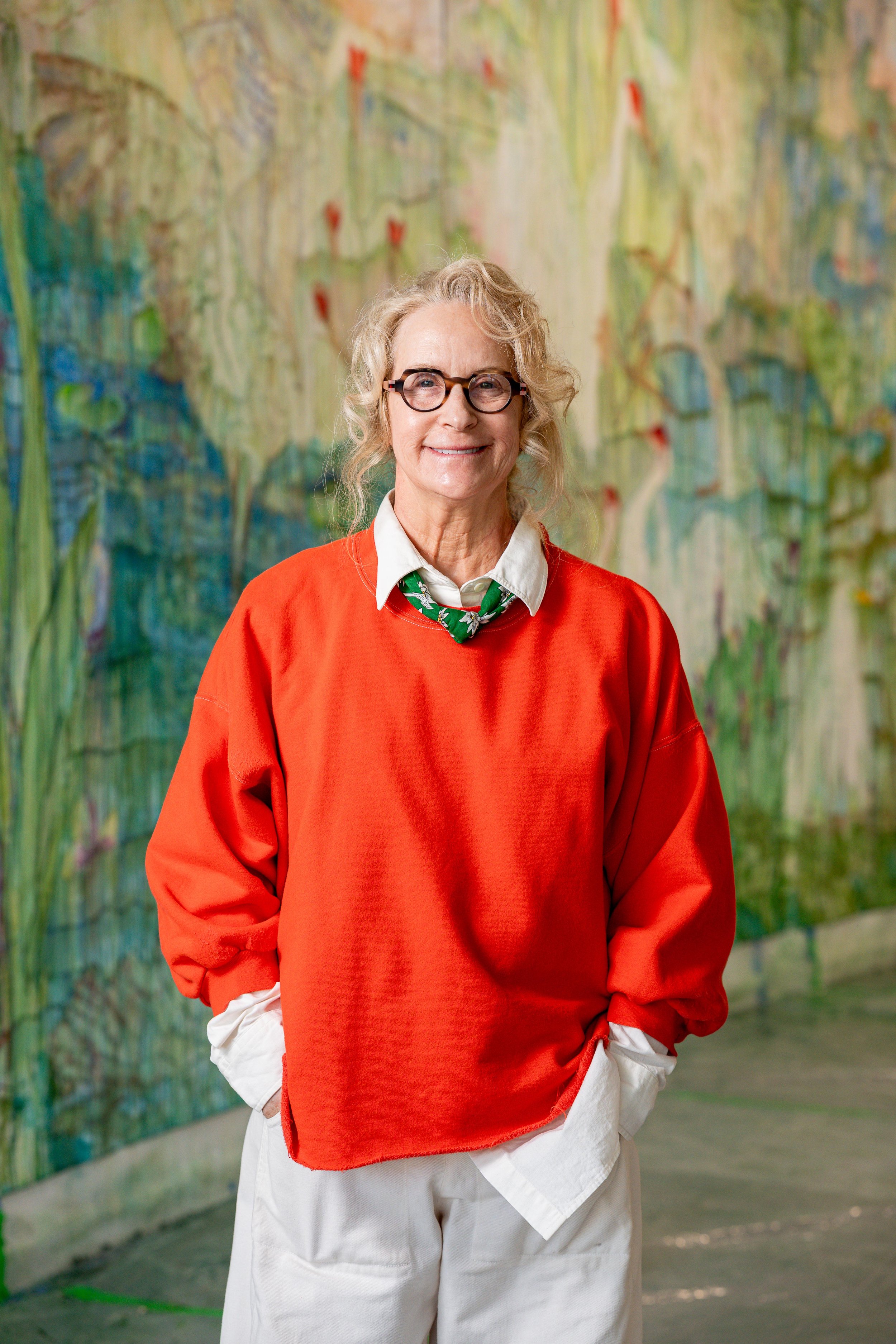
I am an artist who builds living systems. I have been asking one question since 2020: how do we holistically restore ecological balance in a world that has forgotten it was ever part of one?
The answer begins with a single plant. It ends with a city that has remembered what it is.
Read it. Then go outside.
I. The Poverty of the Manicured World
How we got here.
We have inherited a catastrophic idea of beauty. But we came by it honestly.
When the world was mostly wilderness, the cleared ground meant survival. You could see what was coming. Nothing hid in the open grass. The managed edge between the human world and the wild one was the edge between safety and death — and every culture that lived against wilderness understood this in their bodies before they understood it in words.
Then the wilderness receded. The wolves were gone. The snakes were manageable. The instinct that had made the cleared ground necessary quietly faded — but the aesthetic it had produced stayed on, now stripped of its original meaning, kept alive by habit and the human desire to display success.
The colonial lawn was at least maintained by living things — sheep, goats, hands pulling weeds, the first push mowers rolling across English estates in the 1830s. Then came the postwar years. Pesticides. Herbicides. Fungicides. The gas mower. What had once been a display of survival became an industry — and the lawn became something ecologically different from anything that had existed before. Not just cleared ground. Sterilized ground.
Lee Johnson spent his career applying Roundup herbicide to schoolyards. He developed non-Hodgkin lymphoma. In 2018 a jury agreed the product caused it — and that the company had known the risk and said nothing. Studies have since linked proximity to golf courses — among the most chemically saturated landscapes in America — to elevated rates of Parkinson’s disease.
My children attended seven schools. More than one coach, at more than one school, was fighting cancer. They lived on those fields. I always had a bad feeling I knew why.
The world has inverted.
Wilderness is no longer the threat. It is what is disappearing. And the chemicals we used to control it are killing the people who apply them.
And yet we are still running the old program. Still performing the old safety. Still passing the manicured lawn from one generation to the next as if it means what it once meant.
It doesn’t. It never will again.
This is not an aesthetic preference anymore. It is an ecological emergency. And it is a failure of perception — the same perception handed down intact, applied to a world that no longer exists.
The soil beneath a perfect lawn is biological dead ground. The soil beneath a living ecosystem hums with a density of life most of us will never witness. One gives life. The other gives cancer.
Our inheritance.
I am a boomer — the generation that normalized all of this. My grandchildren will inherit whatever my generation chooses to pass forward — the dead ground or the living one. I will not pass this down.
I will pass down life.
A garden fluttering and chirping. Tadpoles with tails and legs wiggling in puddles, a new species emerging every season. Tree frog eggs like tiny strands of pearls floating in still water. A child who already knows.
This is what a living system looks like — when every child knows they are part of it. The rest of this is about how we find our way back.
II. Learning to See
Everything begins with observation. Not the casual glance of a passerby, but the sustained, patient, quiet attention of someone who has learned to stay still long enough for the living world to forget they are there.
Wildlife hides from humans. The tree frog does not reveal itself to the group visiting the garden. The monarch does not perform for the crowd. What the ecosystem actually is — its true density, its complexity, its simultaneous layered activity — only becomes visible to those who have earned the stillness to witness it.
This is a practice. It is trained through repetition and humility. And what it reveals, slowly, is that the world is not organized into the clean categories we impose upon it. It is messy, layered, interdependent, and alive with relationships we have not yet learned to name.
Learning to see in systems rather than specimens — to perceive the relationships between things rather than the isolated things themselves, in a view that is not humancentric — is the foundational act from which everything else follows.
III. The Proof Beneath Our Feet
Theory must be tested by soil.
Lawndale Art Center knew my work. When budget cuts ended their lawn maintenance contract they asked if I would be interested in the garden. I went to look. They had just finished a costly relandscaping and done everything I tell people not to do. I asked about chemicals. They didn’t know. They checked. Yes.
I wouldn’t touch it.
I sent them Endangered Knowledge: the Soul of Humus. They called back and asked me to create an environmental sculpture for the garden. I said I couldn’t put an environmental sculpture in an environment working against the planet. What if instead we applied regenerative principles to the garden itself?
They said yes. Symbiosis was born.
Within six months, tree frogs had arrived. Within three years, hundreds of chrysalis appeared above the entrance door. Within four years, four hundred.
The same soil. The same climate. The same neighborhood. The only variable was a change in perception — and the practice that followed from it.
What I supplied were leaf mold, plants, seeds, and holes dug in the ground — the same things animals do in nature, transporting nutrients and seeds from one place to another. To manage mosquitoes I installed a trough pond — Western Mosquitofish, native to Texas, to consume the larvae. Native aquatic plants to clean the water. No pump, no filter, no electricity. The pond attracted mosquitoes — the bottom of the food chain. The mosquitoes attracted dragonflies. The dragonflies attracted birds.
The food chain built itself as far as the fence would allow.
What built the ecosystem was nature. With each project I learned to let go more — to control less. My fourth living sculpture, in a private garden, went deeper. It was there, in year three, that the monarchs arrived. On October 29, 2025, hundreds of monarch butterflies — a species listed as endangered — covered every foot of the flower bed for two days. The neighboring yards, untouched and manicured, never saw one.
On October 29, 2025, hundreds of migrating monarchs spent two days nourishing themselves in a single urban flower bed — fueling a 3,000 mile journey. The neighboring yards had none.
It recovers the moment we stop preventing it. The question is whether we are willing to loosen our grip enough to let it.
I am still learning. Each year I hope to let go a little more.
Sequel, my fifth living sculpture, grows beside my studio. It will outlast me.
IV. Generational Amnesia
There is a child in every city who has never seen a butterfly land on a flower. Who has grown up between chainlink fences and mown grass and basketball courts. Who knows the symbol — from picture books, from classroom walls — but has never inhabited the same world as the living creature.
When that child encounters a butterfly for the first time, they flinch. They are afraid.
A father told me this at a Symbiosis artist talk in 2022. His four-year-old had seen her first butterfly. She was terrified.
This is not a small thing. This is a child forming their foundational relationship with the living world on impoverished ground. What they normalize at seven or eight becomes the baseline from which they will make decisions as adults — as voters, as homeowners, as parents, as planners, as citizens who will one day decide what to protect and what to pave.
The garden that recovers its biological life is also recovering something in the people who witness it. Children who watch a chrysalis form and open above a doorway are learning something that no curriculum can teach. They are learning that the world is alive in ways that exceed human control and human intention — and that this is not frightening. It is astonishing.
V. Art as Translation
We cannot protect what we do not love. We cannot love what we do not know. And in most cities, on most streets, there is nothing left to know. The living world has been cleared away. Where it is gone, love for it cannot form — and what we do not love, we will not protect.
This is what art is for.
In 1937 Aldo Leopold wrote Marshland Elegy — a poetic account of sandhill cranes on the edge of silence. Only 12 mating pairs remained. His words did what data and policy could not: they made people feel the weight of that absence. The cranes came back. Leopold proved that poetic writing can save what science alone cannot.
I make art like ecosystems function — nothing in isolation, everything in relation. Not about problems. About possibility. Underneath all of it, a dream: to follow in Leopold’s footsteps. To make work that lets people feel what they cannot yet see — and through that feeling, to protect it.
The cranes are proof passed forward — against the forgetting. This is the same work, in a different medium, for a different generation.
VI. Have You Ever?
Have you ever stood inside a wild landscape — real prairie, real wetland, real forest at dawn — and thought: my lawn, my box shrubs, are more beautiful than this?
No one has.
And yet we spend billions every year maintaining the lawn over the living world. It wasn’t born in us. It was built. Decades of advertising, a billion-dollar industry selling the story that nature is something to be corrected. A garden is a problem to be solved. We absorbed it so completely we mistake it for instinct.
The real instinct is older. It is the impulse to observe, to watch closely, to understand the relationships between living things. We did that for most of human history. Then someone handed us a leaf blower and a bottle of something that severs the whole conversation.
Nobody opposes native plantings because they studied the ecology and found it wanting. They oppose them because they look wrong — because the template they absorbed tells them that tangle and density and apparent disorder mean neglect. That template was given to them. It was never theirs.
Beauty is not being redefined. It is being remembered.
The wild landscape was always more beautiful. We just forgot.
VII. The Same Root
There is a connection between how we treat land and how we treat each other — psychological, moral, bone-deep.
The instinct to simplify the land is the same instinct that simplifies people.
The impulse that produces the sterile lawn — the need for control, for legibility, for the elimination of what does not belong — produces exclusionary politics, walls off complexity, treats diversity as threat rather than abundance.
Someone who has learned to build a living ecosystem understands viscerally that diversity is resilience. That what looks like chaos is intricate interdependence. That the thing you might want to remove is probably doing something essential you have not yet understood.
Tending a living garden trains the eye and the mind and perhaps the heart. It is the practice of caring for lives other than our own — beings that cannot ask for help, that simply need conditions to thrive. That capacity, once learned in a garden, does not stay there. Mindsets change. And when mindsets change, relationships heal.
VIII. A Practice, Not a Position
It starts with a single plant.
It begins with stillness. With patience. With the willingness to let go long enough in one place to learn what is actually there.
It continues with hands in soil — the choice of a native plant over a decorative one, a wilder edge over a mown one, living complexity over managed sterility.
It spreads through art and through gardens and through the people who have stood in a doorway covered in chrysalis and understood, in their bodies, that the world is more alive than they had been taught to see.
The front yard. The street median. The home garden. Each one is the daily interface between modern humanity and the living world. Each one is where mindsets change.
Start here. Start now.
● Let something grow that you would have removed.
● Replace one ornamental plant with a native species.
● Sit still in a garden long enough for it to forget you are there.
● Witness one interaction — pollinator and flower, bird and branch — and let it change your idea of what beauty requires.
At an elementary school in Houston, passion vines now grow along the chain-link fence surrounding the playground. Ninety plants, propagated from three living sculptures, sourced to support DNA diversity. Each year new cuttings will be gifted to neighboring schools. It started with a child who was afraid of a butterfly.
There is a saying that moves through regenerative farming circles, passed from farmer to farmer: if you want to make small changes, change what you do. If you want to make big changes, change how you see.
IX. From Chemical Plants to Native Plants
The idea came to me in 2022 — its working title, the Symbiocene Celebration. I started talking about it — through my art, through conversations, through anyone who would listen. City officials heard it and loved it. The ecological potential of Houston, they agreed, was almost unimaginable. But the money and the organizational bandwidth to bring it to life weren’t there. I understood. I kept talking. I kept planting seeds.
The vision didn’t wait. It grew through the work — through Unfolding Hope, through Passionate for Pre-K, through Sequel, through this manifesto. Each living sculpture, each painting, each conversation added something to the picture.
It is something we don’t have a word for yet. That’s usually a sign you’re onto something.
It is a new industry — one that regenerates what it touches.
Every time I described it, I watched people reach for the nearest familiar shape. A bird festival, a nature fair. No. It took years of conversations to understand why the idea kept slipping through language. When there are no words yet, art is the vocabulary. It makes the thing visible before language catches up. It isn’t an event. It is a different relationship between a city and its own wild nature. We don’t quite have a word for that yet. But we have the image.
That is what artists do — envision a new world clearly enough that someone who knows how to build it can see it too.
The living calendar already exists.
The system to make it visible and connected does not.
Along the Gulf Coast and the Houston-Galveston corridor, it runs without pause. Sandhill cranes gather on the Katy Prairie. Whooping cranes near Rockport in winter. Roseate spoonbills at Smith Oaks rookery each spring — one of the great wildlife spectacles on the Gulf Coast. Hummingbirds are tagged at the Gulf Coast Bird Observatory. Every evening at dusk, a million Mexican free-tailed bats pour from beneath the Waugh Bridge into the darkening sky. The monarchs move through in the fall. In the iNaturalist City Nature Challenge — an annual global competition across hundreds of cities — Houston-Galveston frequently ranks in the top five worldwide for species observed. That is what this ecosystem produces while we are still working against it. Imagine what it becomes when we stop.
Houston built the energy capital of the world on coastal prairie. Less than one percent of it remains. The city just hasn’t claimed what that means yet.
Pete Den read an early draft of this manifesto. Something in it caught. He started building — a platform, a framework, a way to make the living calendar visible and connected.
He named it after this manifesto.
That is how living systems work. And apparently it is how human ones do too, when the conditions are right. I continue as founding advisor.
Technology built in partnership with natural systems is the missing layer.
I have spent this manifesto asking you to see what is already there. But the deeper perception is this: human systems do not have to demolish natural ones. They can complete them. It is an act of envisioning the change, not just naming the damage.
Wildlife is Technology.
My generation built the world we inherited without knowing the full cost. This generation has the knowledge, the tools, and now the platform to help repair it. I will keep doing what I know how to do: make the invisible visible, return the living world to places it has been removed from, and describe — as precisely as I can — what becomes possible when we stop working against the systems we depend on.
The organizing moves forward through Pete. Through whoever reads this and feels the pull.
Put the chemicals down. That is where it starts.
Change what is considered beautiful there. Change what grows there. Change what a child sees when they walk out the door.
Everything else follows.
UNFOLDING HOPE 2026
Quisque iaculis facilisis lacinia. Mauris euismod pellentesque tellus sit amet mollis.