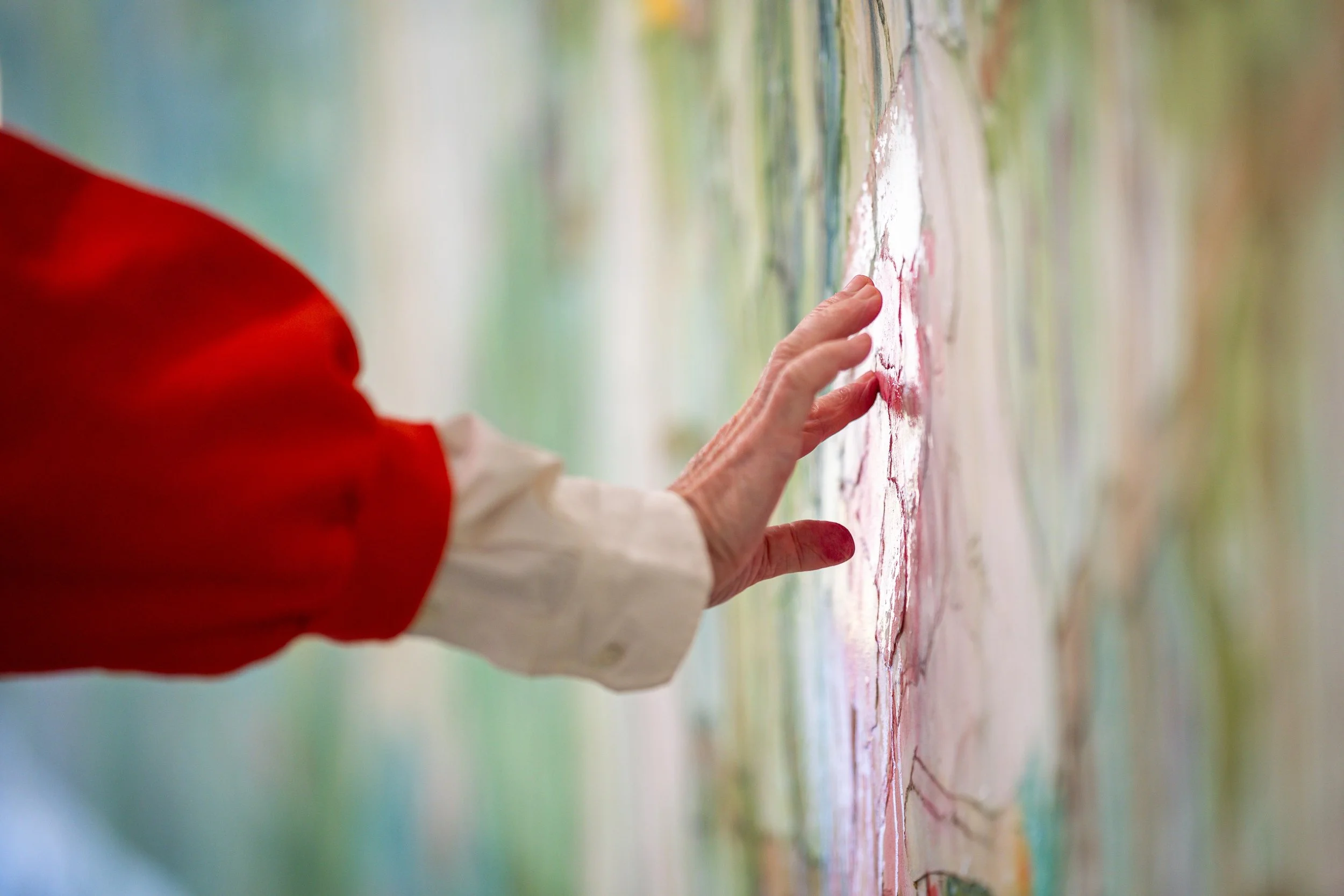
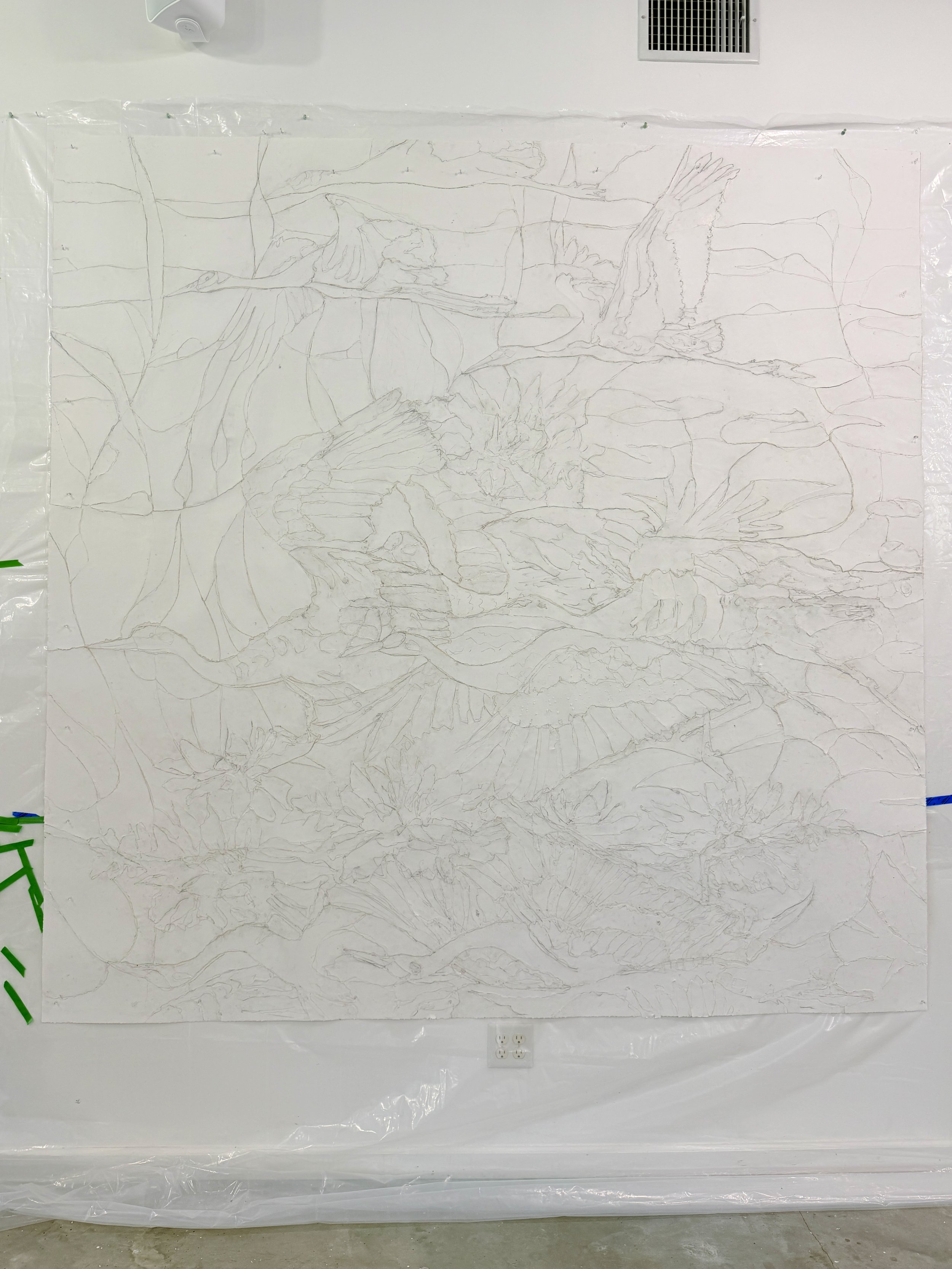
The drawing is finished. The tearing and gluing is finished. Eight feet by eight feet of paper, torn and layered into relief, is hanging on the studio wall — cranes lifting out of a wetland, water lilies, the suggestion of grasses and butterflies threading through all of lif’s messiness.
What remains is the part that scares me most: color. I say that not because I love this phase more than the others — I love every phase — but because fear and love have a weird relationship.
I do not start by mixing paint. I start by looking.
For days now I have been walking through my own life cataloguing proportion — not “what color,” but how much of it, and next to what. How much white beside how much gray. What a tint of gold owes to the sage beside it. Color is never one thing. It is a relationship, the same way a wetland is a relationship: heron and reed and light and silt, none of it legible alone. You cannot ask what a marsh “means” without asking what touches what. Color works the same way. A white is not a color until you tell me what it’s standing next to, what light shines down on it.
This is the practice I call seeing in systems, applied now to a palette instead of an ecosystem. Nothing exists alone. Everything is calibrated against what touches it.
So the search has been for whites — not one white, a whole kinship of them. Bone. Ash. Chalk. The pale underside of a wing. I keep returning to these because I want the piece to hold its intensity in texture rather than saturation: quiet enough that a viewer has to lean in to find the relationship, the way you have to get close to a marsh Abd close your eyes to hear what’s actually happening in it.
I think of the piece in three layers, each one a different organ of the same body. The drawing was the nervous system — the first signal, the line that tells the rest of the piece where to go. The torn paper is the bones — structure, weight, the thing that holds a shape upright in space. Color is the skin. Not decoration. The surface where the organism actually meets the world, where light lands and is read.
None of these layers works without the others. That is the whole point, and it is also be the hardest thing to remember tomorrow when I’m standing in front of a wall of white paper deciding where to place the first true color: the skin will not replace the skeleton. It will reveal it.
The color post will come later, once I’ve actually made the decisions I’m circling here. For now, I am still in the research — still walking around gathering whites, still asking what these torn, dimensional cranes want to become once light starts landing differently on every ridge and shadow the tearing created. Terrifying. Exciting.
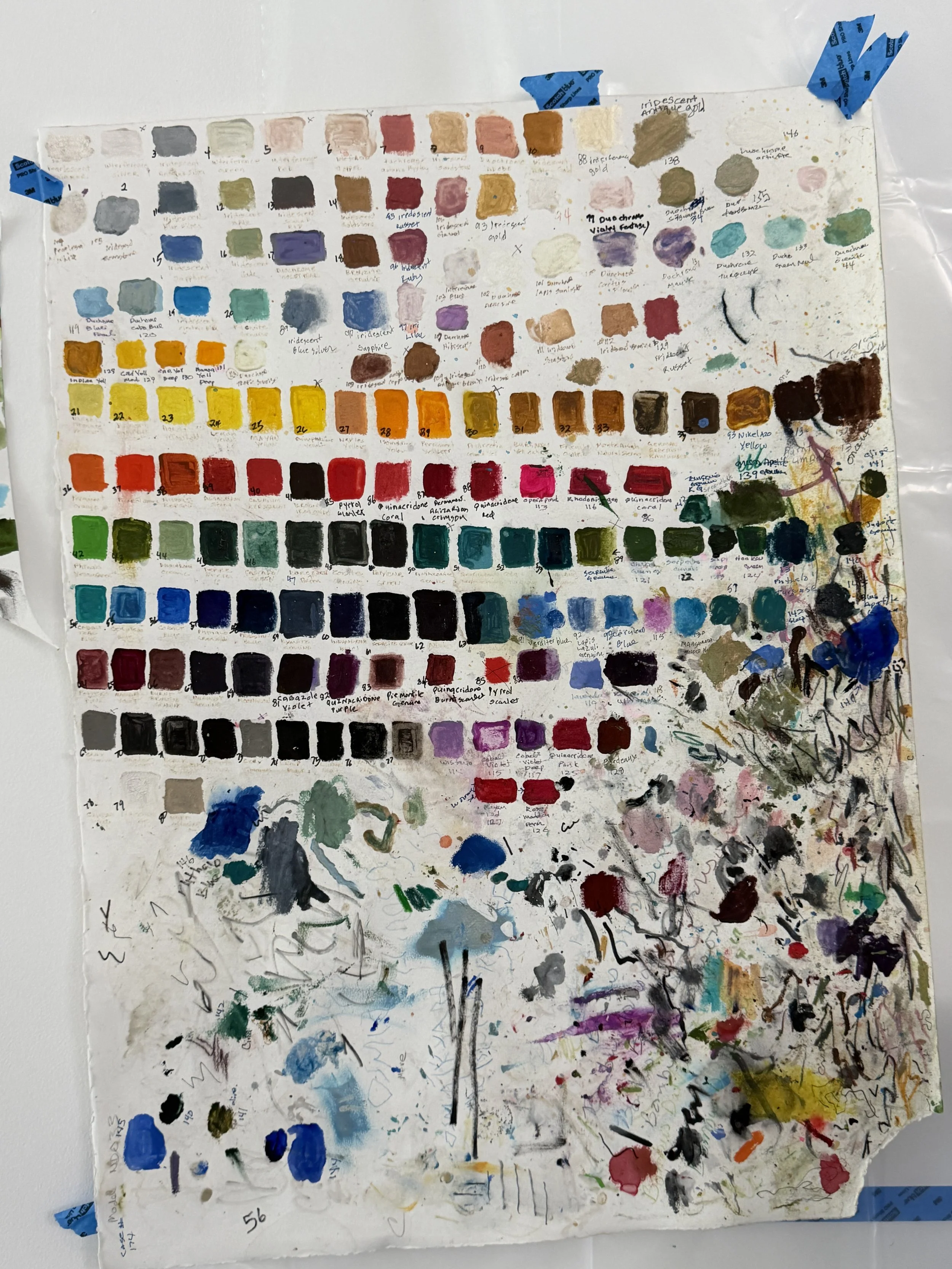
Watercolor inks I will mix from.
