Faux bois Wedding gift ❤️❤️#14

I was not happy with the results of last Thursday's work on the upper branches. The concrete was not sticking to the scratch coat. Afterwards I went through the past blog posts for this piece and this is not the first time I have had trouble with the cement sticking. I made note that the liquid part of the concrete mix was too old. Good to know, the best part of a blog is the documentation of the work. As a result of the old liquid the branches ended up lacking detail. That is what happens when one takes multiple year's to finish one project. Today's work looks better. It does have it's share of wormholes and I love wormholes. I am a sucker for any piece of old wood eaten up by worms. That is the beauty of old wood.
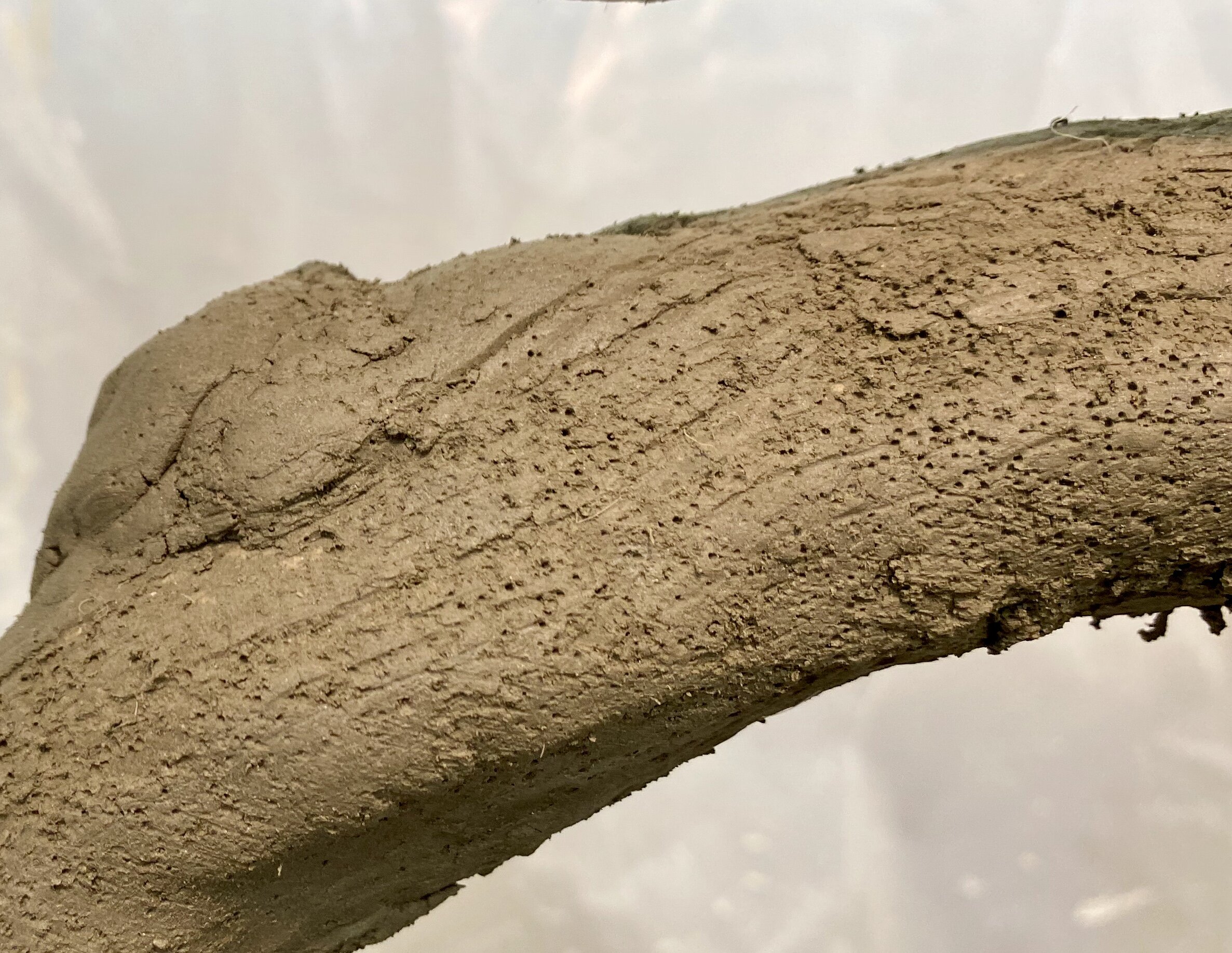
Wormholes and knots

Wormholes and knots

Below is a photo journal of the process.

Mixing the wet part of the concrete mix.

Mixing the wet part of the concrete mix.

Mixing concrete is very similar to baking, you have to measure every ingredient precisely and mix them in the correct order.

A sound concrete mixer is a must; hand-mixing concrete is just too physical. I love this machine. Behind the mixer you can see roots for future bronze pieces drying on the plant trellis

A sound concrete mixer is a must; hand-mixing concrete is just too physical. I love this machine. Behind the mixer you can see roots for future bronze pieces drying on the plant trellis

Fifteen minutes of mixing the dry ingredients.

Fifteen minutes of mixing the dry ingredients.

While I wait for the dry ingredients to mix I paint a bonding agent onto the scratch coat.

While I wait for the dry ingredients to mix I paint a bonding agent onto the scratch coat.

A close up of the white bonding agent after application.
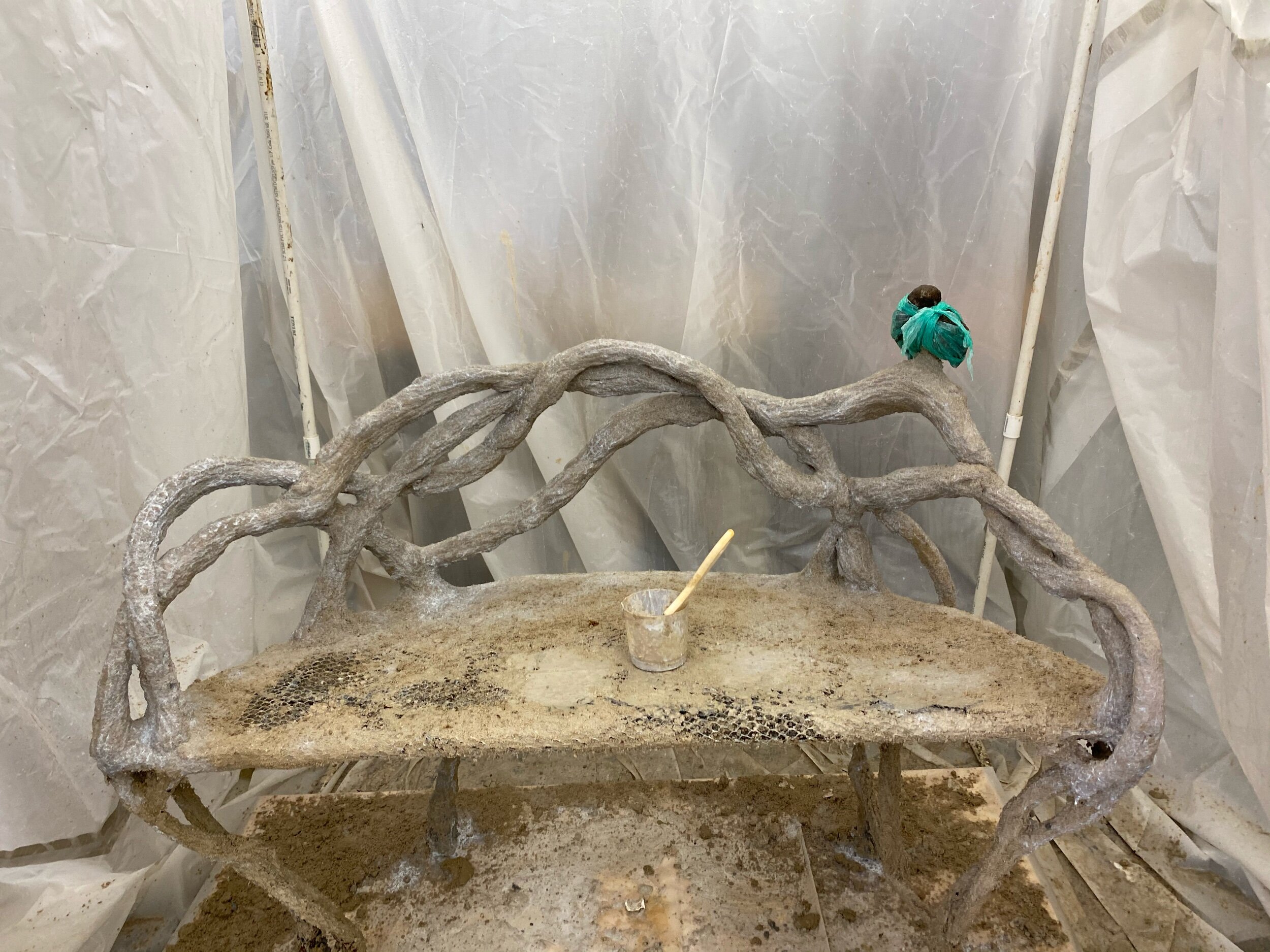
A close up of the white bonding agent after application.

All branches are coated with the bonding agent and drying while I check on the cement mixer.

All branches are coated with the bonding agent and drying while I check on the cement mixer.

When you look closely you can see the fibers I put in the concrete last week. The fiberglass fibers help the new layers of concrete bind to the last coat.

When you look closely you can see the fibers I put in the concrete last week. The fiberglass fibers help the new layers of concrete bind to the last coat.

Just like in baking, you pour just a little wet ingredients in the middle of the dry ingredients.

Just like in baking, you pour just a little wet ingredients in the middle of the dry ingredients.

I clip a cardboard door to the mixer, to keep the dust down.

I clip a cardboard door to the mixer, to keep the dust down.

The mixer kicks up a lot of dust.Even before ppe was a thing, I wore a respirator and a head covering when mixing cincrete. There is nothing like shampooing concrete dust out of your hair.

The mixer kicks up a lot of dust.

Even before ppe was a thing, I wore a respirator and a head covering when mixing cincrete. There is nothing like shampooing concrete dust out of your hair.

Here the mix is starting to stick together and make marble and golf size balls. Ut us about 1/2 way ready.
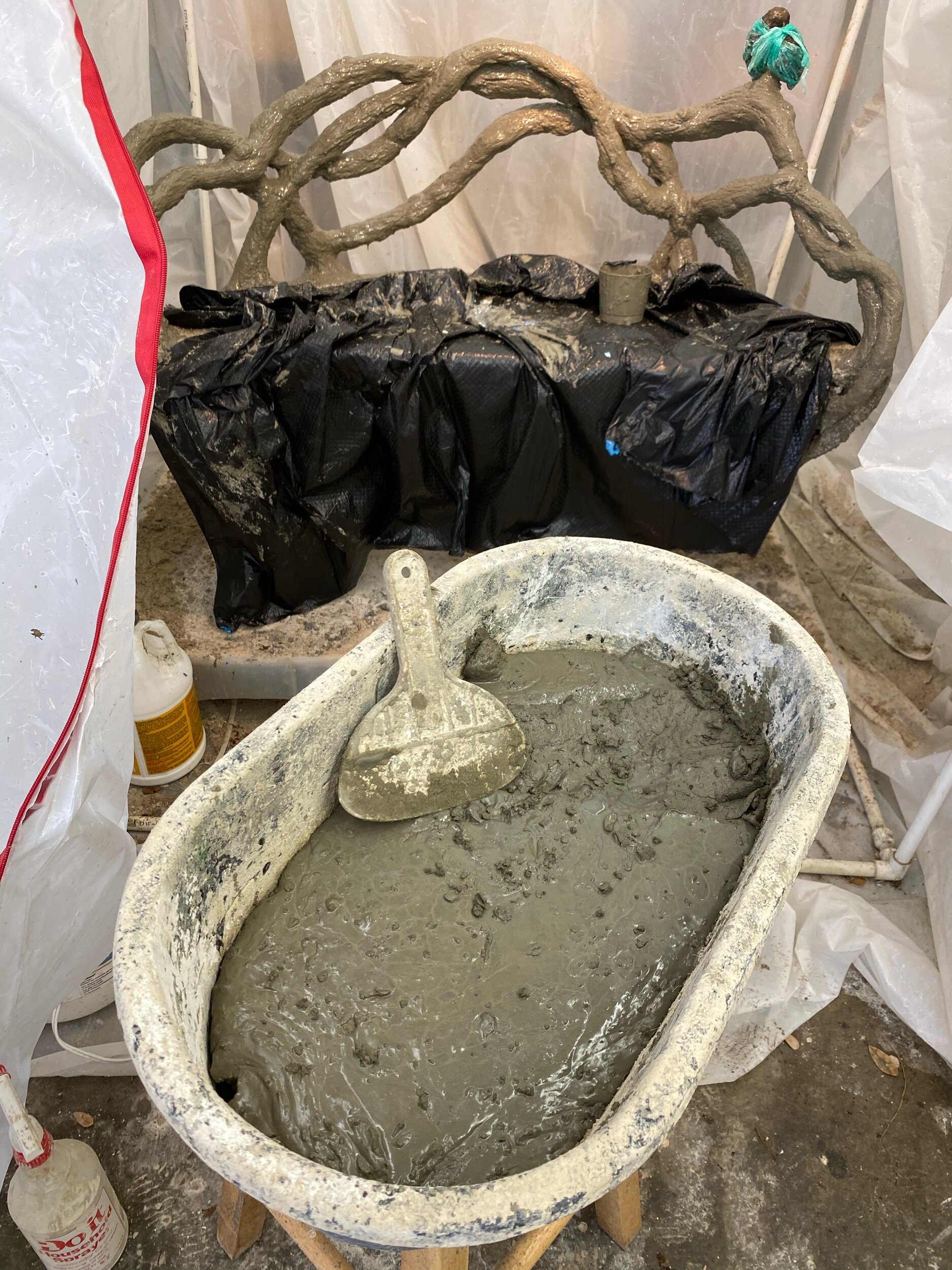
Here the mix is starting to stick together and make marble and golf size balls. Ut us about 1/2 way ready.

Ready to start applying the concrete to the branches.

Ready to start applying the concrete to the branches.

First, I mix a little concrete with the white bonding agent and make a slurry. I paint the slurry mud into the branches to help the first coat stick. Then I wait for it to get tacky.
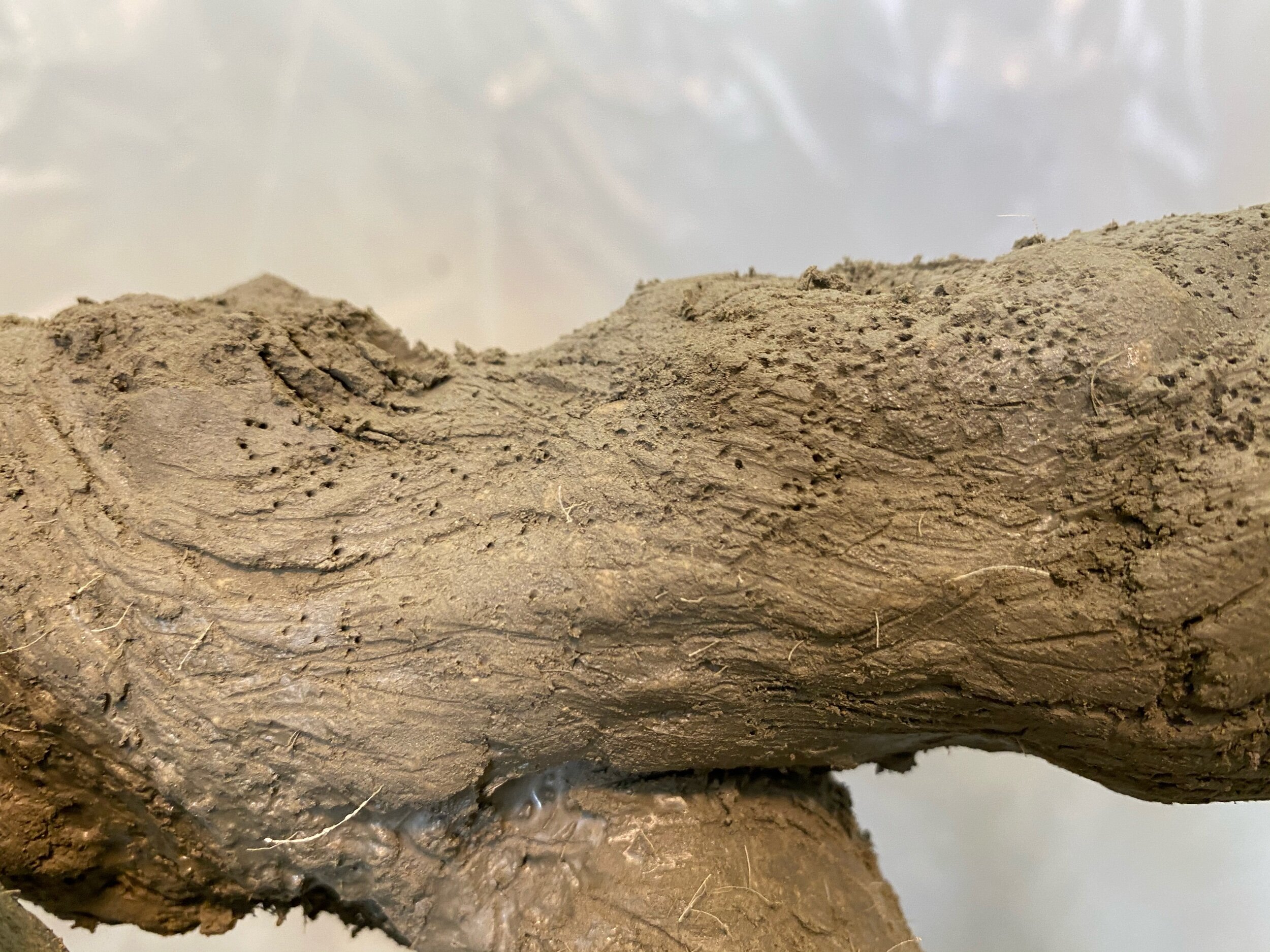
First, I mix a little concrete with the white bonding agent and make a slurry. I paint the slurry mud into the branches to help the first coat stick. Then I wait for it to get tacky.

Another detail look. Some of the fibers from the prior coat are still sticking out. That is ok, when I am finished I will take a small torch Abd burn them off.
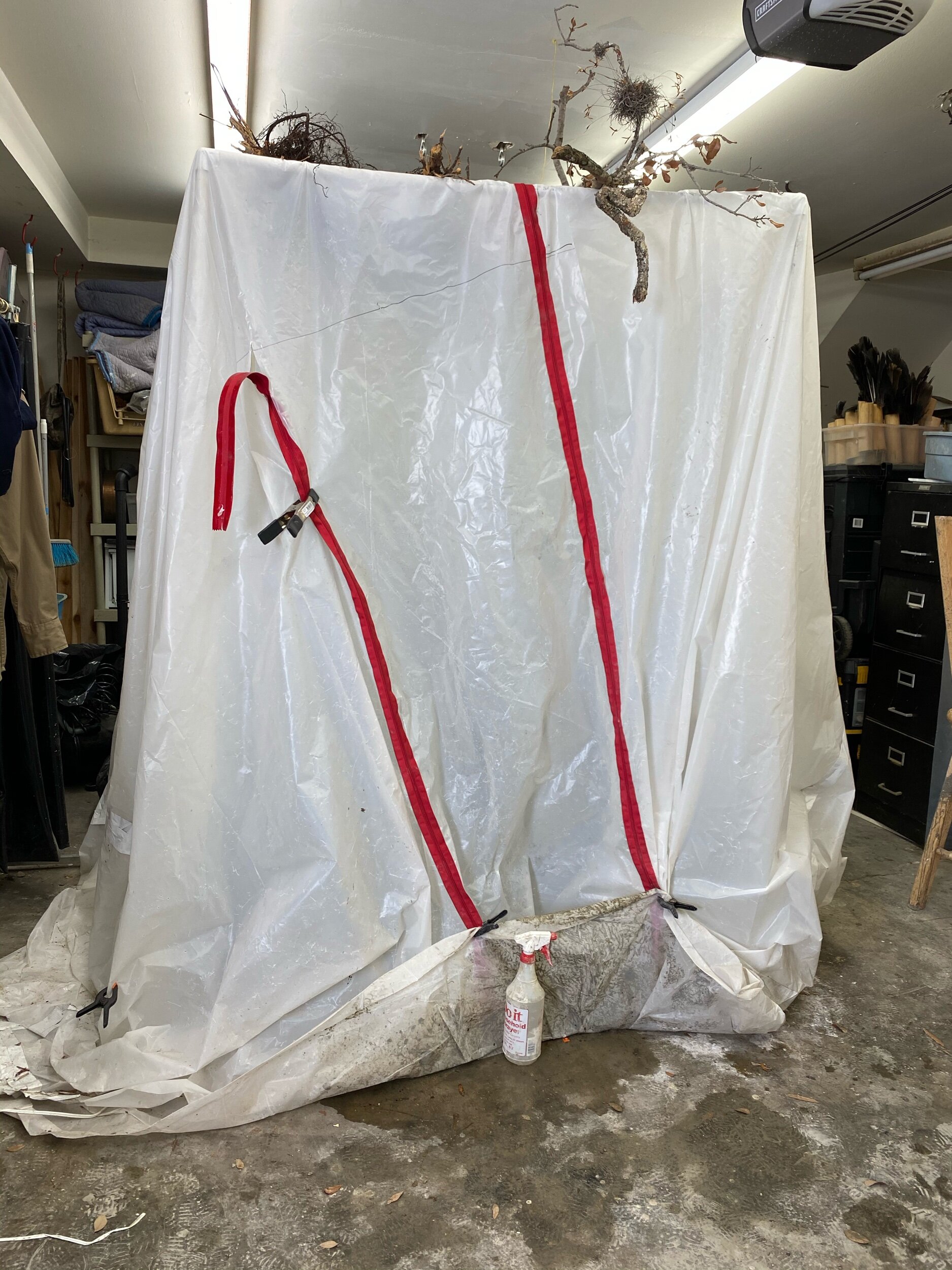
Another detail look. Some of the fibers from the prior coat are still sticking out. That is ok, when I am finished I will take a small torch Abd burn them off.

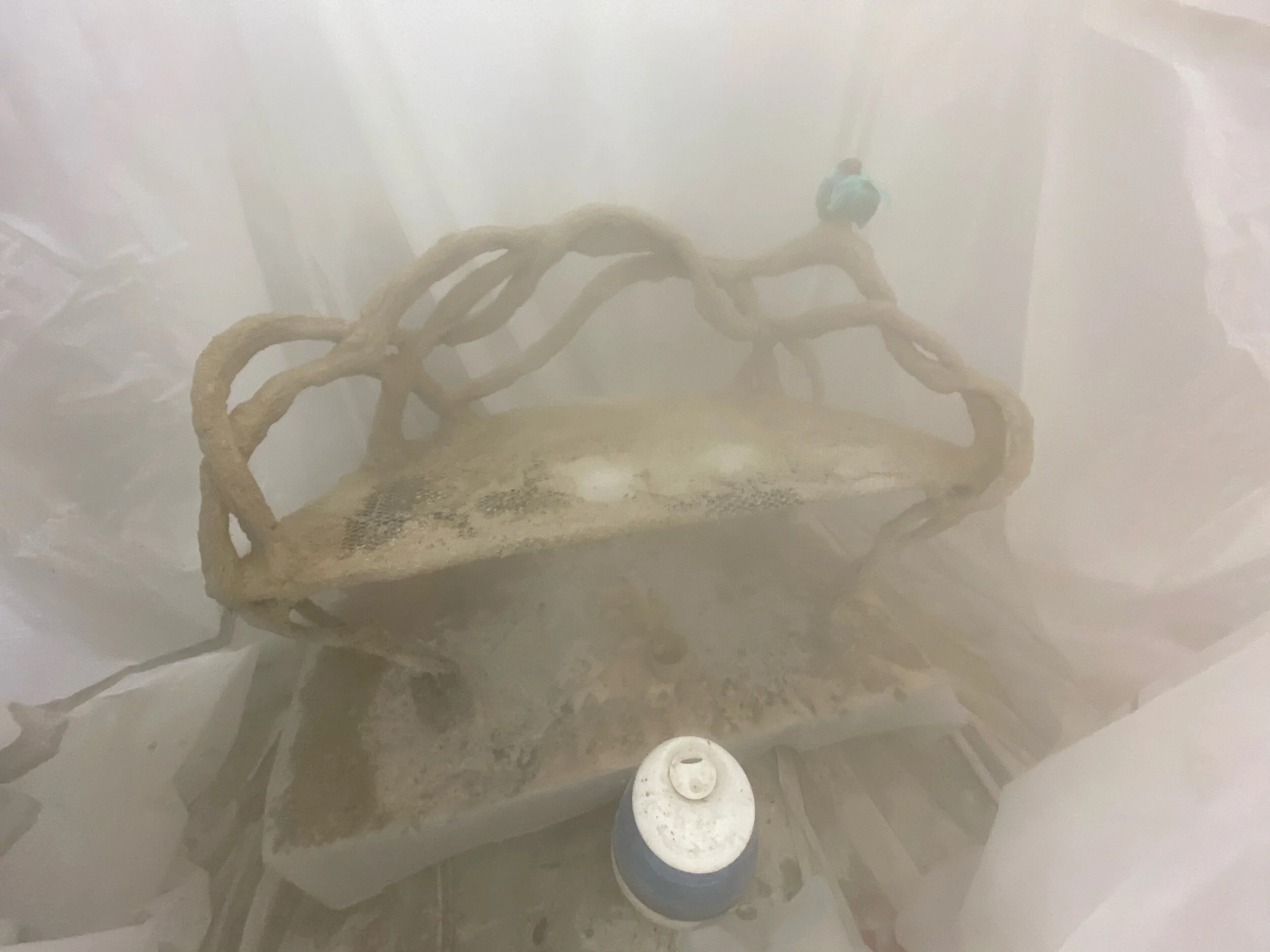
My hydrating tent is getting a bit caddy campus.

My hydrating tent is getting a bit caddy campus.

Five more days of hydrating and then I pour the cement for the seat.

Faux bois Wedding gift ❤️❤️#13

Last Thursday while in Coronavirus 19 quarantine/social distancing I poured a top coat for the upper branches. I actually mixed all the ingredients over a year ago and then got caught up in making the pieces for my Hurricane Harvey Heroes exhibition 51.88” -Art of Resilience. The bucket of dry mix sat by the cement mixer untouched.

IMG_7119.jpeg
IMG_7129.jpeg

The piece will hydrate for 5 days. If it dries too quickly the concrete will crack. I (actually we, Curtis helped me) build a cube out of pvc. I covered it in heavy sheets of plastic that I cut and sewed to fit the cube. I then installed two construction zippers to allow me to get in and check the humidity. I put a humidifier in the cube with the bench, the humidifier keeps the concrete very moist.
Today I started to prepare the dry ingredients so that I can mix the concrete tomorrow morning.

I prepared 30 lbs. of dry ingredients, 10 pounds of fly ash and 20 lbs. of white concrete. And then I panicked - is the piece in white concrete or is it in grey? With the fly ash mixed with the concrete and the piece being wet, I can not determine what color it is. Yikes! this is a problem. I decided to mix a second bucket of dry ingredients. Tomorrow I will be ready for anything.

Stitching a Sweat bee and incorporating time and movement

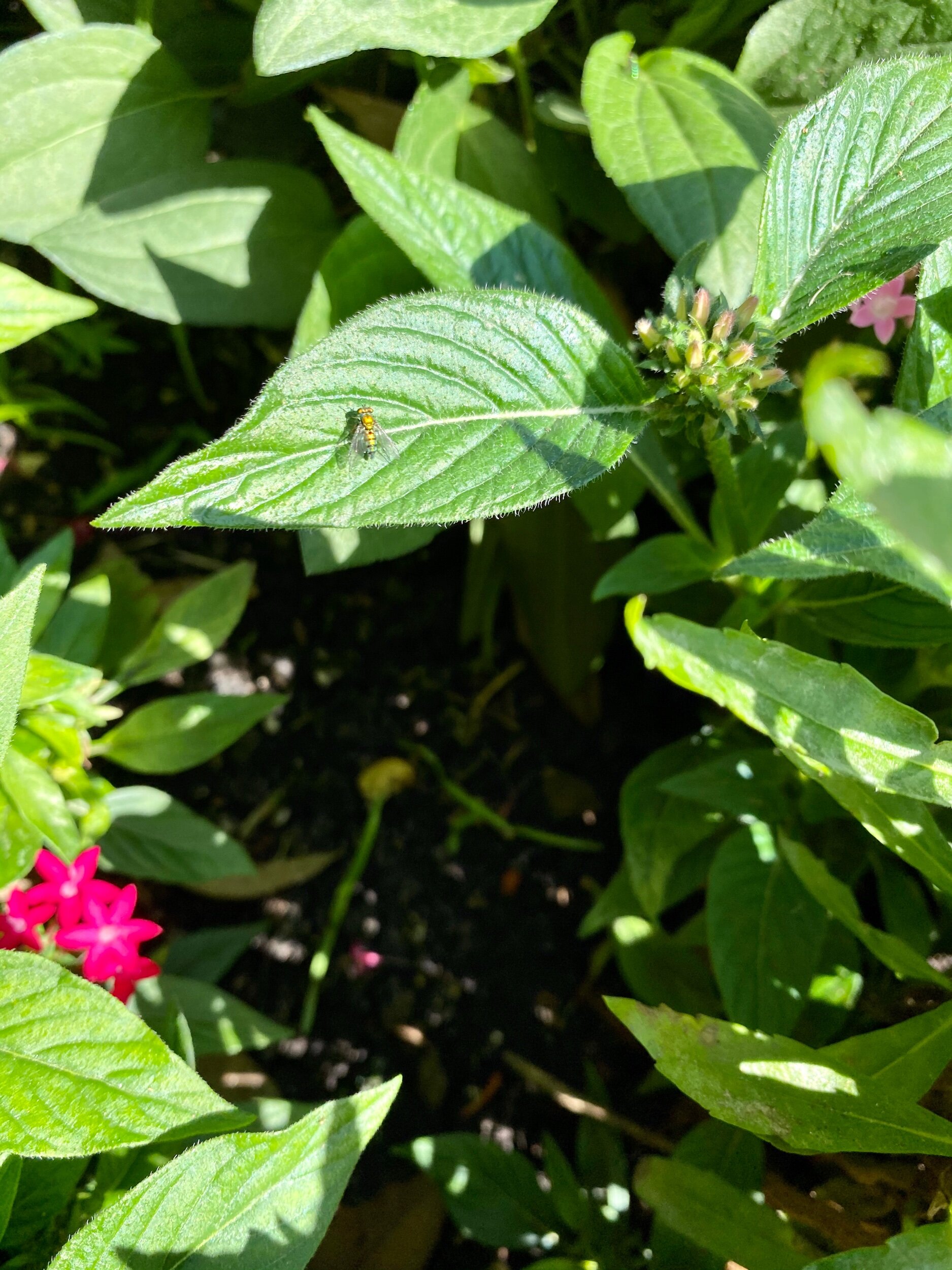
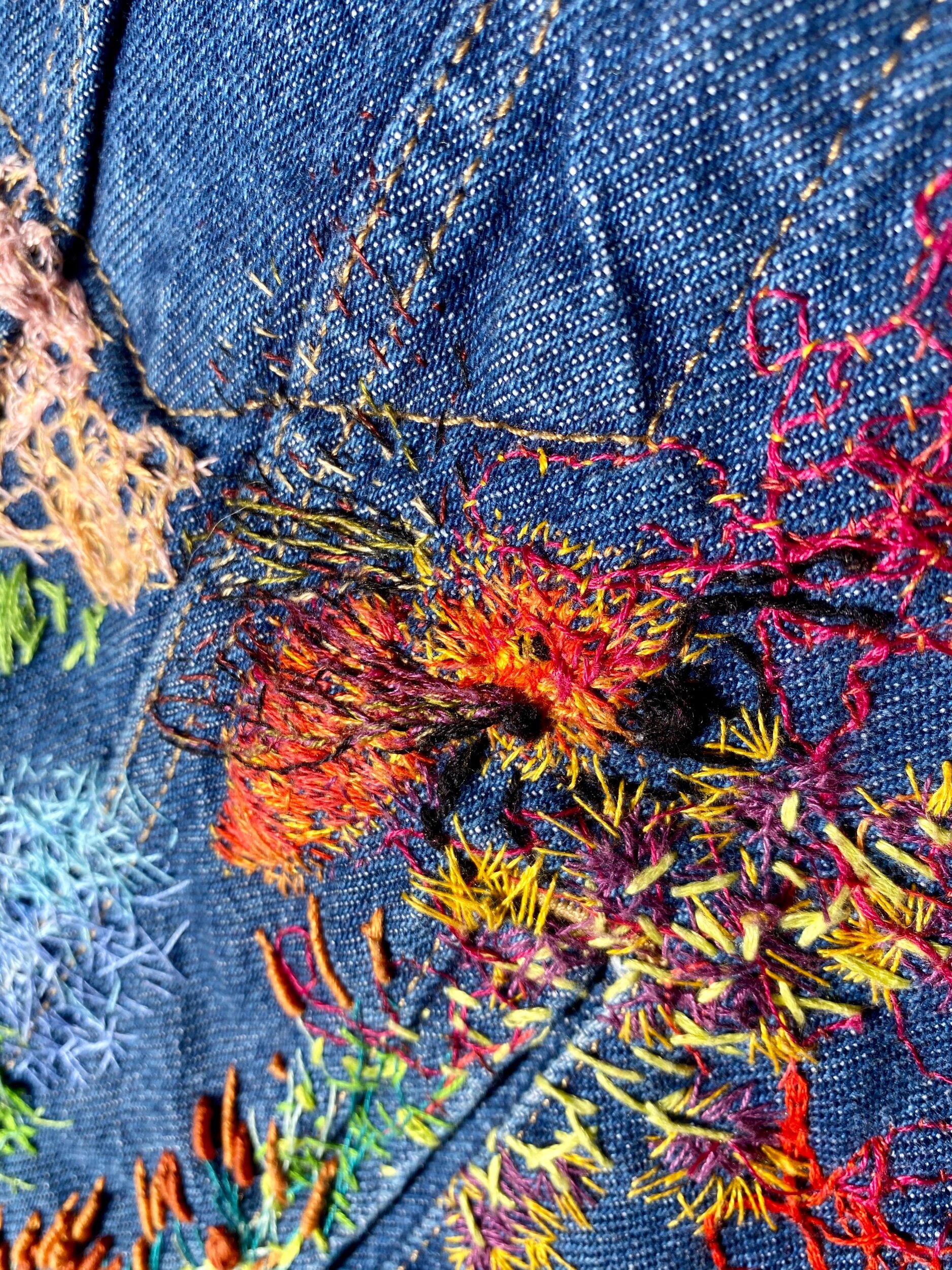
Another day of social distancing and not being able to get in my studio. Today's stitching, I added the first of several sweat bees. In reality, they are only about 1/4 ” long. They have beautiful metallic greens and blues. I am working to show more time and movement in my stitching.

I added a tiny sweat bee - he is moving fast and as a result blurry

I added a tiny sweat bee - he is moving fast and as a result blurry

First I cut some thread of the colors I want the bee to be.

First I cut some thread of the colors I want the bee to be.

Next I wad them up into a cocoon.

Next I wad them up into a cocoon.

Then I untangle them into the shape of the movement of a bee.

Then I untangle them into the shape of the movement of a bee.

Then I stitch them into the shape of the movement.

Then I stitch them into the shape of the movement.

Sweat bees

I have had several people text me or Dm me to tell me about the bees they have seen this spring. That they are looking for bees during their Coronavirus afternoon walks. Some have was even said they would have killed the bees, except they knew I would not have been happy and that they need to protect the bees. It is so lovely to hear about these sightings. Thank you for the feedback- the role of an environmental activist artist can be frustrating at times. This feedback is inspiring. I love this native bee. Did you know this minuscule creature buzzing your native plants is a bee? I think it is a sweat bee part of the Halictidae family. There are 4,000 native bees and hard to identify. The Halictidae is the second largest family of Apoidea bees. Halictid species occur all over the world and are usually dark-colored and often metallic in appearance. With a macro lens, their colors are amazing. Several species are all or partly green, and a few are red; a number of them have yellow markings, especially the males, which commonly possess yellow faces, a pattern widespread among the various families of bees. (Source: Wikipedia, Halictidae, CC BY-SA 3.0) They are tough to photograph as they are swift and only about 1/4” - such a beautiful creature. Aren’t they cool.

Zoomed in

Zoomed in

This gives you an idea how tiny these are.

This gives you an idea how tiny these are.

Bombus dahlbomii

Bombus Dahlbomii is #1. on my bee bucket list. It is about three times larger than the largest bumble in the US. B. Dahlbomii is 1.5” long, they are affectionately called "flying mice" or "a monstrous fluffy ginger beast." This fluff bomb is in serious buzz pollinator mode. They are the primary pollinator of a Chilean bellflower, the National flower of Chile. Native to Chile, this bright orange-ish red arthropod is one of the few bees that can see red. Birds pollinate most red flowers, but this reddish bee loves red bellflowers and Alstroemeria the Peruvian Lillies. The decline of the fluffy ginger beast populations started with the introduction of commercial bumblebees. In the end, the commercial bumblebees did not pollinate as effectively and spread disease. If you are in Patagonia, keep your eye out for this amazing creature.
scientific American has a great article about this unique bee.

https://blogs.scientificamerican.com/extinction-countdown/biggest-bumblebee-threatened/

These pieces are a part of an environmental abstract body of work - Rumblings. In the natural world a rumbling in the distance forewarns a forthcoming gale. Rumblings; a monumental collection of endangered wild bee portraits. The watercolor ink carefully manipulated on the monotypes to reflect the synergistic, aqueous effect of; the wild bee's magnetic attraction of golden dust, the movement of the Keystone species mission to cross pollinate, and their fragility due to the applied chemicals that flood industrial agriculture. With Rumblings there is knowledge and knowledge is power.

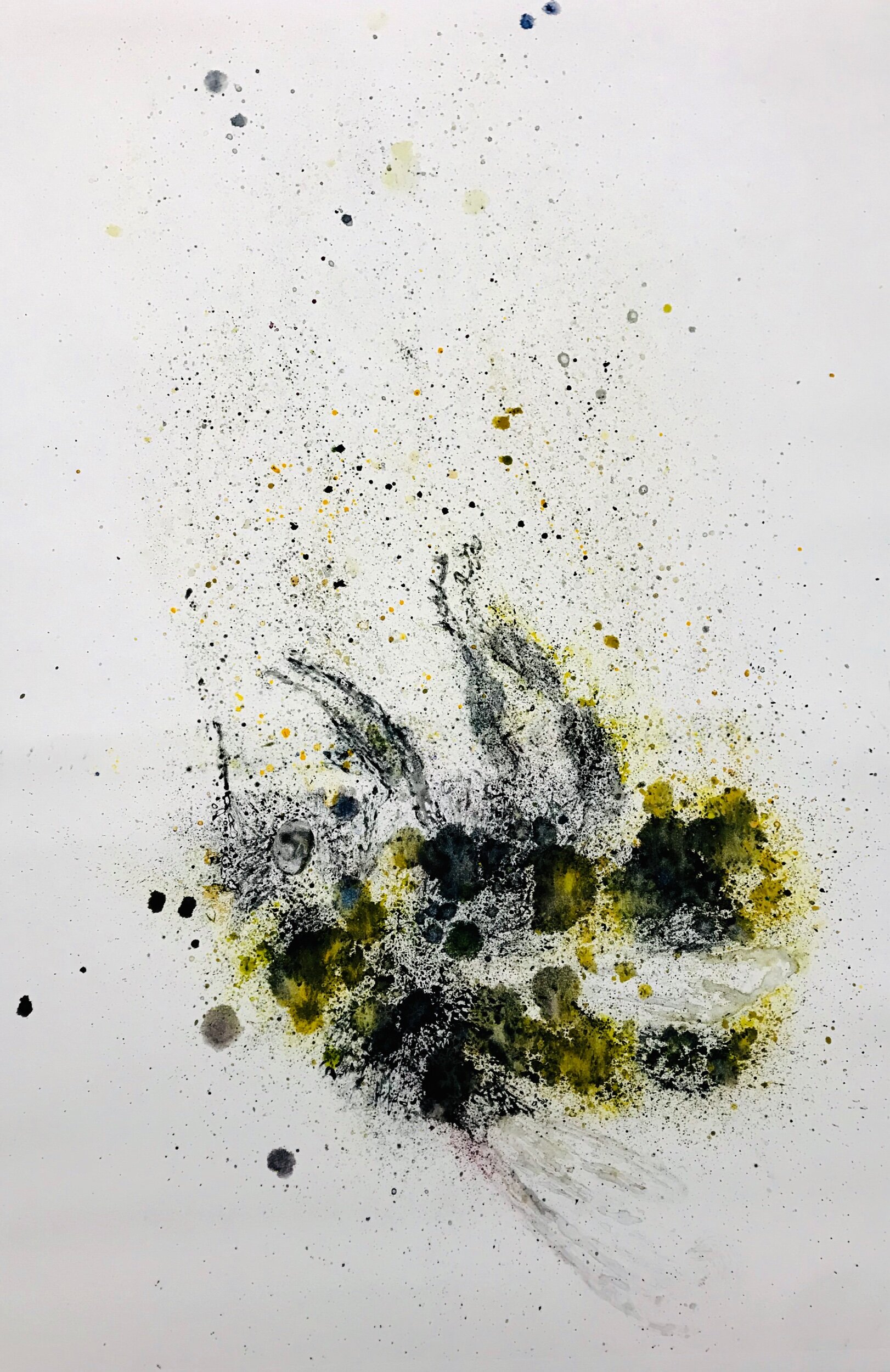
I have made 2 experimental monotypes of a Bombus Dahlbomii. I was experimenting with techniques to make him extra fuzzy. I went a bit crazy with the botany around the bee. These pieces feel experimental, or maybe I need to step back from them. As individual pieces they feel overworked to me- muddied and too much background- That said they may work when all 50 bees are exhibited as one piece. It is good to have options. When I get back in the print studio I will redo them in my normal style just to have on hand.

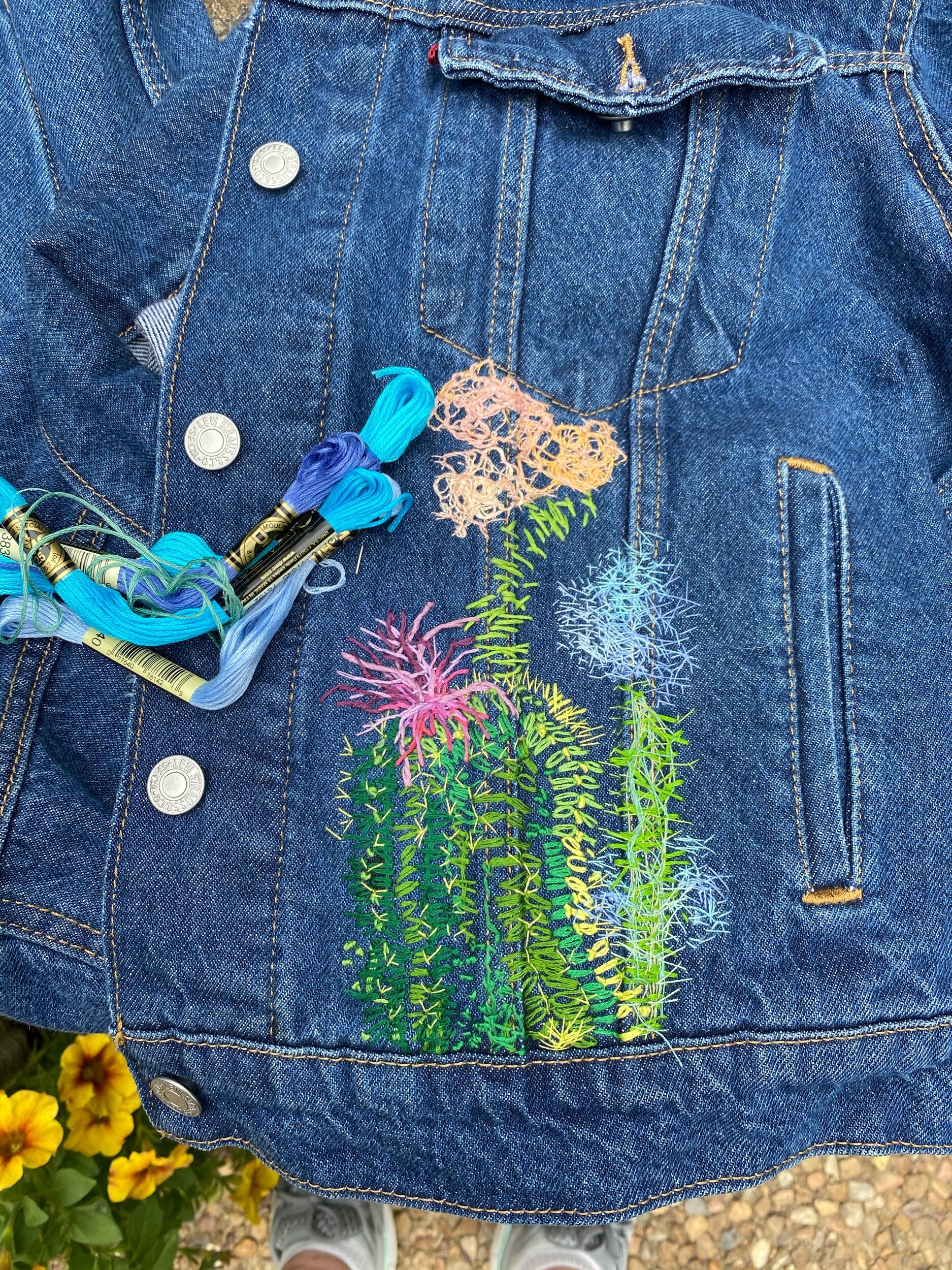
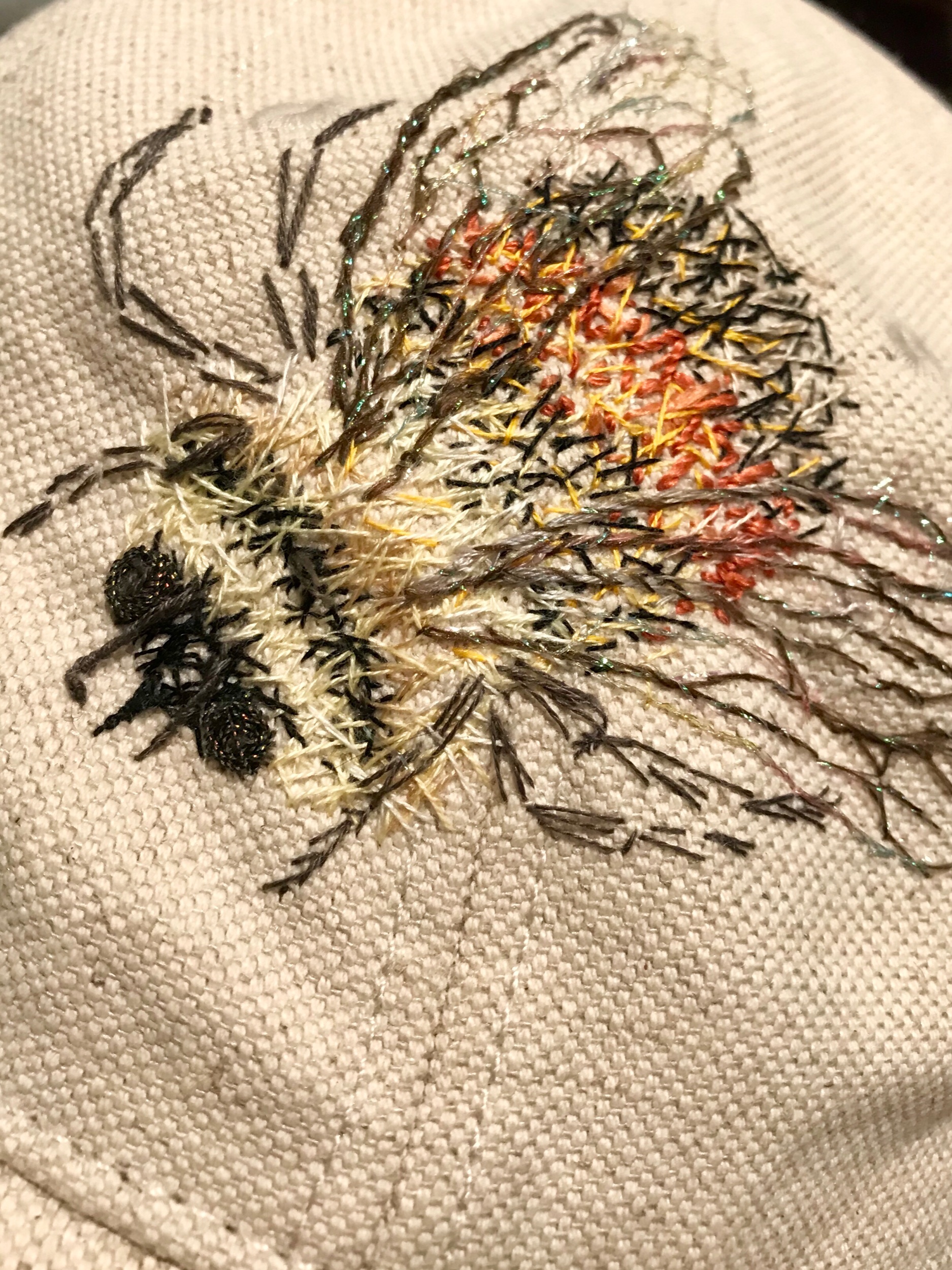
In quarantine during the coronavirus epidemic I do not have access to a large press. In lieu I am stitching bees and native plants on a jean jacket. Stitching keep my hands busy, is a meditation and really good fo mental health.

Bombus dahlbomii Thread on denim

Bombus dahlbomii Thread on denim

Bombus dahlbomii I 30” X 44” watercolor monotypes

Bombus dahlbomii I 30” X 44” watercolor monotypes

Bombus dahlbomii Il 30” X 44” watercolor monotypes

Bombus dahlbomii Il 30” X 44” watercolor monotypes

Gorilla Art - native Wild flower bomb

Earlier in the year I sent the below letter to my City council representative. She is very supportive and agreed to review the Cities landscape ordinance and bring it up to date to reflect our current environmental situation as it pertains to native bees. The bees that are endangered, the honey bee is not endangered. I anticipate that with the health scare our city is facing our bees have been put on the back burner. Since the bees can’t wait for the c virus to die down, I decided I need to act. . Below is my letter. If you agree with me we need to all become gorilla artist and install texas wildflower seeds in every vacant spot we can. See my below post for how to be a gorilla artist and save the Native bees. If you want something done do it yourself. I still have hopes our city will reimagine our urban landscape and save the bees. #bees #houston #cindeeklementart #gorillaart Scientists predict that without pollinators, human life can only continue for four years. In 2017, the U.S. Fish and Wildlife Service listed the Rusty Patch Bumble Bee on the endangered species list. The campaign to list a species as endangered is lengthy and complicated. With this system it is difficult to gauge how many species are actually endangered. Bees are responsible for pollinating 75% of the world's flowering plants; they are crucial for the production of most fruits, nuts, and berries – that our agriculture depends on pollination by bees. Rural areas are highly impacted by the unanticipated consequences of our industrial agriculture’s dependence on chemicals that weaken bee’s immune systems. Urban bee populations can be more diverse than in rural areas. Researchers are finding in cities such as Chicago, Berlin, Berkley, and Melbourne that have reimagined their parks, neighborhoods, city centers, vacant lots, street medians, and rooftops planted with native flowers, grasses, and fruit, and vegetables support healthy, vibrant wild native bee populations. There are four thousand native bee species. They pollinate over three hundred times more effectively than honey bees. For example, A single female Leafcutter Bee visits 100,000 plus blossoms per day whereas a honey

IMG_6275.jpeg
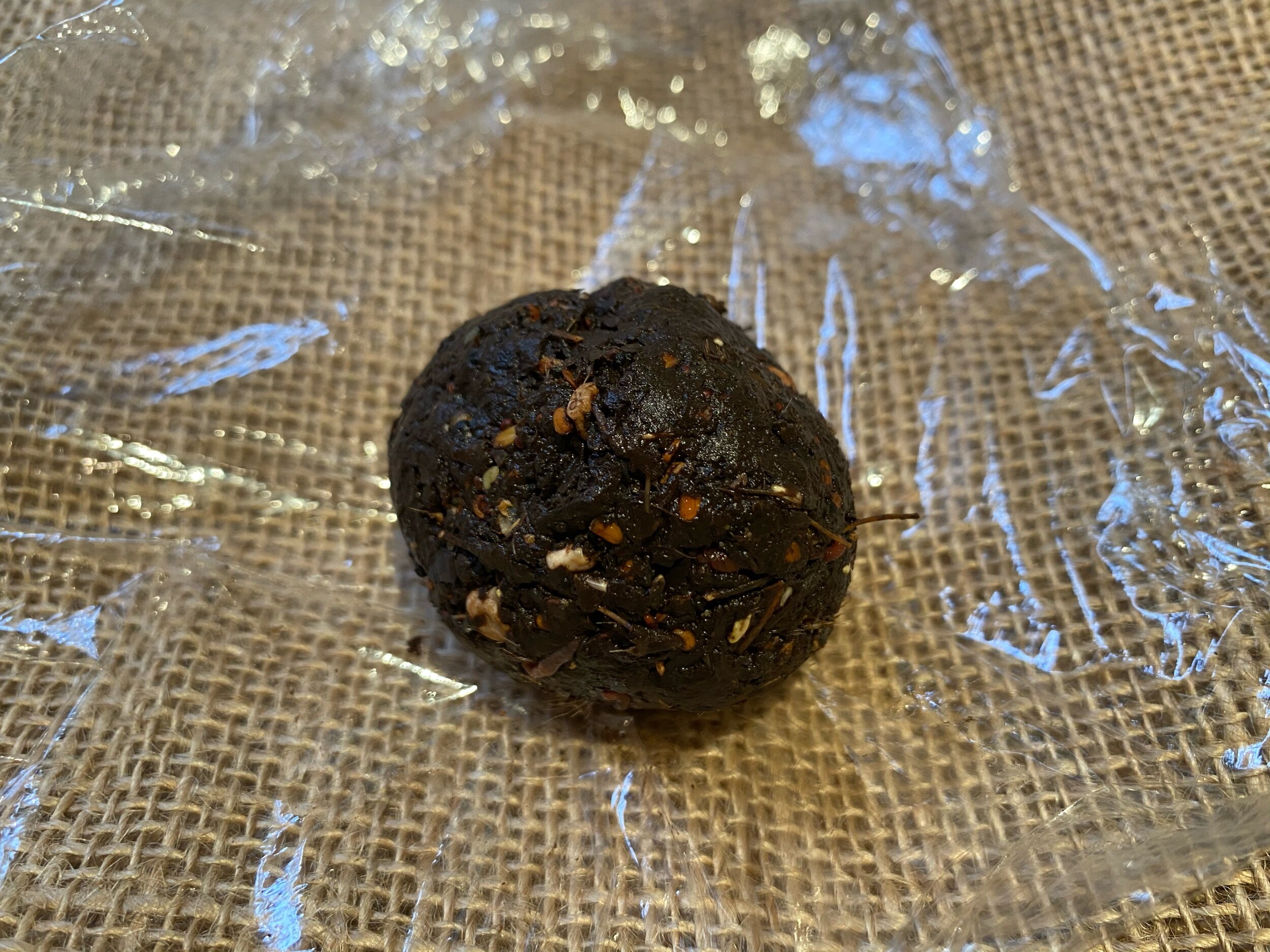
Mix native wild flower or grasses seeds with soil. I am using a handful of compost from my bin.

Mix native wild flower or grasses seeds with soil. I am using a handful of compost from my bin.

Wrap it up so you can carry it and not get your hand muddy.

Wrap it up so you can carry it and not get your hand muddy.

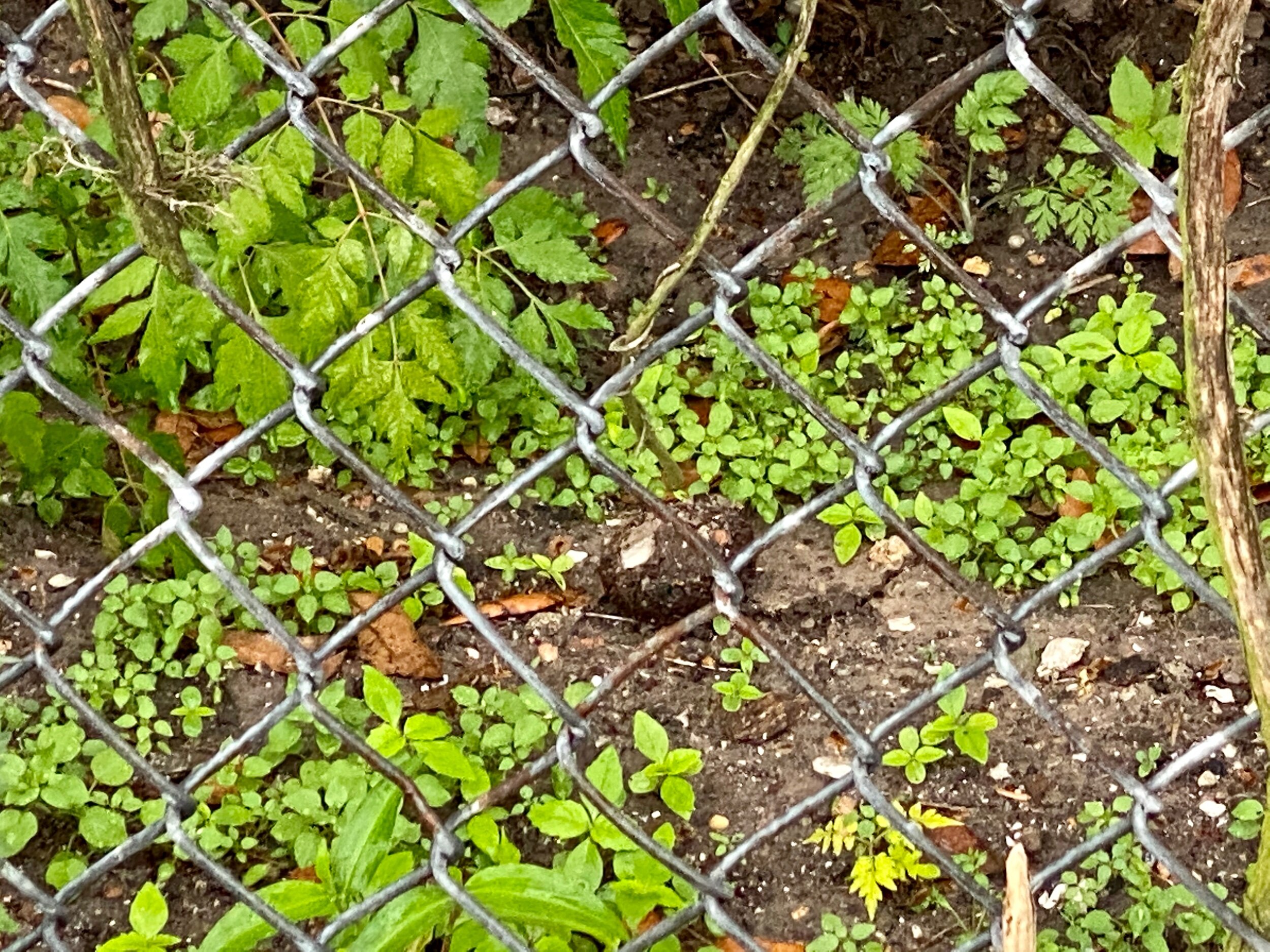
Find a place to throw it that will not be mowed. I picked behind this chain link fence, in the parking lot of my art studio.

Find a place to throw it that will not be mowed. I picked behind this chain link fence, in the parking lot of my art studio.

Here she lays.

Here she lays.

A closer look at - native wild flower seed bomb.

A closer look at - native wild flower seed bomb.

Three weeks later.

Three weeks later.

There are so many weeds sprouting up it is hard to see my seed bomb. But I see it. It does not have any blooms yet but my fingers are closed it will.

Since we are in quarantine I decided at this time to not make a bunch of bombs to share with others. I would love to share but I am erroring in the side of caution. i put the rest of my wild flower seeds in my flower beds that I needed more plants.

COVID 19

The last almost three weeks have been emotionally challenging for everyone. That said I am very fortunate that no one close to us is sick and for that I am very grateful. I do have friends who have very sick people in their family. It is hard to hear their pain. I tear up just thinking about how many people this second are worried about next breath. I am trying not to think of it- it is too painful.

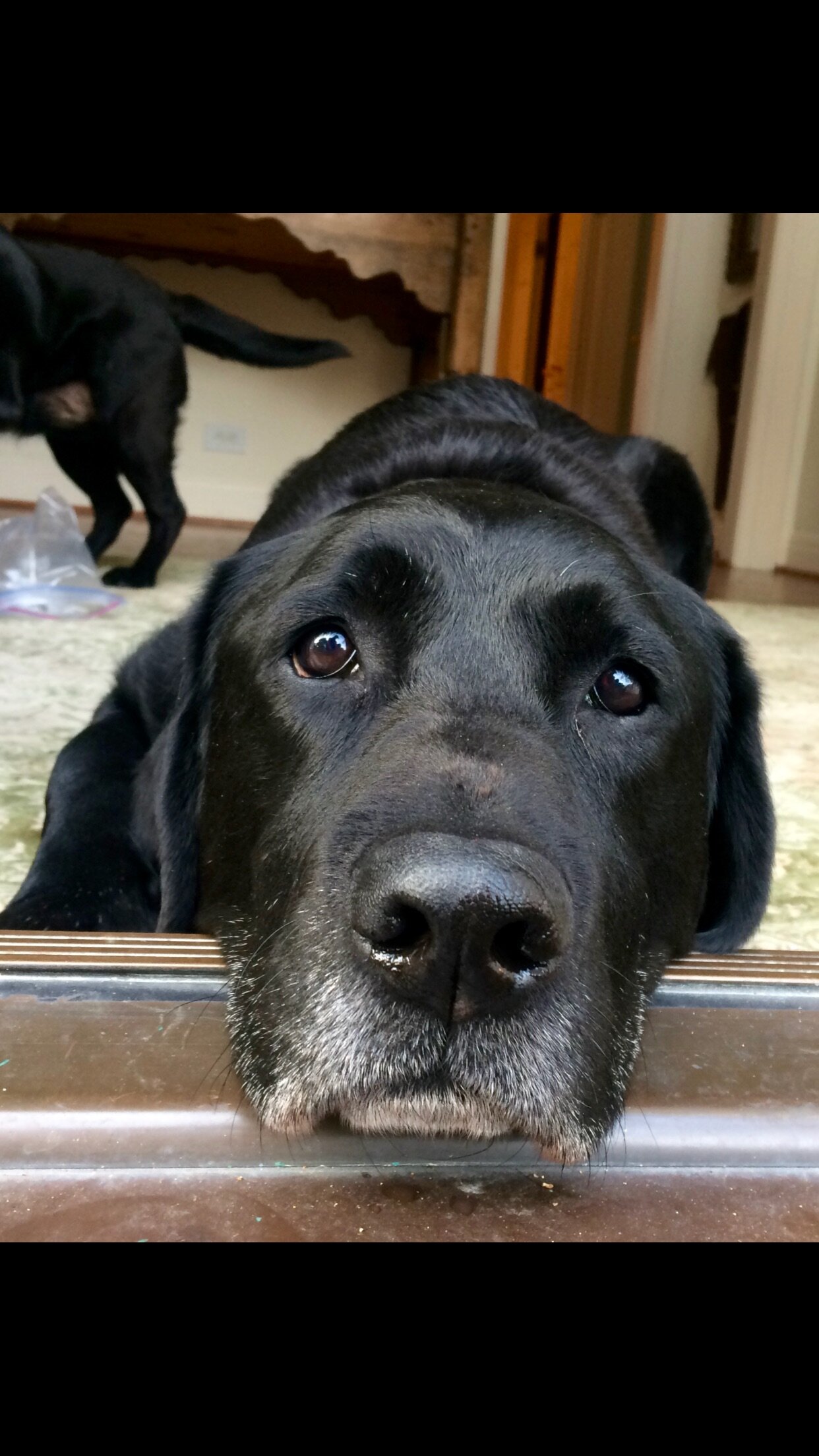
I am trying to keep myself busy and stitching is very therapeutic. I am free stitching bee habitats onto a stained jean jacket and getting a lot of dog walks in. We lost our oldest male labrador Goose to kidney failure last week. He is missed. The timing was bad as he brought us a lot of joy.

The jean jacket

The jean jacket

My sweet Goose watching me work in the yard a few years back.

My sweet Goose watching me work in the yard a few years back.

Azalea Trail and wild native bees

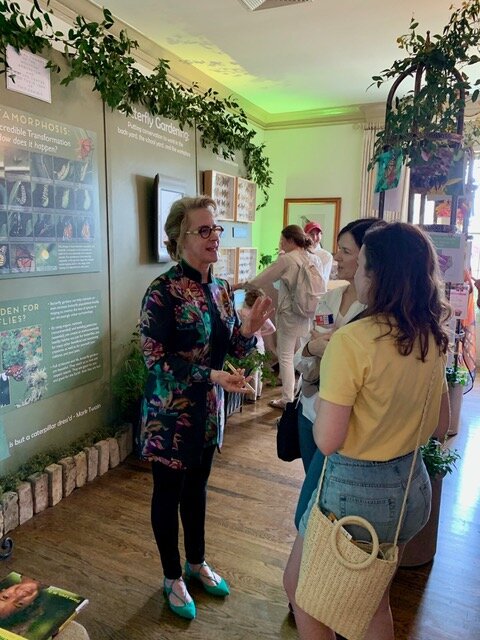
This summer it came to my attention that the River oaks Garden Club was having a luncheon with a bee theme. I quickly reached out to their luncheon Chair and she connected me to their environmental chairman. They came to my studio and we talked about the 4,000 wild bees species and how most people only know about honey bees.

Long story short I was invited to talk about the bees at their annual Azalea trail fundraiser. They were Slammed with people. I spoke none stop on Sunday from 11-5.

In addition the environmental chairs decided to work the native bee (the endangered bees) story into their both at their garden show this spring. It is organizations and ladies like these that can save the wild bees.

Adjustments.jpeg
Image courtesy of Janna Webber

Image courtesy of Janna Webber

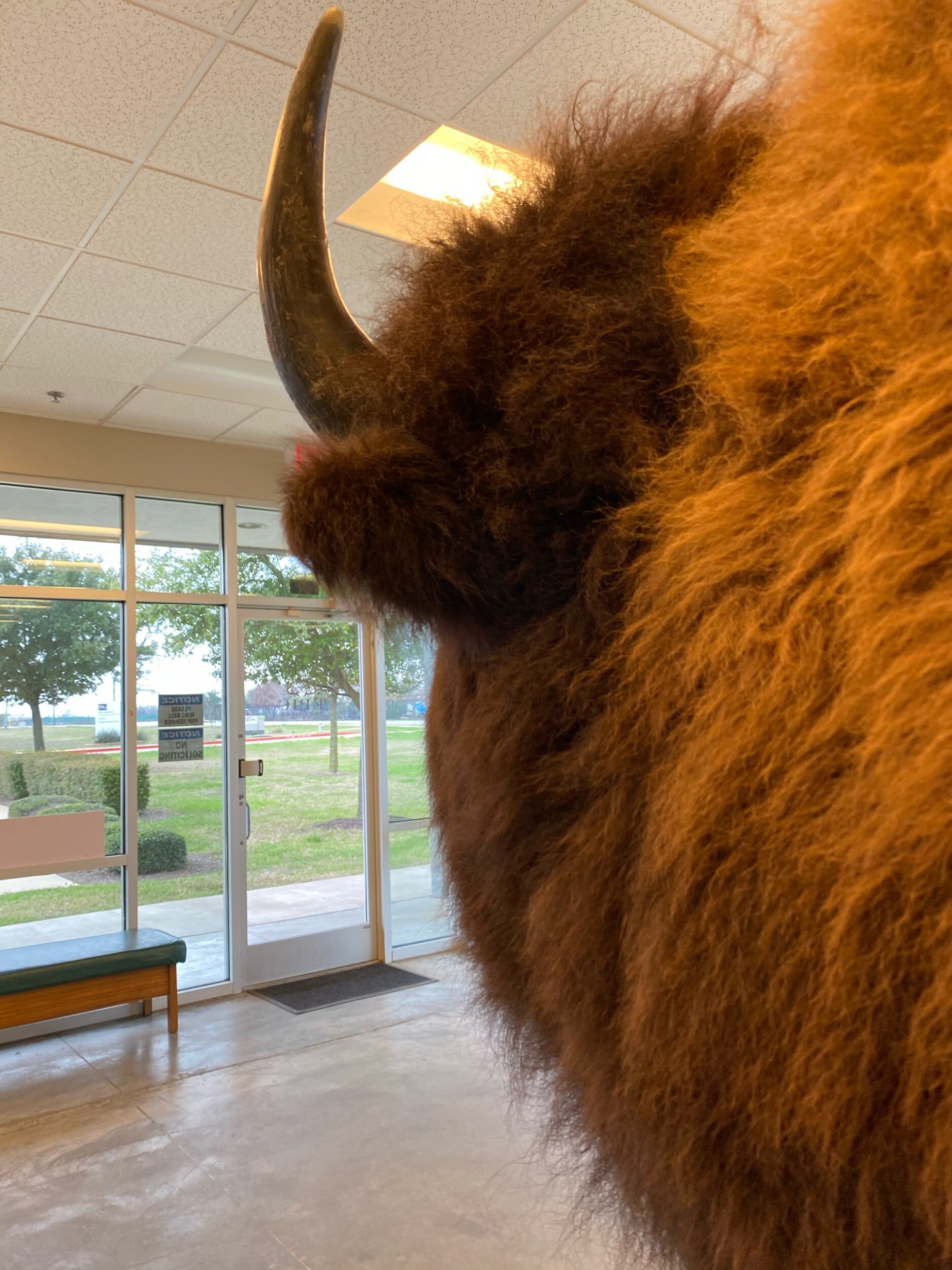
Bob the bison

Have you ever asked a Houstonian- “ why do you think Buffalo Bayou, is named Buffalo Bayou?” The aswer I get 100% of the time is - I don’t know.............. 😞 Right after they mumble “I don’t know?” you can hear the sound of a quiet cracking as my heart breaks. It is heart breaking that living in urban environments we have become disconnected to animals and nature. Thanks to EPIC bar last week I took another step in the direction that will reconnect urban populations to one of the most important natural processes on the planet. I would also like to thank Bob the Bison.

IMG_5093.jpeg
IMG_5059.jpeg
A landscape

A landscape

Lumps

Lumps

IMG_5058.jpeg
IMG_5038.jpeg

Falling through the bee looking glass #1

In the past years, blogging about my art practice was something I did every day. It is how I document my work. Then I started focusing on bees. At first, it was bees and the weed killer Glyphosphate.

Adjustments.jpeg
Adjustments.jpeg
Adjustments.jpeg

The above pieces we're done in response to learning that Glyphosphate does not kill bees but impacts their immune system. With compromised immune systems bees subcome to disease. Glyphosphate is also now well known for causing cancer. I then made a five flip lenticular from these three images.

Bee fossils- inspiration

Studying our past is an incredible learning tool. With that in mind, I found the below article about the oldest bee fossil.

https://www.livescience.com/amp/4255-oldest-bee-fossil-creates-buzz.html

https://tmm.utexas.edu/sites/default/files/Amber%20Activity%202019.pdf

Coincidentally I just made a mold of a fossil for personal reasons. Reading this article is inspiring some new ideas that will involve the fossil mold and bees.

IMG_4690.jpeg

Osmia Texana - the berry bee

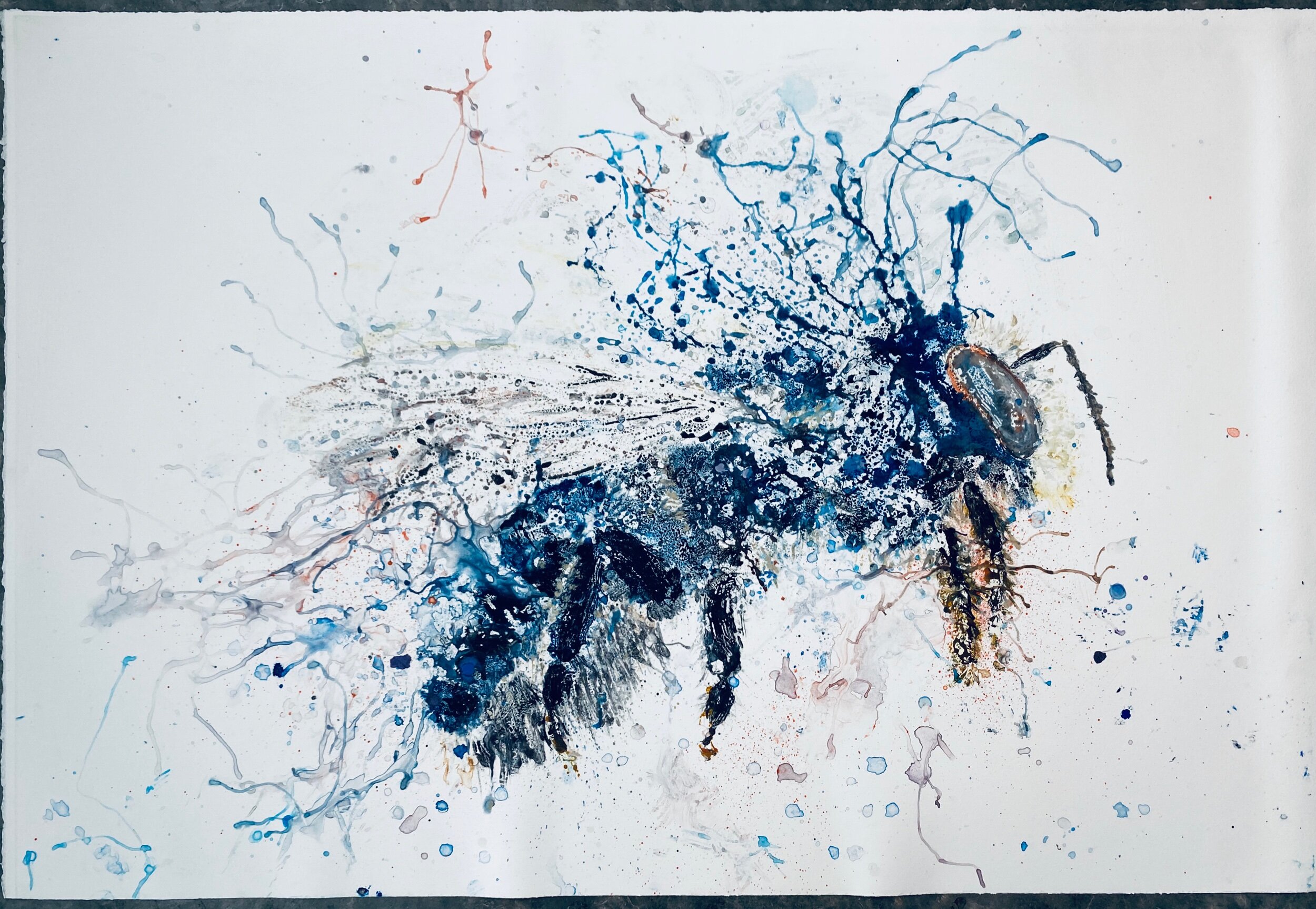
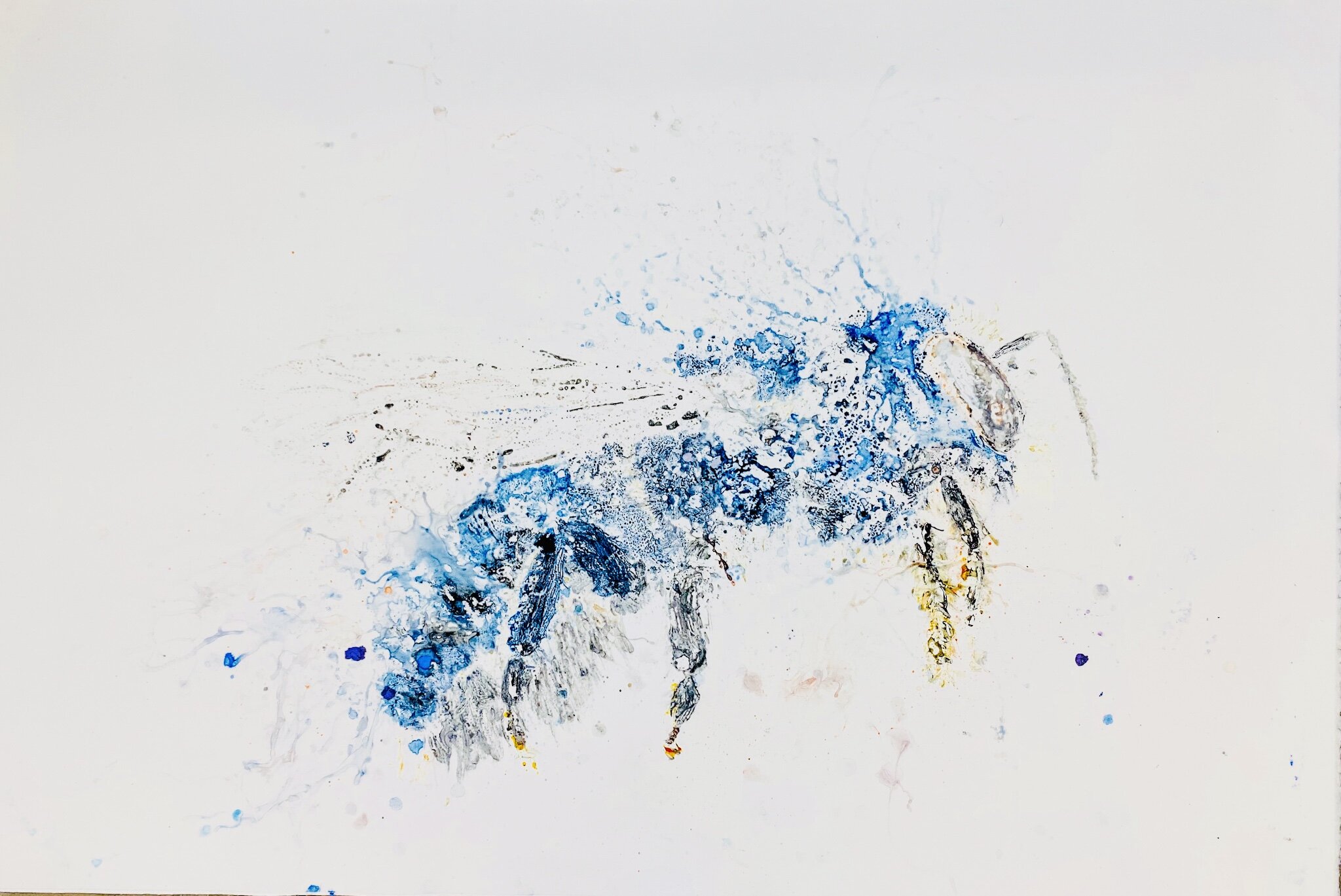
Osmia Texana - The Berry Bee This frantic bee is about as big as a housefly. If you look at one with a macro lens you can see they are a beautiful metallic blue. The underside of their abdomen is a fuzzy pollen mop. These pollen magnets are the perfect shape to collect pollen from blueberries, raspberries, strawberries, melons, and veggies, to name a few. They are not picky pollinators.

A single Texana Bee frantically visits 20,000+ blossoms per day, whereas a honey bee visits 50-1000. They are not- aggressive and non-colonizing, solitary bees.

They emerge in the spring and have an average pollinating season of 6-8 weeks, after which they die. Their offspring will hibernate over the winter and emerge the following spring.

They are found on both the central and North American continent.

Watercolor monotype 44” X 30.”

Watercolor monotype 44” X 30.”

The ghost

The ghost

Let it Bee

30” X 44” Lenticular in In the words of Paul Mc Cartney and the Beatles in “Let it Be” I think of Mother Mary as mother nature. Some day I would like to have a children’s choir sing “Let it Be” with my shadow piece,” World of Hum.”. But for now it is Spotify and a lenticular in my studio.

30” X 44” Lenticular in In the words of Paul Mc Cartney and the Beatles in “Let it Be” I think of Mother Mary as mother nature. Some day I would like to have a children’s choir sing “Let it Be” with my shadow pieces ”World of Hum”. But for now it is Spotify and a lenticular in my studio.

Sewing bee #6

I give these hand stitched caps to people that help me make an impact and bring back the endangered wild bees.

Bombus Affinis, the Rusty Patch Bumble bee was listed as Endangered January 11, 2017.

public.jpeg

A great resource for learning about native bees is below.

https://xerces.org/wp-content/uploads/2016/10/2017-009_B-affinis_IDGuide_web.pdf

Copy of SITE Gallery- Sculpture Month Houston - Installing the work#2

Things are now going smoothly maybe too smoothly. All the work I did this summer is paying off.

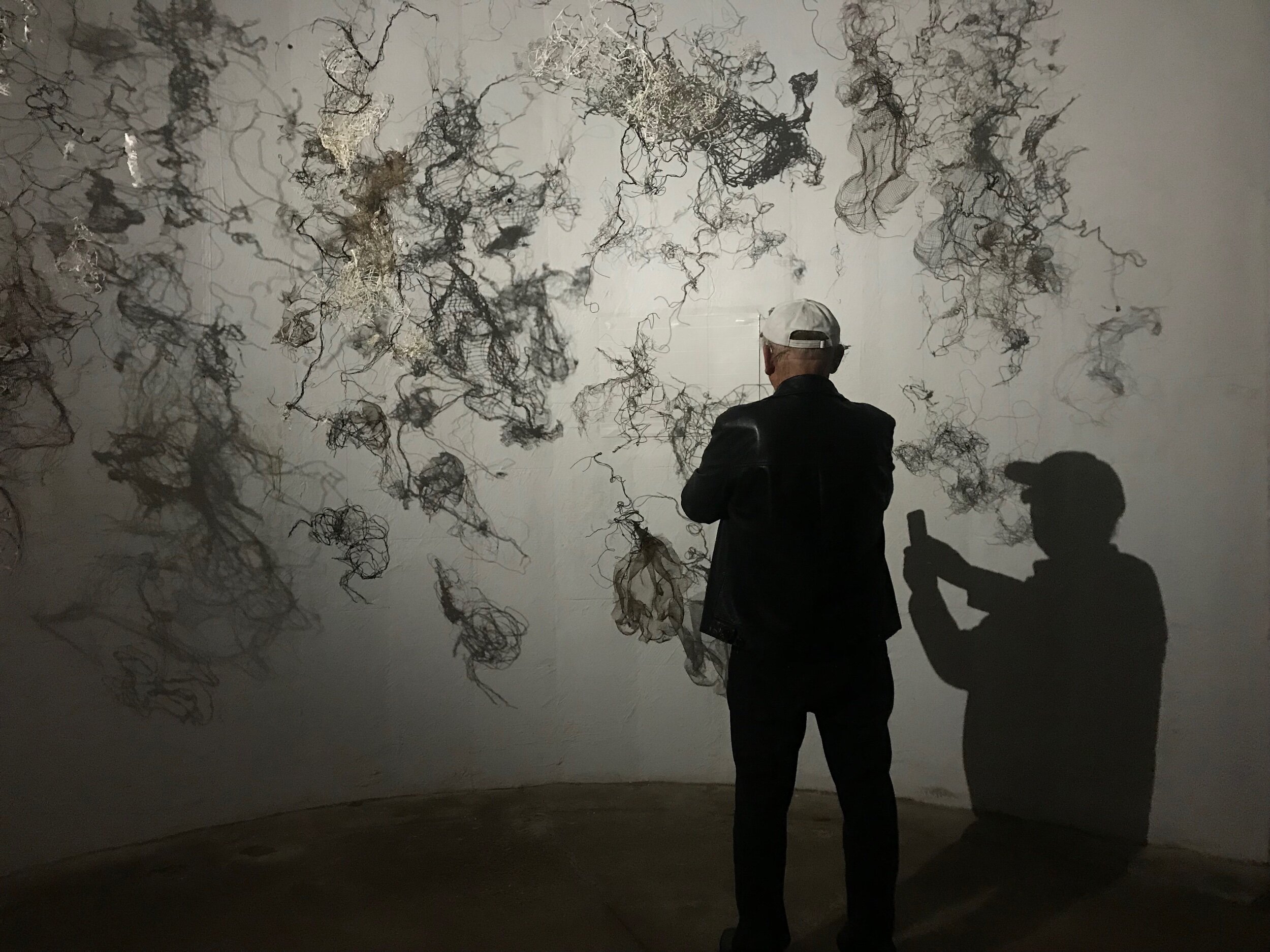
Environmental installation work in progress for the Sculpture Month Houston Outta Space exhibit in the silo Site Gallery on Sawyer street, Houston Texas #environmental installation. #world of Hum
 

SITE Gallery- Sculpture Month Houston - Installing the work - my pregame plan

With lots of time spent preparing to install my work, installing it went by quickly.

During the days prior to the installation, I imagined trying multiple compositions of the pre-assembled sections, spending lots of time looking at it, adjusting it, and tweaking it and then adding smaller elements to tie the work together... and repeating the same process over and over until I was satisfied it was finished. That was my pre-game mental plan.

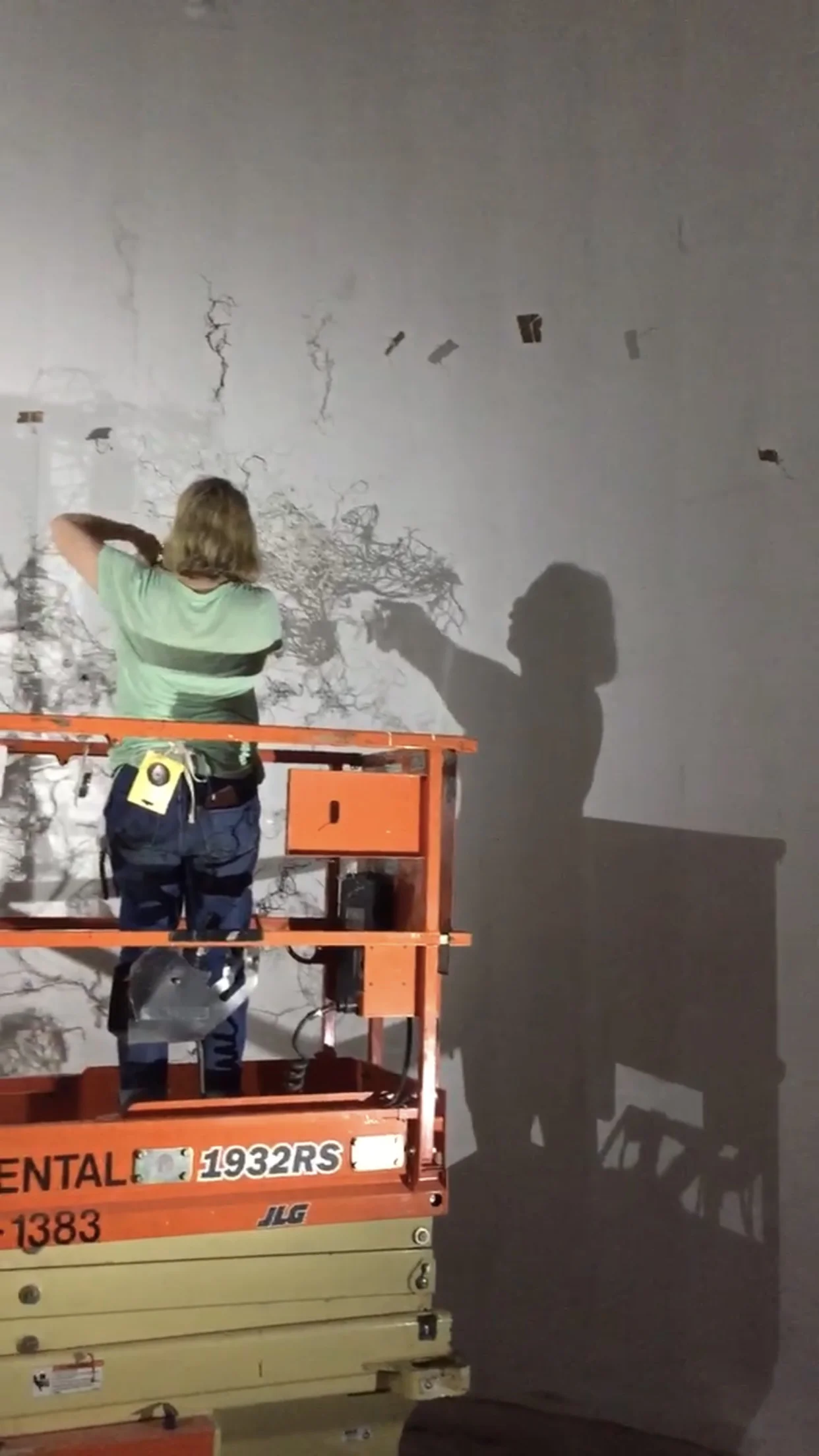
Once the support structure was in place, secure, and painted, it was time to install the work. First, I hung the two pieces I knew would be part of this work. I then looked at the way the shadows were falling on the concave surface of the wall and hung the two end pieces. It was then late in the day, and I decided to call it a day and decide what the next step was with fresh eyes in the morning.

The next day I showed up early in the day ready to sit, look and make changes that would be best for the work on the concave wall of a silo. I was excited to see the curator, Volker Eisele, in the parking lot when I arrived. I invited him to come take a look at my progress. 

Smiling he said, "You are done, it is finished." I was really happy that he was pleased, really happy. I was also surprised. Finishing this early was not my game plan. Yikes! It isn’t easy for me to mentally change my game plan. I think Volker could see this in my face, and as he walked away, he said, "You know my name is on this too, it is good." I completely understood and reminded myself how lucky I was that he liked it.

A good problem.🙂

ps. I now have the equivalent of another silo full of work in my studio………. bursting at the seems. Anyone need a keystone animal environmental installation?

public.jpeg
public.jpeg

SITE Gallery- Sculpture Month Houston - Installing the work

This summer, I made 7 sections of kinetic sculptures, approximately 6’-10’ long X 36” in diameter, anticipating that I would not use all of them. Now that I am in the space and see what the light does on the convex wall, I think I will use 4 of my favorite sections and add 4 extra lines dropped for smaller pieces that will help integrate the 4 sections into one piece.

Experimenting with the placement of the light.

Experimenting with the placement of the light.

Experimenting with the shadows with the light in a convex wall.

Experimenting with the shadows with the light in a convex wall.

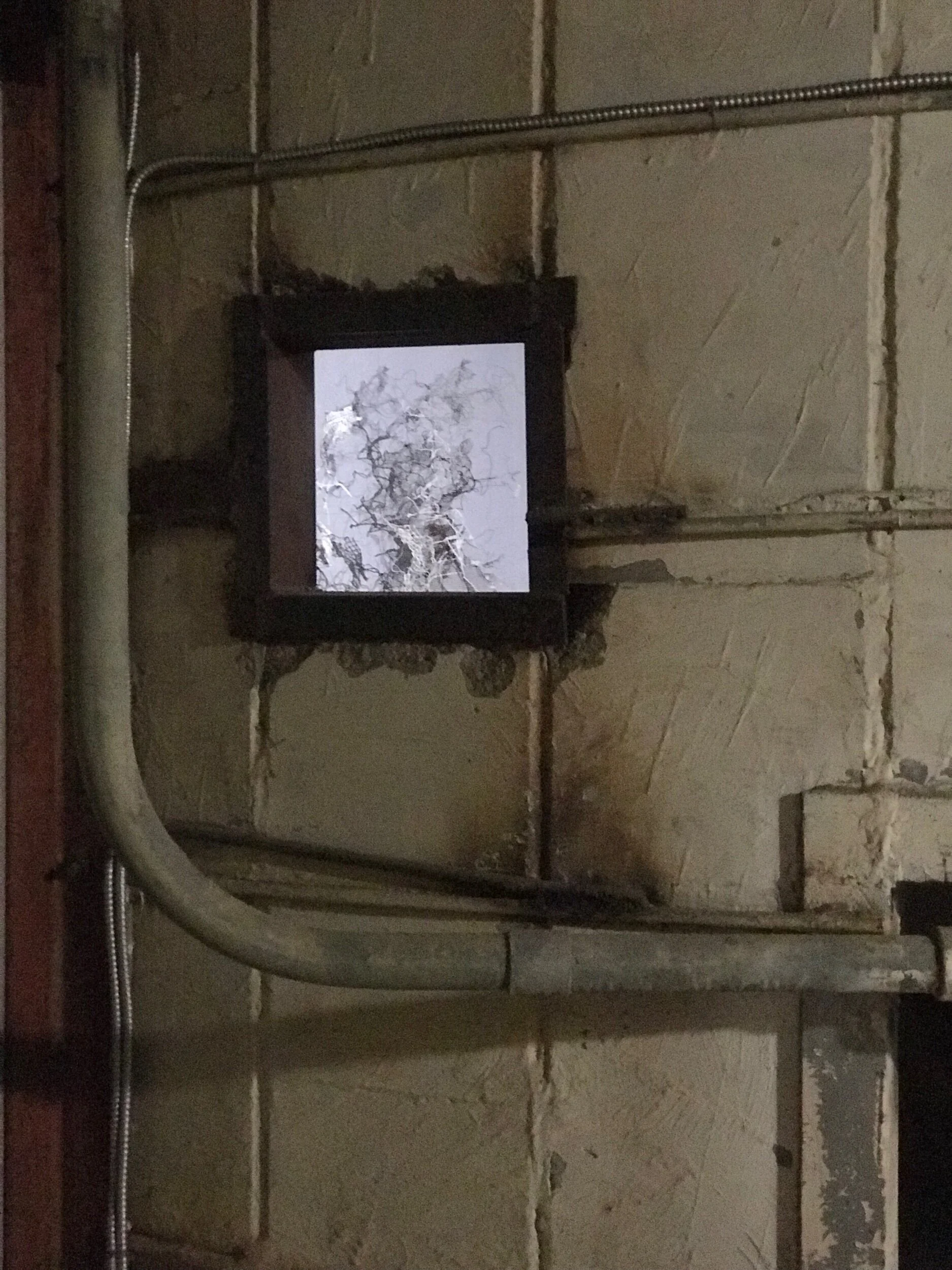
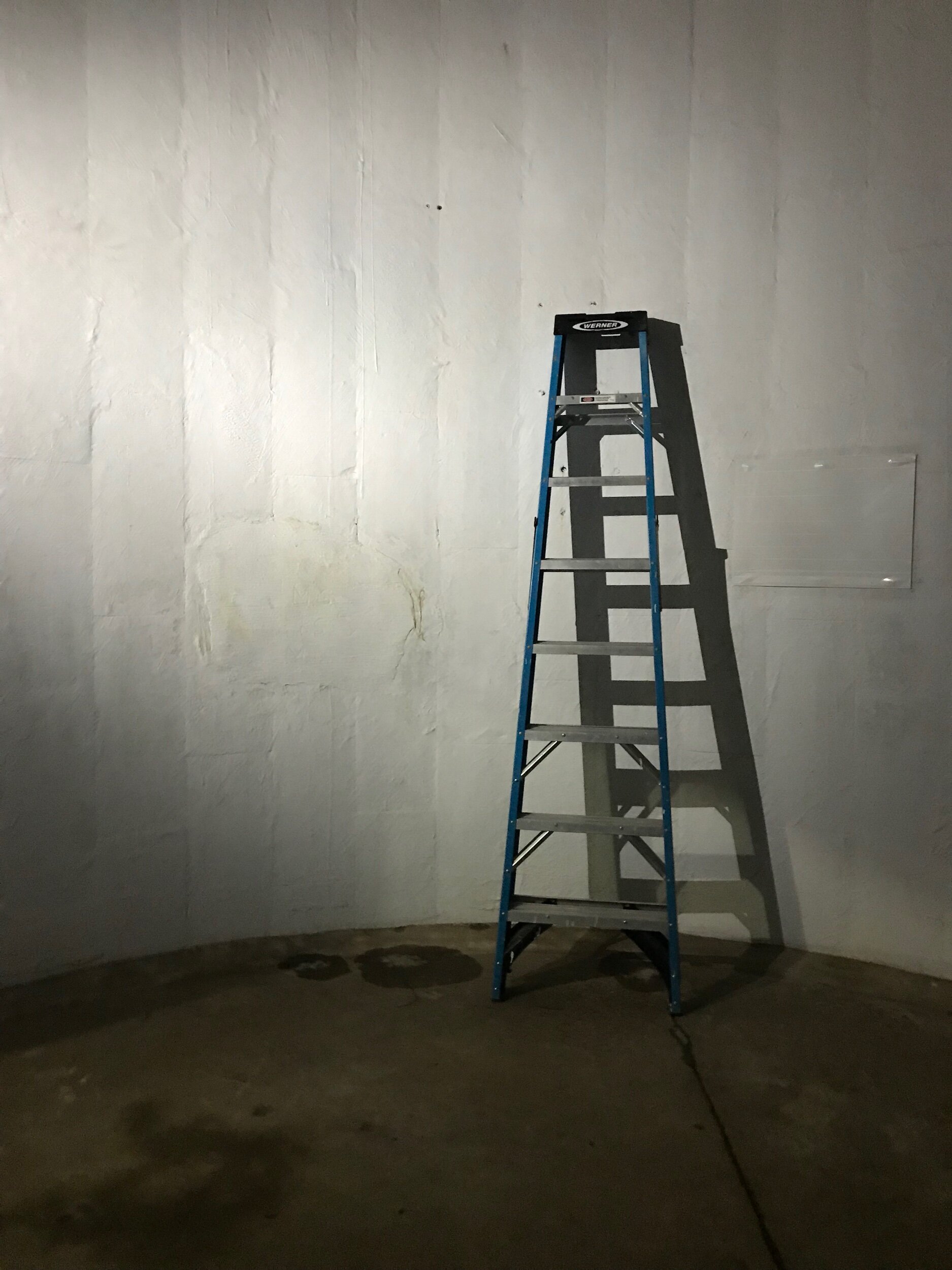
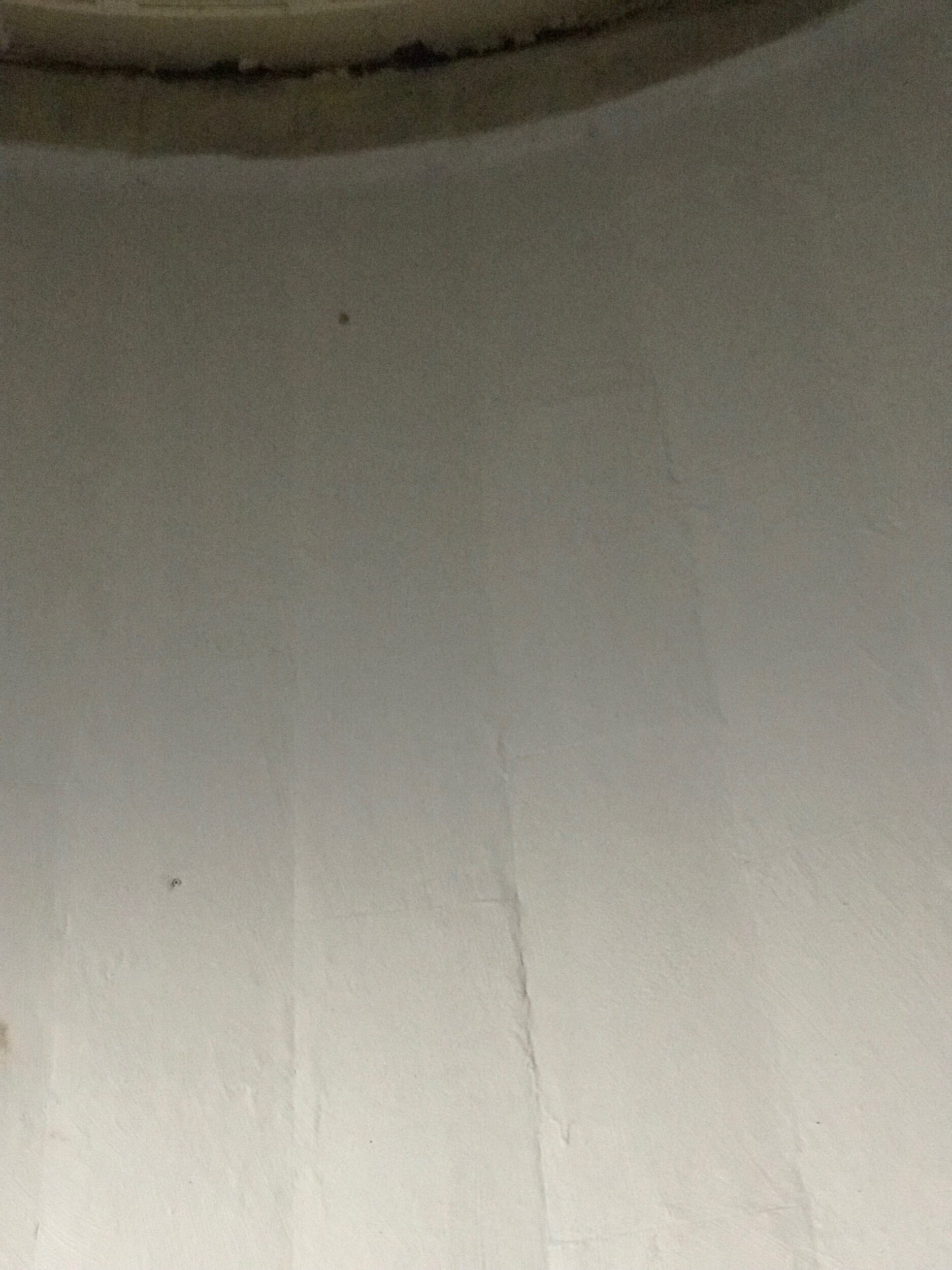
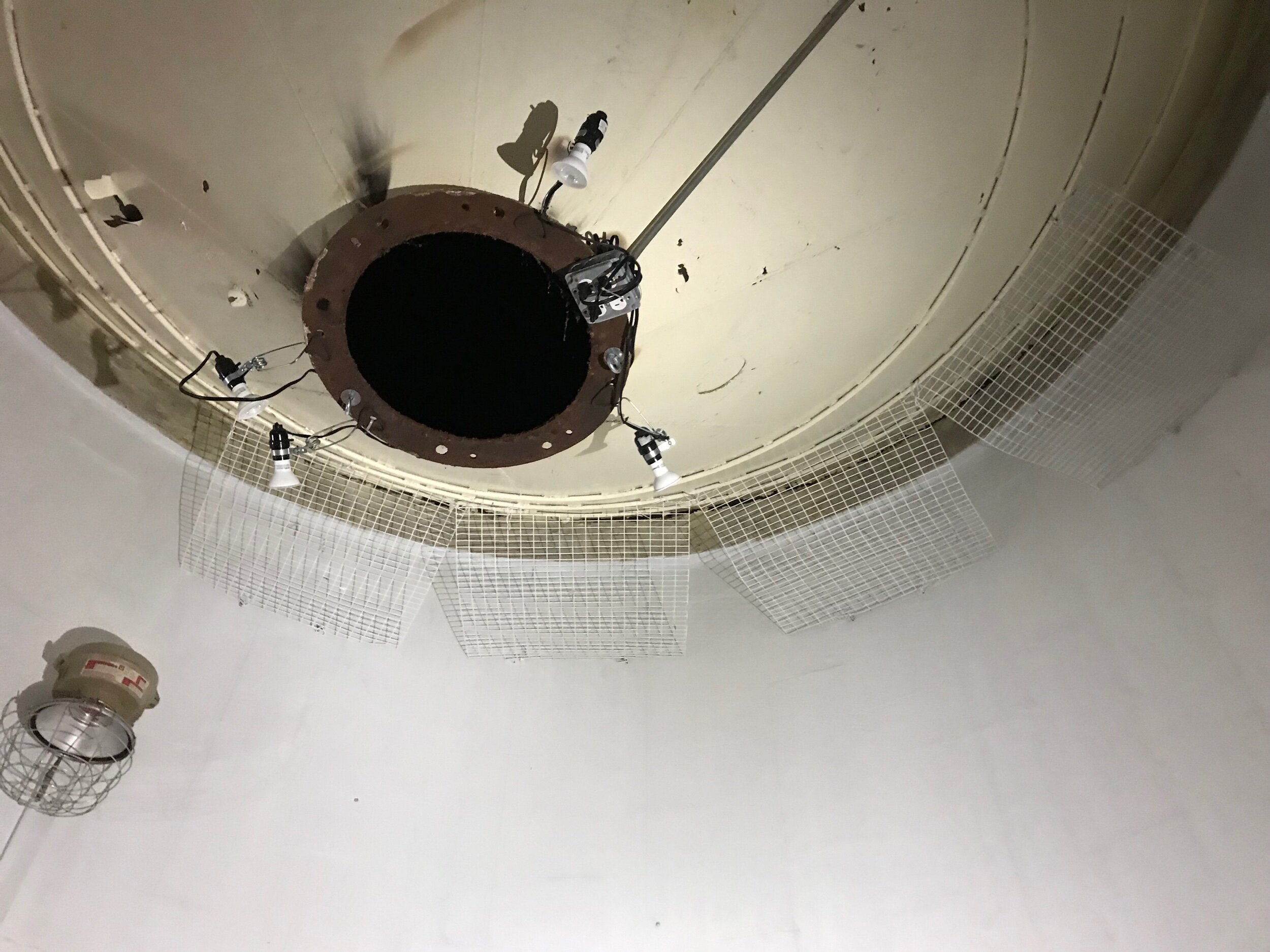
The walls are not "museum pristine", they show their age,  I am not bothered, it is a grain silo and I ❤️ It.

The walls are not "museum pristine", they show their age, I am not bothered, it is a grain silo and I ❤️ It.

SITE Gallery- Sculpture Month Houston - Building the support system

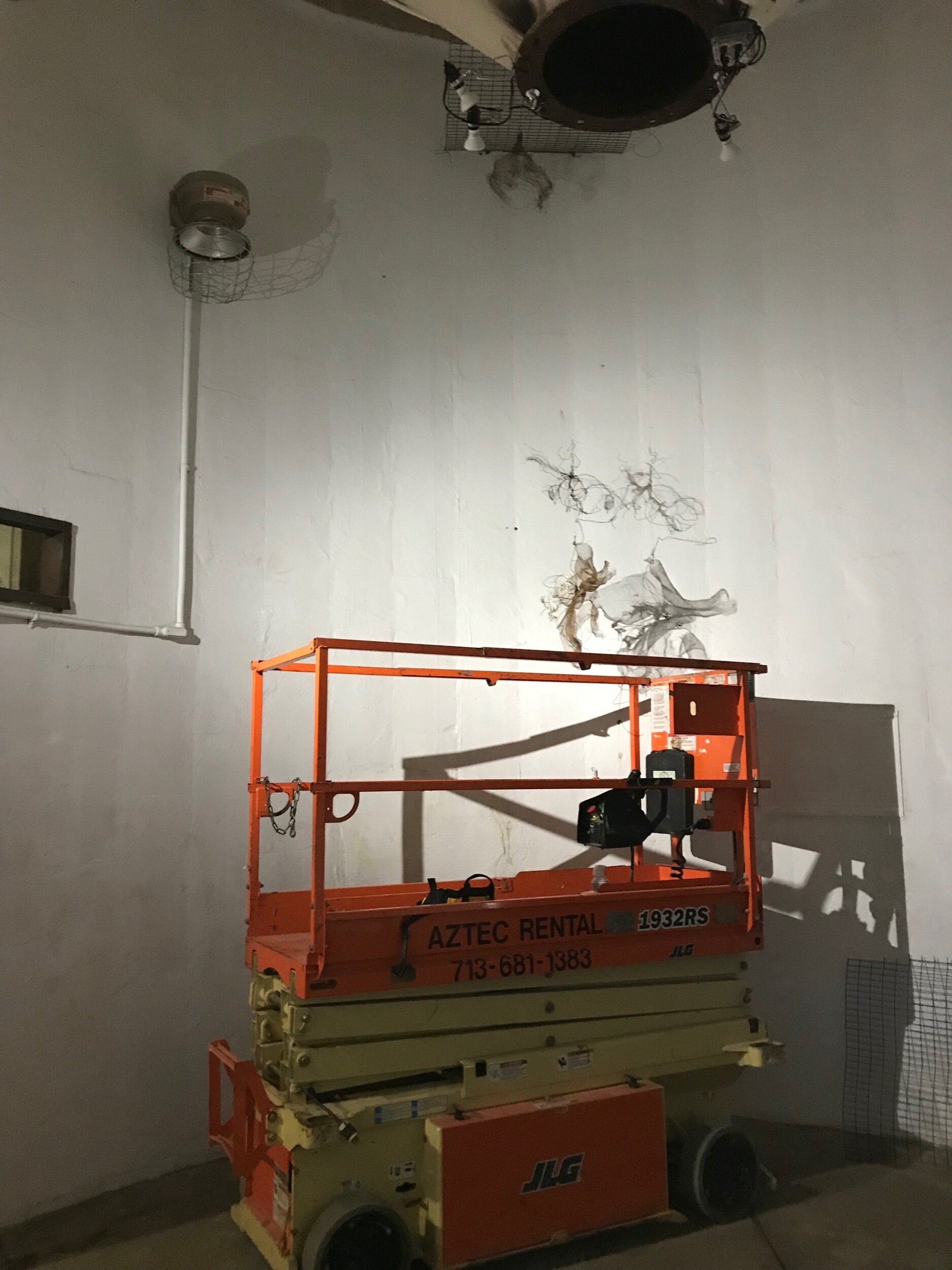
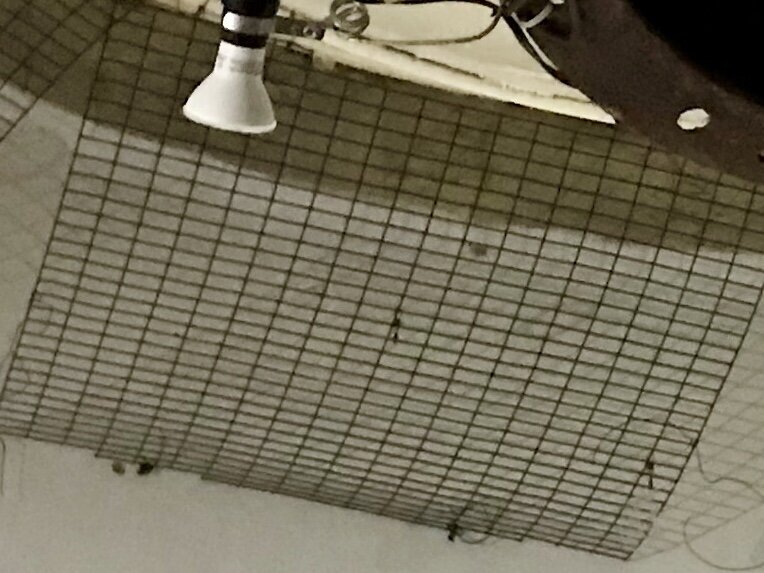
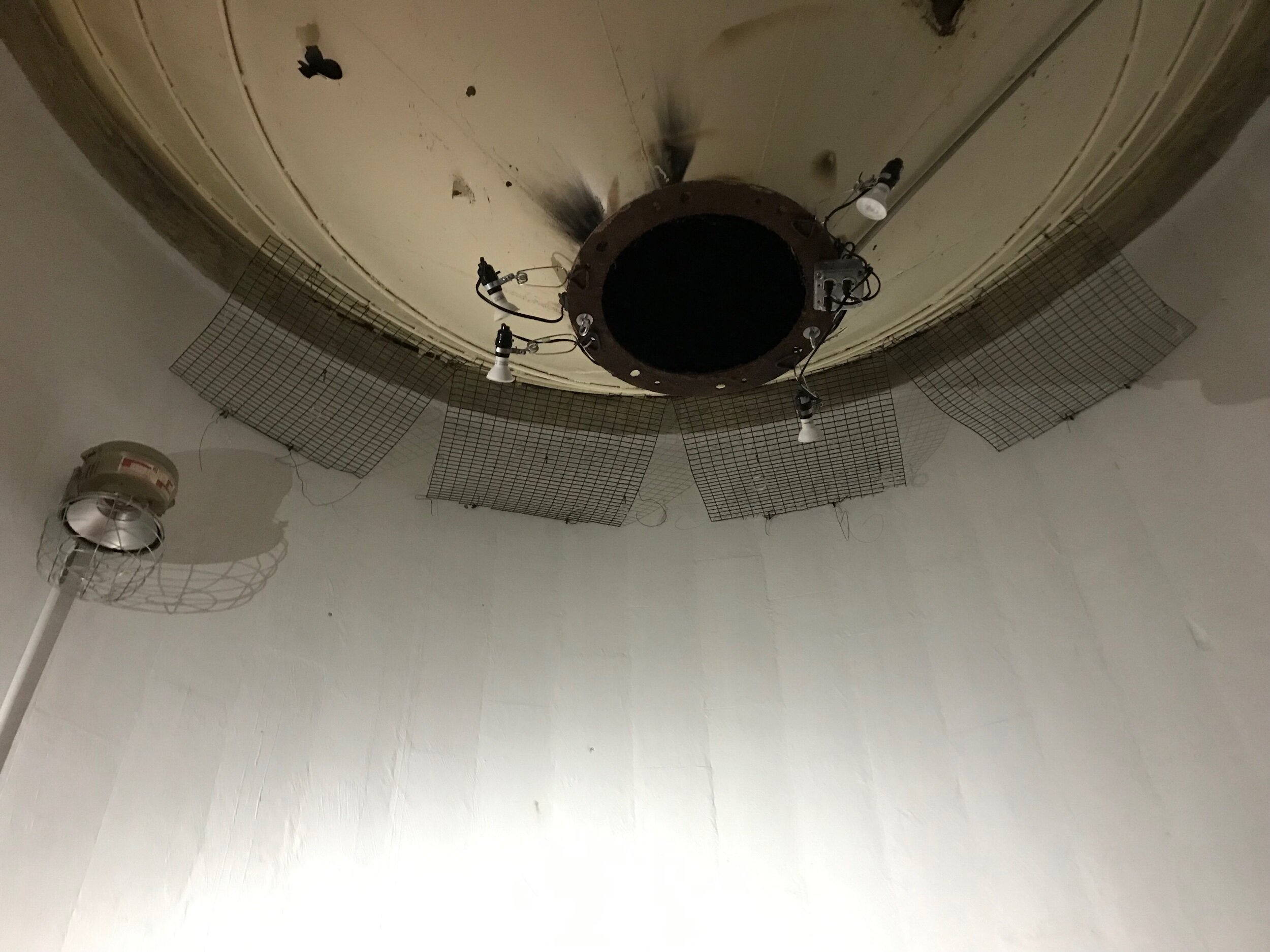
Finally, I feel like I can make some progress. Step one is to make a structure that I can hang my sculptures from. The gallery owners are trying to preserve the space in its original condition, and ask the artists to deface the silo as little as possible when installing our work. Normally I use acrylic hangers that I designed to hold the pieces. Each bracket takes four anchors. I feel like that is too much destruction to the silo. Instead, I decide to buy some black 14 gauge wire fencing, 20 feet X 36”. The silo funnel has metal bands tack welded to it. The middle metal band is 31” from the wall. I cut the fencing in 31” pieces. I cut one end in a concave shape and the other end convex. The convex end will rest on top of the metal band and the concave end will be supported by two screws in the cinderblock wall. This is 19‘ high, and I feel pretty good that my screw holes will only be minimally defacing the silo.

Close up of support system

Close up of support system

public.jpeg

The moment I got off the scissor lift and looked up at my support system, I realized I had made a big mistake. I should have painted them white. The black stood out too much on the white walls. I could not sleep that night trying to decide if I should repaint them... It was not easy, but I spent the next half day painting the system 19’ in the air white.

I think it was worth it, the support system is much less intrusive.

I think it was worth it, the support system is much less intrusive.

I hung from the support system 8 fishing tackle swivels with 25 lb filament attached to each swivel. Four of the swivels are 36” apart 18” from the wall. At these distances the pieces will not touch each other or the wall. Everything should move independently. These are for the big pieces. The other swivels are for smaller pieces and are spaced randomly. I am guesstimating where I want these. Tomorrow I will start hanging work.

Packing the hanging pieces for transporting to the silos.

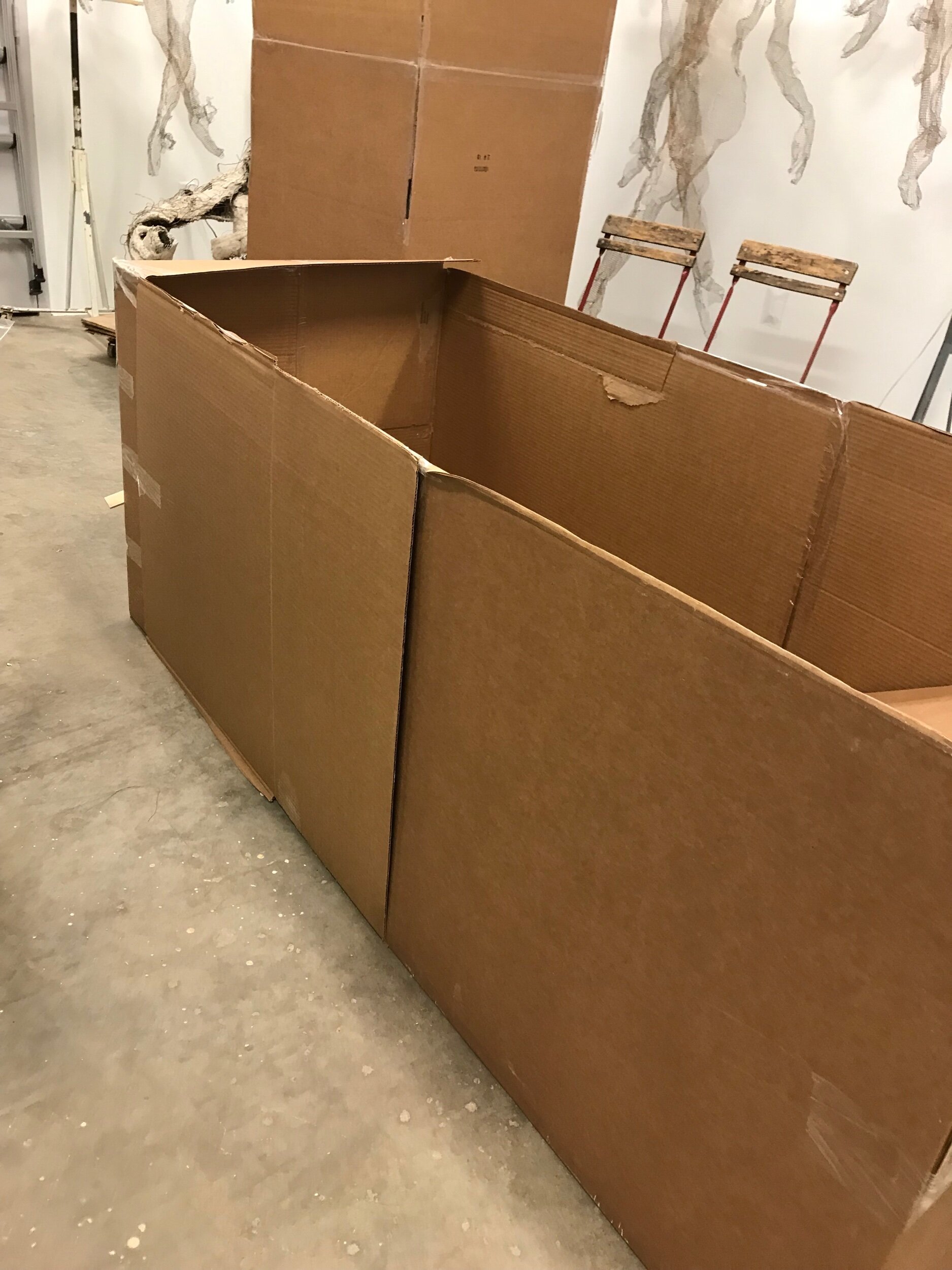
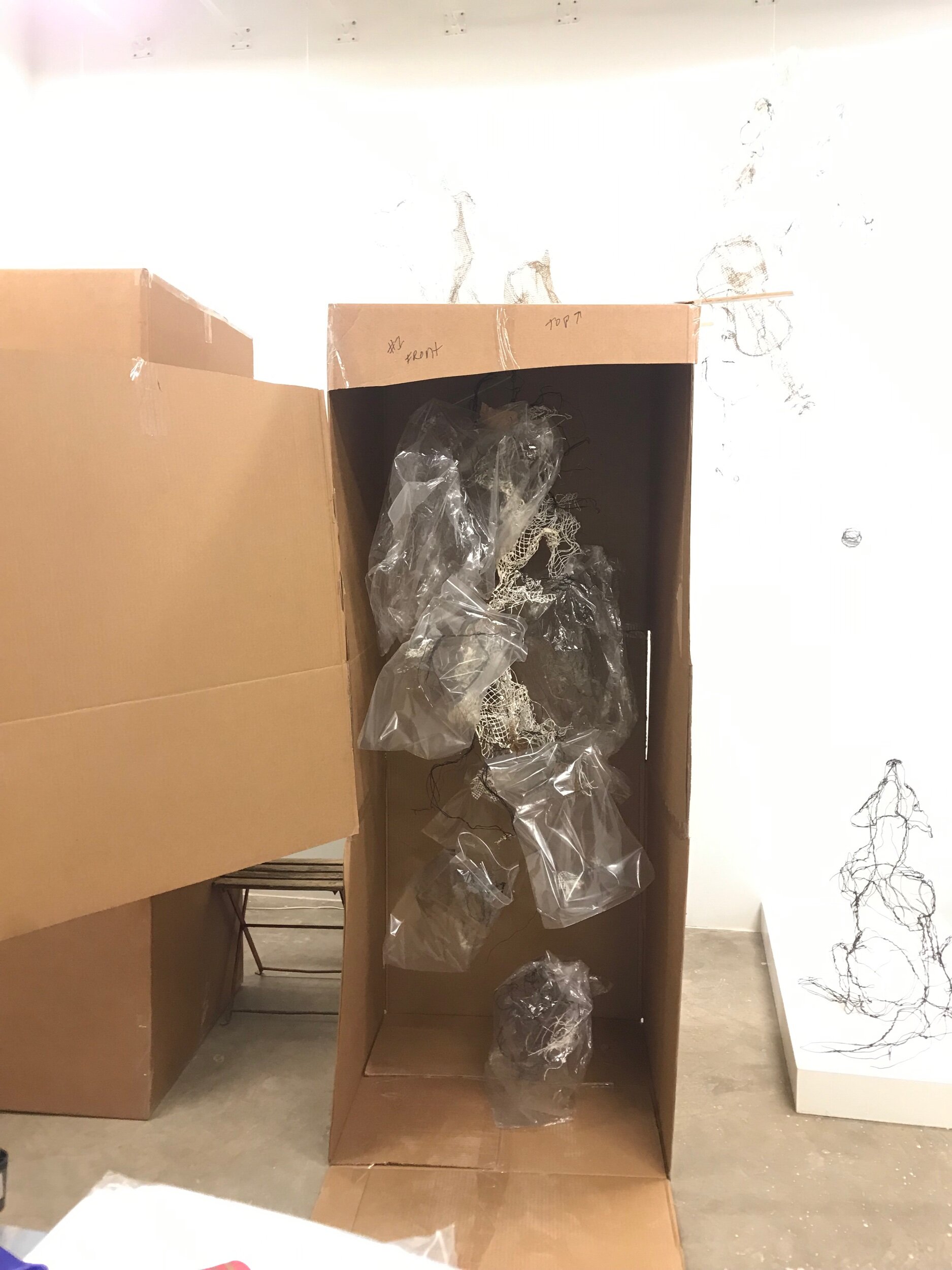
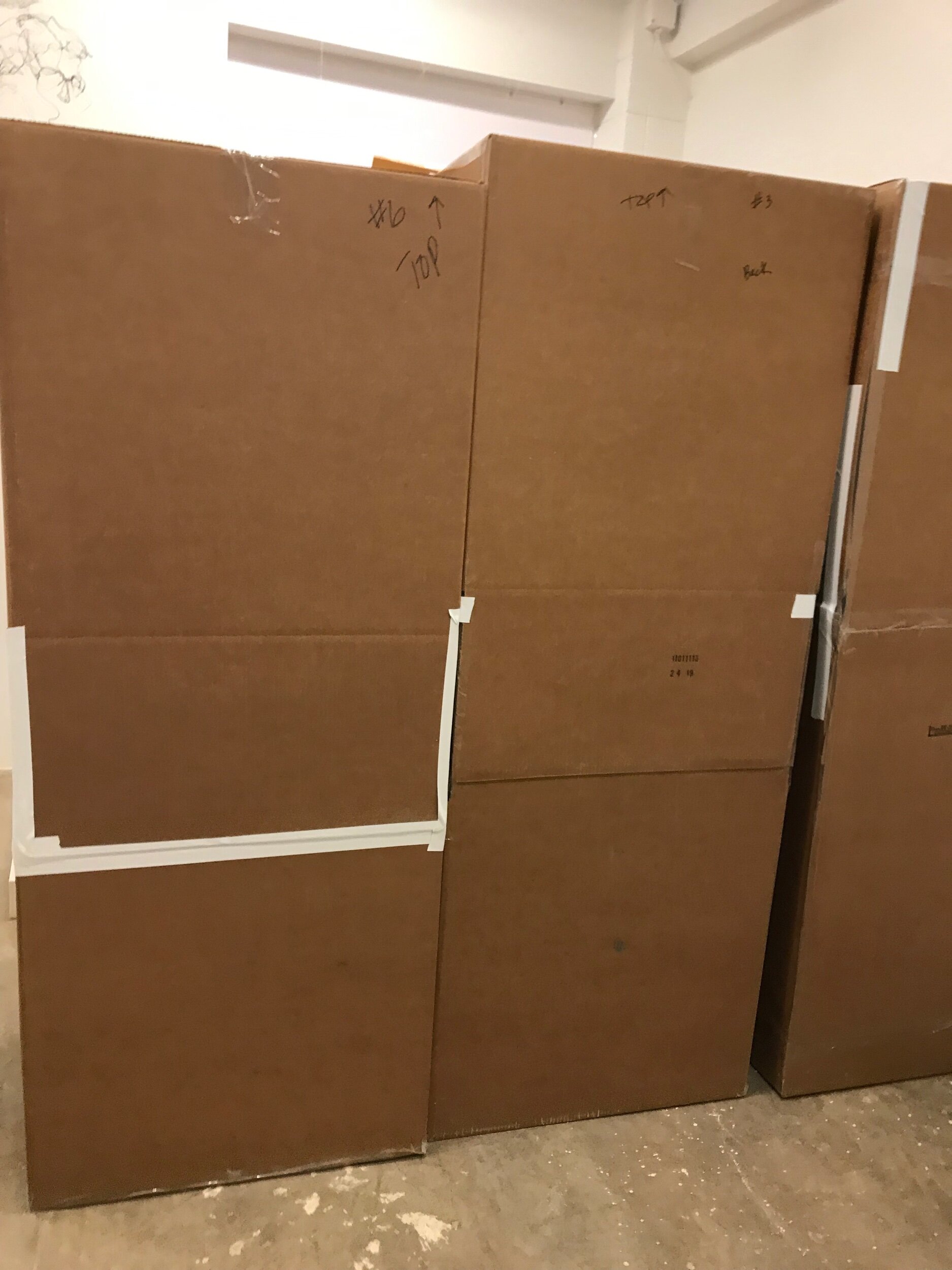
Last week I spent everyday packing and boxing the pieces I made this summer. I needed boxes they could hang in. Regular wardrobe boxes are not wide enough, so I made my own wardrobe style boxes to transport the sculpture pieces. I took two 30” X 30” X 30” boxes, stacked them and taped them to make them 78” tall.

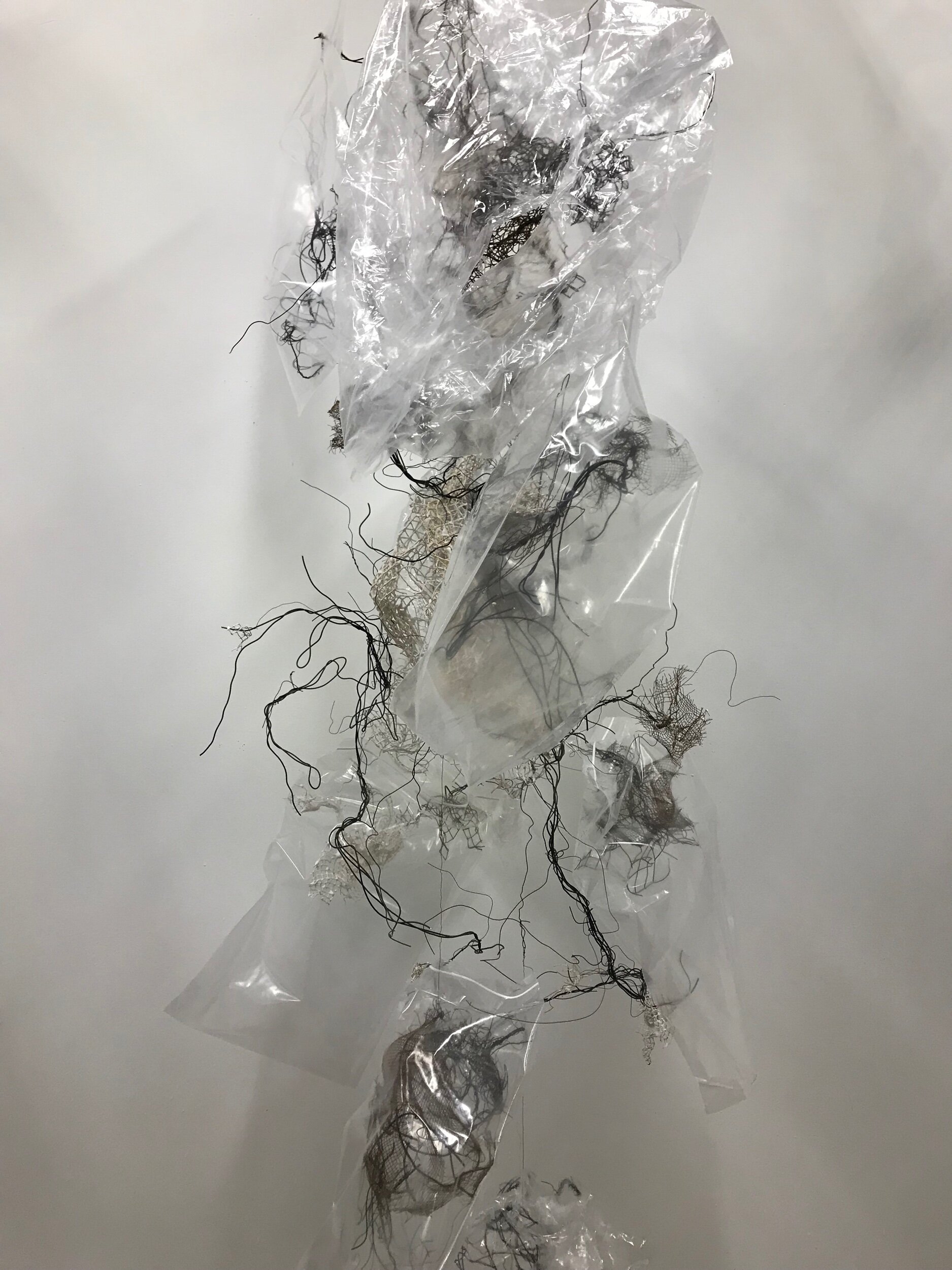
Then I wrapped each element of each piece in thin plastic dry cleaning bags and kitchen zip lock bags. I don’t want any thing getting tangled. Each little section is in its own plastic cocoon.

Each small element bagged separately making bouquet of bee cocoons

Each small element bagged separately making bouquet of bee cocoons

Making my own wardrobe style boxes.

Making my own wardrobe style boxes.

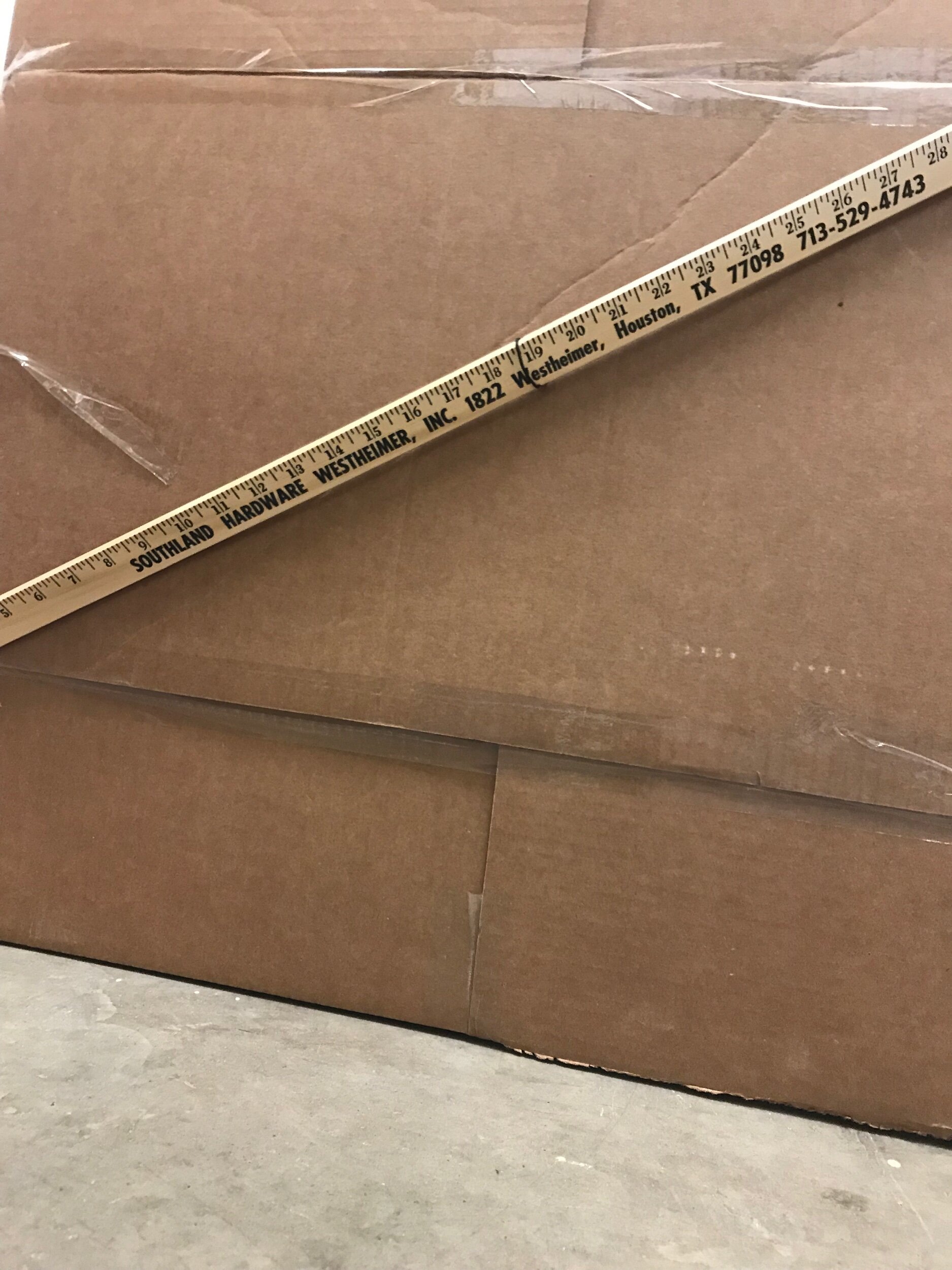
My pieces hang from the top of the boxes. I needed something to support the top of the box. Southland hardware yard sticks were the cheapest thing I could find. I think they will work.

My pieces hang from the top of the boxes. I needed something to support the top of the box. Southland hardware yard sticks were the cheapest thing I could find. I think they will work.

My sculpture wardrobe boxes have doors.

My sculpture wardrobe boxes have doors.

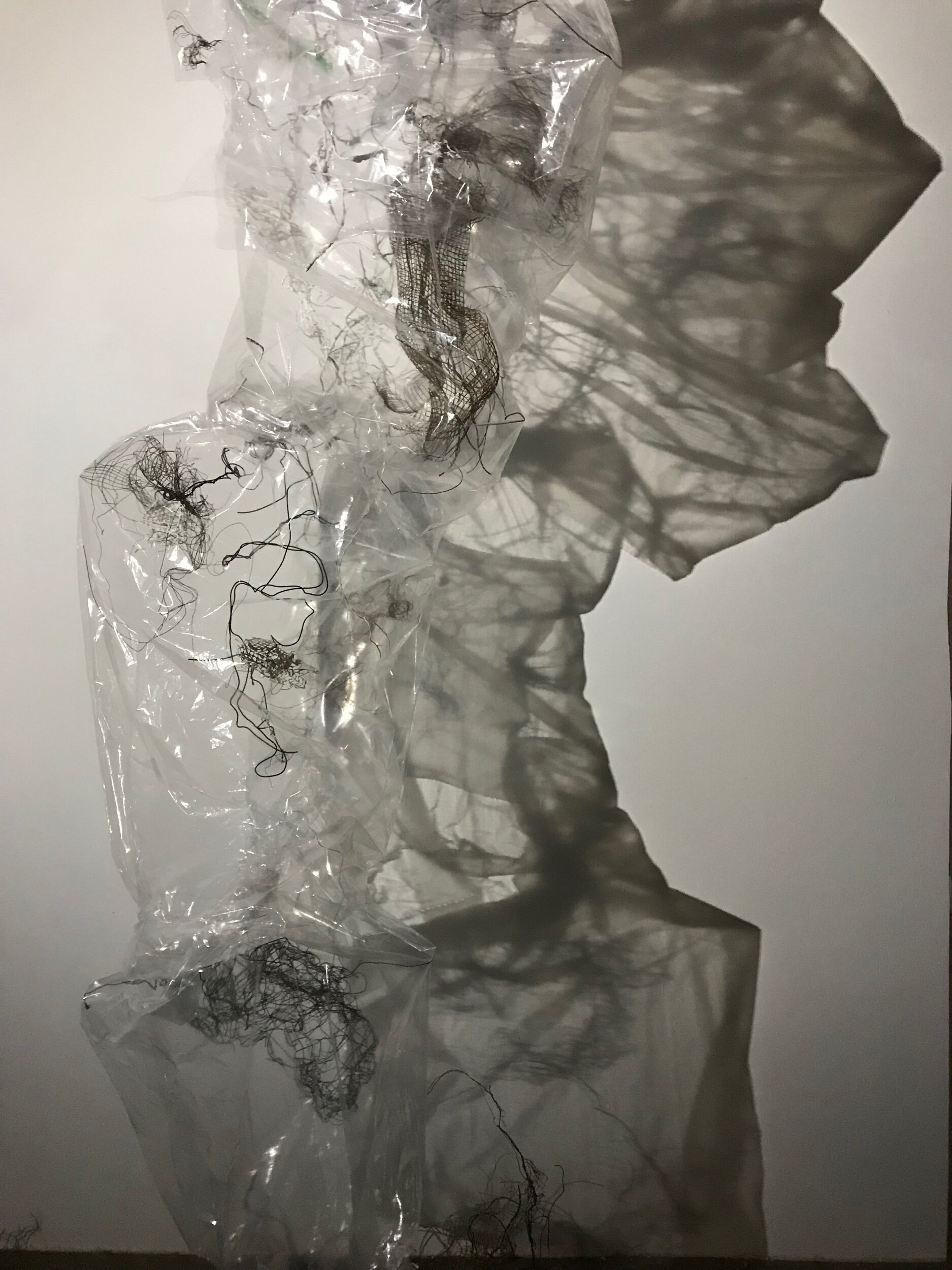
The pieces in bags make awesome amnion shadows

The pieces in bags make awesome amnion shadows

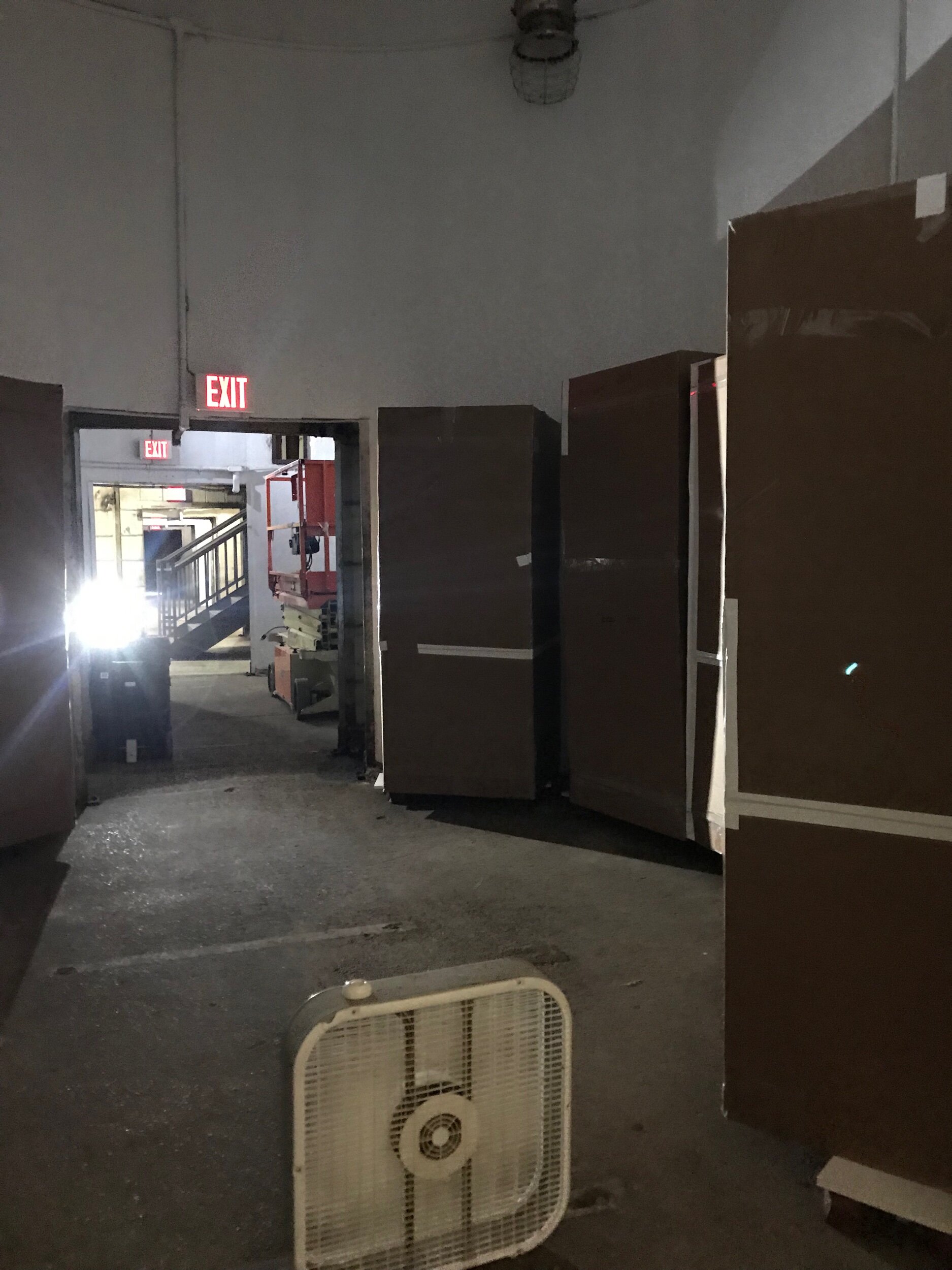
7 boxes ready to go.

7 boxes ready to go.

public.jpeg