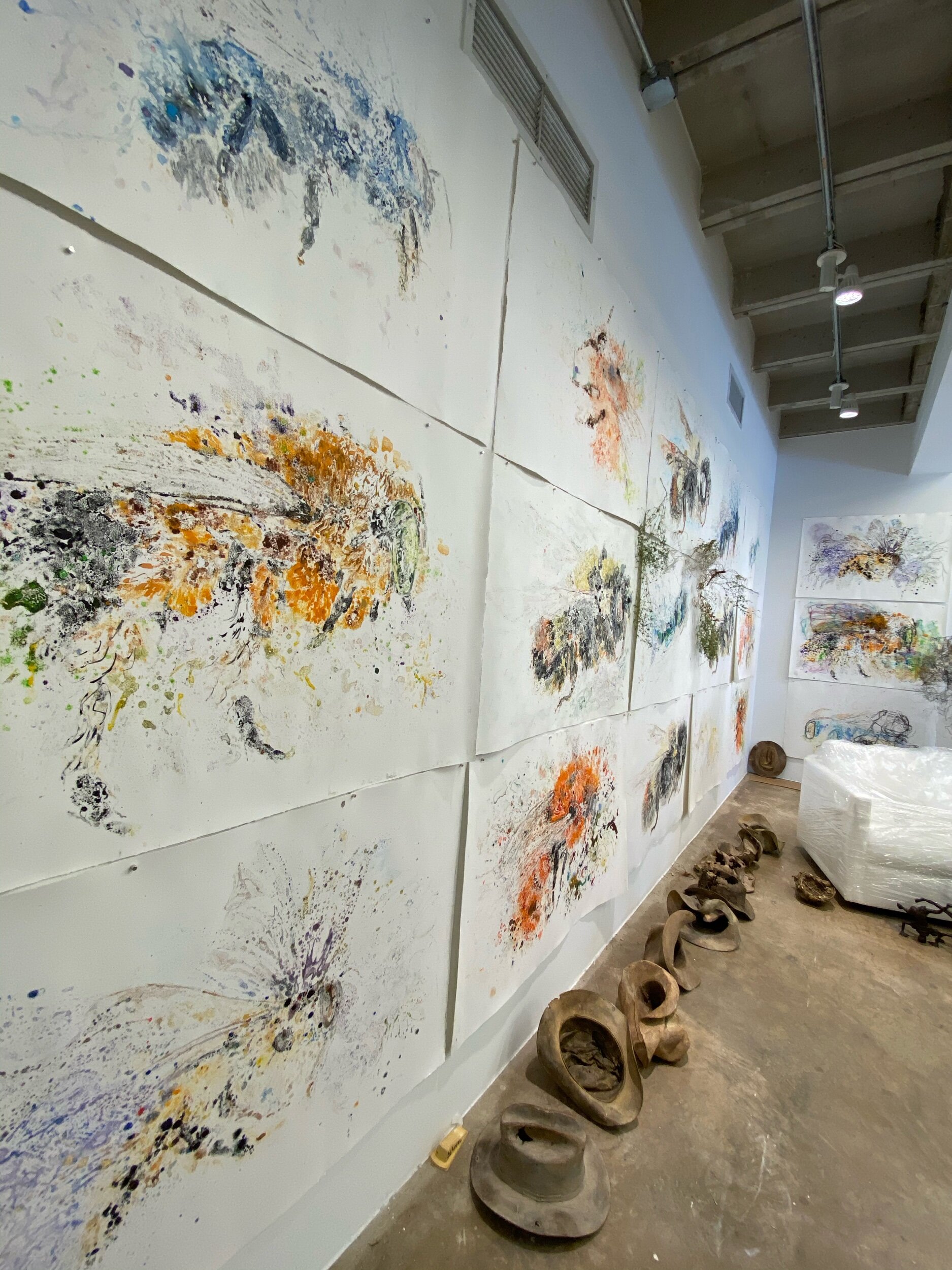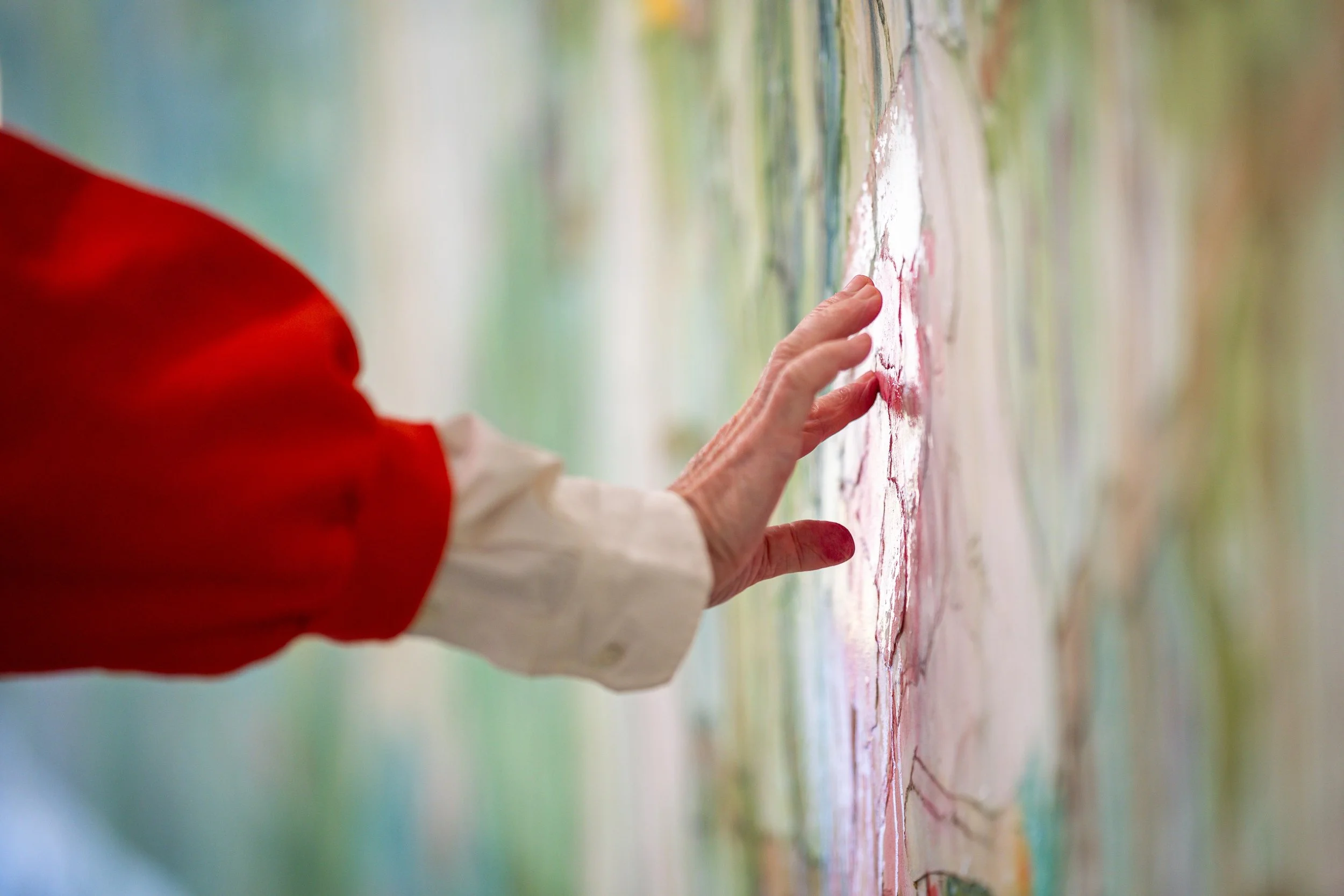
THE DAY THE WIND DREW

An Introduction

Some invitations arrive like weather — unexpected, and carrying something with them.

When Holly Josey reached out asking if I would curate her exhibition for FotoFest, I said yes before I fully understood why. That is, I think, the only honest way to say yes. You feel the pull of something before you can name it. You trust the tug.

What I did know was this: my own work has long been in conversation with the natural world. Gust, a body of work I’ve been developing for years, is rooted in wind — in its invisibility, its insistence, the way it shapes everything it touches without ever being seen directly. So when Holly described pens suspended from tree branches, left to draw whatever the wind drew, something in me recognized it immediately. Not as a concept. As a kinship.

We began with a studio visit. She laid out everything — paintings, photographs, the tender evidence of a practice built on deep looking. What unfolded over those hours was something I’ve come to treasure in the work of curating: the slow revelation of an artist’s inner world. Holly’s relationship with the natural world isn’t borrowed or decorative. It is structural. It holds everything up.

Getting to know a new artist who listens this carefully to nature — who is willing to hand the pen to the wind and mean it — lifts something in me. It reminds me why I make work, why I say yes, why paying close attention is never wasted.

Saying yes, I’ve learned, is its own form of letting go.
THE DAY THE WIND DREW

Curator’s Statement

There are two questions underneath all of these works — what does it mean to let go? And what does nature already know? Holly Josey answers these questions with open hands.

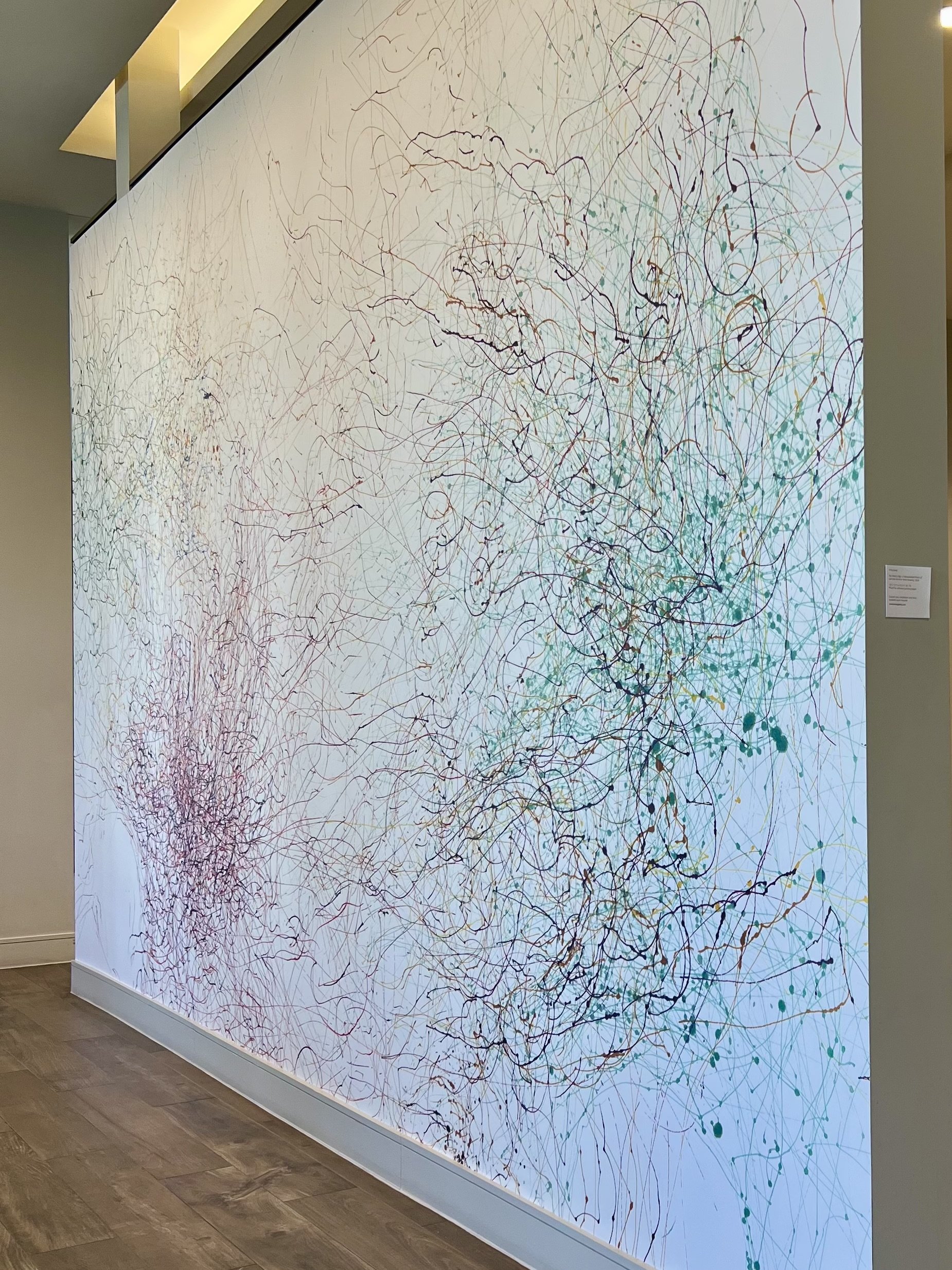
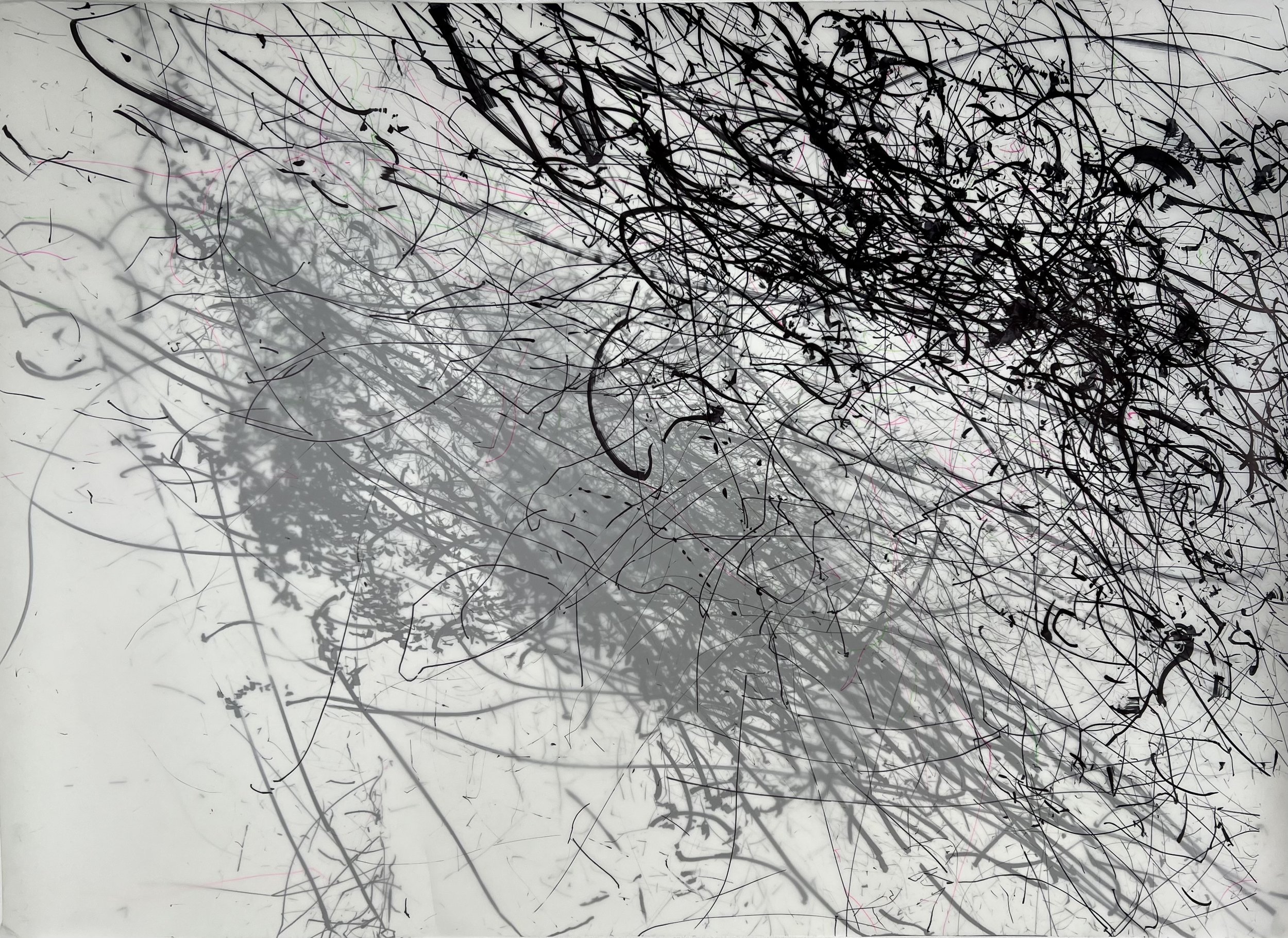
Holly Josey’s exhibition The Day the Wind Drew began with a simple act: pens suspended from tree branches, left to move however the wind moved them. Over hours and days, the marks accumulated — not chosen, not corrected, just received. The original work is intimate — 84 inches, on paper — but the wind is not intimate. It is vast, so the wind’s drawing was photographed and printed at monumental scale, filling a 10.5 by 18-foot wall. What remains is a kind of frozen breath, a single moment pulled from an endless series of compositions.

As a curator who works as both an eco-artist and a citizen scientist, I am drawn to what is happening in this work on a deeper level. We are living in a moment when it is dawning on us — slowly, and not without resistance — that the natural world’s intelligence has been unfolding since long before we arrived. The wind has its own logic. The tree has its own memory. Natural systems have been perceiving, connecting, and evolving for far longer than we have. To make art with them, rather than simply from or of them, feels urgent right now. It feels necessary.

It calls to mind something Marcel Duchamp understood a long time ago — that an artist does not have to be the one holding the brush at the final stroke. When his large glass work was damaged in transit, shattering into a web of cracks, Duchamp did not mourn it. He called it finally finished. The accident had completed it. Earlier still, he had let threads fall from a height and fixed their landing exactly as they landed — chance crystallized into form. He was making room for the world to collaborate.

Josey does the same, only her collaborators are alive. The tree. The wind. Time itself. These are not abstractions — they are presences in the room with you as you look. The erratic lines on her paper are evidence of a relationship, a conversation carried on without words between the viewer and the elements. This is what any artist or citizen scientist recognizes: that watching carefully, without forcing a conclusion, is itself a form of knowledge. That the most beautiful things happen at the fringes, in the borders, in the unexpected moments when you let go.

This is what connects everything in this exhibition. Not a style, not a medium, but a willingness to not know exactly what will happen — and to begin anyway. To stay open to risk. To let the work breathe. To learn, as natural systems have always learned, by paying close attention to what the world is already doing.

Cindee Travis Klement

www.cindeeklement.com
From Dusk to Dawn- Four works on paper
I wrote this post in 2025 and forgot to post it. Here it is —

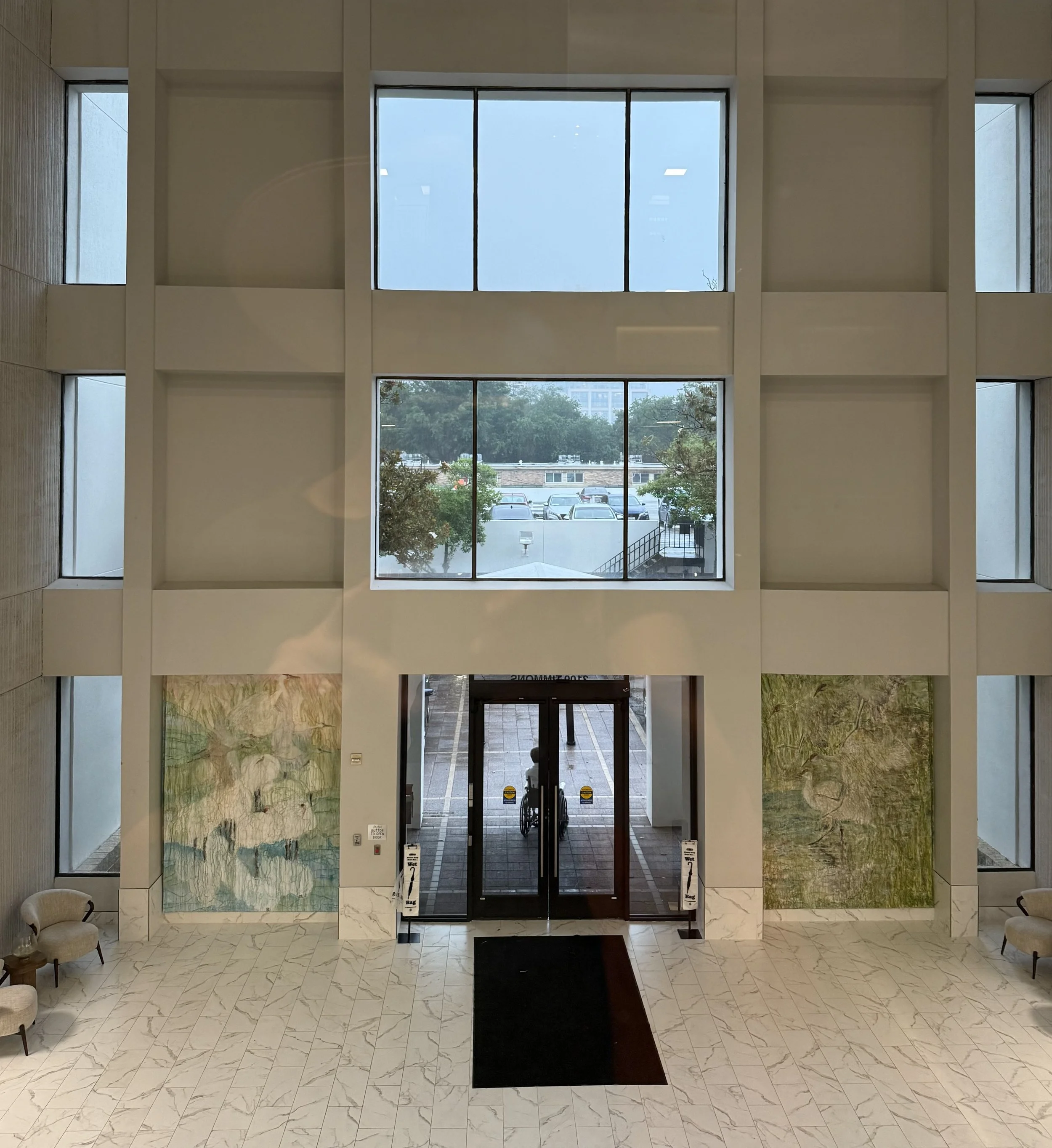
I was contacted to create two small artworks for an older office building in Houston, Texas, that is getting an updated look.

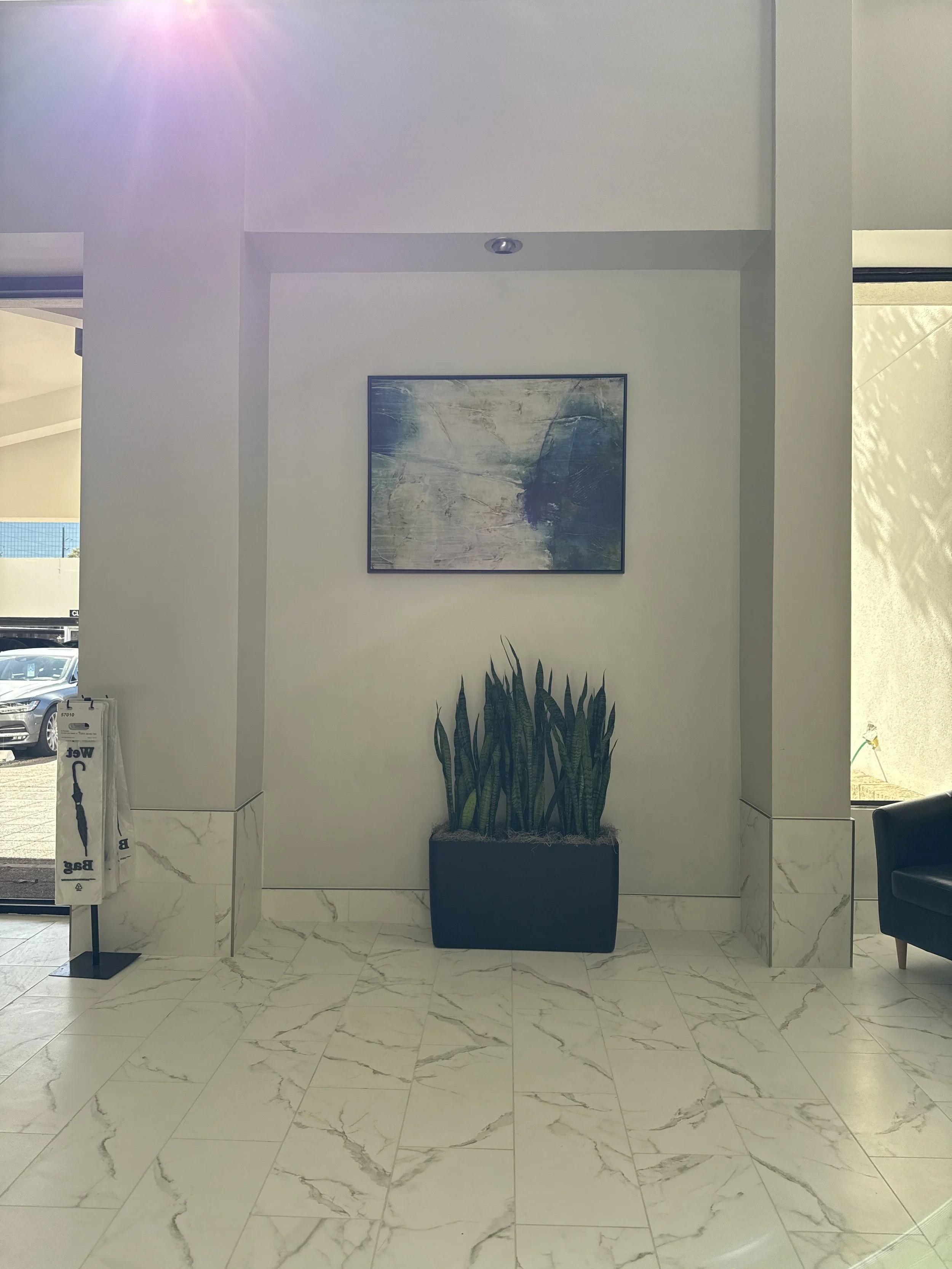
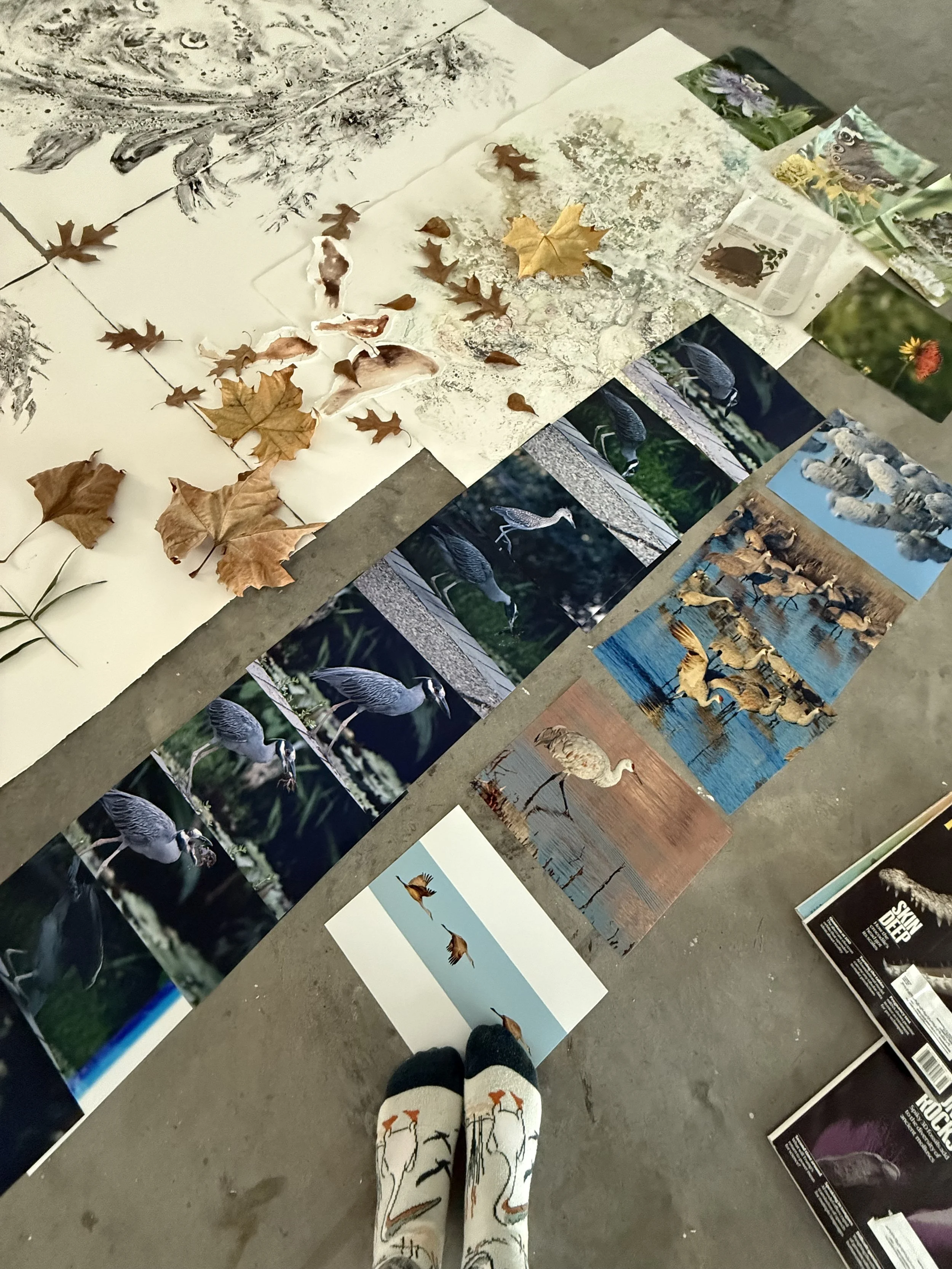
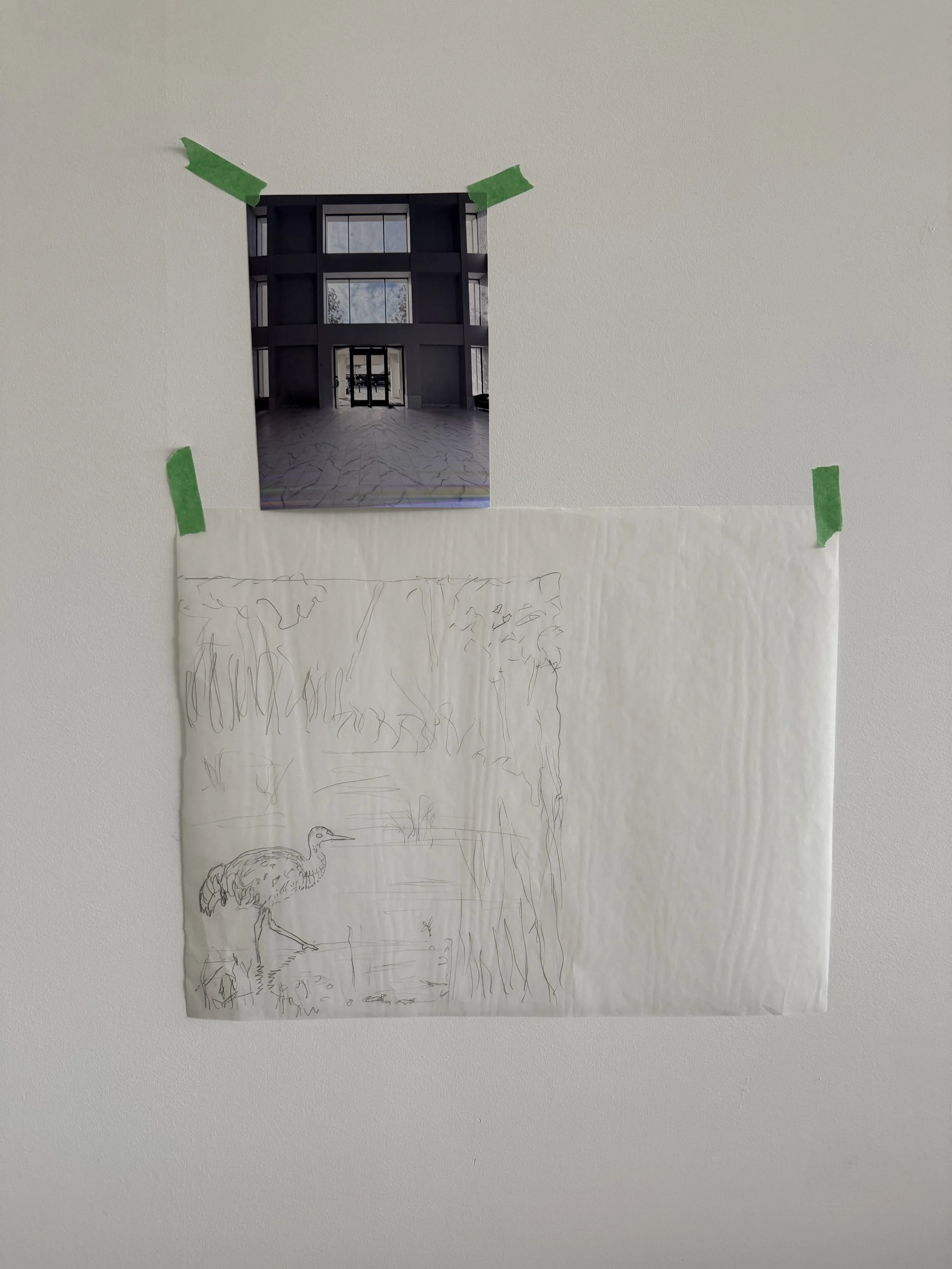
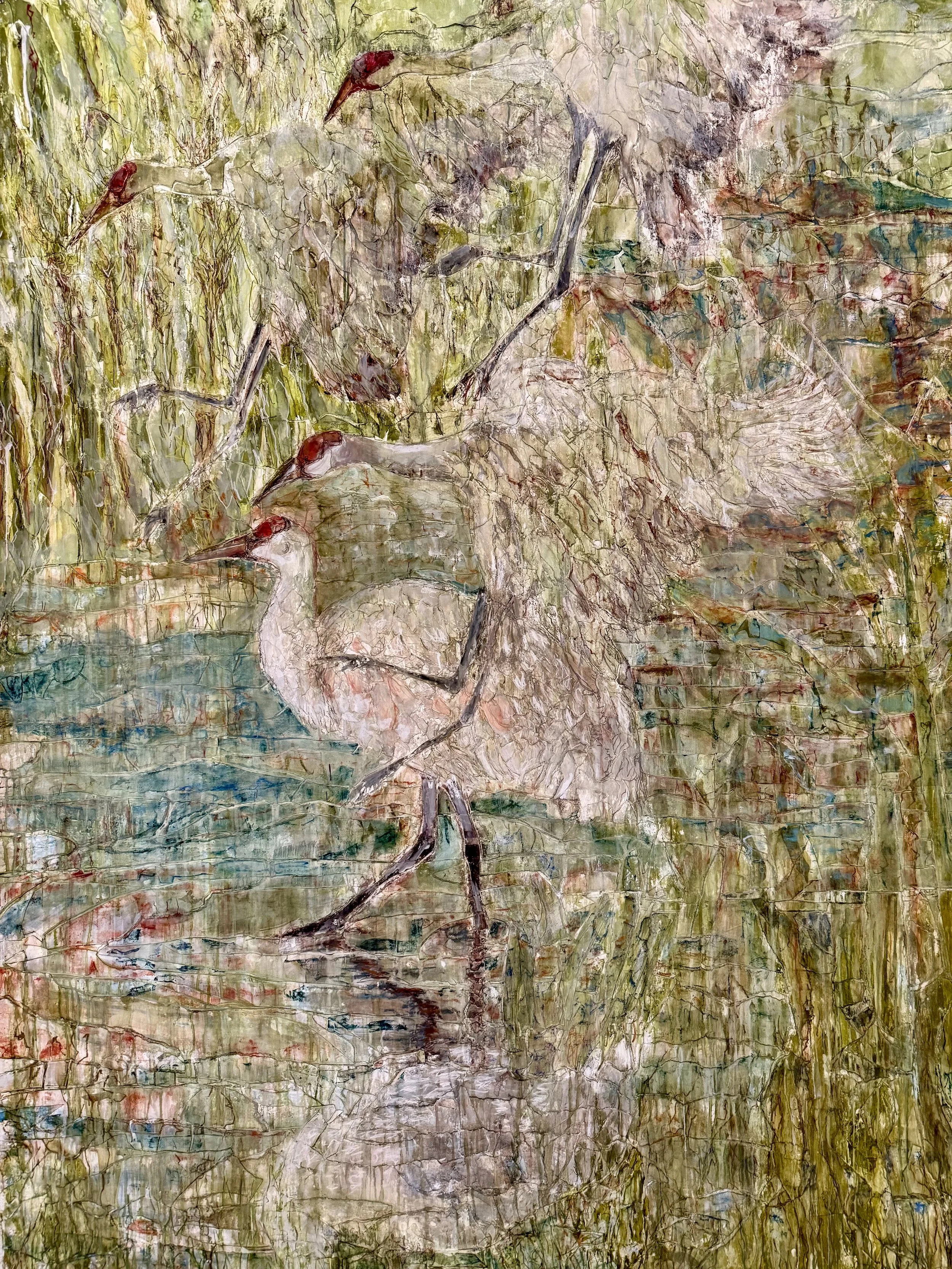
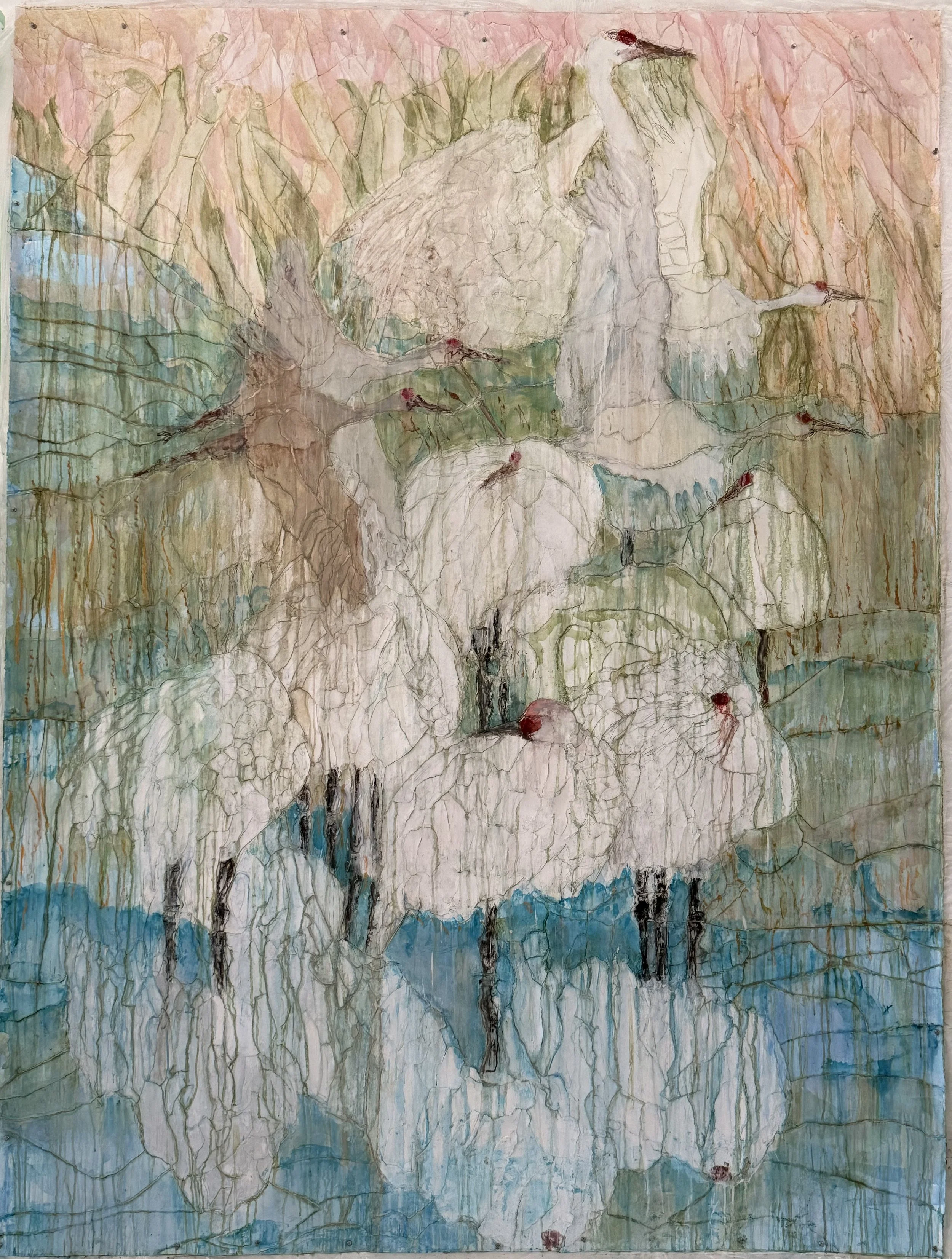
The building is at 3100 Timmons Ln. When I saw the space, I knew right away that it held great storytelling opportunities. I was particularly excited to tell the success story of the Sandhill cranes.

3100 Timmons Lane

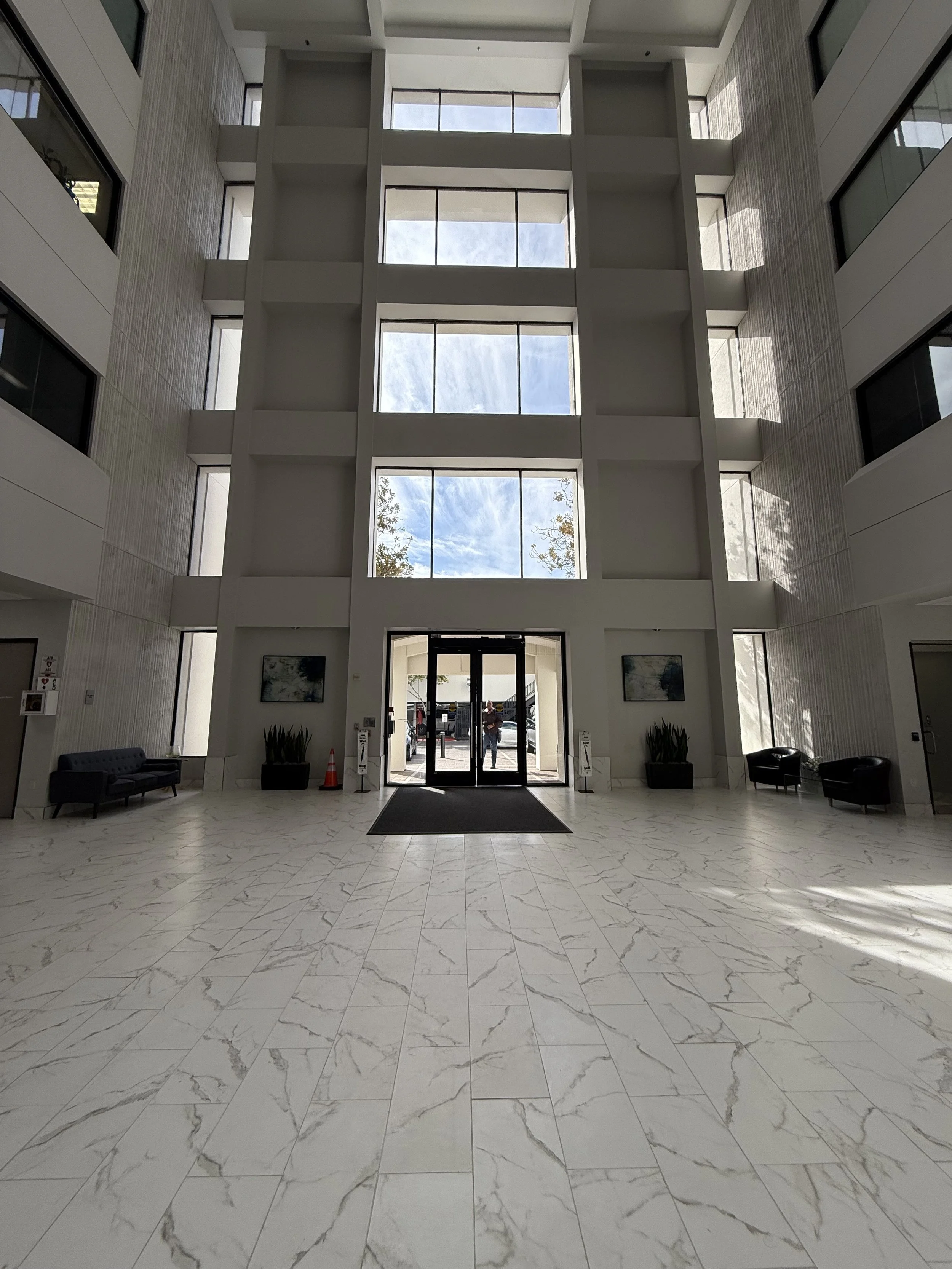
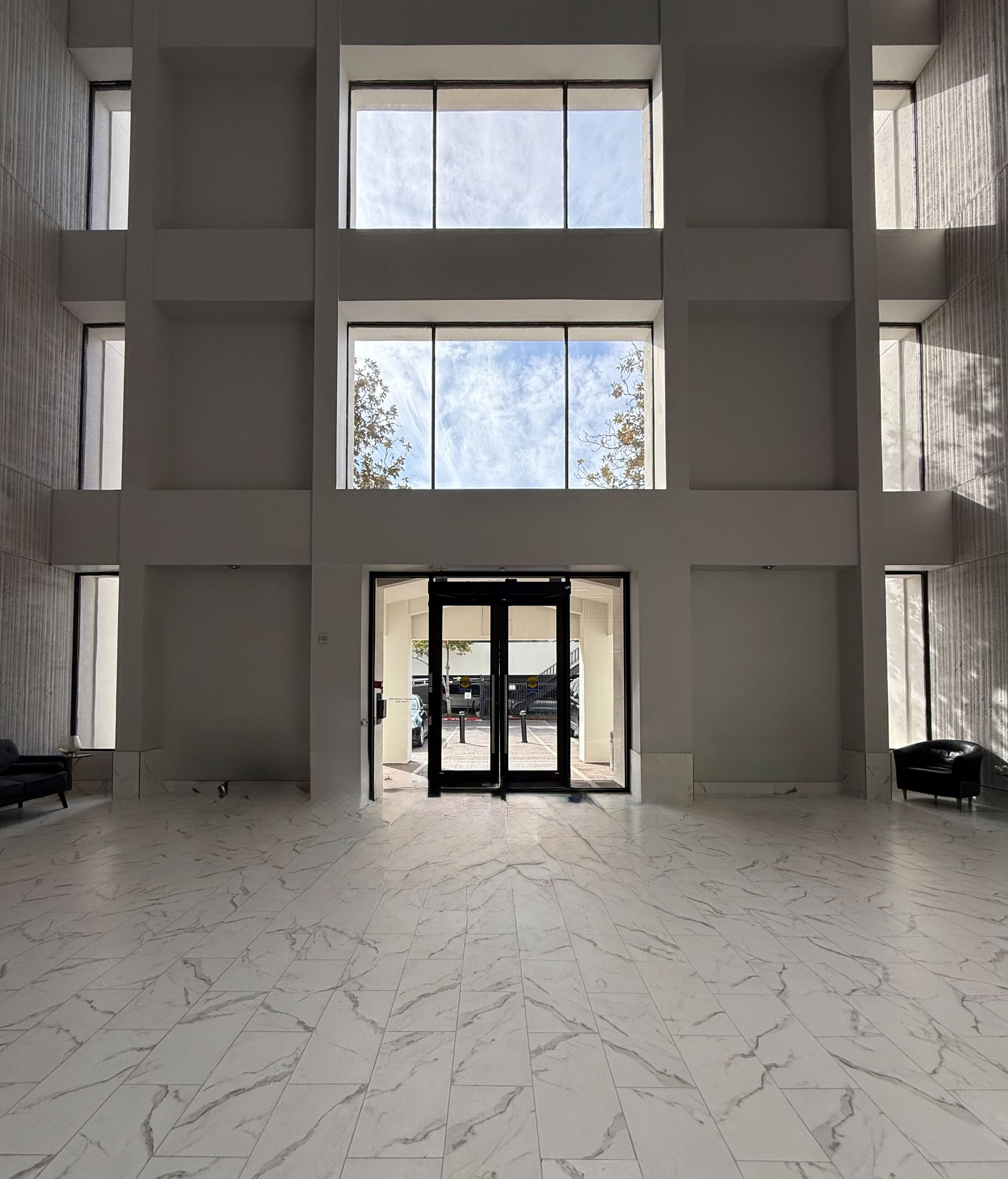
Specifically I was tasked with creating new pieces to replace the small decor elements flanking the entrance. However, after considering the entire space, I felt inspired to propose a different approach. The building features a stunning lobby with a grand, five-story ceiling, which presents a wonderful opportunity to enhance the buildings overall design more impactfully.

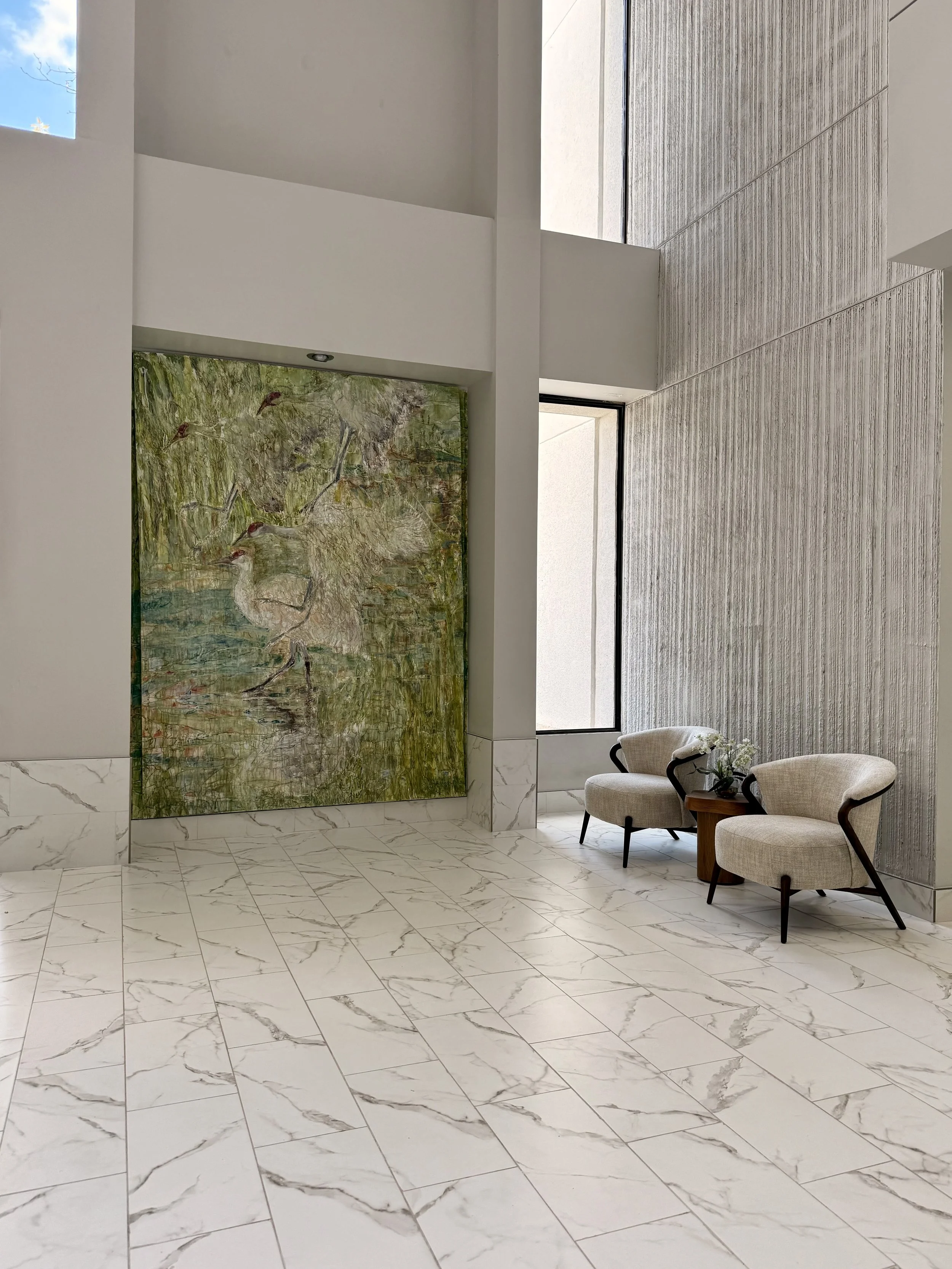
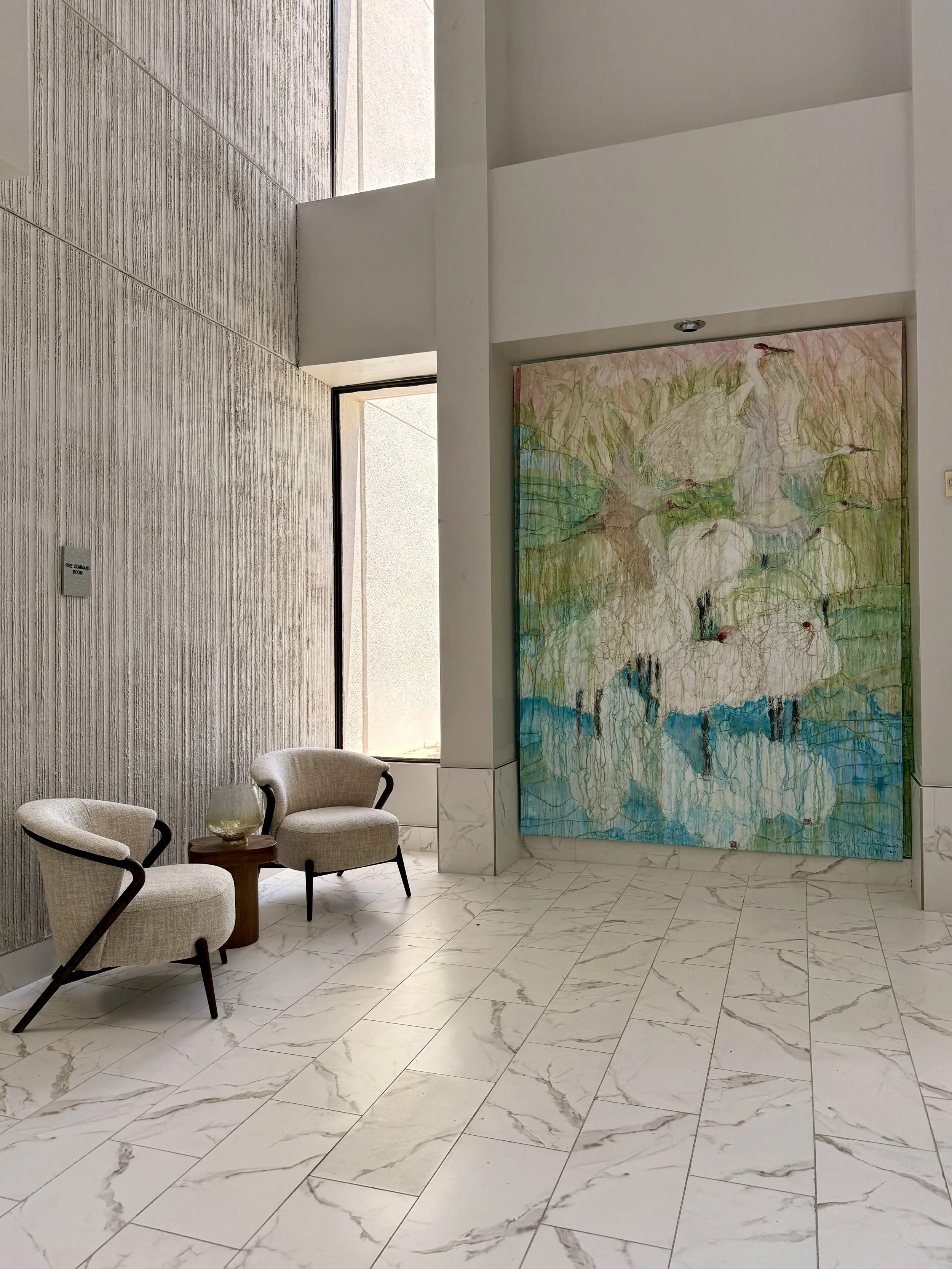
One of the 7’ X 9’ recessed spaces for artwork.

The lobby.

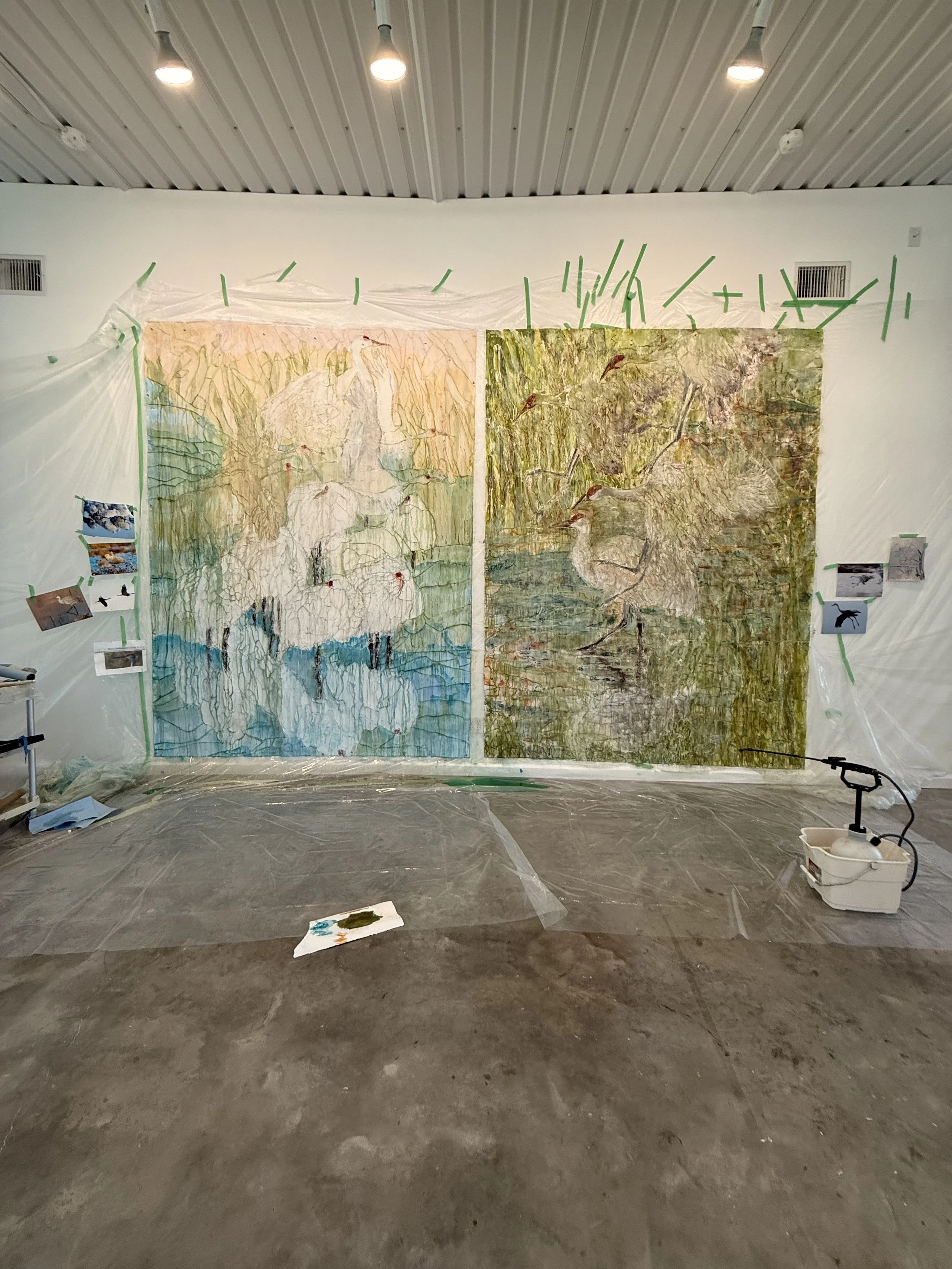
To fully enhance the impressive ceiling height, the artwork in this space must be substantial and impactful. Smaller pieces will be overlooked in such an expansive setting. I suggested introducing large, vertical artworks that could significantly alter the atmosphere of the room. I suggested that the pieces could effectively integrate the beauty of the outdoors into our indoor spaces. The developer resonated with this concept and proposed that I create designs that span two stories. This collaborative idea presents a fantastic opportunity to elevate the space and reach a new audience for my social practice. A few weeks later, I welcomed him to my studio to share my vision.
My presentation to the developer.

A early sketch

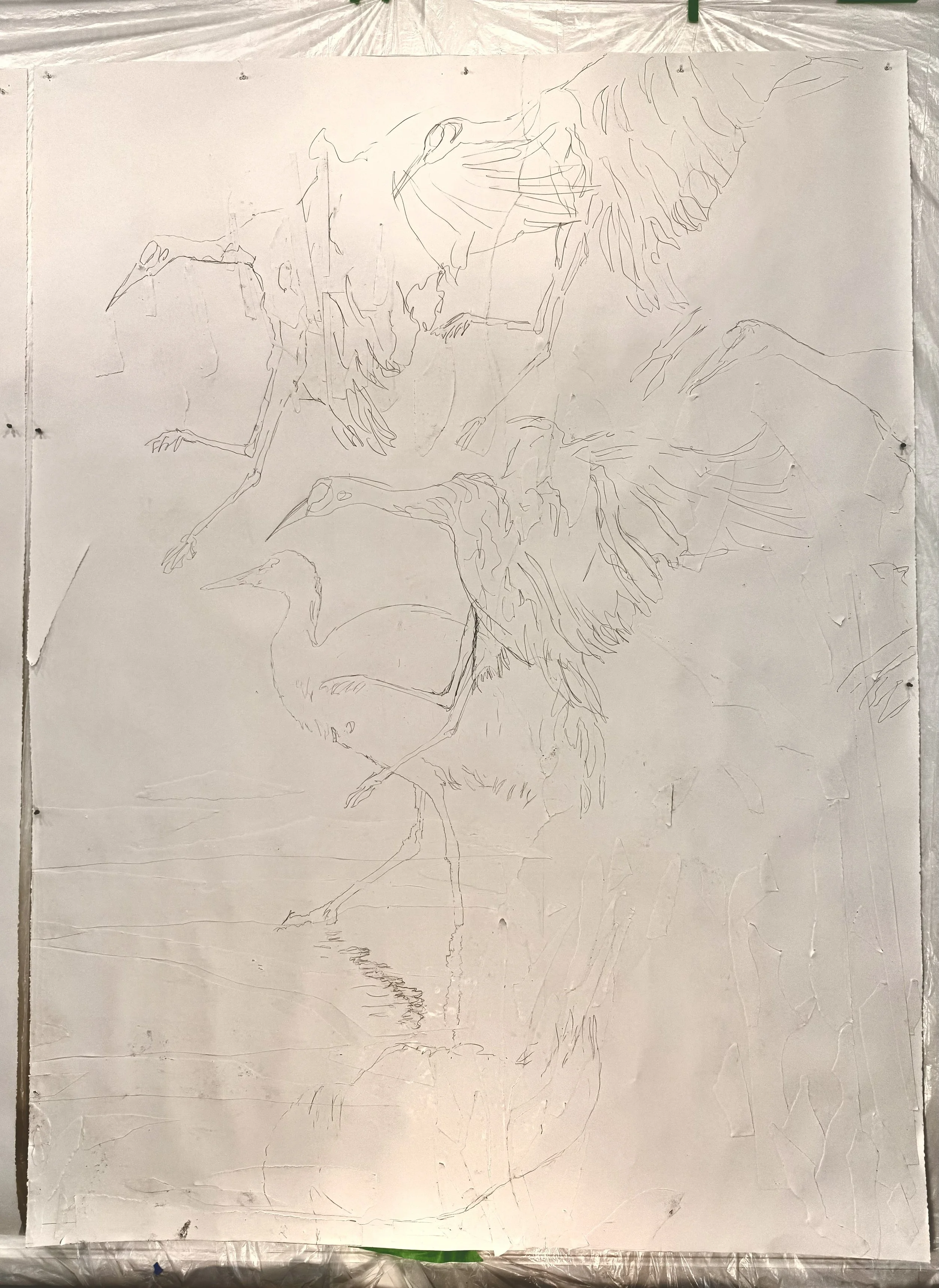
This is the final drawing of the first piece, which beautifully captures a crane landing in a wetland during twilight. The scene reflects the moment when the cranes wait for it to get dark enough that they aren't easily visible. My intention with this artwork is to encourage viewers to look closely and discover the subtle presence of the cranes in their environment.

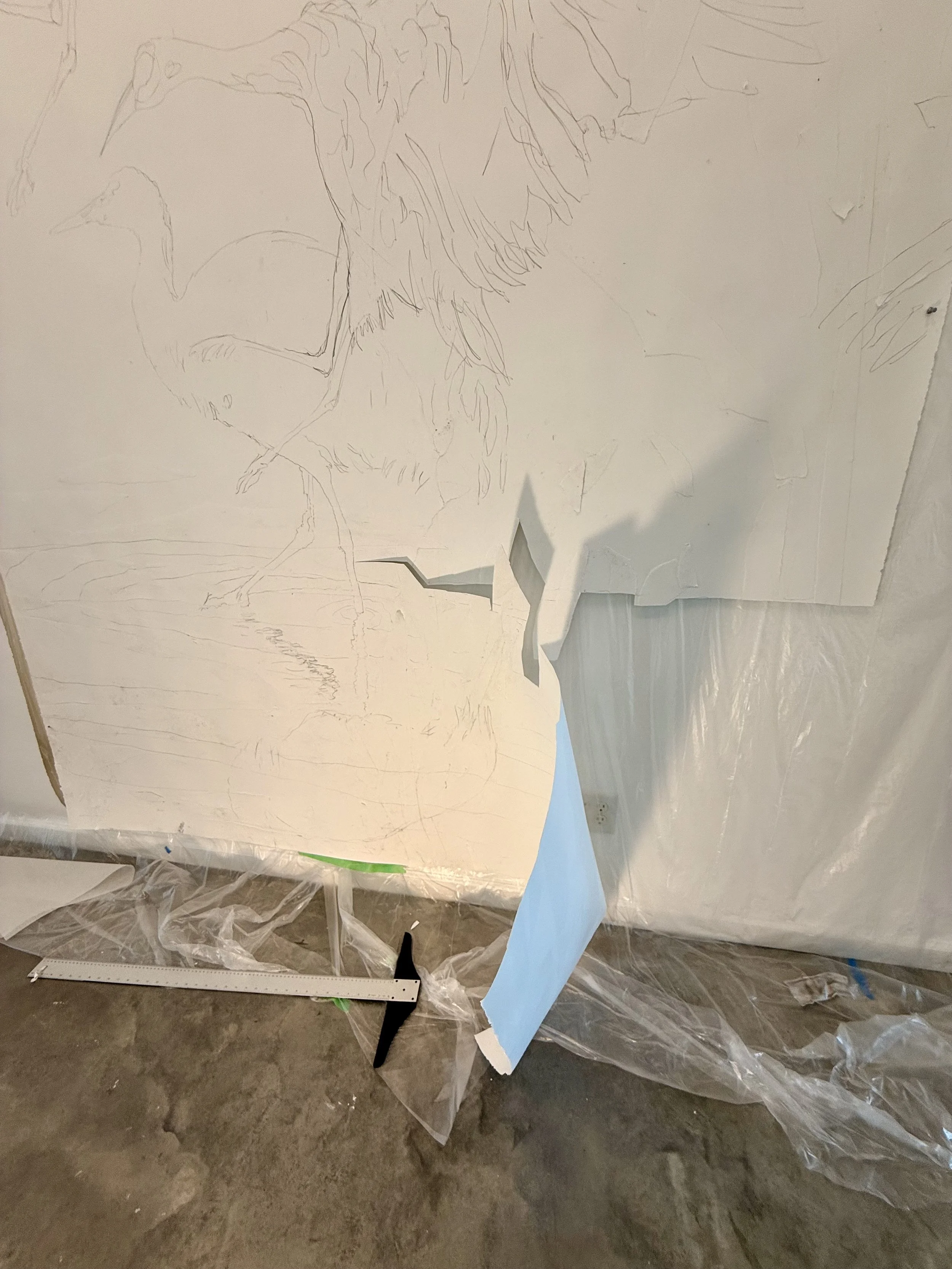
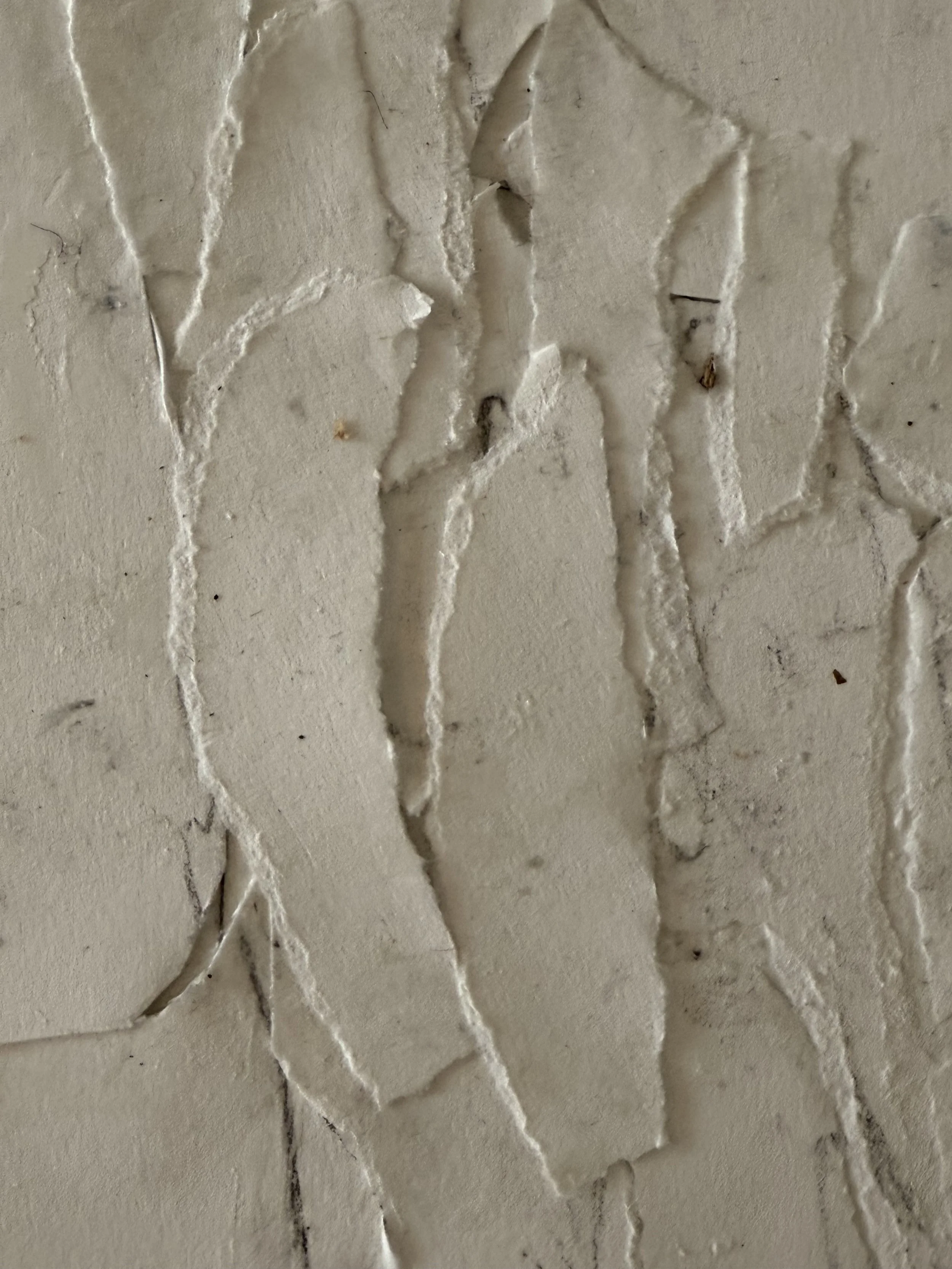
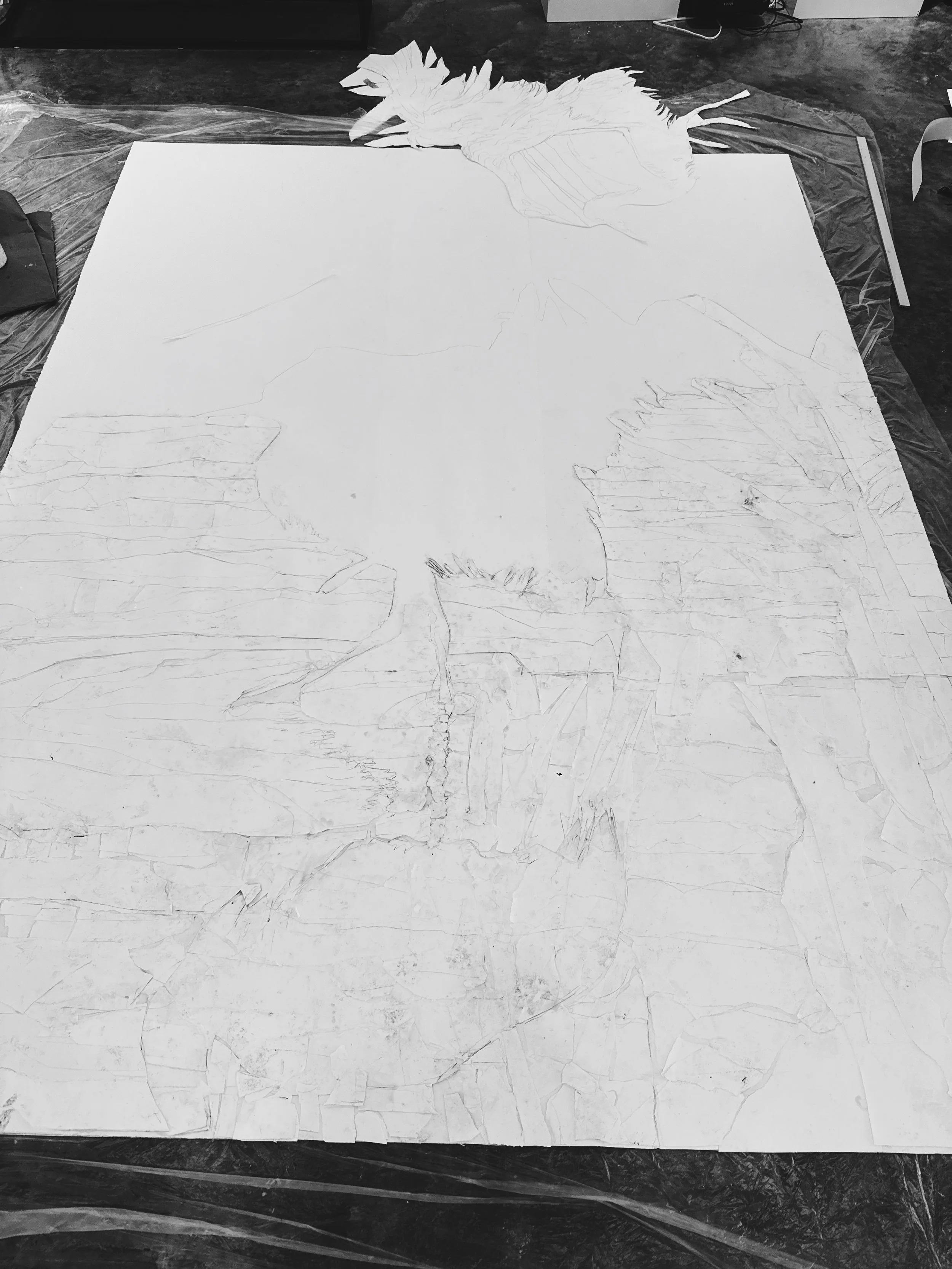
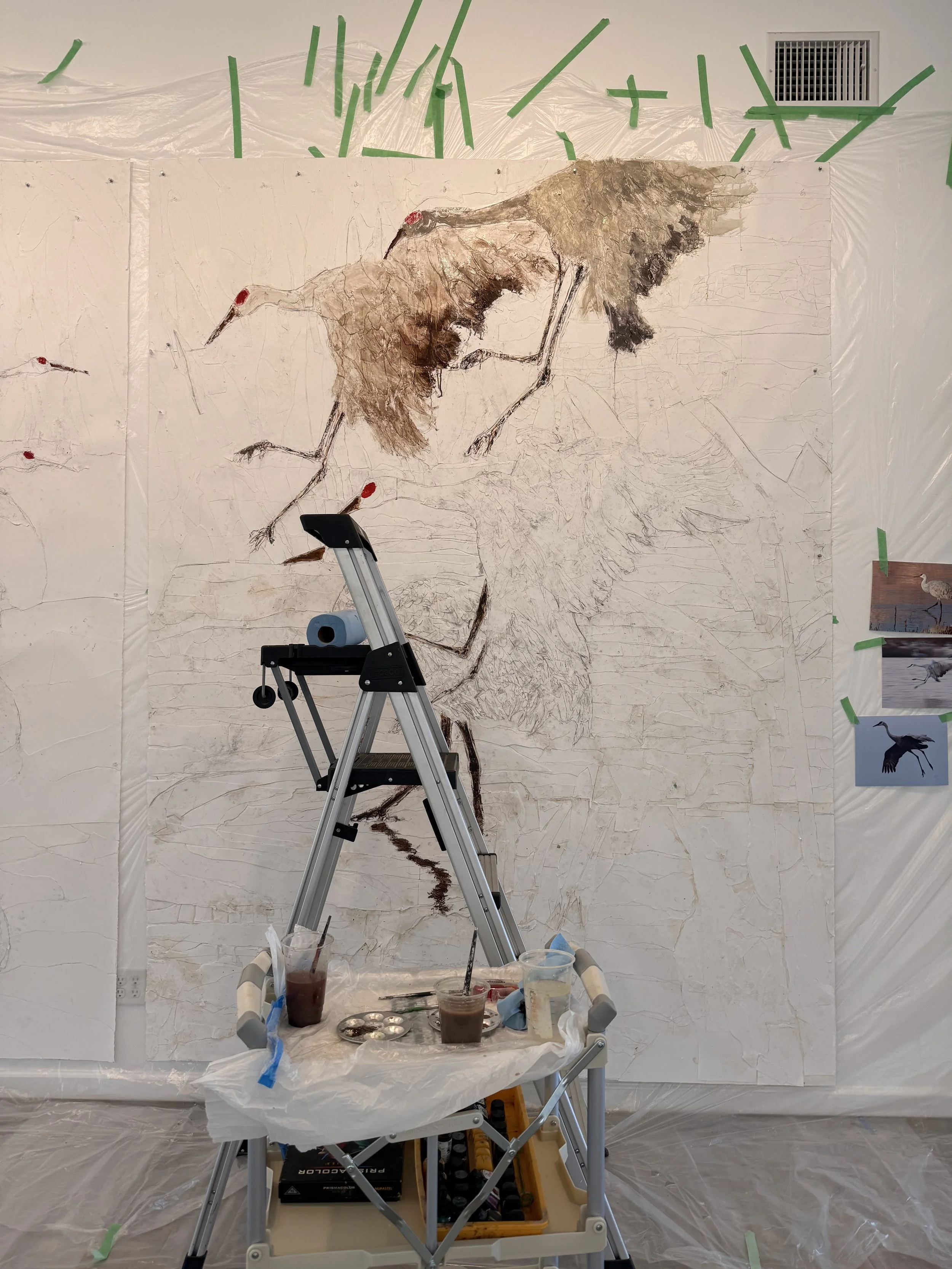
The next step involved deconstructing the drawing by tearing it into various shapes. After that, I can create a relief by reassembling these shapes on a second sheet of paper..

Then comes the color.

TWILIGHT’S VEIL

7” X 9”4”

watercolor, pastels, ink on collaged Stonehenge paper.

Image by R. Wells

The weight of truth

The concept of the “weight of truth” emphasizes the essential role honesty plays in our society and the significant pressures that accompany it. This raises an important question: when does the acknowledgment of new scientific discoveries and truths, particularly those overlooked by community leaders, become an ethical or even a justice issue?

In the fields of soil science and environmental studies, we are witnessing the alarming effects of extreme weather patterns, land subsidence, and the loss of biodiversity. Urban policies shaped by city councils, homeowners associations, and societal norms often worsen these challenges. The focus has shifted from environmentally harmful practices, such as maintaining monocultures of non-native grasses using gas-powered tools—which contribute to air and water pollution and the use of toxic chemicals—to a more regenerative approach.

These decisions not only have profound implications for our health, particularly for children who are at an increased risk for cancer, but they also endanger the fragile wildlife biodiversity that is crucial for the planet’s well-being.

Once again, I ask: when does the recognition of new ecological truths begin to outweigh the legacy of colonial landscapes? It is time that our leaders and institutions bear the weight of truth. Let’s encourage and support them. I'm thinking about the situation in Houston, where our waters drain into the Gulf of Mexico. Homeowners are required to OBTAIN A PERMIT to AVOID using cancer-causing chemicals, and reducing lawn mowing which significantly decrease emissions—up to eleven times more than those produced by a new car. This approach supports biodiversity, helps maintain the water table, and prevents land subsidence. Shouldn’t homeowners who want to use chemicals to maintain their perfect lawns and gas-emitting machinery be required to have a permit?

Living Llabyrinth- Building the grid

Building a Large Grid for Installing a Labyrinth: My Process. One reason I write these blog posts is to record my process. The other is to share information.

Constructing a labyrinth grid of this magnitude may seem like a daunting task. And it is for me. With the right strategy, it can be accomplished efficiently. As I embarked on this venture, I took the time to experiment and optimize my methods. Here's a breakdown of the process that was the most efficient.

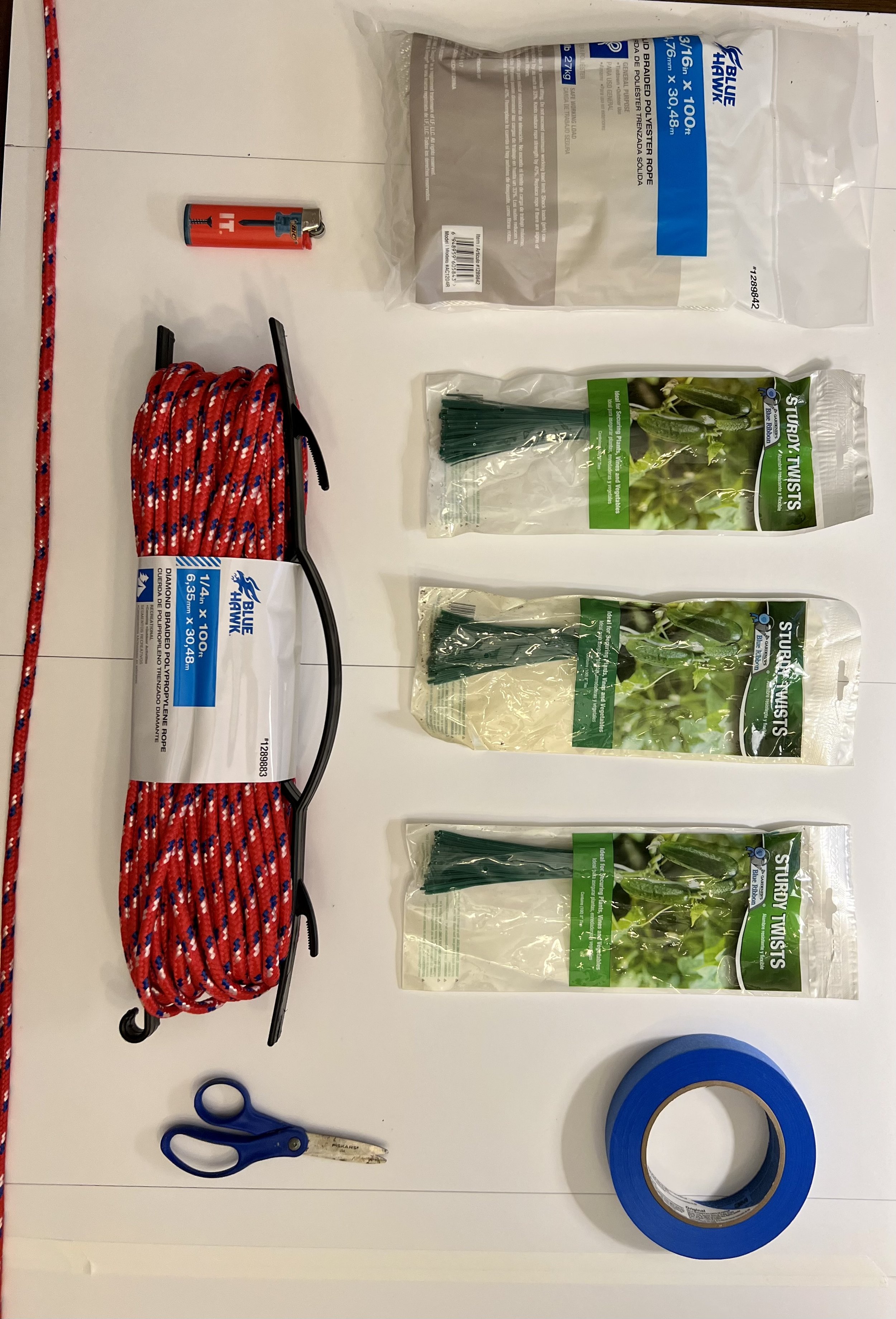
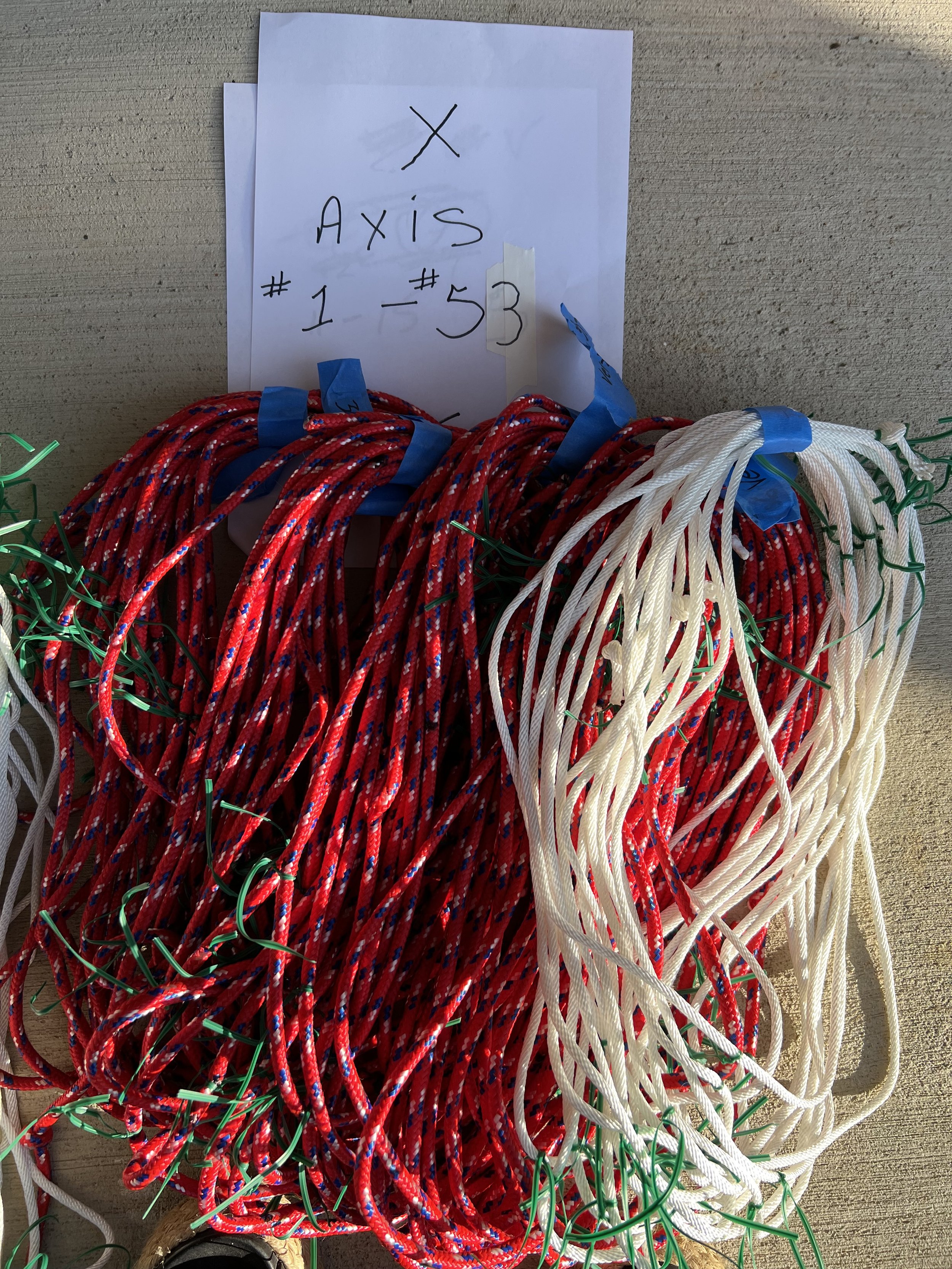
To begin, gather the necessary materials: X-axis cords measuring 53 at 54' and Y-axis cords measuring 33 at 88' lengths. Keep in mind that the cords come in 100-foot lengths.

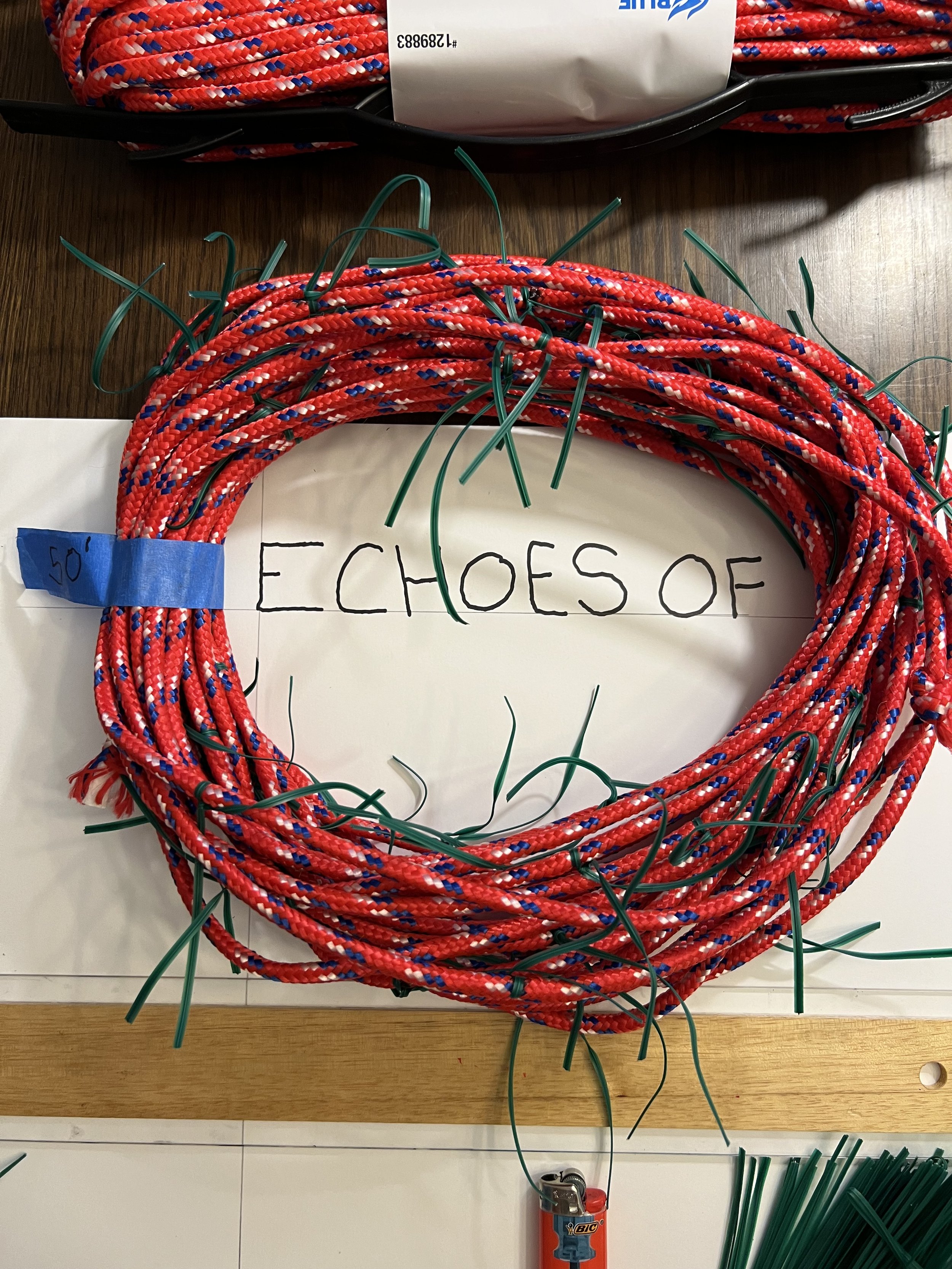
I wish I had of planned at 50’ by 100’ bison. The lighter is for singing the ends so they will not ravel. The tape is for tapeing the measured and twist-tied ropes for the installation.

I am making each cord that is a multiple of 5 a white cord. I think this will helpful the day of the installation.

1. X-axis cords: Start by unwinding the hundred-foot cord carefully, ensuring it doesn't become tangled. Here's a handy tip: tie a knot at one end and secure a twist tie next to it. Place the knotted end in a doorway and shut the door on it. This will hold it in place. Then, stick your arm through the middle of the looped cord and slowly unwind it, walking away from the door until it's completely straight.

2. Measure and cut the cord, leaving a few inches to knot and singe the ends to prevent unraveling. Tie another twist tie at the 54' mark. This will serve as the reference cord for measuring all other X-axis cords. Keep this cord secured in the door.

3. Take the leftover cord singe the end and knot it and tightly tie a twist tie inside the knot. Shut in the door with the reference length cord. Measure it against the reference cord and splice it with a piece of the next 100' wound-up cord to measure the 54' length accurately. Now you have a cord to start marking the grid on.

To mark the grid on the first cord—

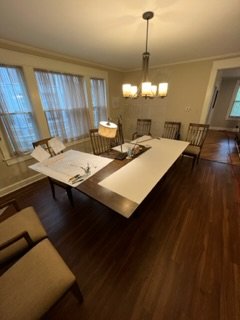
The dining has been my studio work space. First I covered the 8’ table in a thick paper to protect it. Next I marked every 20” from end to end.

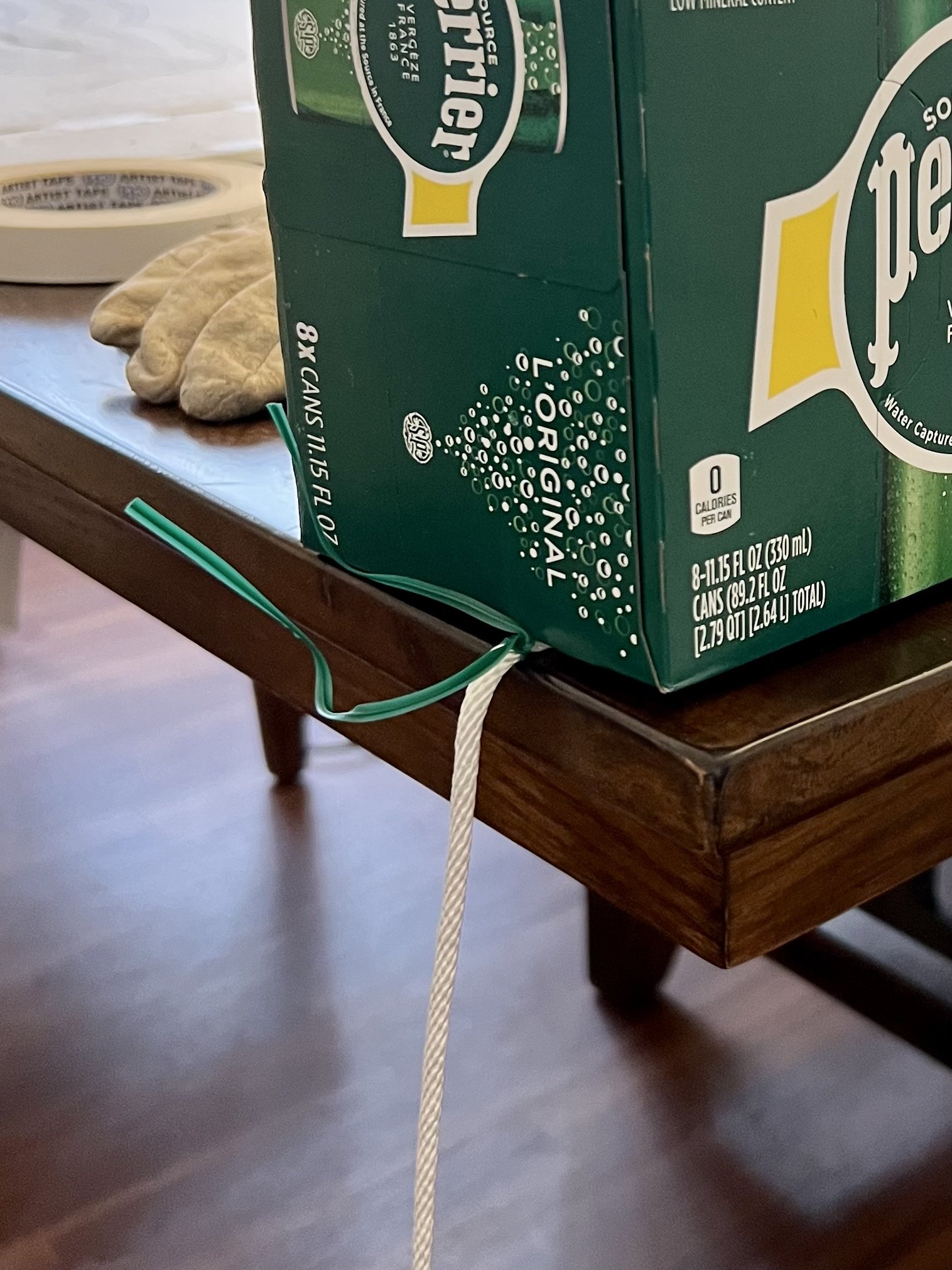
4. Prepare a long table by placing sheets of paper and securing them to the table so they will not slip. Measure and mark on the paper every 20". Lay the cord on the marked paper. To ensure stability, anchor the cord with a heavy object like a case of water.

I used a case of water to weigh down the cords.

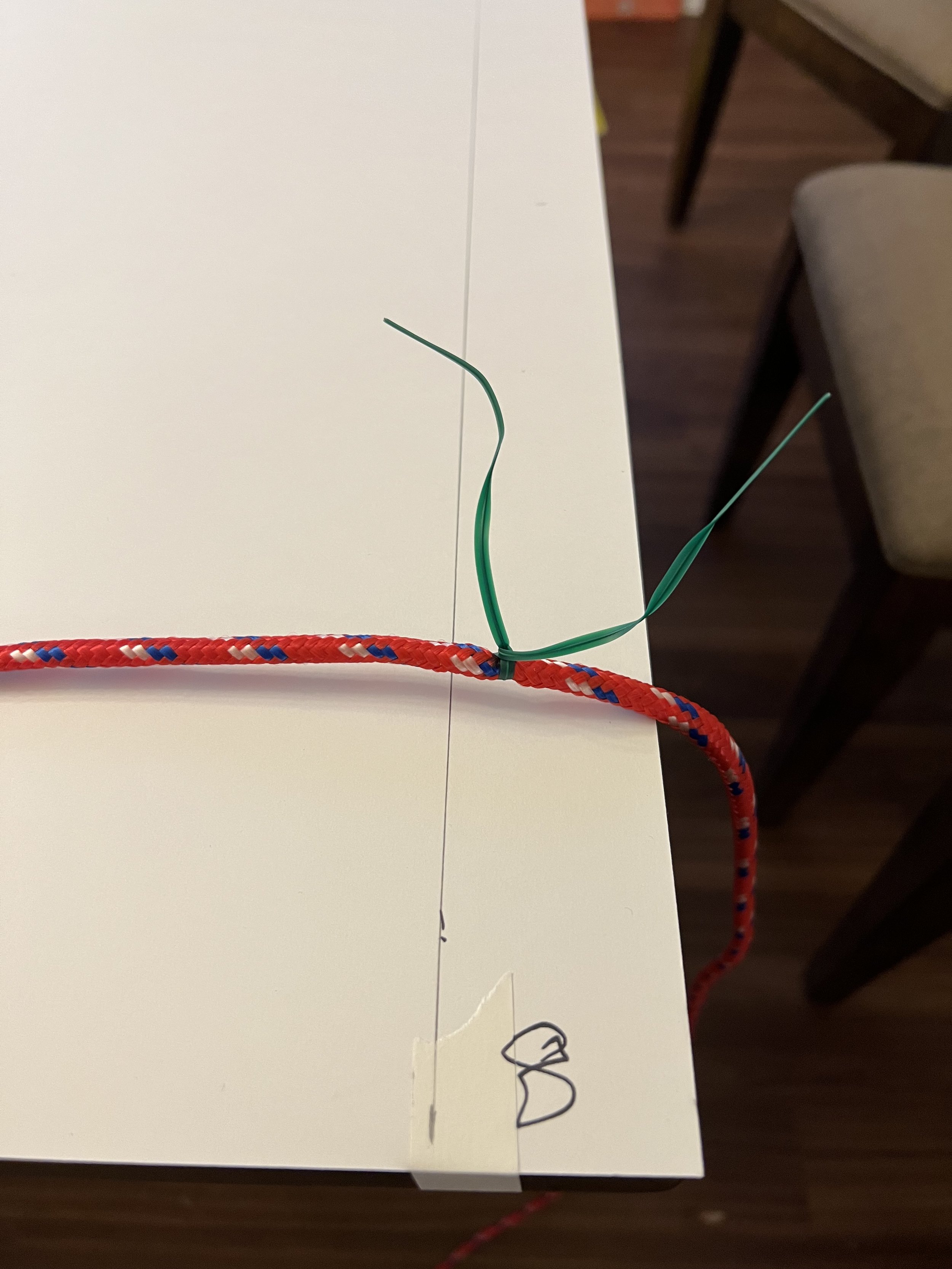
Starting from the first knot, and twist tie secure each twist tie tightly along the edge of the table at the 20' marks. Continue tying twist ties until you reach the end of the 54' mark. You may have a little excess cord hanging after the last tie.

The 8’ mark of the table length and the last twist tie. I leave a few inches at the end just in case.

The first piece with every 20” tightly tied with a twisties.

5. Carefully wind up the cord, tape it securely, and mark it as X-axis 54'.

The first grouping of five- 4 red and the 5th white.

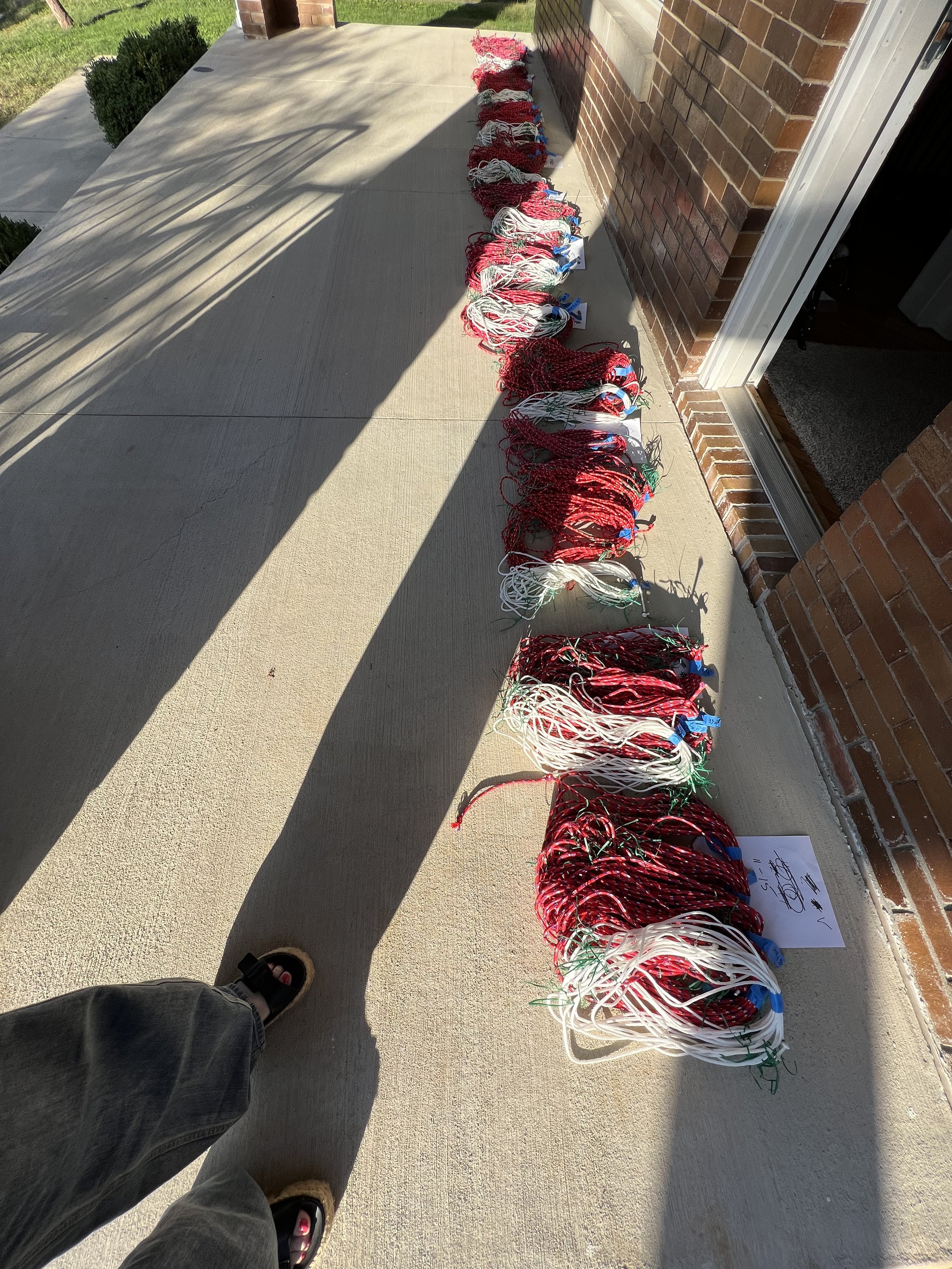
53 pieces - completed.

6. Finally, organize the cords by making four red and one white, keeping them grouped together.

The National Wildlife Federation - feature

Partnering with communities, schools, governments, and organizations across the country, the National Wildlife Federation is leading the charge for conservation.

Through their tireless commitment to protecting and restoring habitats, they have managed to breathe new life into endangered species like eagles, deer, elk, bighorn sheep, and whales.

I am deeply proud to have my work featured in the prestigious fall edition of the National Wildlife Federation magazine. It is a true honor to be recognized alongside such incredible conservation efforts.

The Baby Whisperer

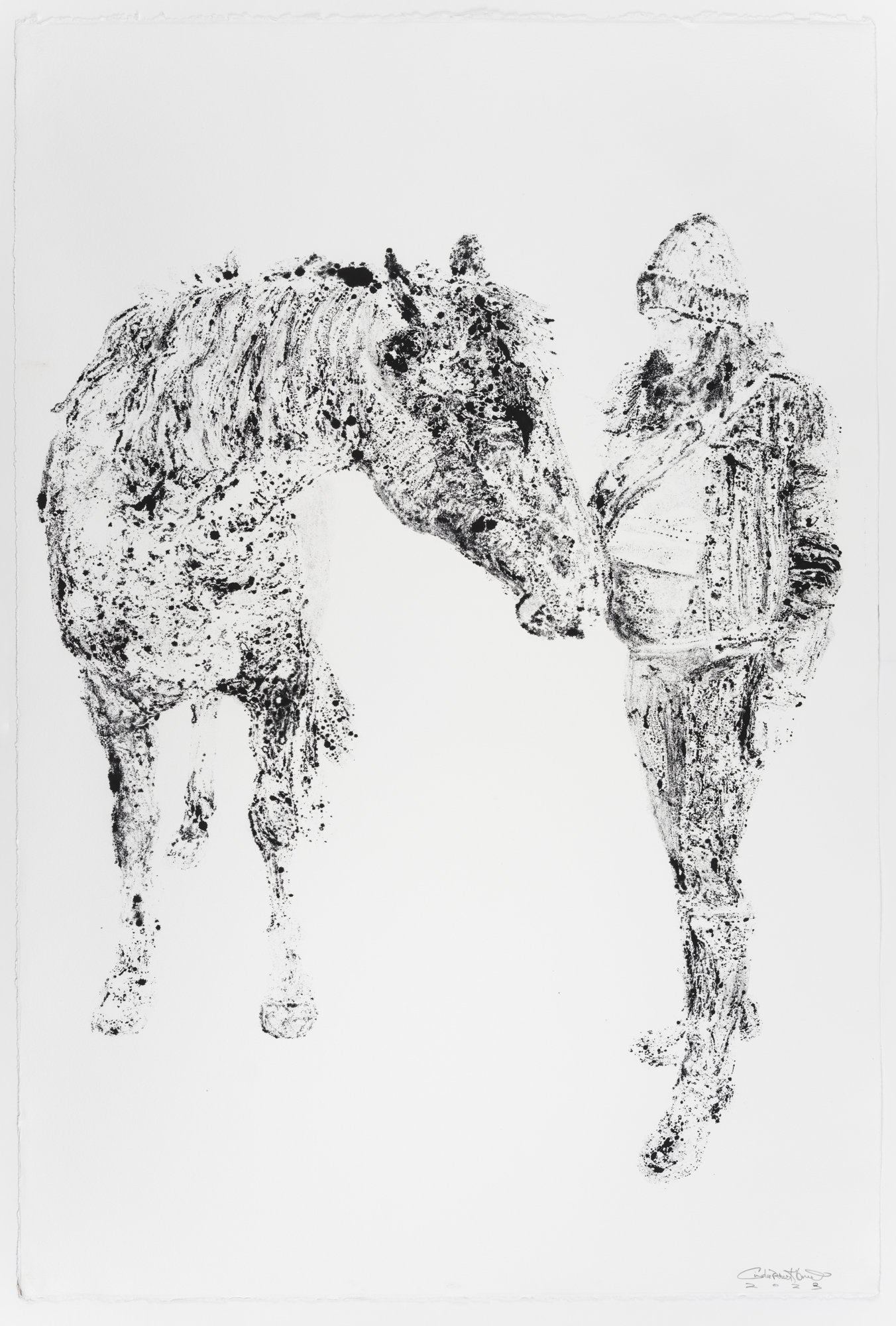
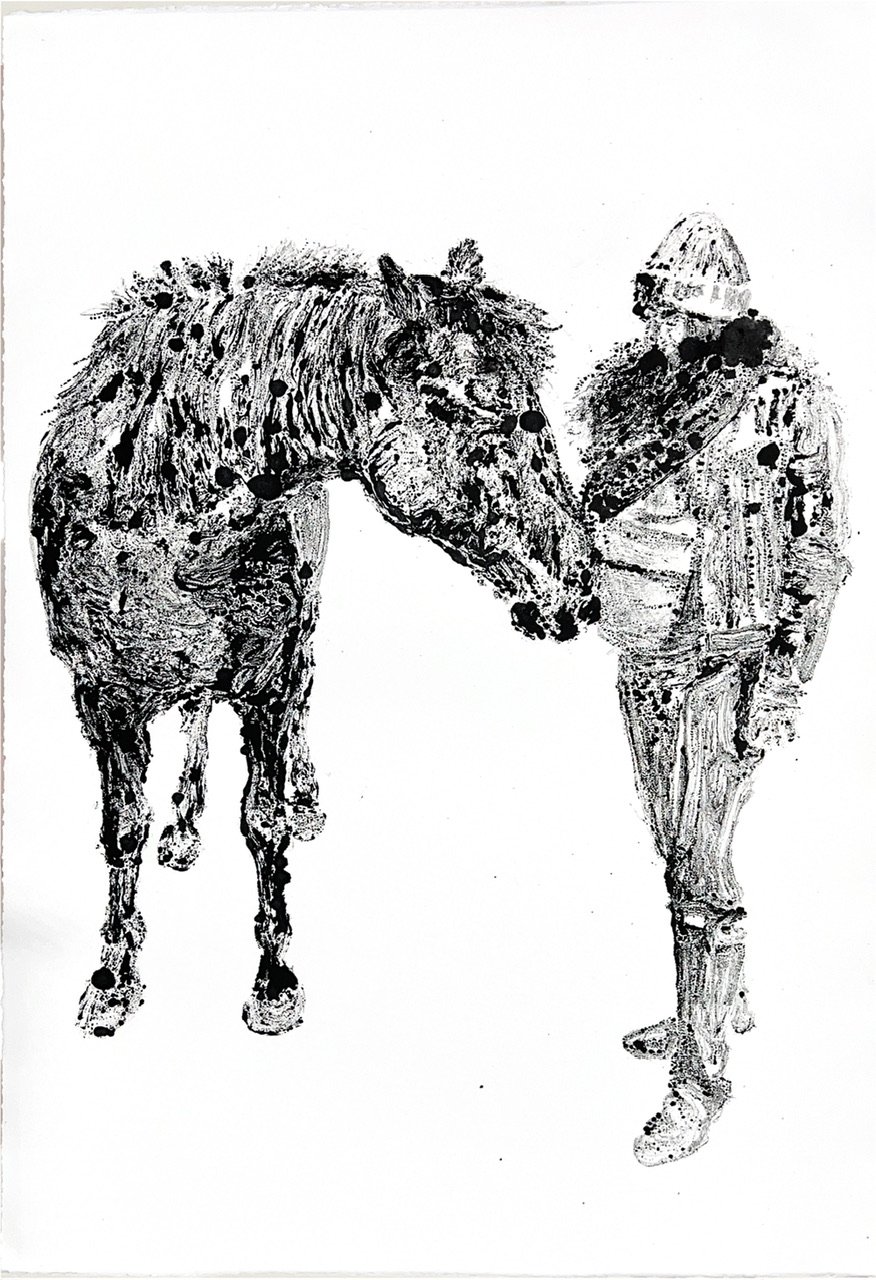
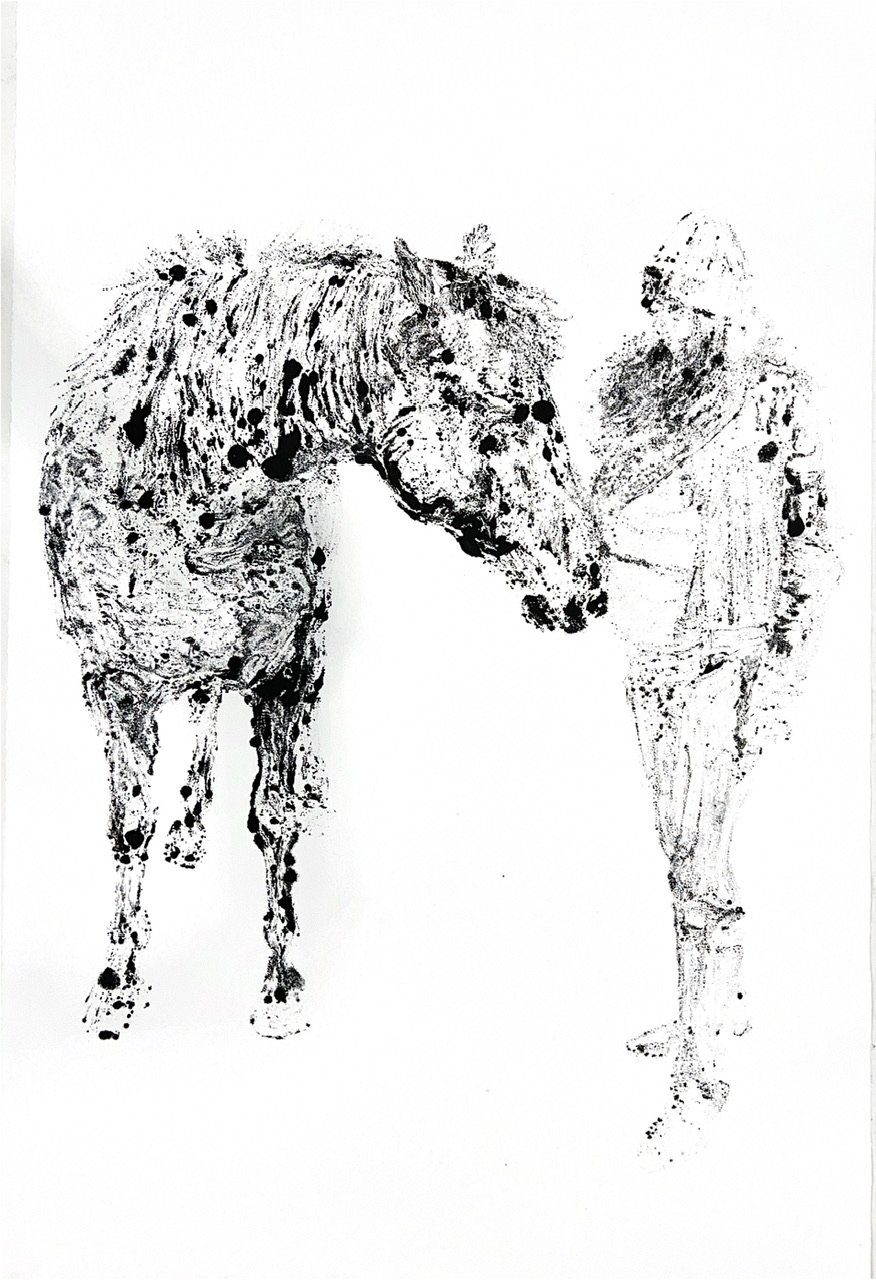
“The Baby Whisperer” 30” X 44” watercolor monotype Horses are truly a marvel of sensitivity and emotion. My daughter-in-law recently visited a stable where she used to ride, and while my son shoveled manure for their garden, she had a beautiful moment with one of the mares. Even though she had never ridden that particular horse, it became clear that the horse had been affected by its owner’s recent pregnancy. This experience reminded me that wildlife deserves much more credit than we often give them.

This observation also underlines how crucial it is to build connections with all creatures in order to restore and maintain a healthy ecosystem. I want to express my gratitude to Griffin and Alex for providing a stunning photo that inspired me to reflect on these profound ideas. They continue to motivate me each and every day.

A few weeks later I created two more pieces. One for my daughter-in-law's parents and one for my son.

Baby Whisperer I

Watercolor monotype 30” X44”

Baby Whisperer I ghost print

Watercolor monotype 30” X44”

Baby Whisperer II

Watercolor monotype 30” X44”

Baby Whisperer II ghost print

Watercolor monotype 30” X44”

“Rumblings” the next step

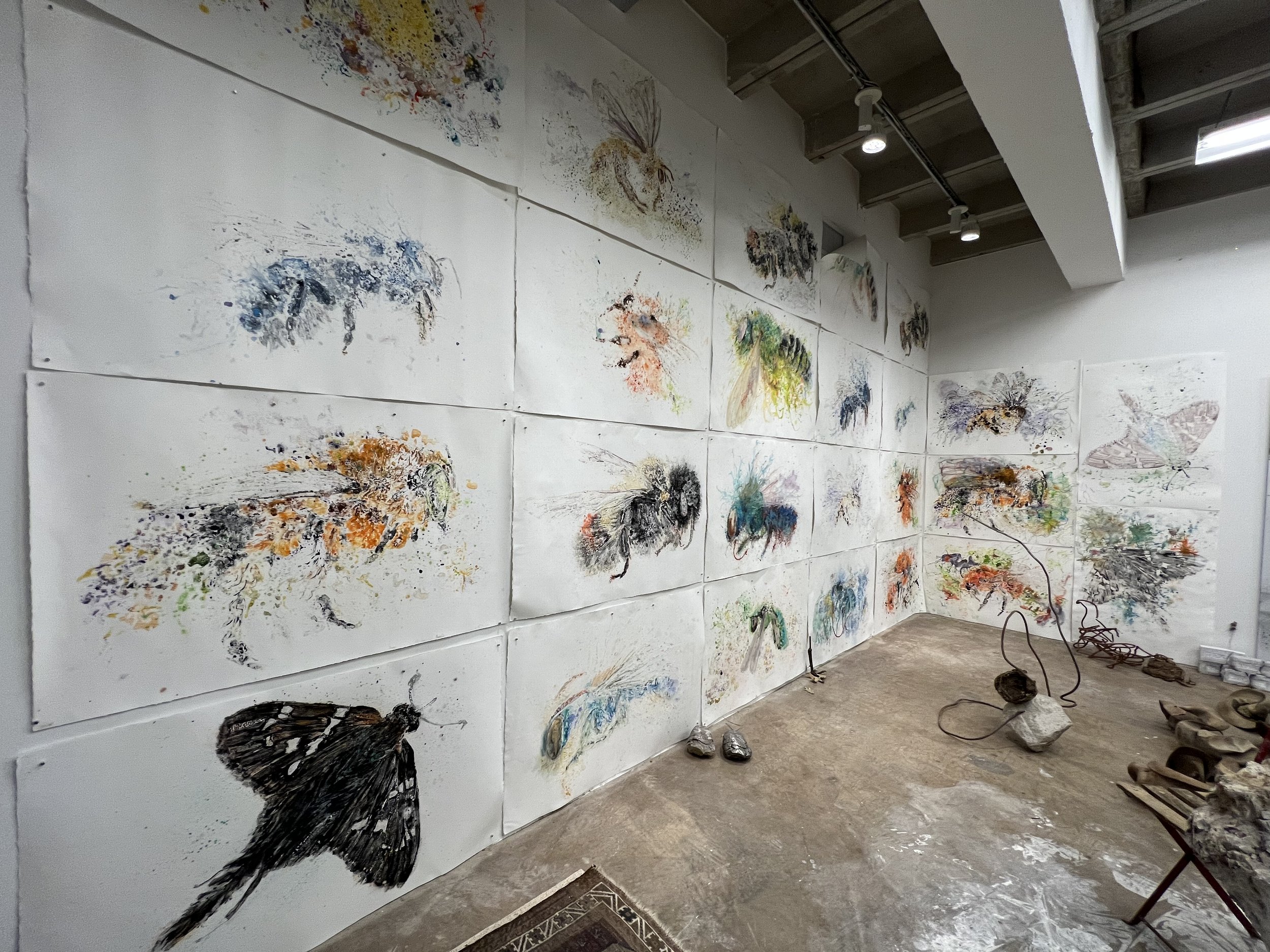
Originally Rumblings was going to be a wall of wild bee portraits, 50/10,000. It is time to start thinking about the next step.

Since I started these in 2019 my knowledge has expanded. It is no longer enough to exhibit the bees as portraits. They are an integral part of a bigger system. In incorporating systems thinking I will arrange the pieces into a 11’ X 25’ work on paper composition, an abstract eco-landscape that holistically balances urban and natural systems.

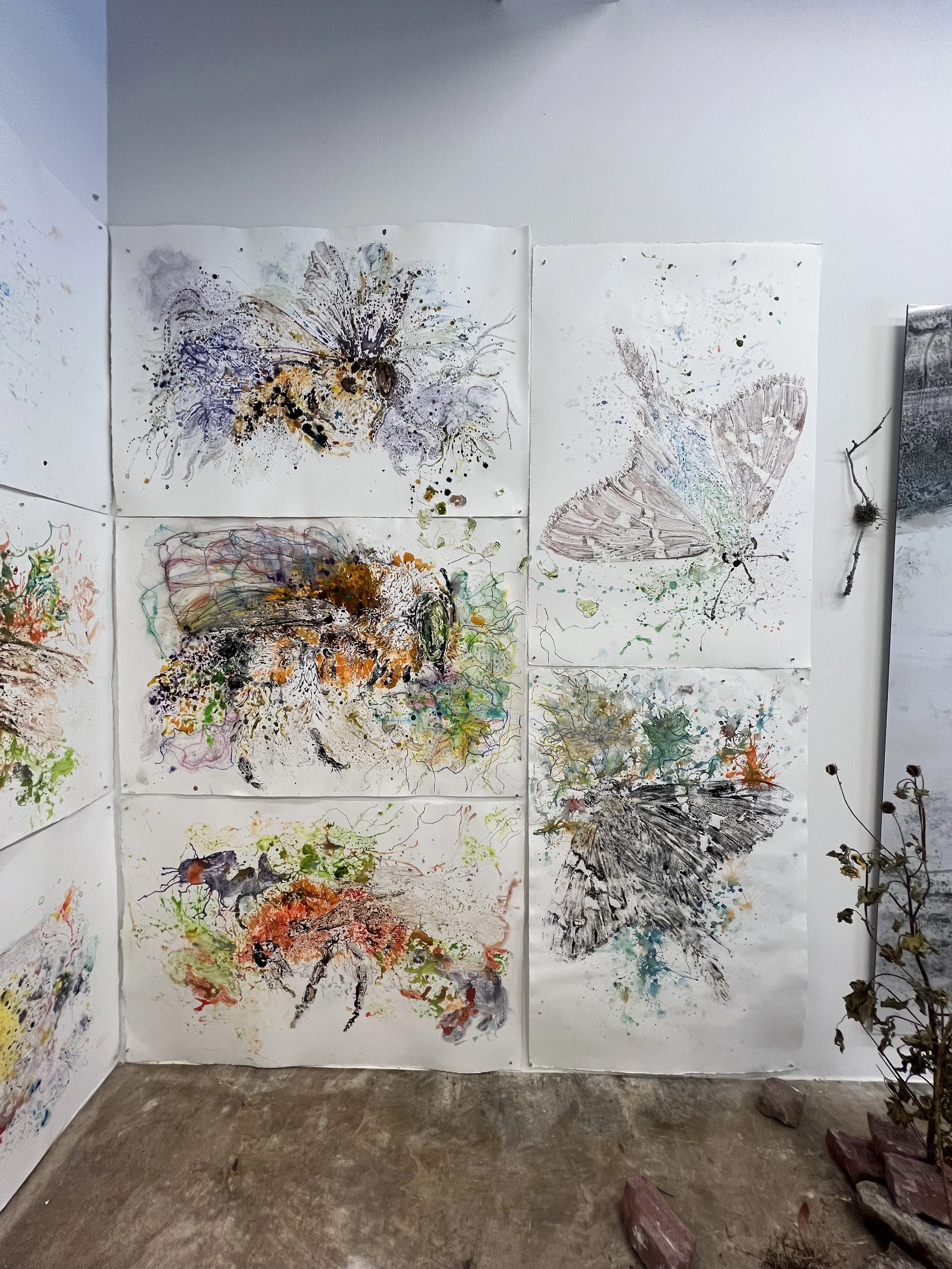
It will be a composition of twenty-eight 30” X 44” watercolor monotypes from my Rumblings* body of work. The pieces will be installed in a tight grid to reference urban development. Centered in each 30” X 44” piece is an abstract portrait of a wild pollinator.


The work will be completed in my studio when the defined space dimensions are finalized. At that time, I will select the portrait pieces and organize them in a systematic manner that works best for the size and shape of the proposed space. I will then transform the individual portraits into the monumental composition of an urban ecosystem that balances manmade and natural systems. To do this, I will add abstracted shapes representing biological systems that pollinators depend on into the blank spaces of the individual works. These marks will be extremely light and delicate, watercolor and pastel. They will be leaf and petal-like silhouettes of birds, vines, blooms, grasses, roots, water, and hooves. These shapes will weave in and out chaotically, connecting the portraits in the urban structured grid and transforming them into an ecologically balanced urban landscape composition.


RUMBLINGS* WORKS 2019 — present


Expecting a grandchild- sunflower

It is a heart warming privilege to craft something from the heart for two special souls my son Griffin and our precious daughter in law Alex both who have deep ties to nature.

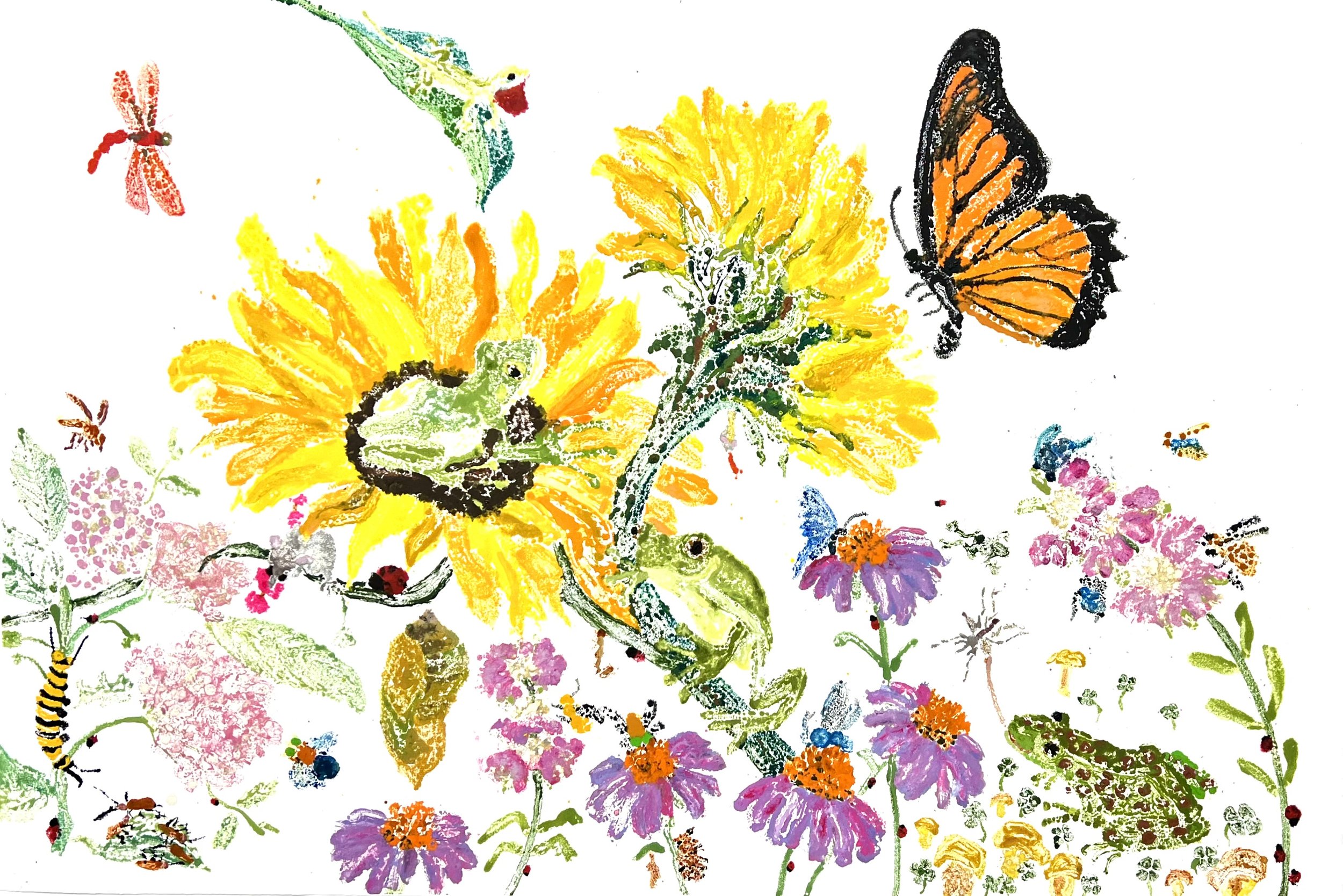
Around each giant sunflower bloom lies bountiful tiny creatures and details designed specifically for their new born’s imagination. Being able share my joy as these parents-to-be anticipate the birth of their little one makes me feel truly honored!

"Baby klement’s Ecosystem"

watercolor and pastel monotype

30" X 44"

Field mouse and  American beautyberry

A Field mice enjoying a snack of American beauty berry

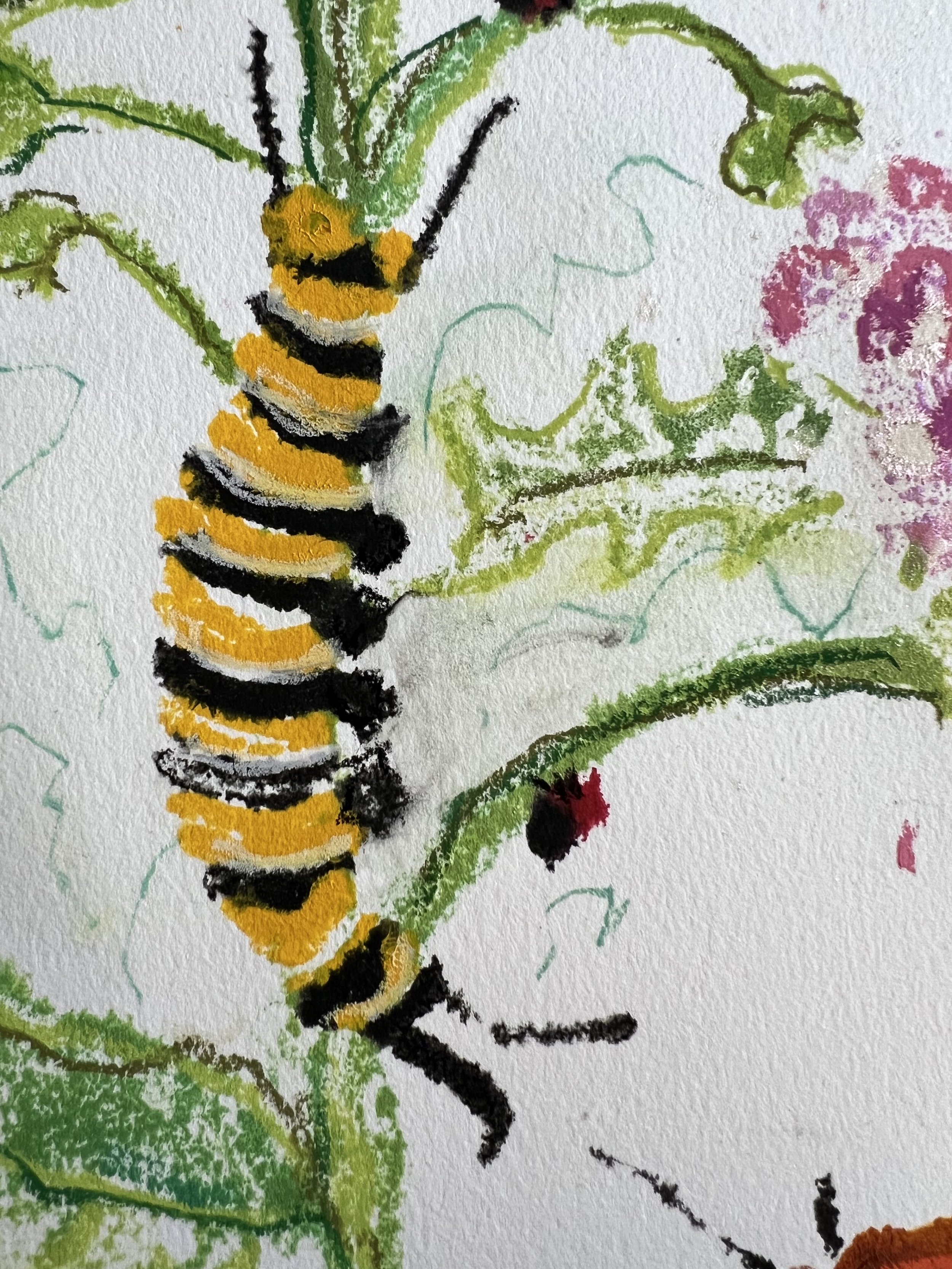
Gulf Fritillary caterpillar in the “J” stage of metamorphosis.

Monarch caterpillar, aquatic milkweed, Monarch chrysalis, Purple coneflower, wasp, dragonfly

On a personal note- Griffin and Alex have not picked a name so I think of our future granddaughter as Sunflower.

Symbiosis - Hairy water clover incorporates time and movement

Since the beginning of my artistic journey, I have consistently explored elements of time and movement within both two-dimensional and three-dimensional works. With "Hairy Clover," an element in Symbiosis this exploration takes on another layer of complexity - exploring how the water cycle creates motion that stores carbon, ultimately building the planet's energy.

Marsilea species are an extraordinary group of ferns, displaying a fascinating phenomenon known as nyctinasty - the daily movement of leaf orientation. During daylight hours they reach out to capture sunrays and then at night fold inwards into vertical positions due to pulvinus joints located towards the base of each stalk which adjust based on water flow into motor cells. This adaptation ensures that these plants remain attuned with their environment by regulating transpiration through stomata opening and closing cycles - remarkable!

I have read that this Texas native is endangered in many states. :(

Marsilea vestita, southern water fern

8” X 8”

Ink

The largest Mammal

The eating and Waste Habits of the largest mammal of the greatest numbers on a land mass have the greatest impact on all other life forms. In Texas there are 26,448,193 humans and 10,900,000 cows. Homo sapiens are the most impactful mammal.

In today's society our eating habits define some of us socially and morally. This makes the discussion of eating meat vs. a vegan lifestyle and saving the planet a loaded topic. One of the most important topics of our day triggers emotions that progress bit discussion and block minds. When I find a movie or a book that looks at the topic in a non-threatening, non emotional context I like to highlight it.

The documentary Goodbye Cows looks at the impact of the two consumption models.

If you want to take a deeper dive into the beautiful and complex relationship between ruminants the planet and humans, I recommend the book Cows Will Save The Planet. By Judith Schwartz

On a lighter note in 2015 I was invited to visit a a friends family farm that raises cattle for consumption and regeneration. My friends incorporate methods that mimic nature and manage the cattle’s movement as predators managed herds. This process builds the health of the planet’s soil and tempers climate. .

My rancher friends Lisa and John threw some healthy treats in the back of their pick-up so that I could get some cow close-up.

The photo that inspired Mooove

I had to draw the expressive cows as they contorted, licked and moooved the pick-up clean.

MOOOVE 

4' X 6' c

harcoal, ink pastels,

2015

Below is the drawing. It still makes me laugh.

Rumblings - Agapostemen Virescens

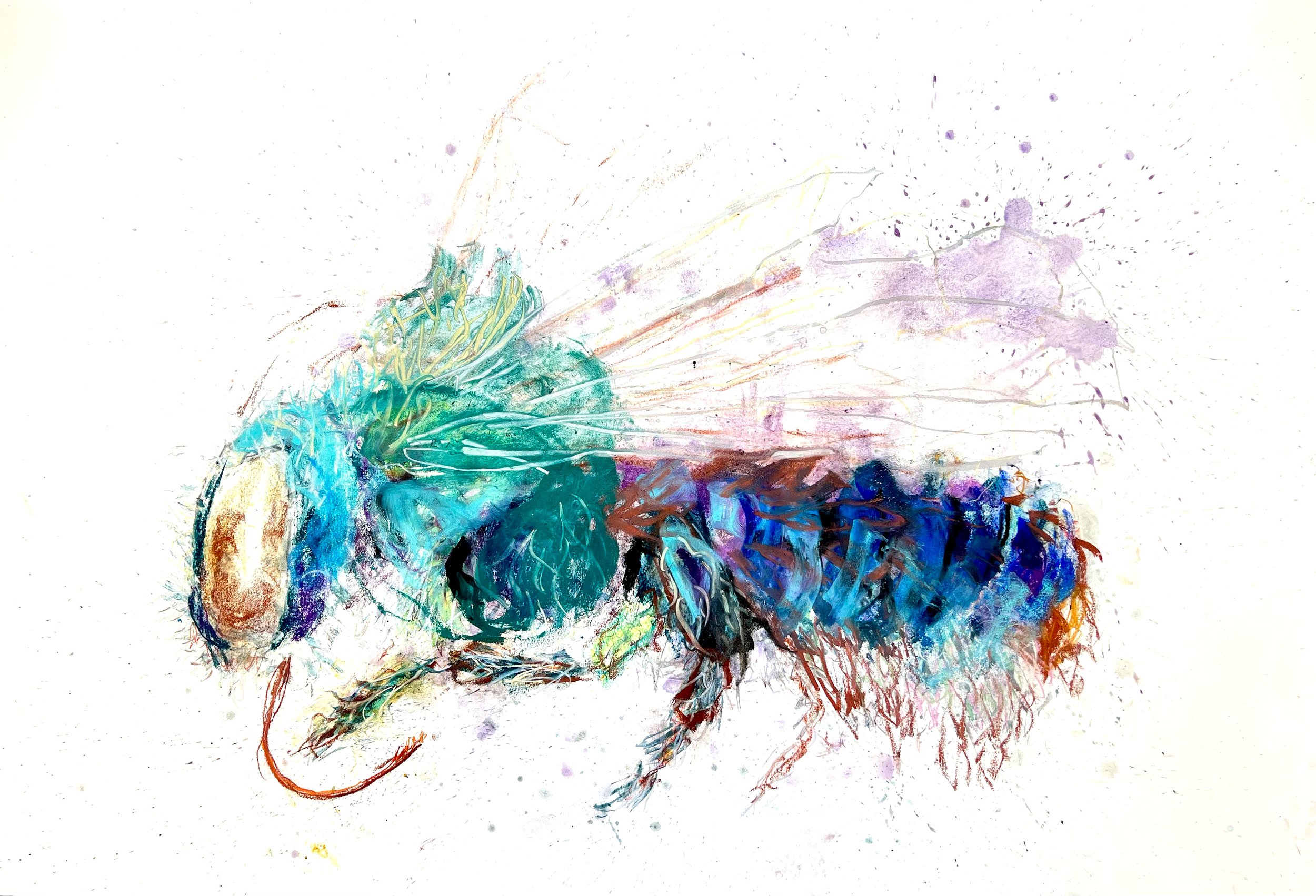
This is part of a large body of work I started in 2019, Rumblings.

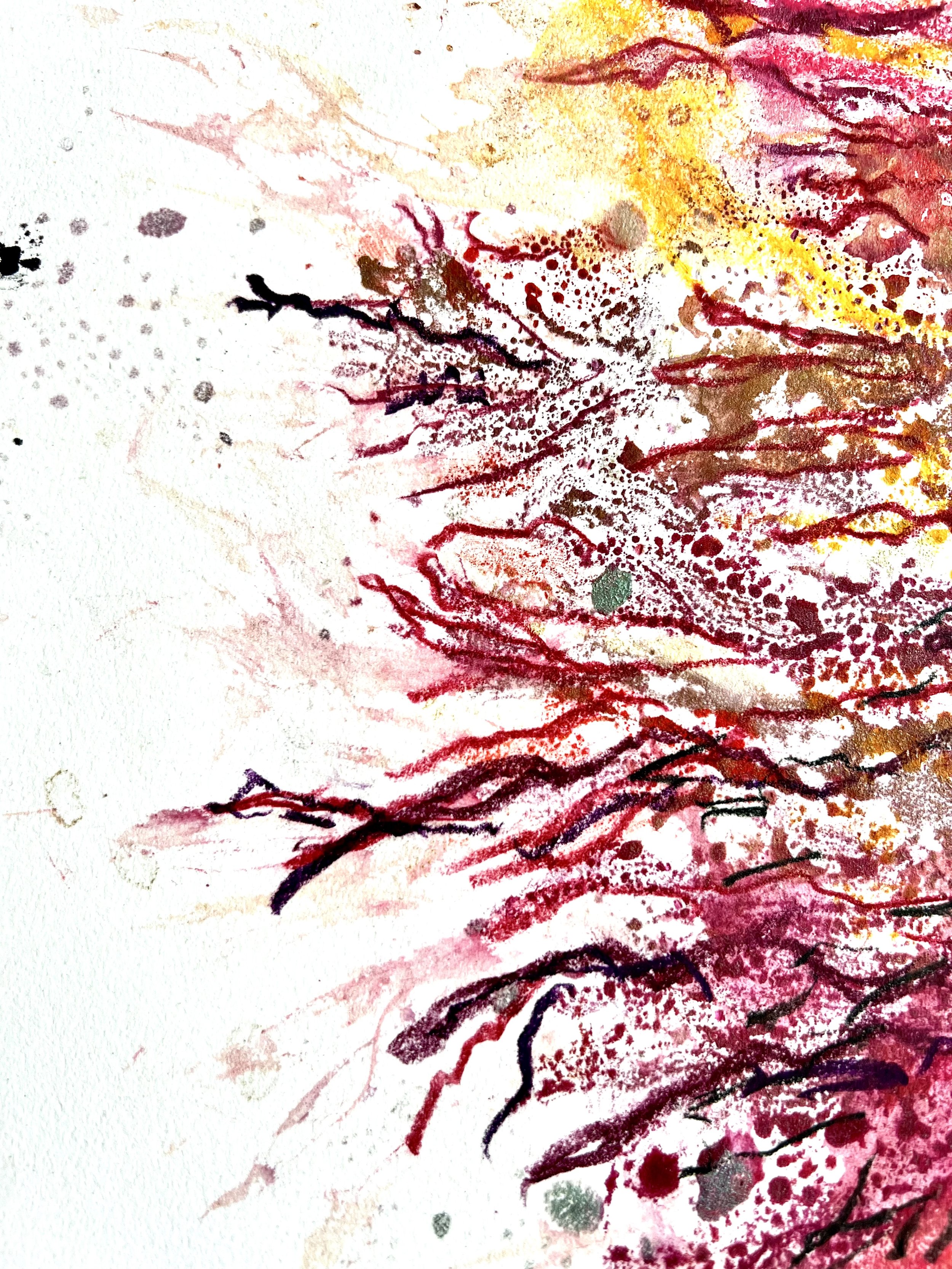
I pressed this monotype in 2019. I loved parts of it and not others. In 8/2022 with pastels I addressed the issues that we're not working on. I am pleased with the minute beast.

Agapostemen Virescens

watercolor and pastel monotype

30” X 44”

Little is known about this metallic green eye-catching Agapostemon virescens, a bicolored striped-sweat bee in the family Halictidae. It is commonly found in North America and is the official bee of Toronto. Its metallic green head and striped abdomen make it identifiable

The bicolored sweat bee is a solitary ground nesting bee. Each spring the female will dig a tunnel in an open patch of ground. Off the tunnel will be several branches. After building her nest, the female will gather pollen, take it back to her nest, form it into a ball with a little nectar and place it in one of the branches before laying an egg and sealing off that branch so each egg will have its own “room.” -.backyardecology

Monotype- leafcutter (petalcutter)

Leafcutter (petal cutter) Megachile and the Blanket flower

Watercolor and pastel monotype

30” X 44”

Leafcutter bee flying to its nest just after cutting a petal from the Texas native Gaillardia pulchella aka blanket flowers. They use the petals to protect walls and to seal their nests. In exchange for the petals, the leaf cutter pollinates the blanket flowers bloom. It is one of my favorite relationships in “Symbiosis.”

Rumblings - diversifying and implementing systems thinking.

All living and nonliving matter are connected in form or system. Through my work on “Symbiosis,”  I have witnessed the power of holistic management, also called systems thinking. I can see that Changing our decision making process to consider whole systems and connectedness is the solution to our environmental and social issues. Changing how society thinks is the driving force in my art.

With this new awareness I am inspired to consistently reflect it in my work. I have decided to rethink  “Rumblings,” which began as a collection of monotypes of 50 of the 10,000 bee species. It wasa mono crop of bees. However, you can’t separate the interconnection between bees, humans, or other living organisms and the earth's natural systems. We are all part of the living planet Earth. I will start applying systems thinking to all my installations. “Rumblings ” will celebrate the relationships among a diversity of species up and down the food chain.  I will weave into these pieces the relationships that whisper of Earths biological processes and Physical  and chemical Elements. The connections can be obvious or  subtle, they can be  unmeasurable or invisible. This will be fun.

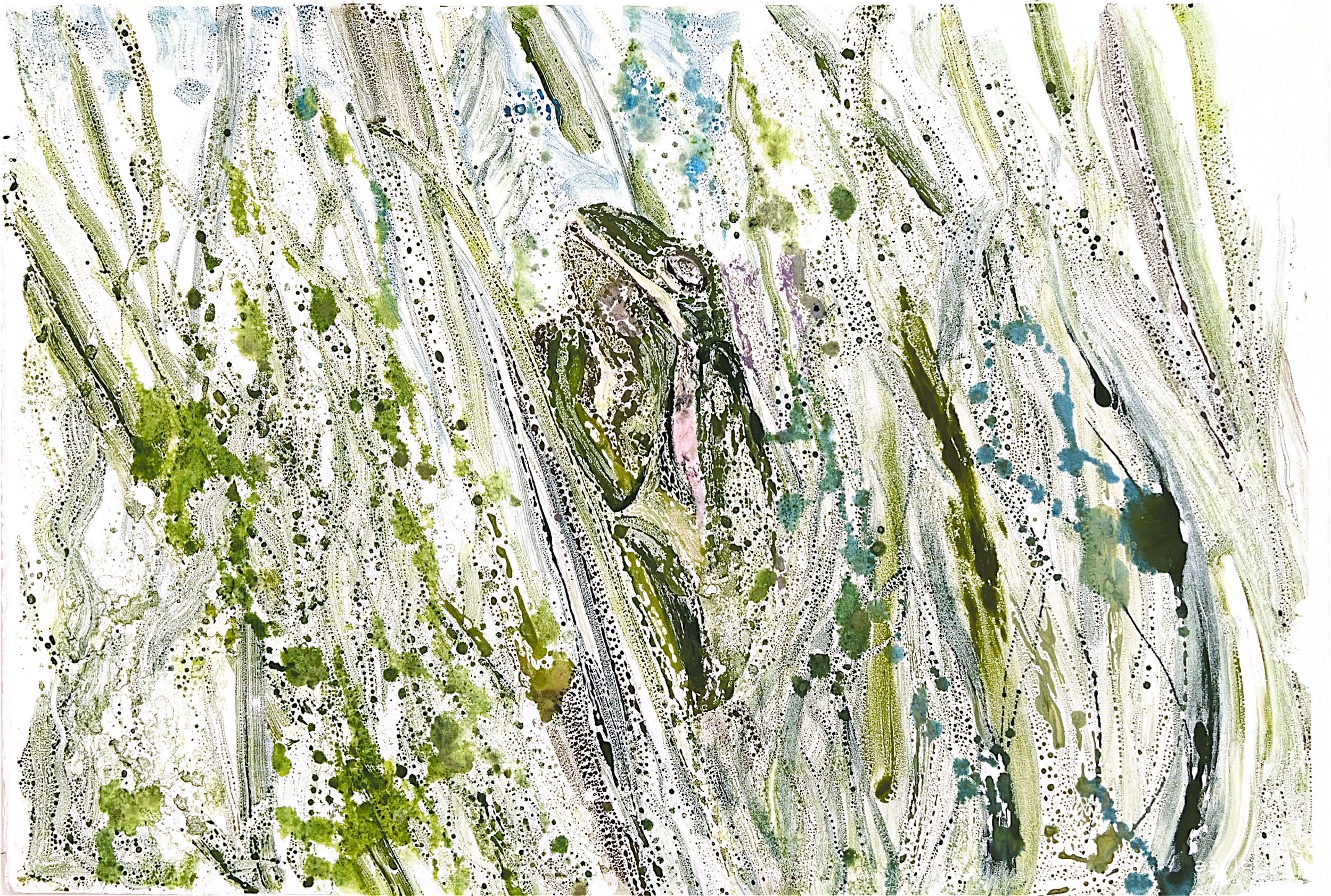
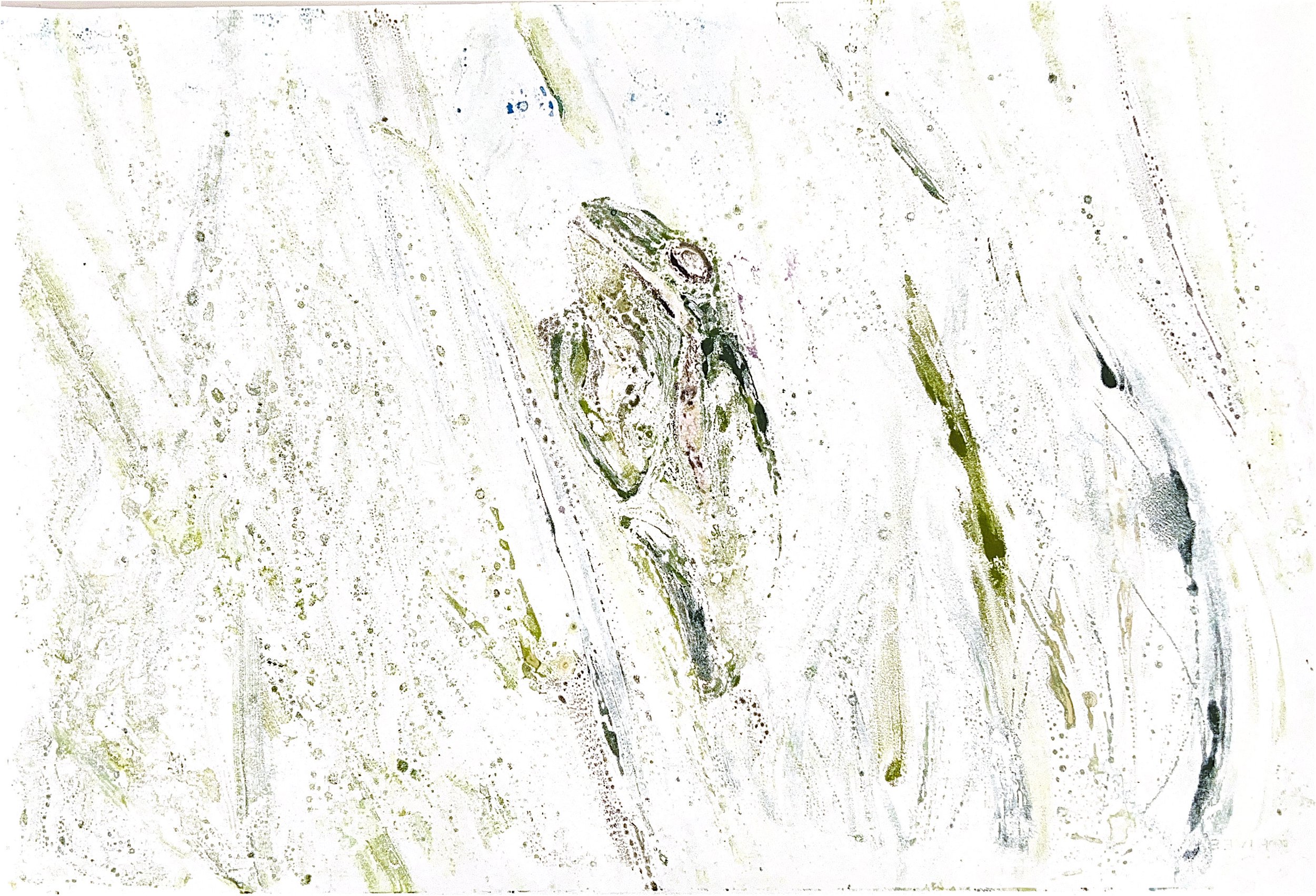
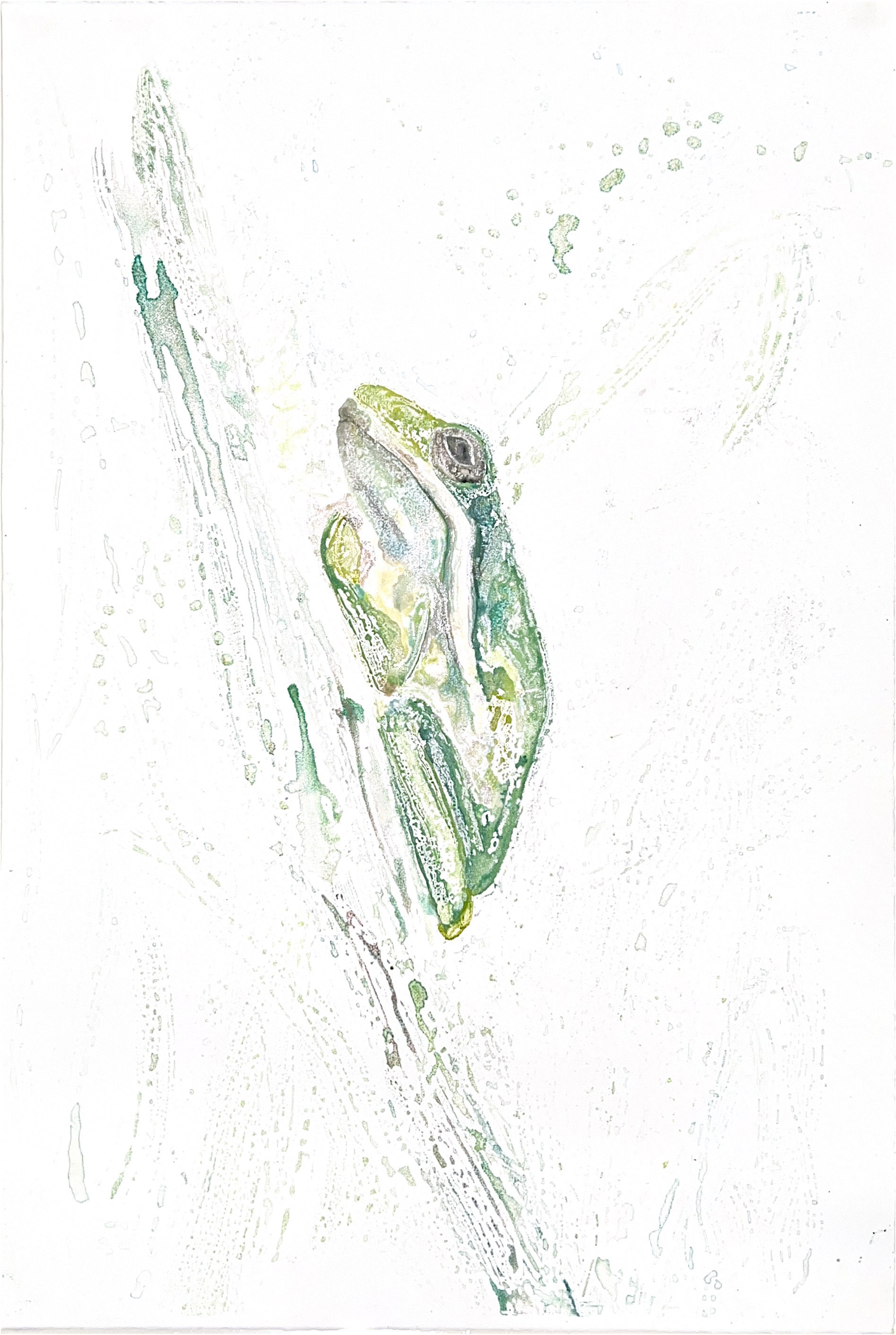
Green Tree Frog Eggs

We had the first big spring rain the week before Mother’s Day. That Saturday , I stopped in "Symbiosis" to check out the wildlife and chat with anyone visiting the exhibitions. To my surprise, the pond is now a green tree frog nursery. The trough pond is surrounded by tall native plants that tree frogs love. I have not seen the green tree frogs since last year, I thought I heard them one night few weeks ago. Mother toads and tree frogs have to have water to lay their eggs. I believe tree frogs lay their eggs on limbs where they fall in the water.

Above are a few watercolor monotypes I did of the tree frog.

Symbiosis - Pollack

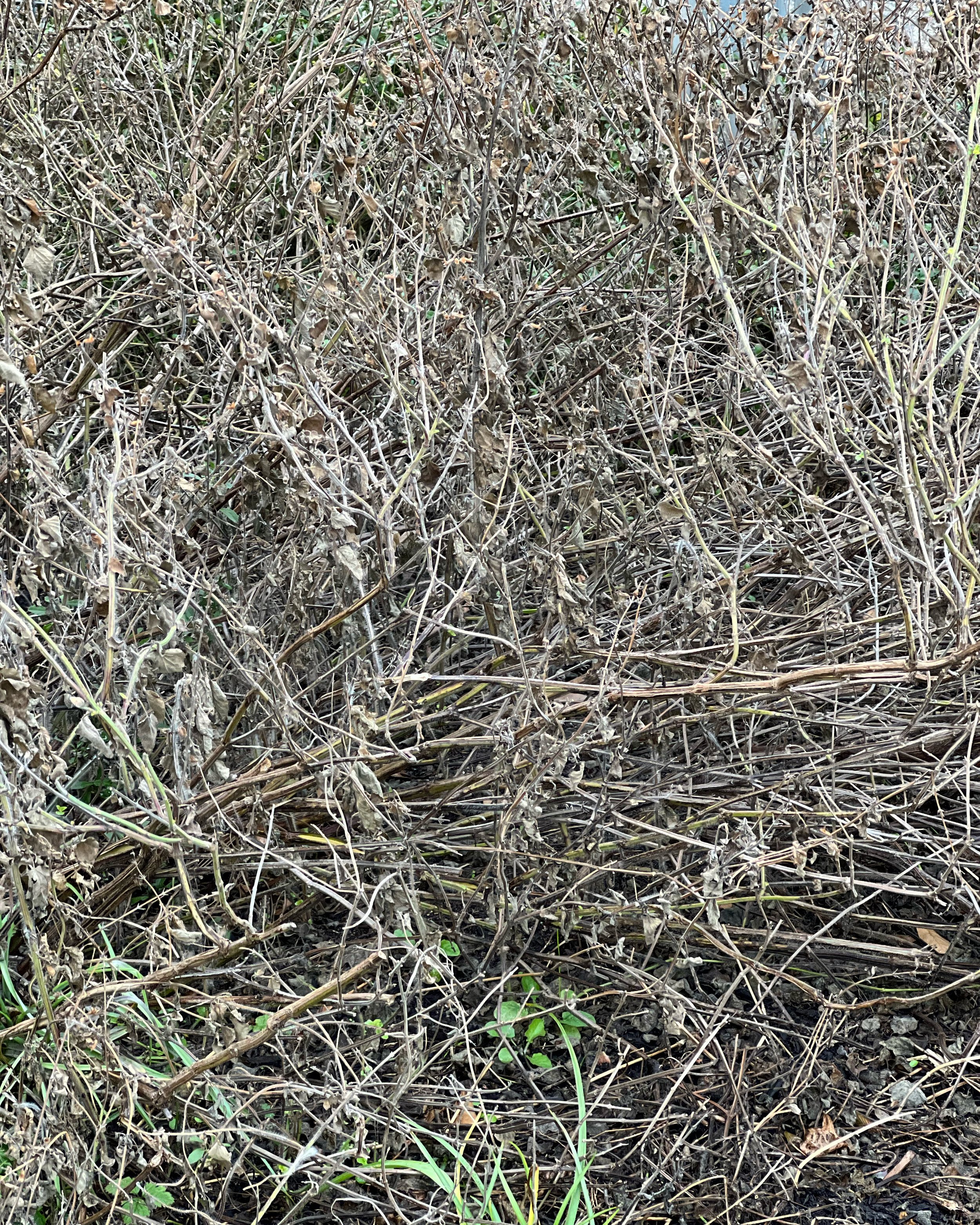
When I study the areas of the work that visibly support the most wildlife in Symbiosis I often think of the the most notable works of Pollock. I am presently reading The Extended Mind by A.M. Paul. In the chapter on thinking in natural spaces she wrote. - “Nature changed Pollocks thinking - gently tempering his raging in-tensity- and it also changed his art. In New York, Pollock worked at an easel, painting intricate, involved designs. In Springs, where he worked in a converted barn full of light and views of nature, he began spreading his canvases on the floor and pouring or flinging paint from above. Art critics view this period of Pollocks life as the high point of his career, the years when he produced "drip painting" masterpieces like Shimmering Substance (1946) and Autumn Rhythm” the extended Mind by A.M. Paul. I often see Pollockness in “Symbiosis”. This images especially reminds me of his Autumn Rhythm. In “symbiosis” it is winter shelter. This scarlet sage was damaged after the freeze.

Endangered knowledge:The Soul of Humus

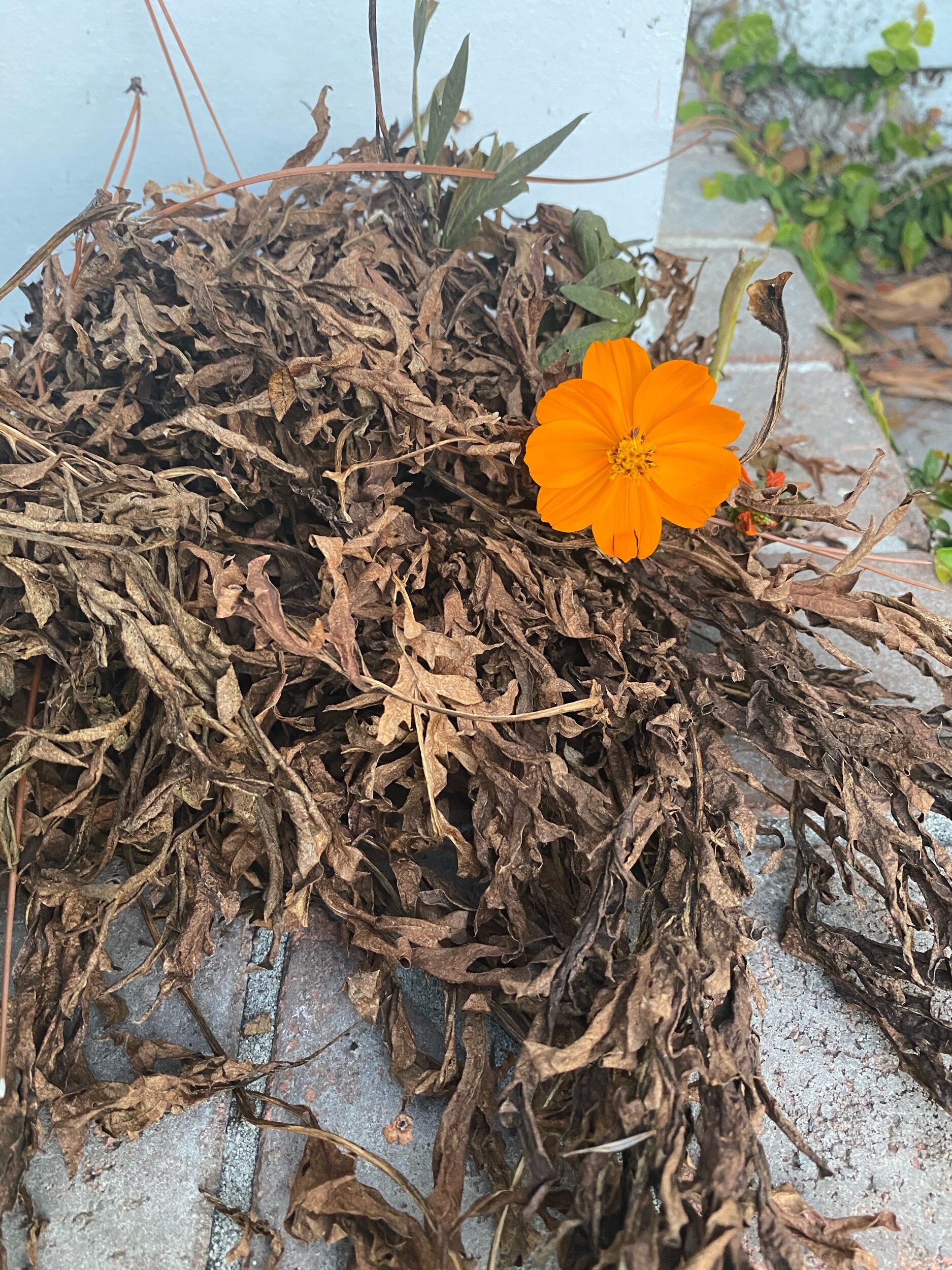
I dried some cosmos leaves to us as the coat of a sculpture that is in the works - Endangered knowledge: the Soul of Humus. The piece will be in the #sculpturemonthhouston 2021 exhibit. I started the armature during COVID for the SMH 2020 exhibit, which was postponed. The sculpture looks at the ecological history of the coastal prairie. This texture is perfect #cindeeklementart #endangeredknowledge #coastalprairie #tezasart #houstonart #bioart #environmentalart #cosmos #art #sculpture #bison

IMG_4772.jpeg

Rumblings - work in progress-

Neonicotinoids disturb bumble bee and flies sleep and ability to know when to forage. It is banned in the EU and not in the US. This isn’t enough, these products used in urban gardens harm bees. Articles like these inspire me to plug on.

I have lost count

I have lost count

artist statements are also works in progress

as it sits

RUMBLINGS

Artist statement

A rumbling in the distance is nature's way to alert living creatures to their environment.

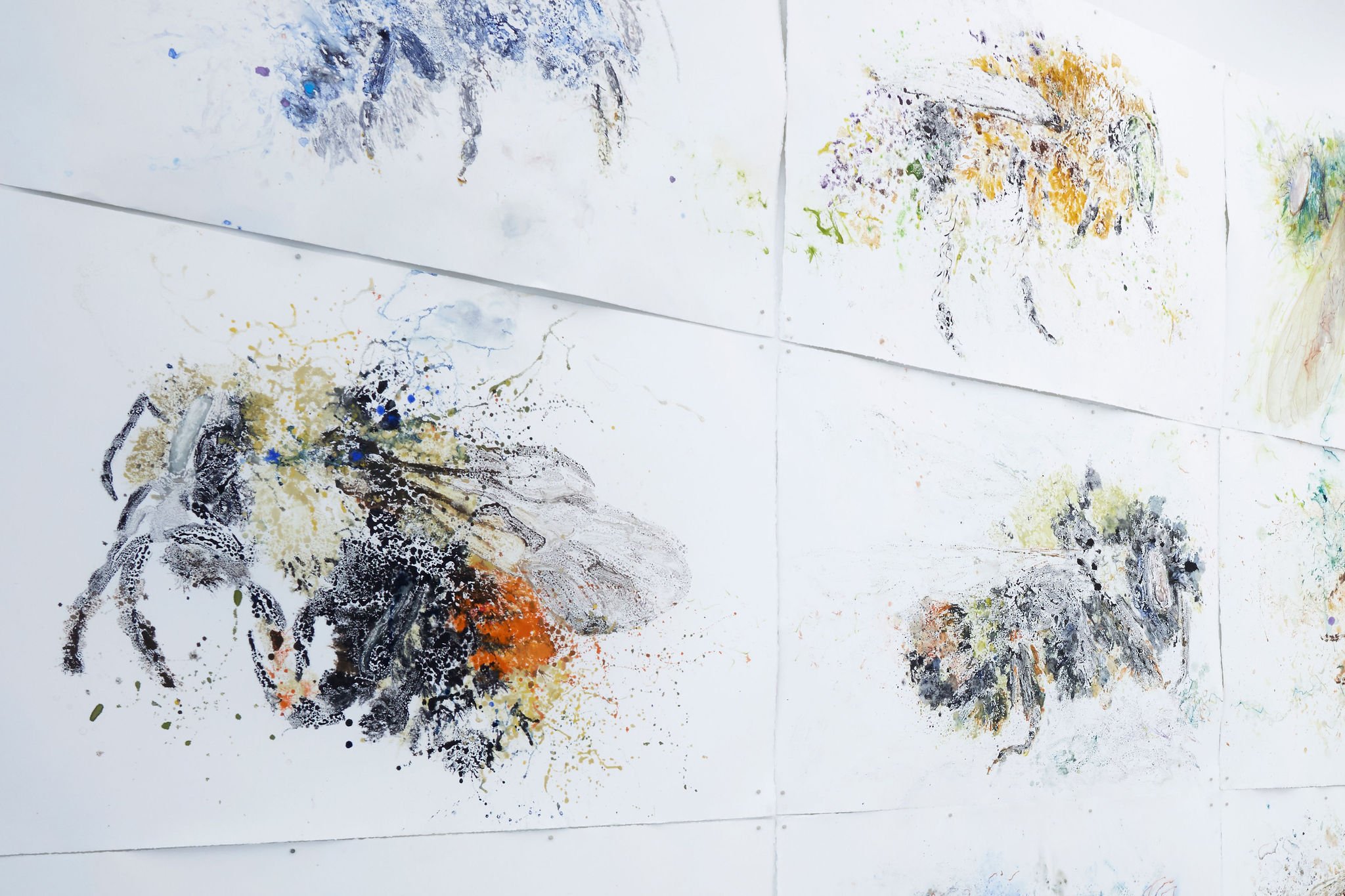
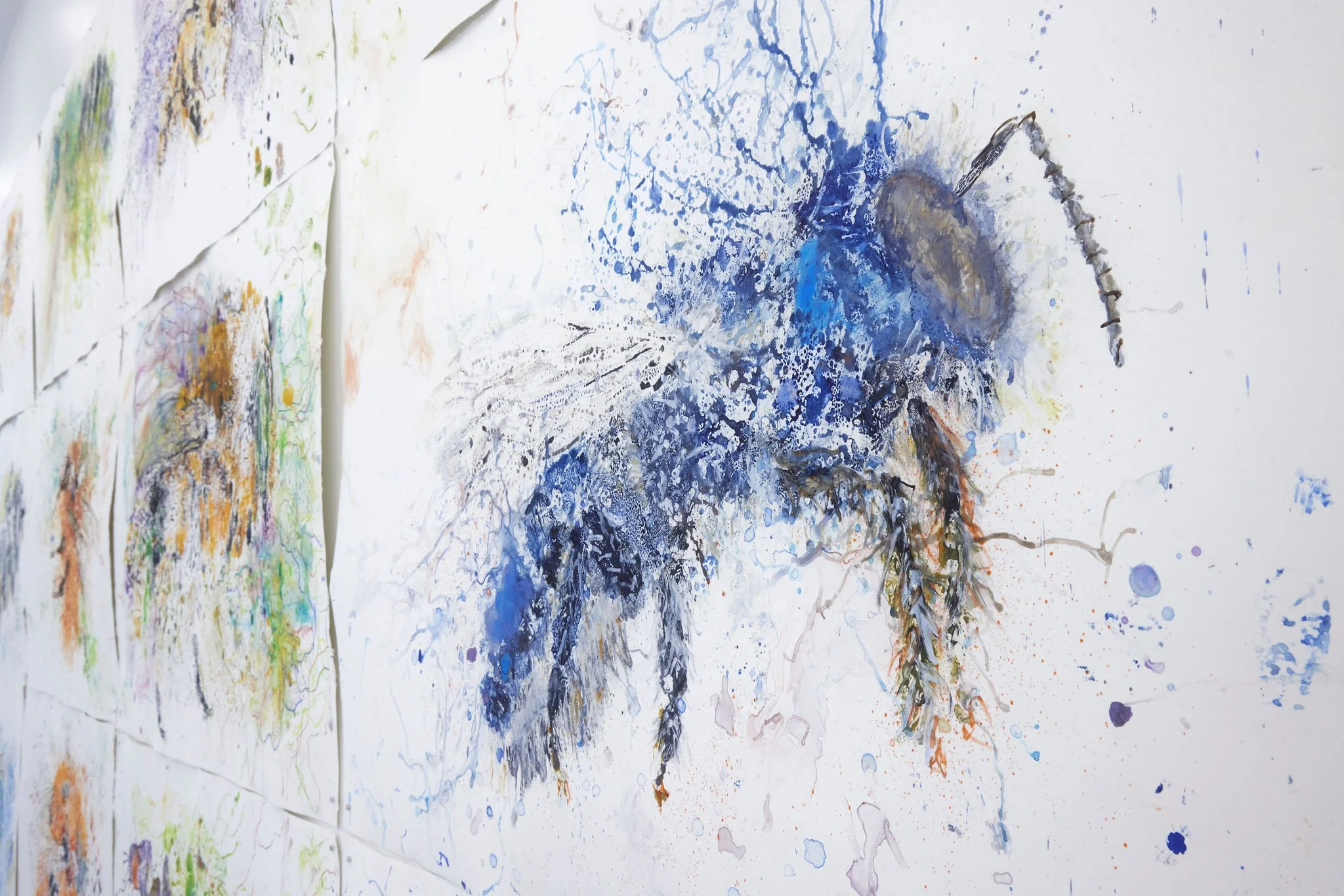
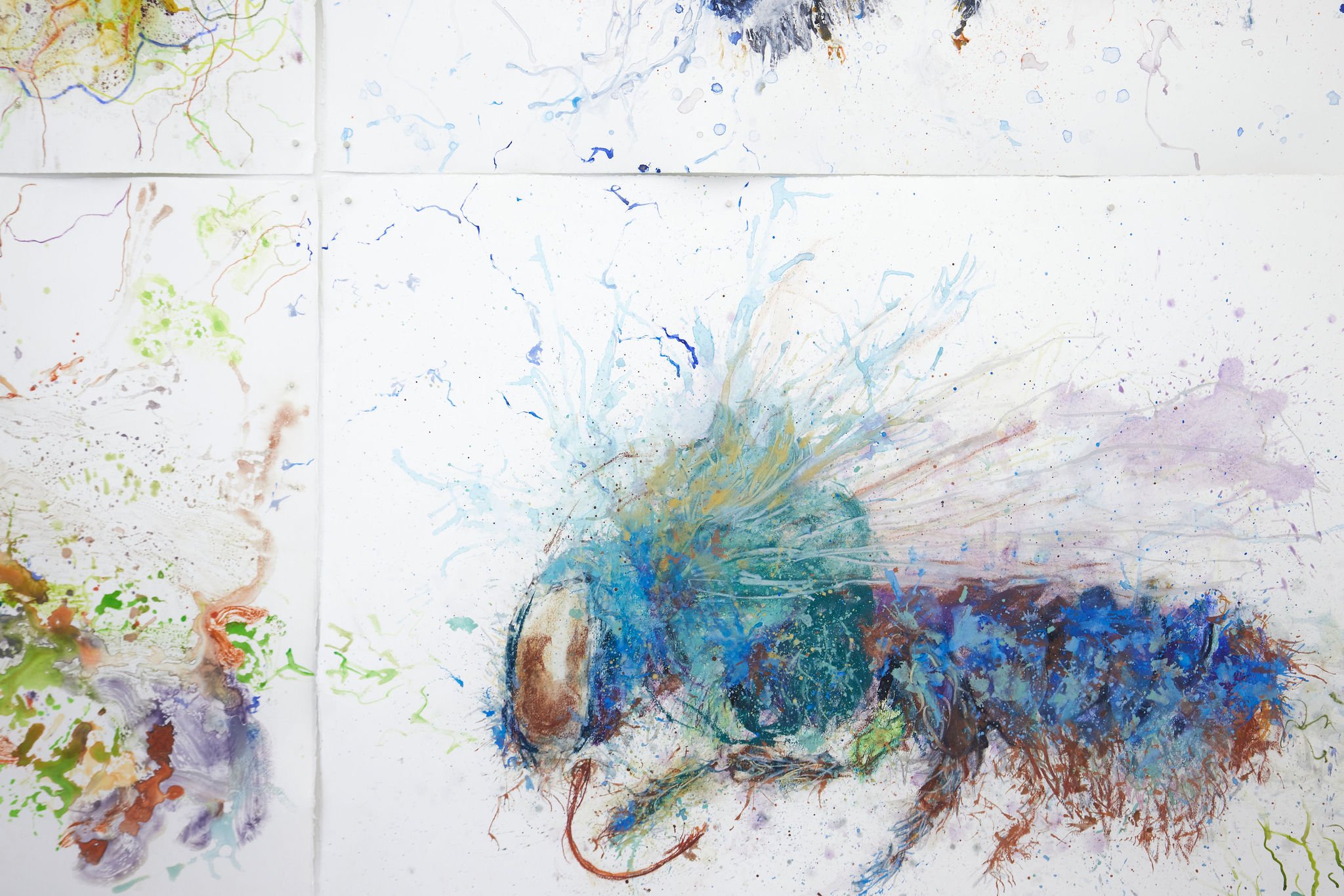
Rumblings is a work in progress, a monumental collection of fifty 30" X 44" watercolor monotypes that draw attention to the endangered knowledge of the 20,000 species of wild bees.

In these works, I carefully manipulate watercolor ink, and solvent into a chaos of infinitely miniscule paint particles. The materials are interconnected across the over-size monotypes, paralleling the synergistic, aqueous effects of the untold bee species' magnetic attraction to golden dust and their corresponding fragility due to the applied chemicals that flood residential gardens and industrial agriculture. Closely studying their exceptional ability to buzz and pollinate with their exceptional pollen-adhering bodies, I use abstraction and zoom in to depict the organized mayhem of their movements.

The installation of Rumblings inspires curiosity, alerting all viewers to pay attention, asking them to consider the unintended consequences of their actions in our-interconnected micro ecosystems. It is a resounding call to decrease pesticide usage, provide habitats for nesting, and plant native indigenous plants providing nectar for the bees that are responsible for 70% of the foods we eat.

What I do not know is when and where they will be installed, when that is in the picture I may find ways to connect the pieces visually. That will have an impact on the statement. Until the plant beautiful native plants.

There are bees that have not been seen since the 60’s that are not listed as endangered.