From Dusk to Dawn- Four works on paper

Written in 2025. Posted late —

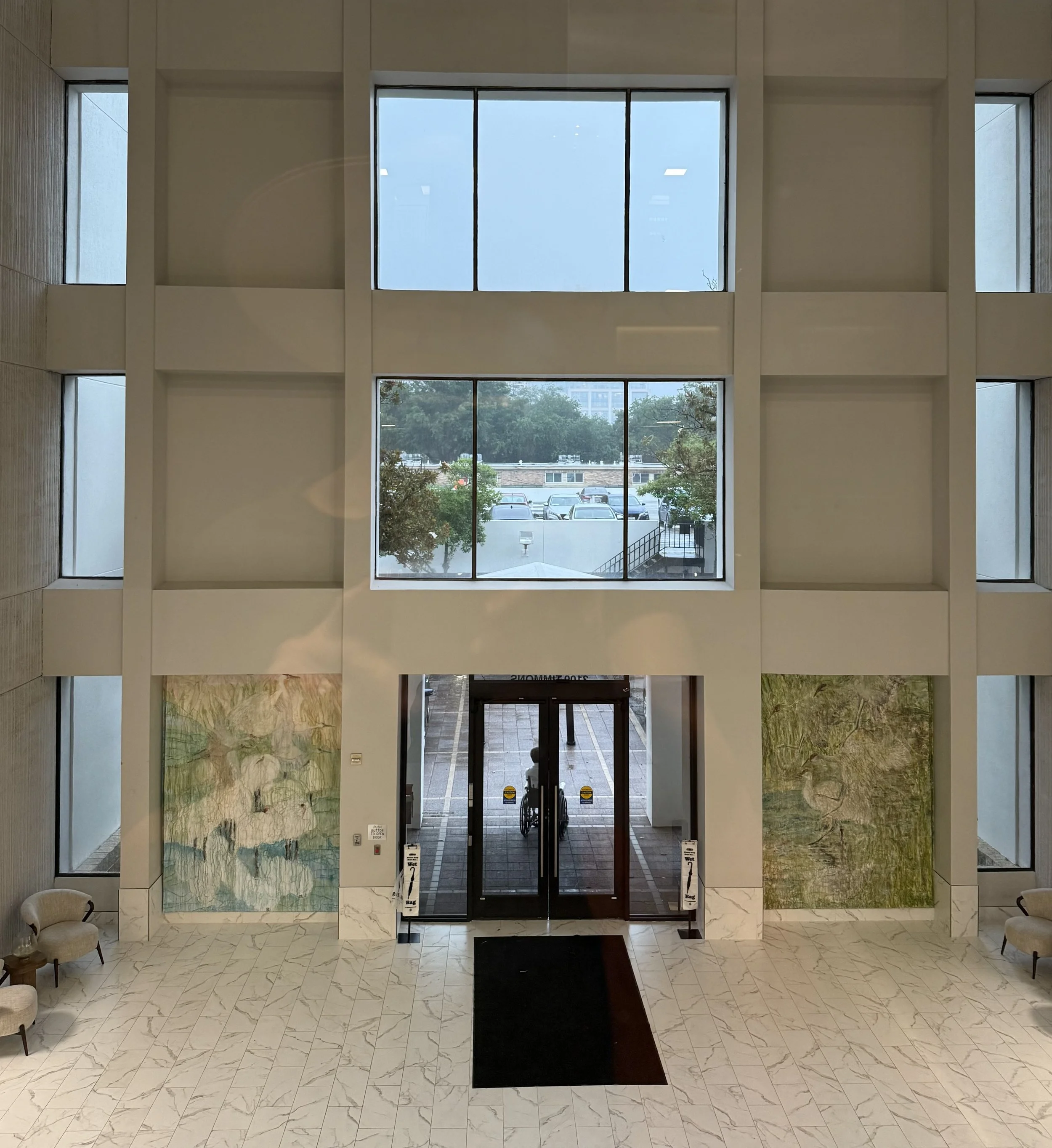
I was contacted to create two small artworks for an office building in Houston getting an updated look — 3100 Timmons Lane.

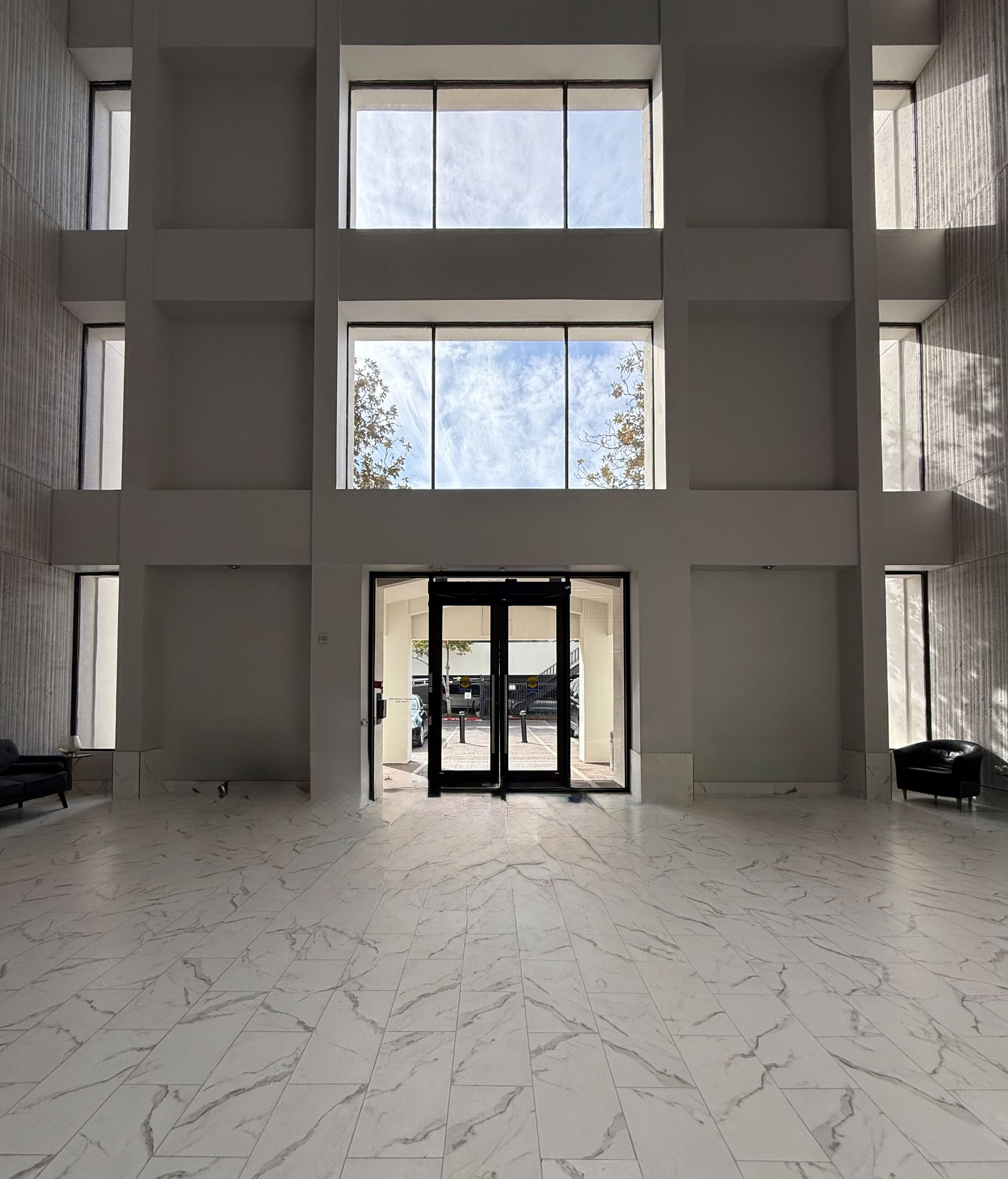
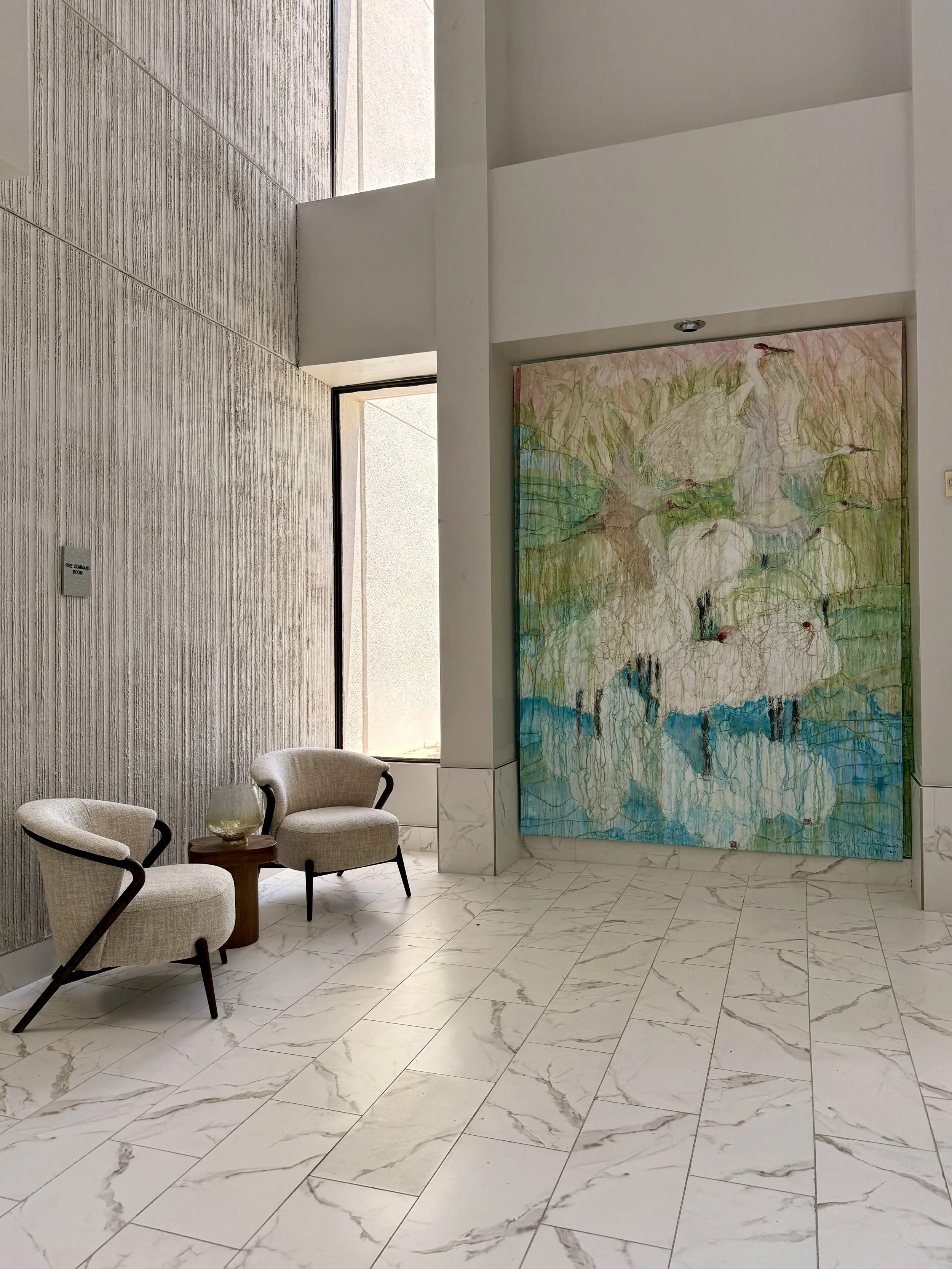
When I saw the space I saw an opportunity. An audience coming and going nine to five with no connection to the natural world right outside their door. A five-story lobby with open wall space and nothing to draw your eye there.

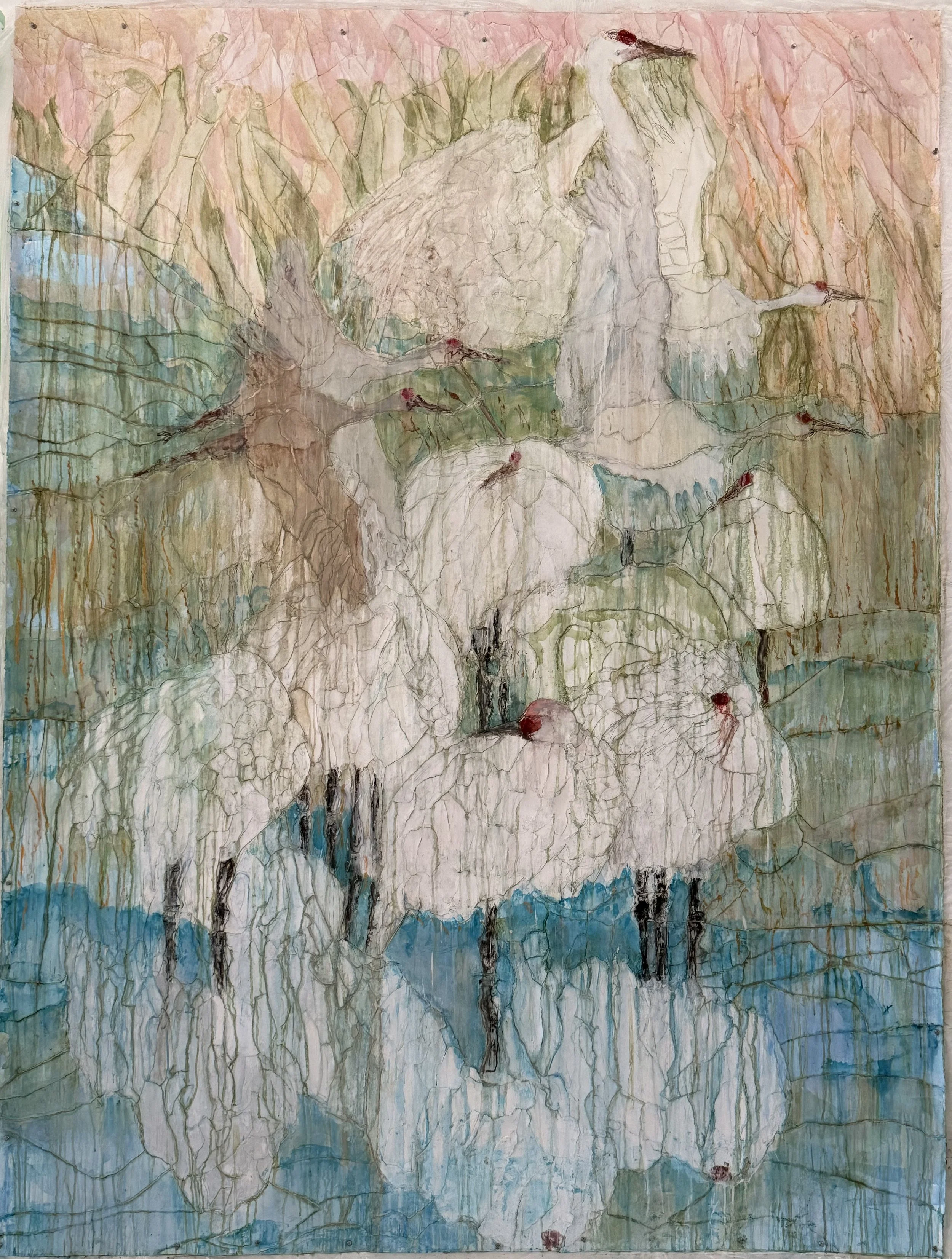
I proposed something bigger than what was asked. Two works, two stories tall — Sandhill cranes in a wetland on the first floor, Roseate spoonbills in the trees on the second. Two successful conservation stories, stacked one above the other, in a building full of people who might never otherwise encounter them.

The developer said yes.

3100 Timmons Lane
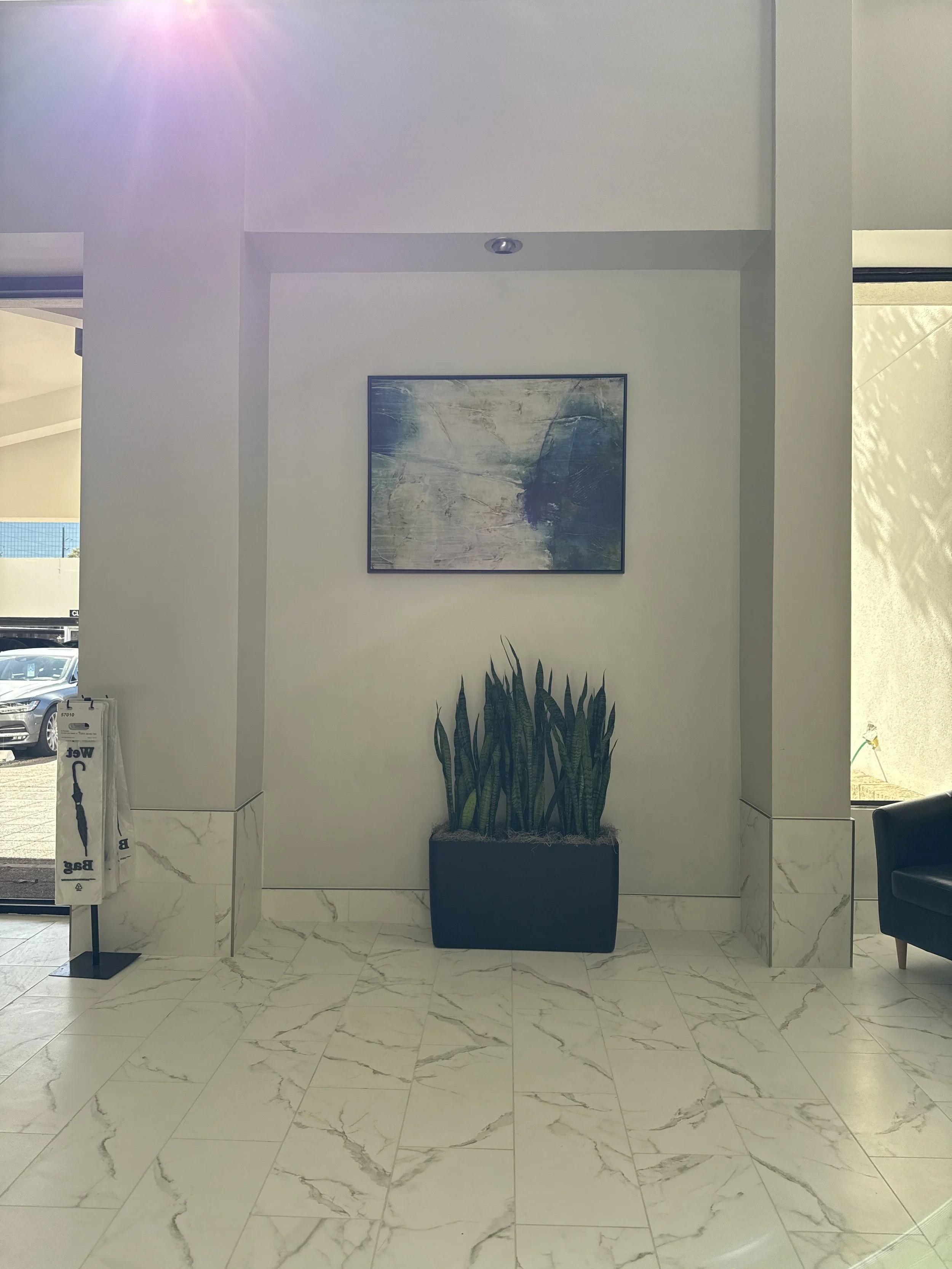
One of the 7’ X 9’ recessed spaces for artwork.
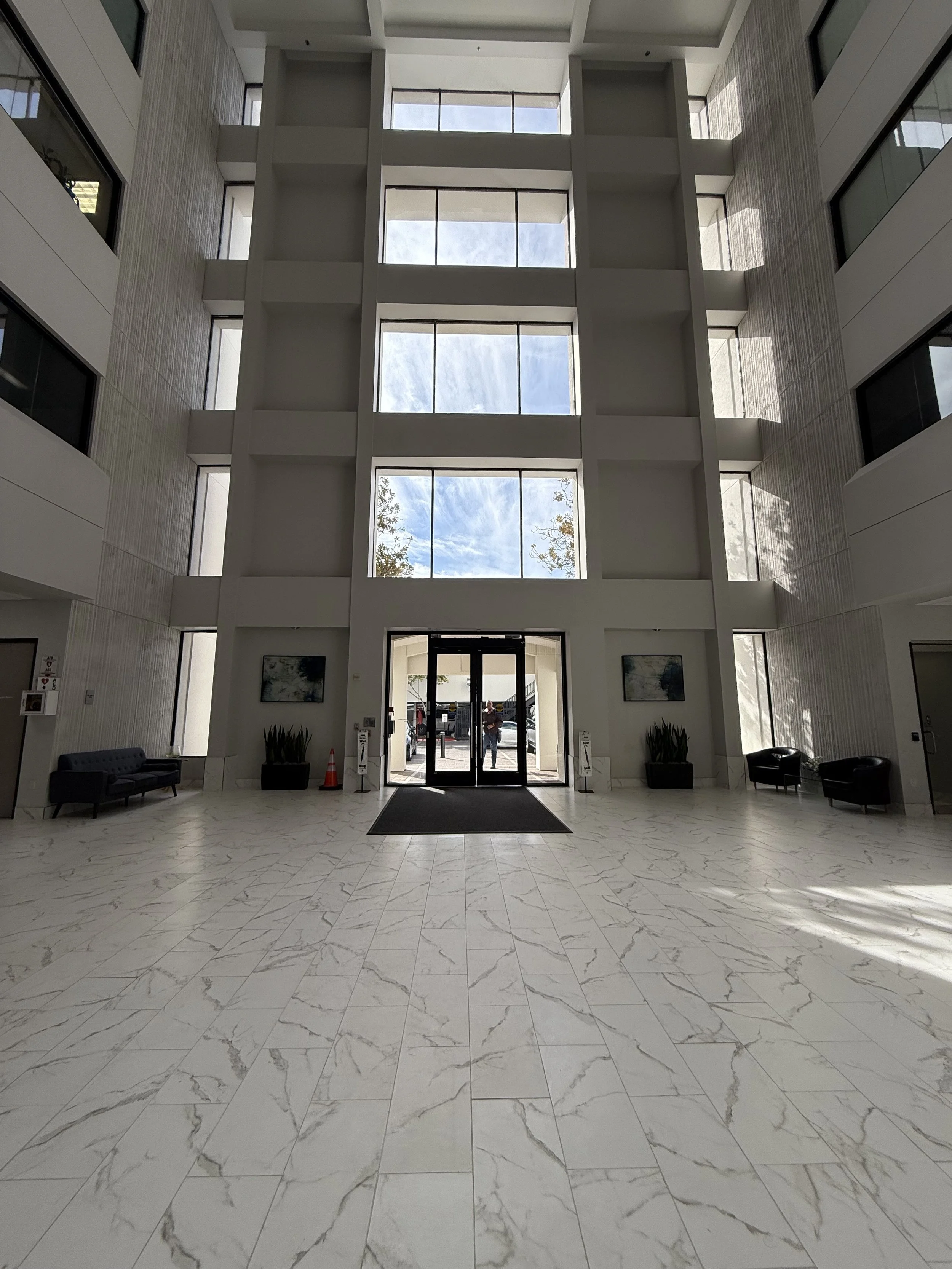
But before any of that — I had to figure out how to make them.

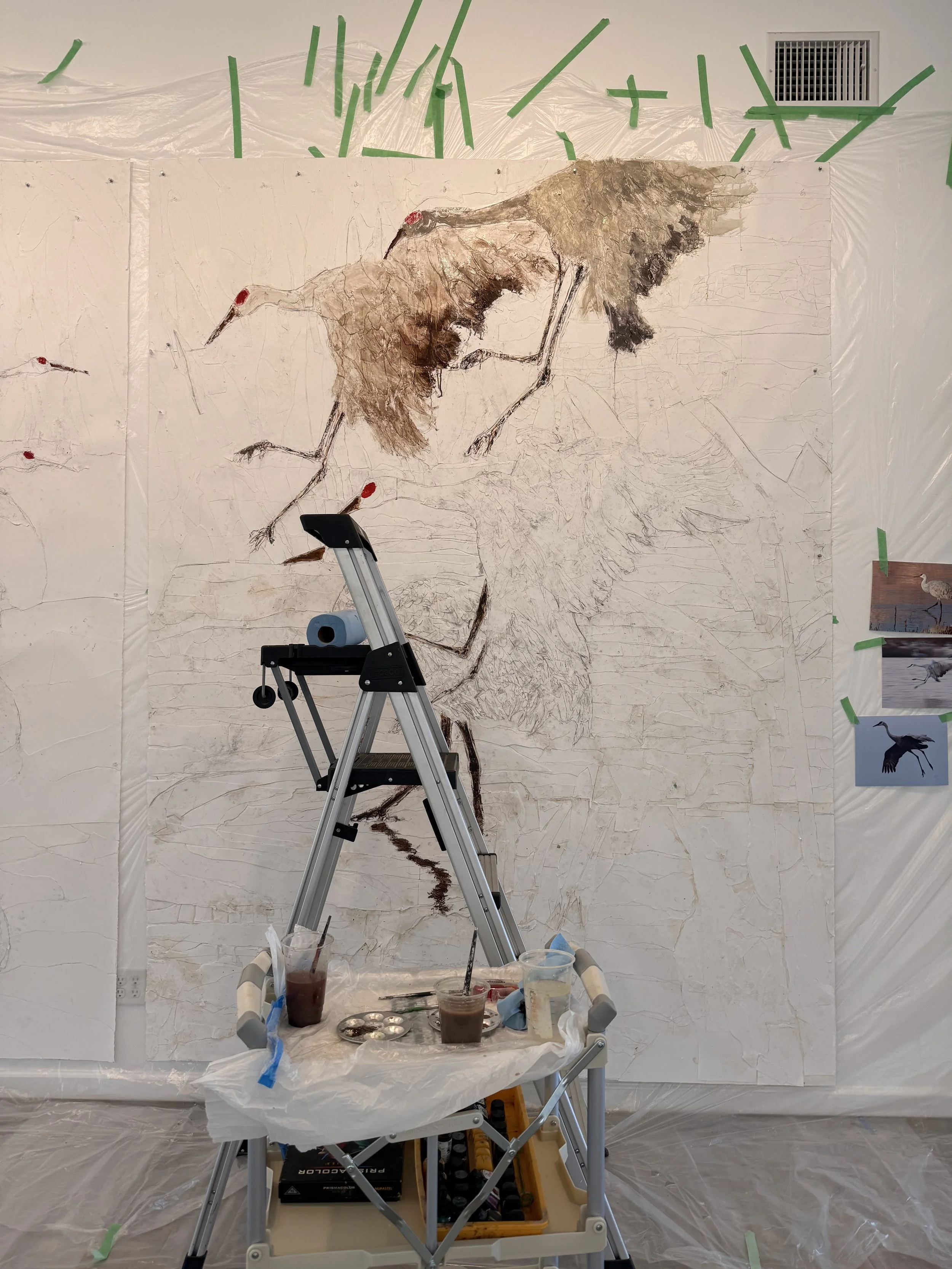
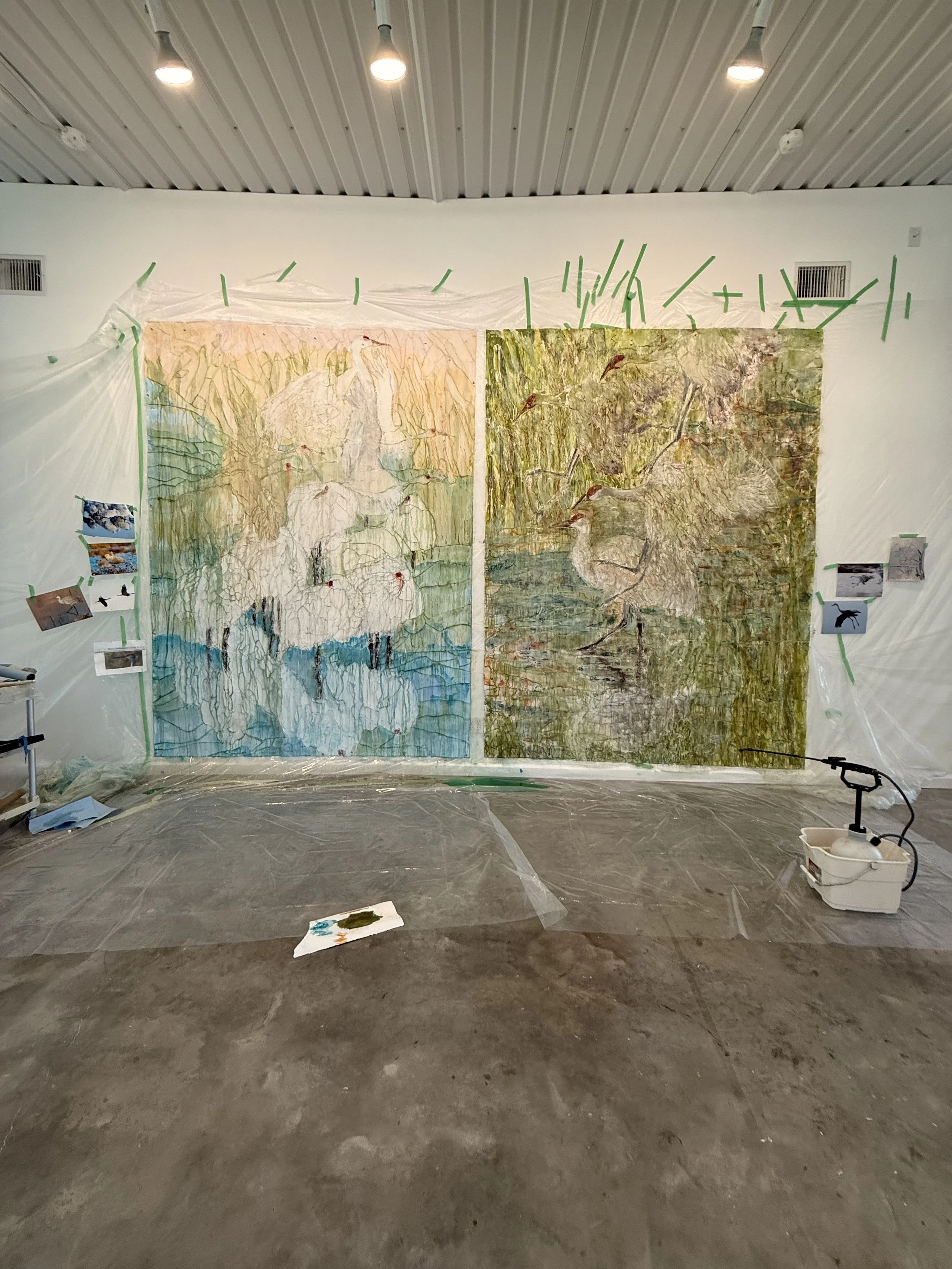
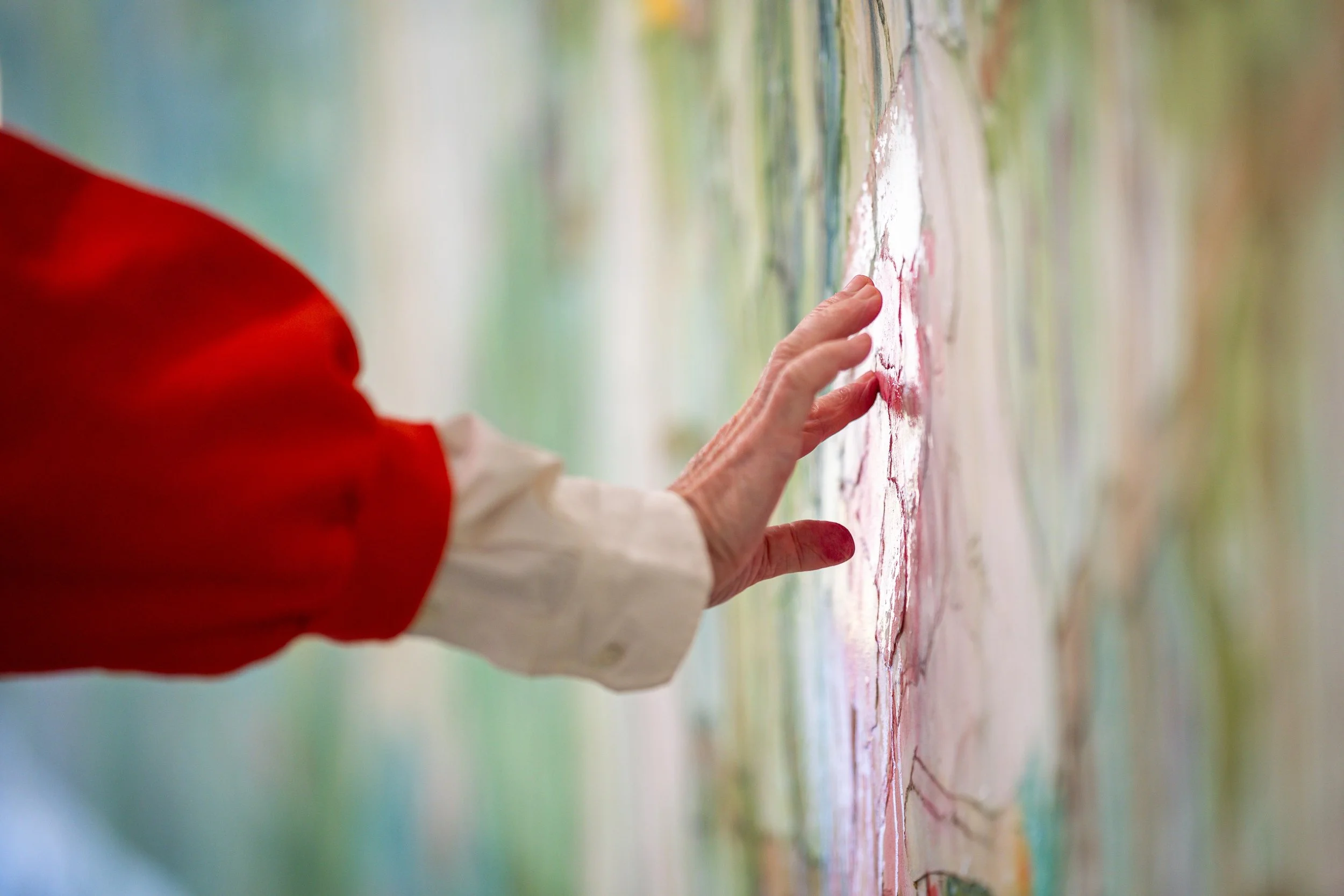
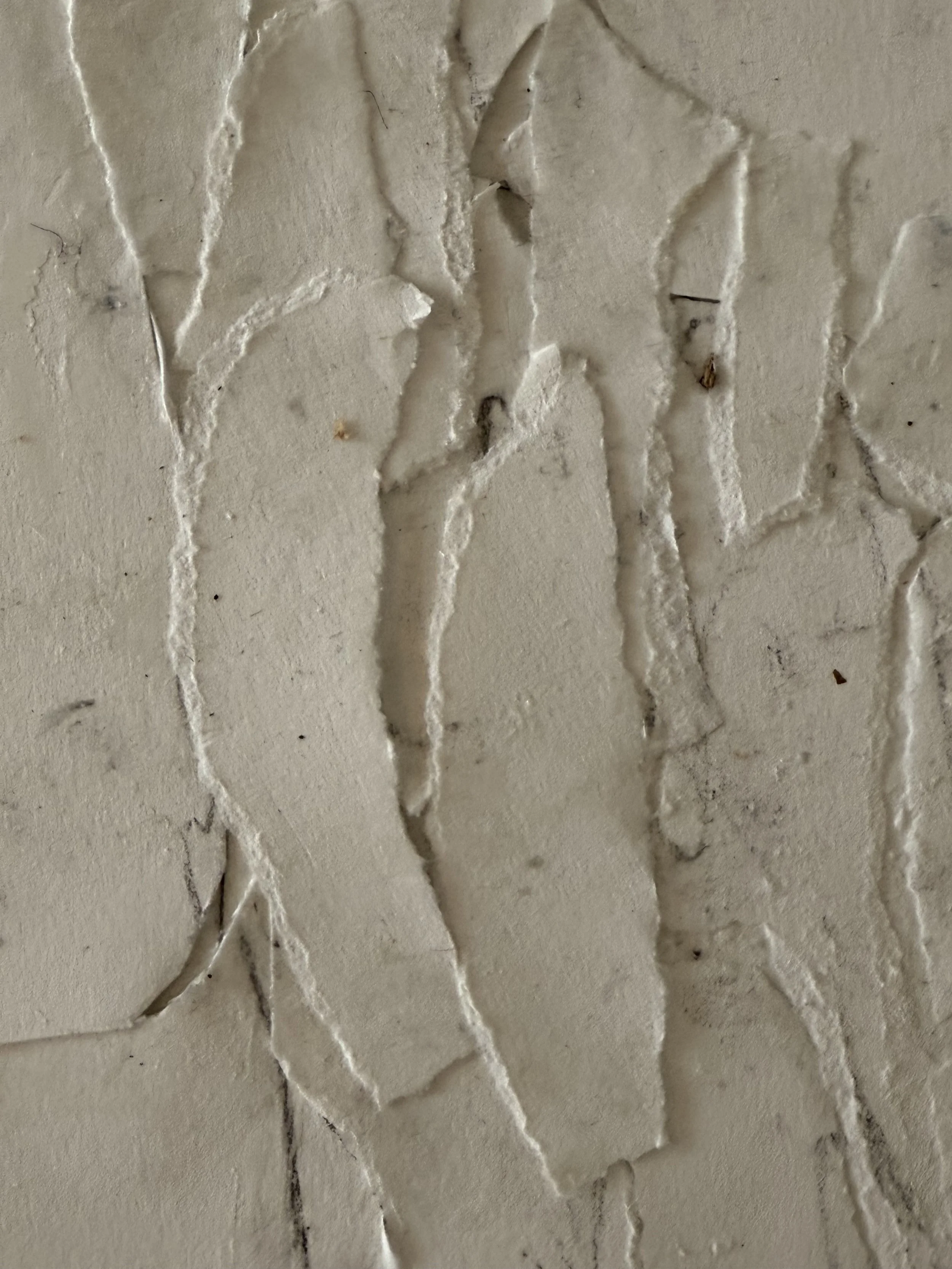
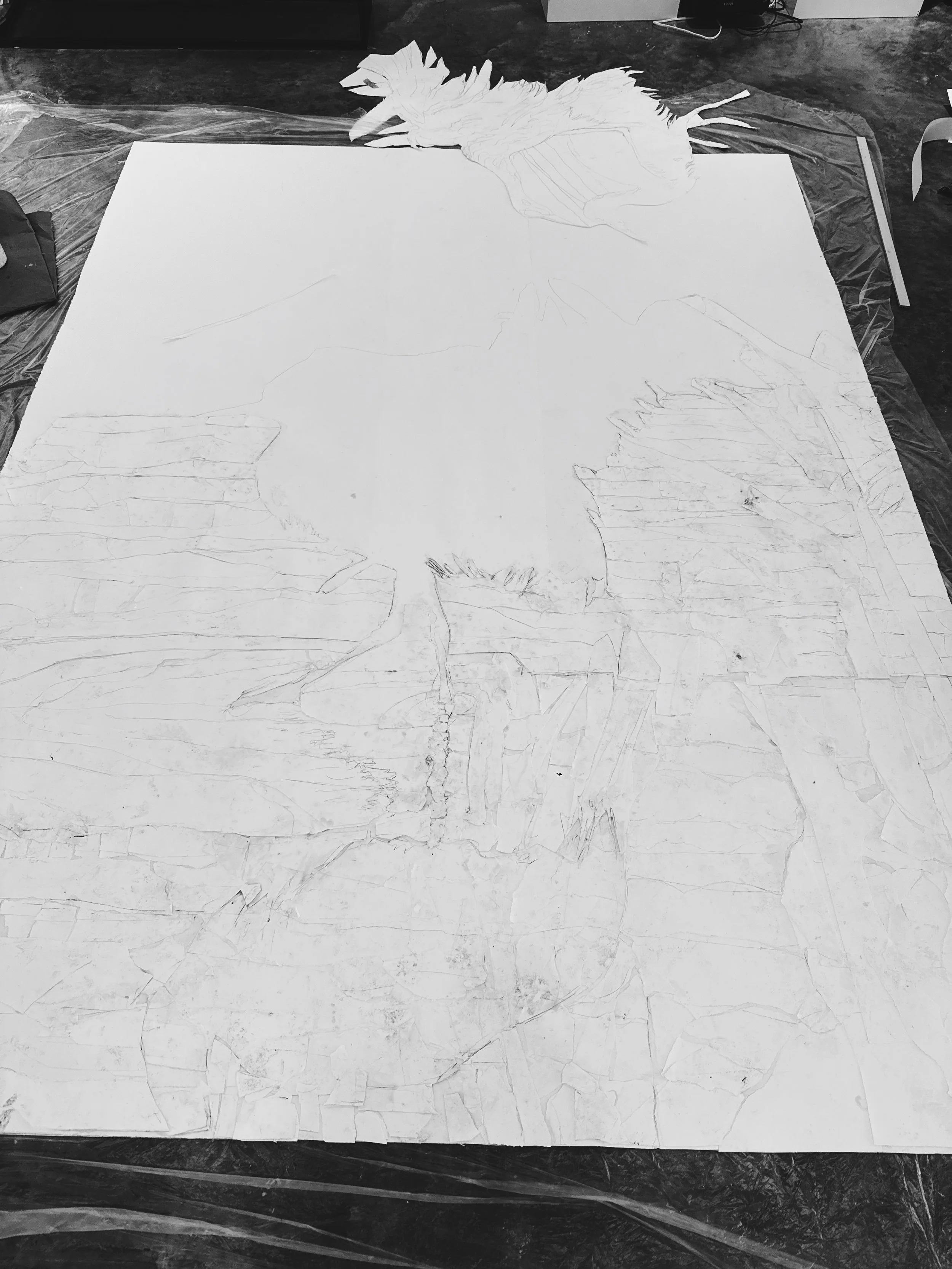
This commission was the first time I worked with a process that has since become central to my practice. I start with a drawing. Then I tear it apart — deconstructing the image into shapes. I reassemble those shapes on a second sheet of paper, building a relief. Once the relief is built I brush on large swaths of watercolor, then use a garden sprayer to manipulate the color — letting it run into the crevasses of the relief, redrawing the image through movement and gravity. Then pastels for the detail marks. The drawing finds itself again, but changed. Looser. More alive.

That process led directly to Unfolding Hope — the body of work I created for the Houston Endowment Jones Artist Award. But it started here, in a studio sketch for an office building on Timmons Lane, trying to figure out how to put a Sandhill crane in a five-story lobby.
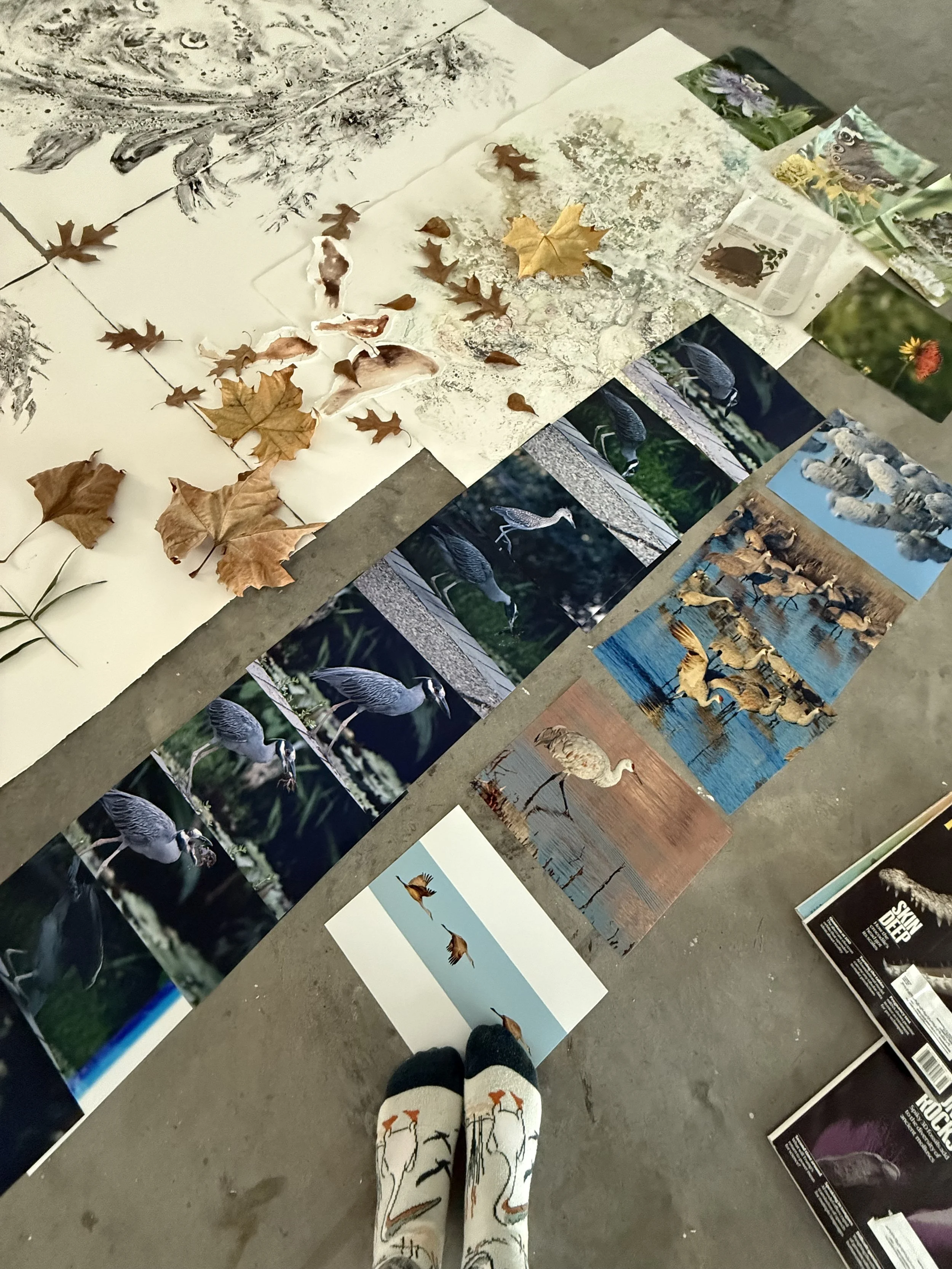
My presentation to the developer.
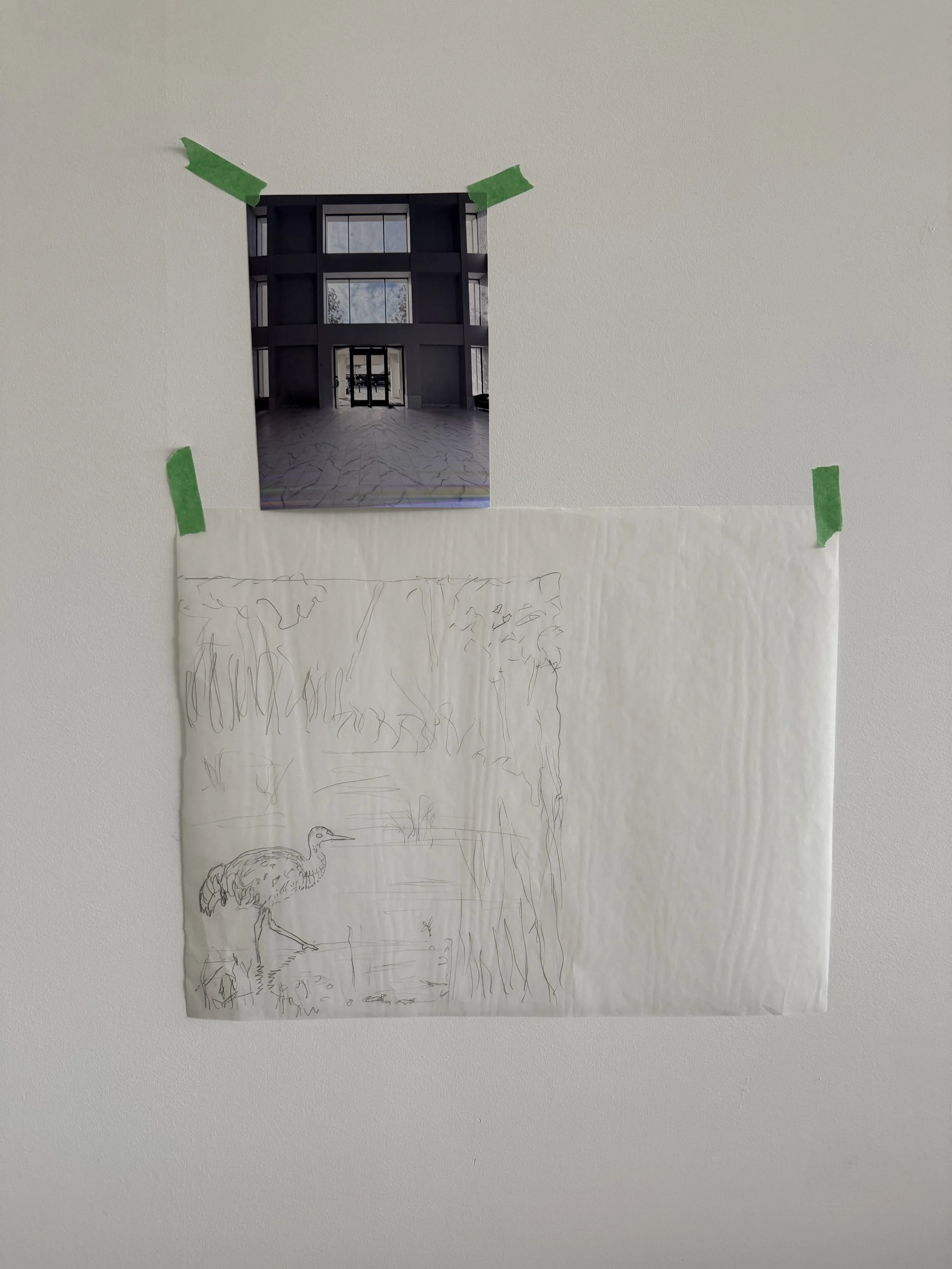
A early sketch
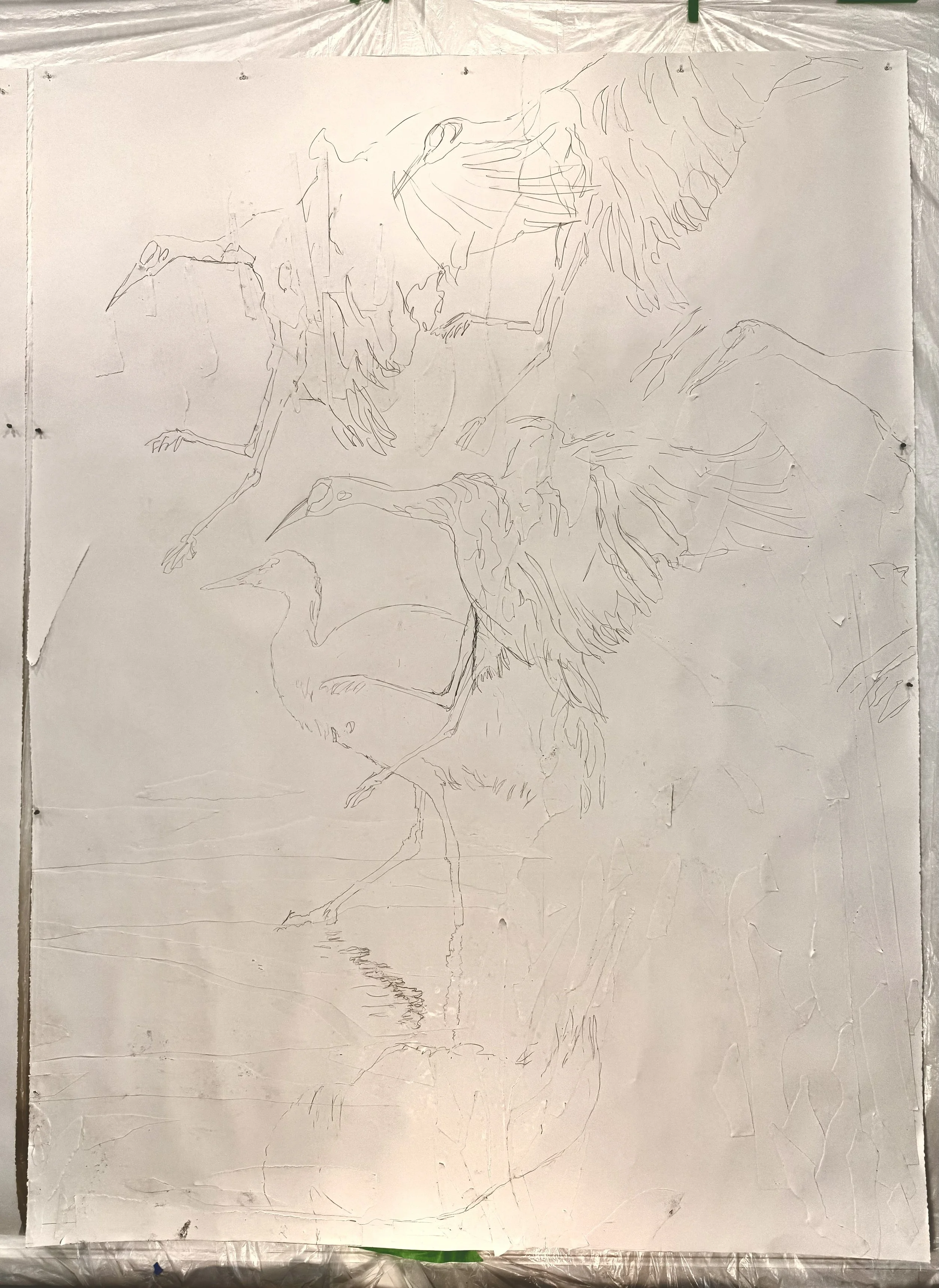
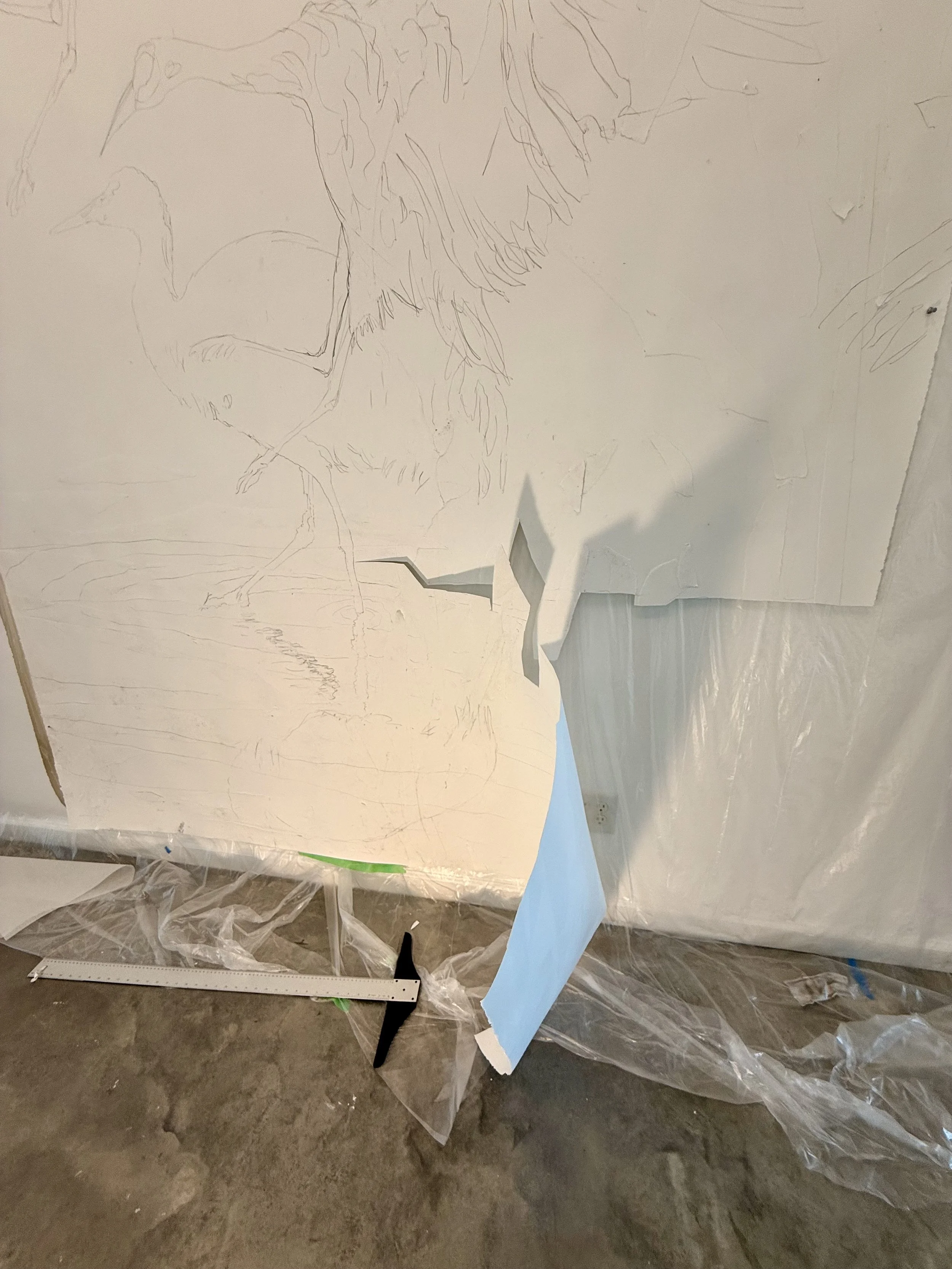
The next step involved deconstructing the drawing by tearing it into various shapes. After that, I can create a relief by reassembling these shapes on a second sheet of paper..
Why Sandhill cranes?

In the early 1900s relentless hunting pushed them to the brink of extinction. Only 12 mating pairs remained. What brought them back was wetland restoration and habitat protection — initiated by hunters who understood what they were losing. Today Sandhill cranes are the most plentiful crane species in the world.

That is the story I wanted in that lobby. Not a decorative bird. A comeback. Evidence that when humans choose to act as conservationists, the results can be staggering.

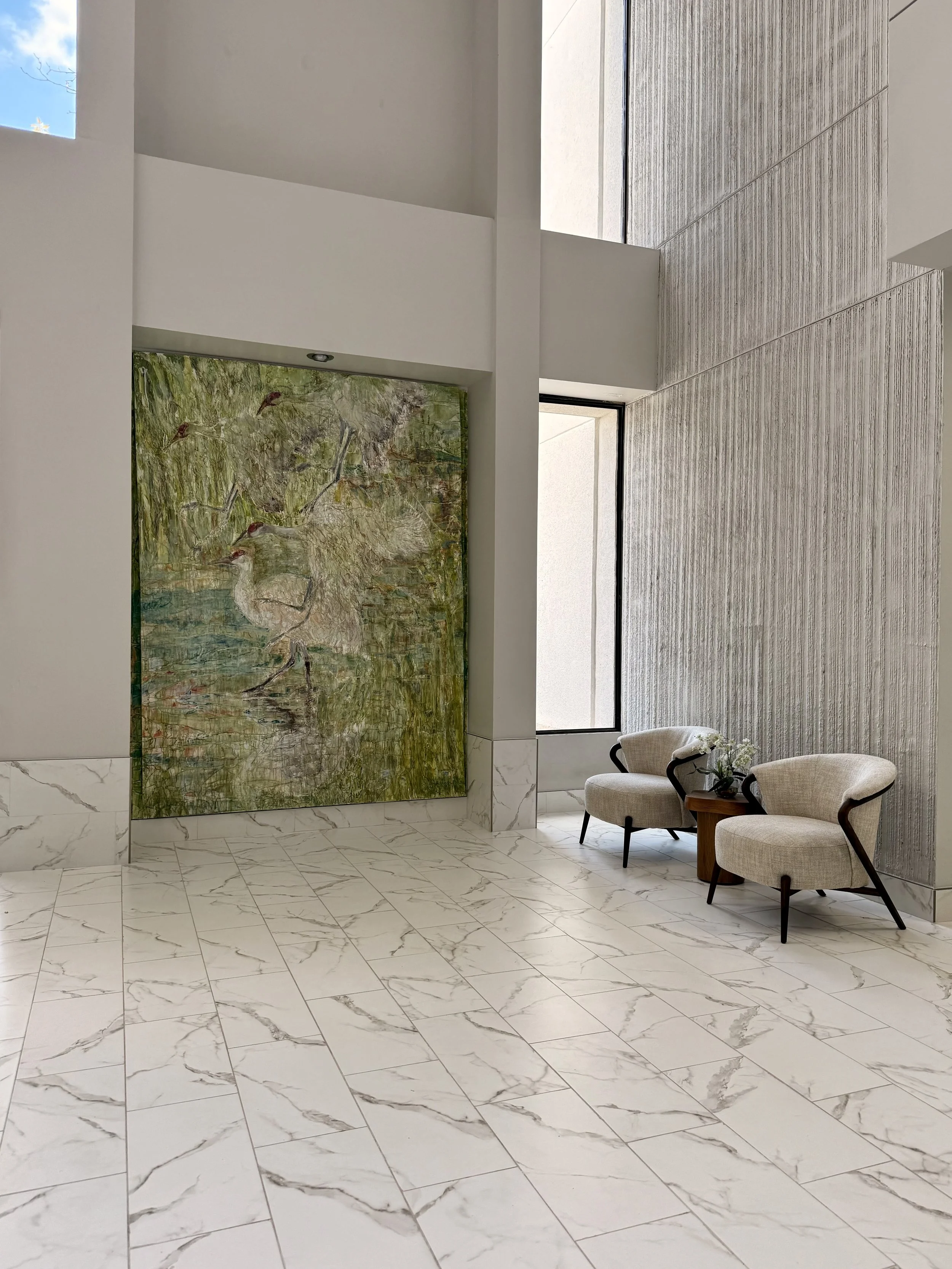
The Sandhill cranes are installed. The Roseate spoonbills are finished and in storage until the upper levels are repainted.

When the cranes went up the developer told me something I didn’t expect — the building became a community. Tenants were talking to each other about the birds. He leased his largest spaces the next month.

That is what I hoped for. Not decoration. A reminder — for people who spend their days inside — that nature matters and we feel its pull even through art.

The two finished pieces — Sunrise: Sandhill Cranes and Sundown: Sandhill Cranes — can be seen in my 2025 portfolio. Come see them. Better yet — come to the studio

Then comes the color.
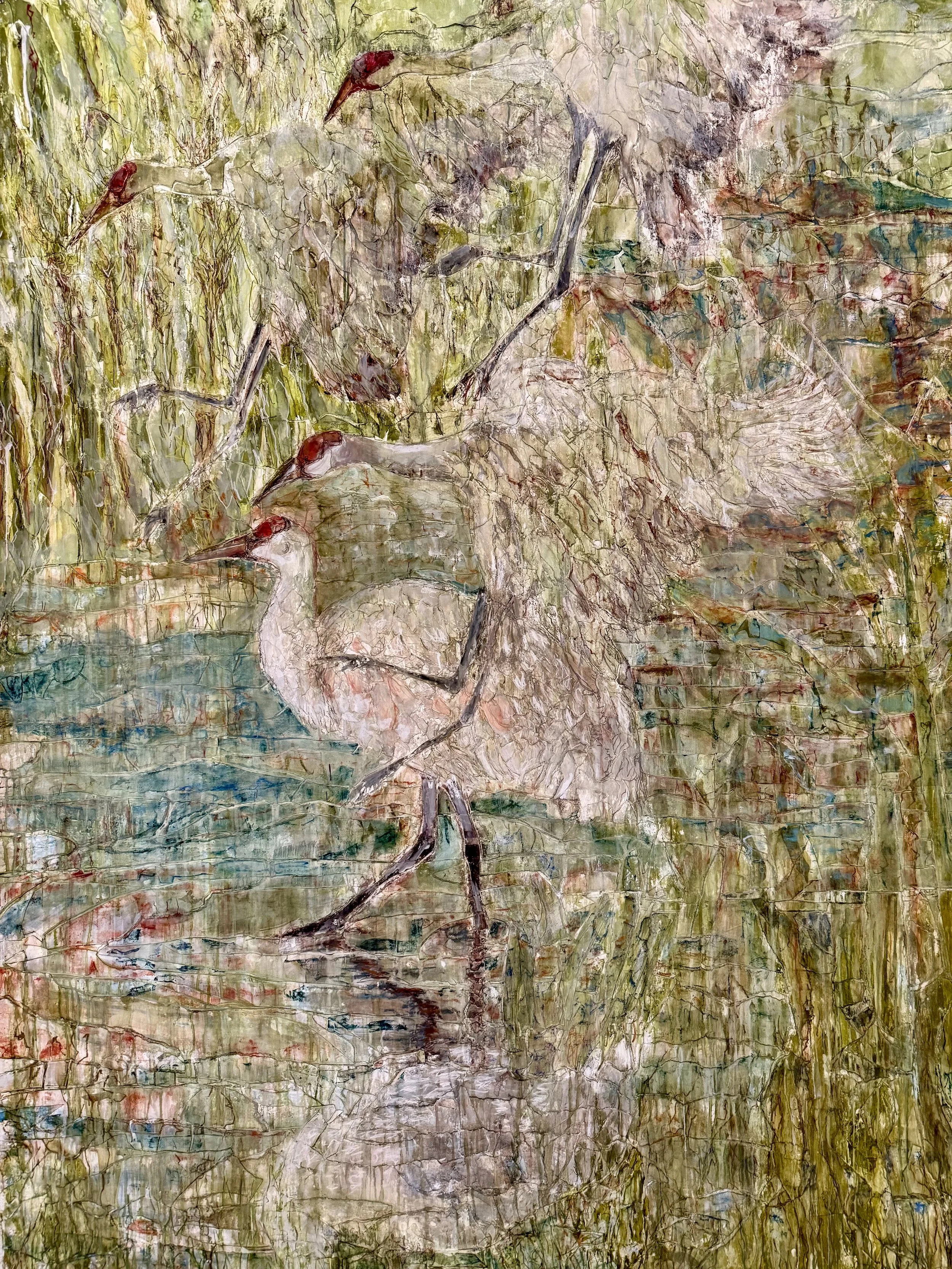
SUNDOWN CRANES

7” X 9”4”

watercolor, pastels, ink on collaged Stonehenge paper.

Image by R. Wells
SUNRISE CRANES

7” X 9”4”

watercolor, pastels, ink on collaged Stonehenge paper.

Image by R. Wells
Passionate for Pre-K

This post will serve as a journal for the work.

“My four-year-old daughter saw her first butterfly and was terrified.”

— Lawndale Art Center patron, 2022

This remark, shared during my Symbiosis artist talk at the Lawndale Art Center, stopped me cold. Imagining a generation untouched by the gentleness and fragility of wings — this is a sorrow too heavy to bear and do nothing.

Wildlife plays a vital role in early childhood brain development. At the very least, let each school day begin with a procession past living poetry: vines sculpted in fragrant blossoms of lemon honey, trembling with the promise of caterpillars, alive with the fragile ballet of butterflies. Each child deserves to develop in the company of nature’s intelligence.

With small acts of passion, this is within reach.

DESCRIPTION

Passionate for Pre–K is a living social sculpture installed in the fall of 2025 on the chain-link fences surrounding the playground at Clemente Martinez Elementary School in Houston, Texas. I sourced approximately 90 Texas native vines from my three living sculptures: Symbiosis at the Lawndale Art Center, Deeper Than That at a private residence, and Sequel, located next to my art studio in Acres Homes. Passion vines are highlighted in the mix. Sourcing from multiple locations supports the DNA diversity of the ecosystem. Hope Stone and landscape architect Caroline Craddock coordinated this installation with the school administration.

THE PROCESS

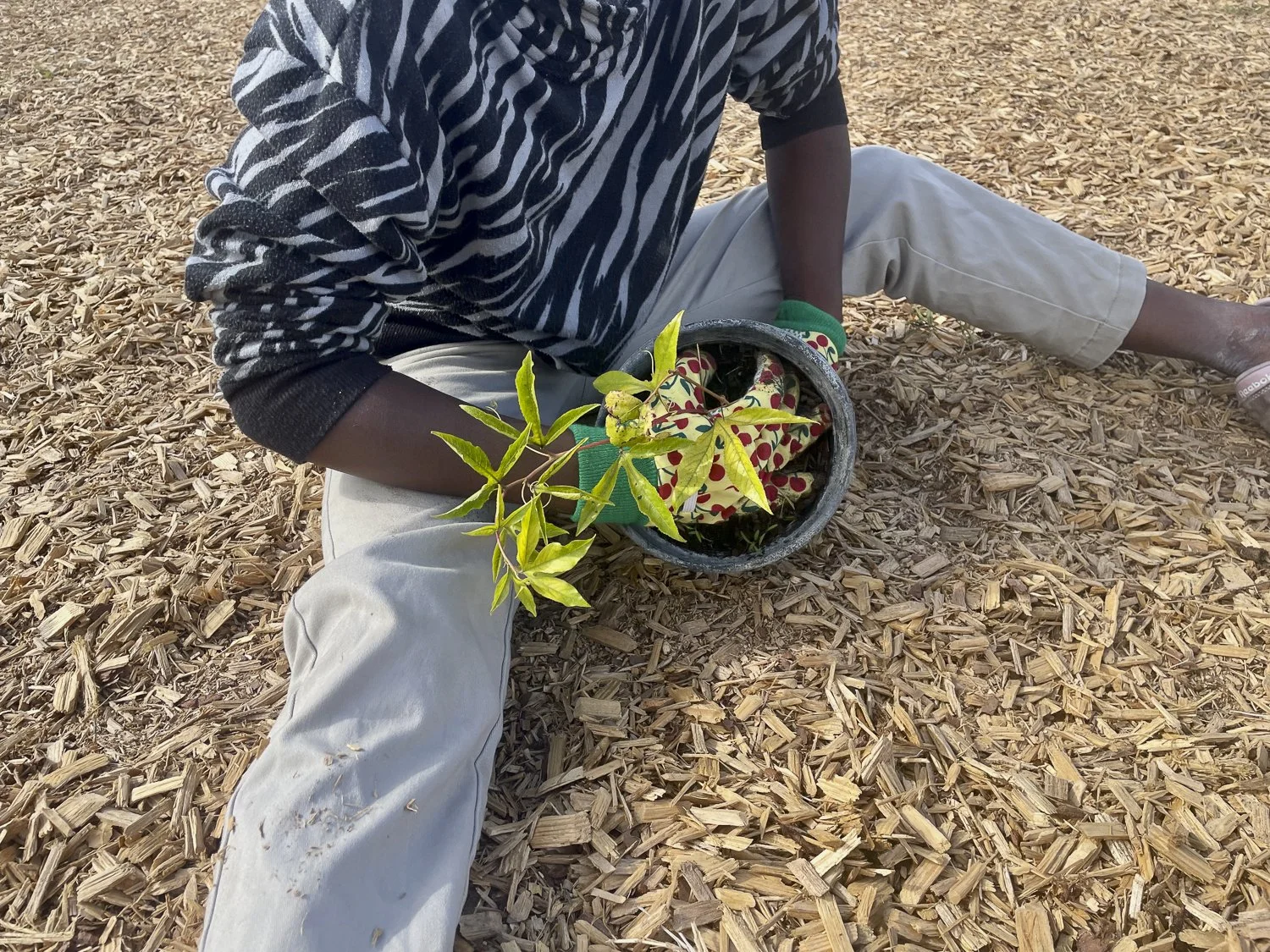
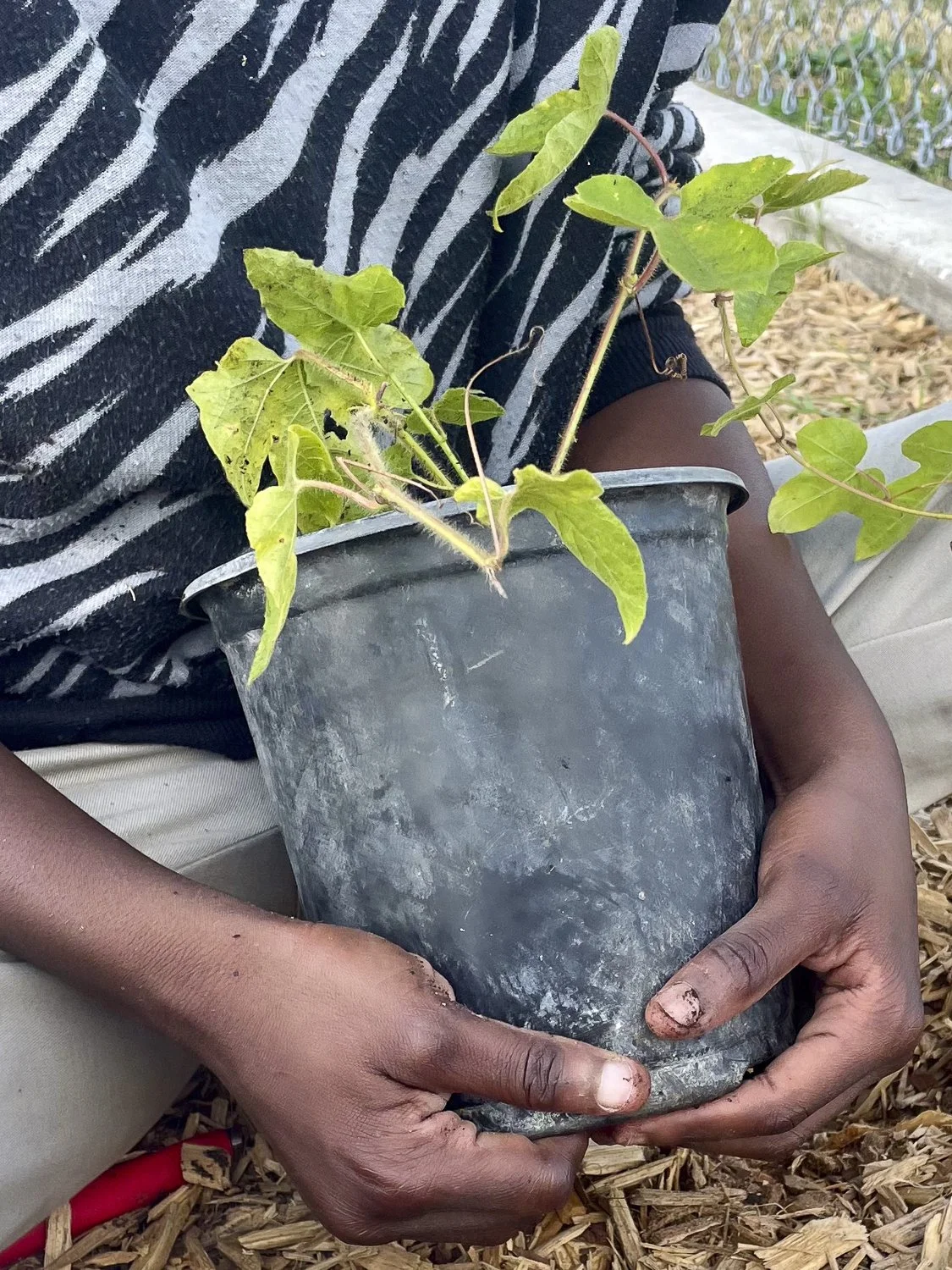
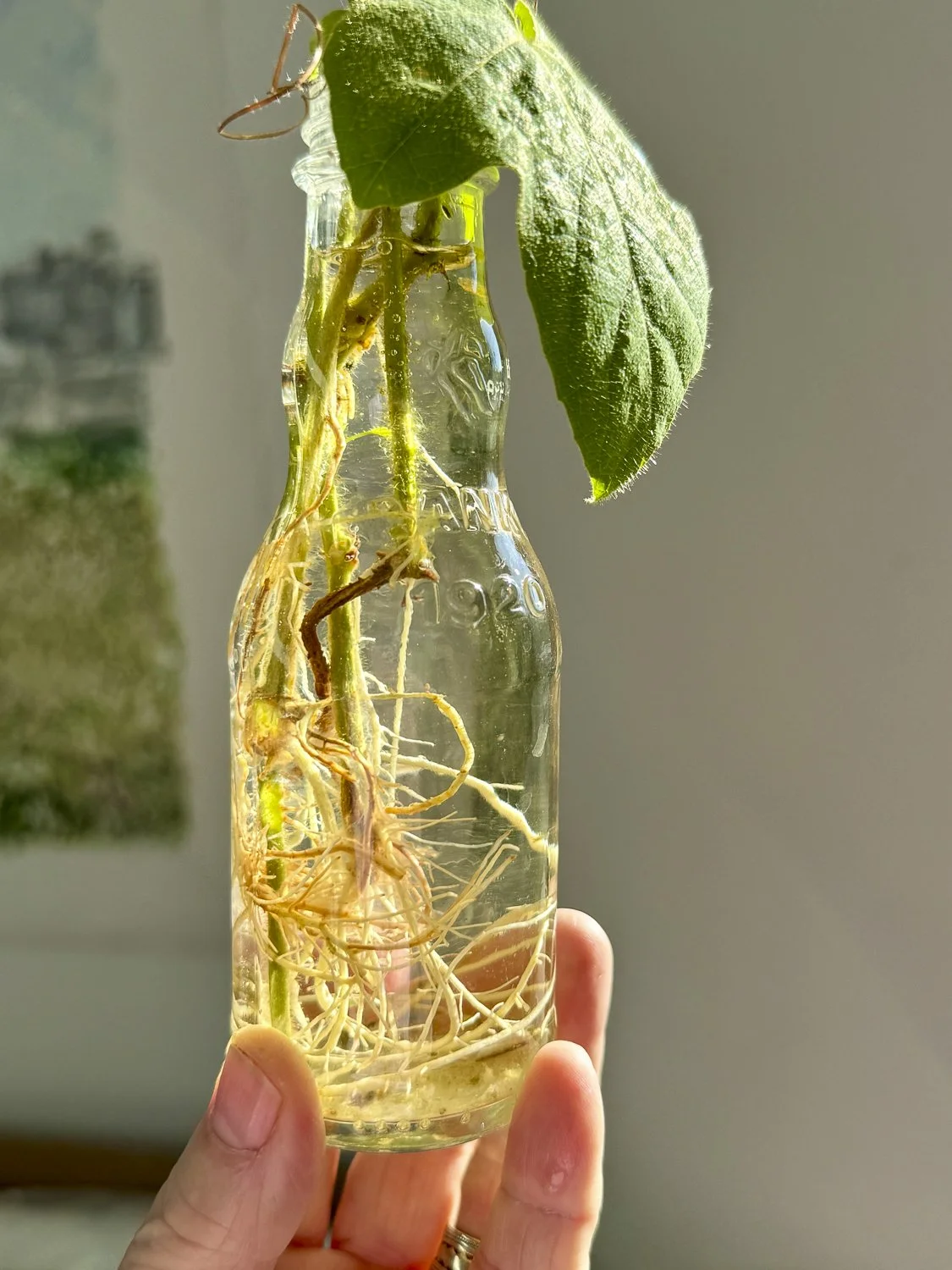
Taking tender 10-inch vine cuttings, using root stimulator and native leaf mold to propagate the plants. I selected 90 plants of different species to support a variety of wildlife and accommodate different growing seasons. The school community assisted with the planting in early October.

LONG-TERM GOAL

As ecological knowledge from Symbiosis has taken root in Deeper Than That, which has grown into Sequel, the hope is that Passionate for Pre–K will act as a catalyst. Annually, new tendrils — carefully propagated — will be gifted from Clemente Martinez Elementary School to neighboring schools, allowing the spirit of regeneration to spread from playground to playground, blossoming into a living legacy of wonder and natural intelligence.

PLANT LIST

May pop, Passiflora incarnata

Stinking passion vine, Passiflora foetida

Various proven passion vine hybrids

Trumpet honeysuckle, Lonicera sempervirens

Hairy clustervine, Jacquemontia tamnifolia

Muscadine grape, Vitis rotundifolia

American wisteria, Wisteria frutescens

Crossvine, Bignonia capreolata

Carolina jessamine, Gelsemium sempervirens

COLLABORATION

Passionate for Pre–K is a collaboration with Hope Stone, Caroline Craddock, and the Clemente Martinez Elementary School community. This would not exist without them, or without the incredible volunteers who gave their time and hands to this work.

NOVEMBER 2025 UPDATE — SETBACK & RESILIENCE

During phase two, a fifth-grade class carefully planted the remaining plants for the installation. The following week, the eager students returned to check on their plantings — and found devastation. A child left unattended in the play area had pulled up plant after plant, leaving only 7 of the original 90 still alive.

This is heartbreaking and frustrating — but it highlights exactly how important this project is. The lessons a garden teaches about social responsibility, care, and wonder are fundamental. I will not let one act derail it. Every child has the right to be inspired by nature.

I am propagating new cuttings. We plant again in the spring.

Special thanks to Caroline Craddock for capturing these moments in photographs.

—special thanks to Caroline Craddick for capturing these moments in photos.

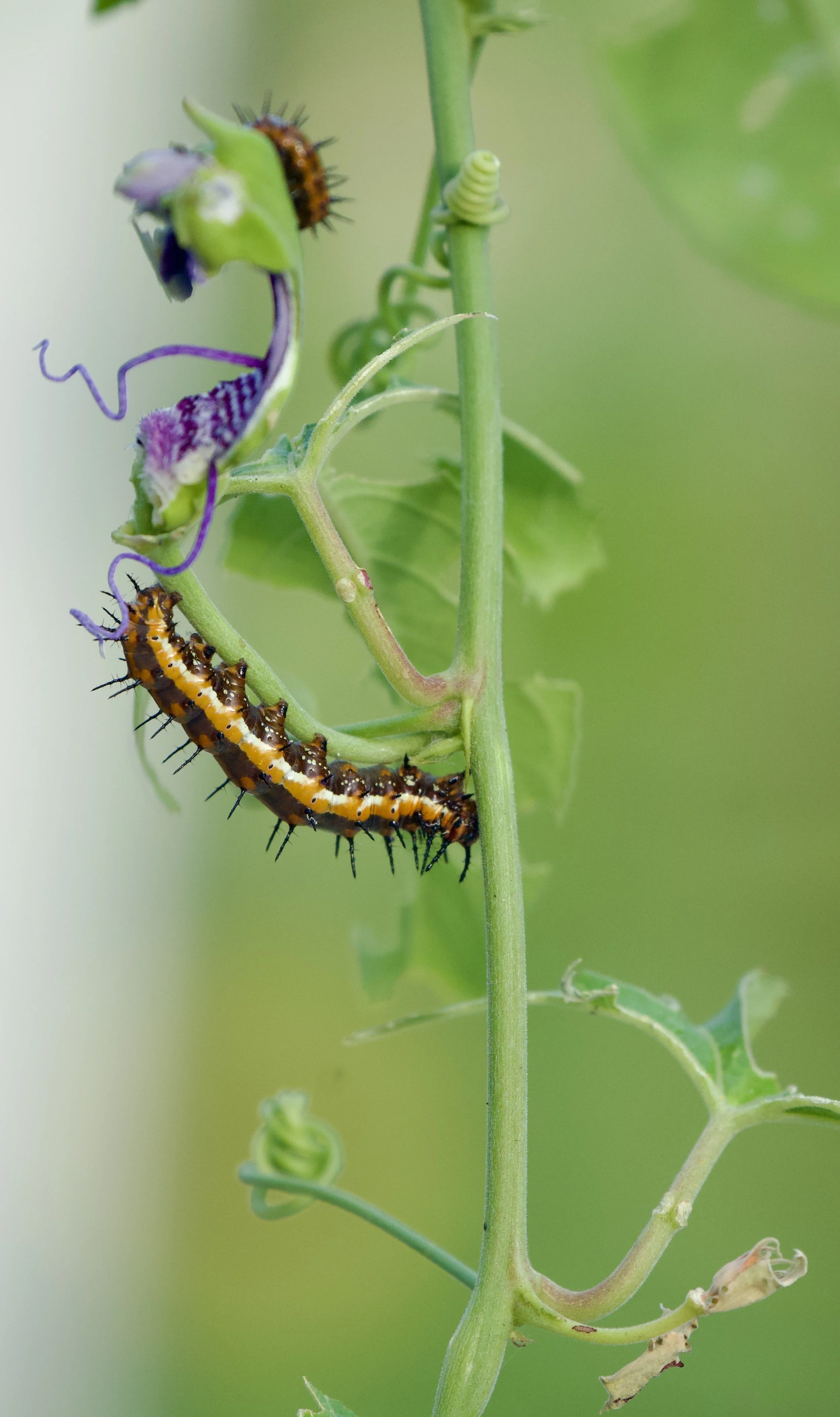
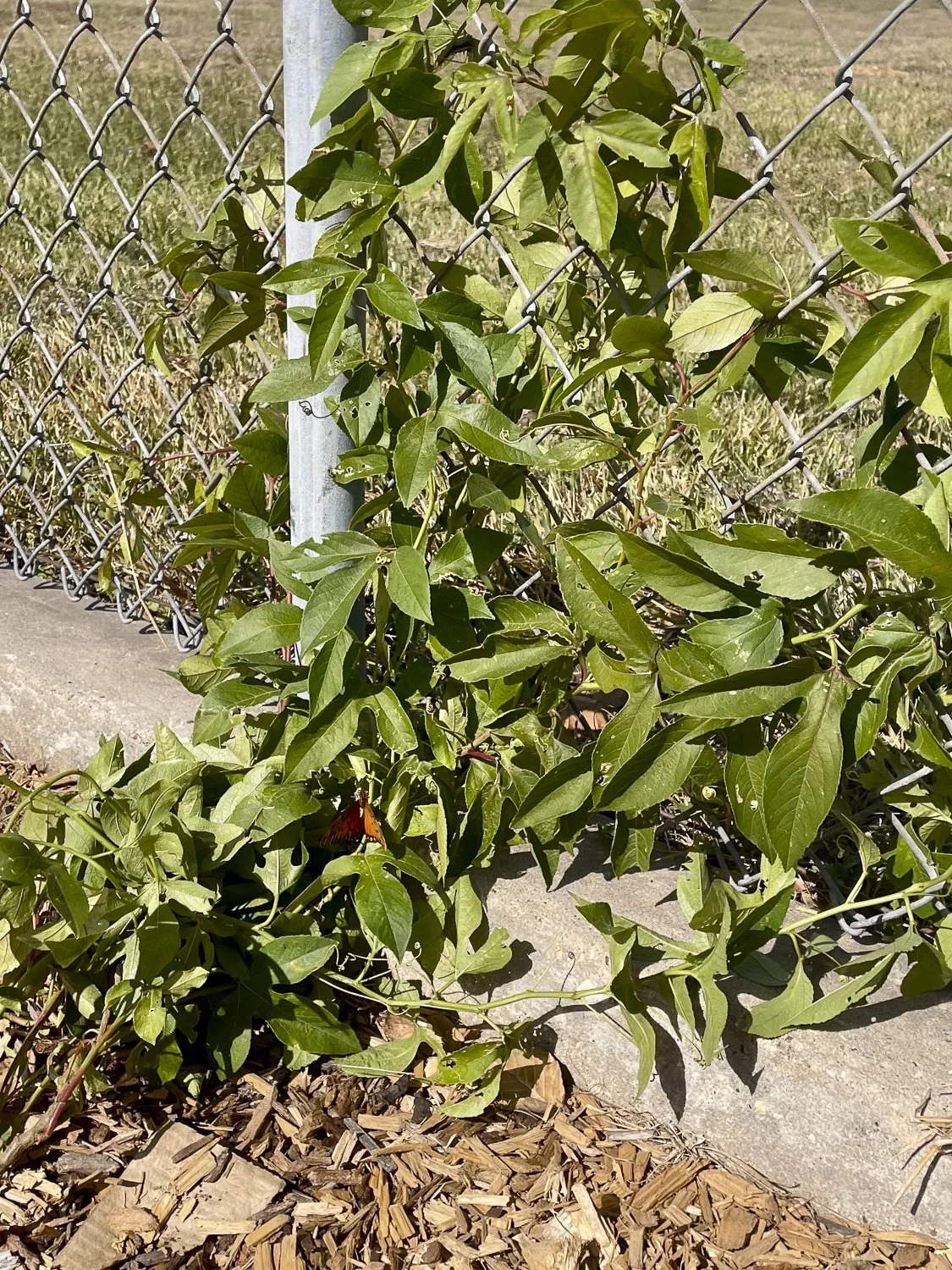
One of the plants from the previous planting that was part of the vandalism. Notice the gulf Fritillary butterfly hiding in the shadow.

propagating a passion vine in water.

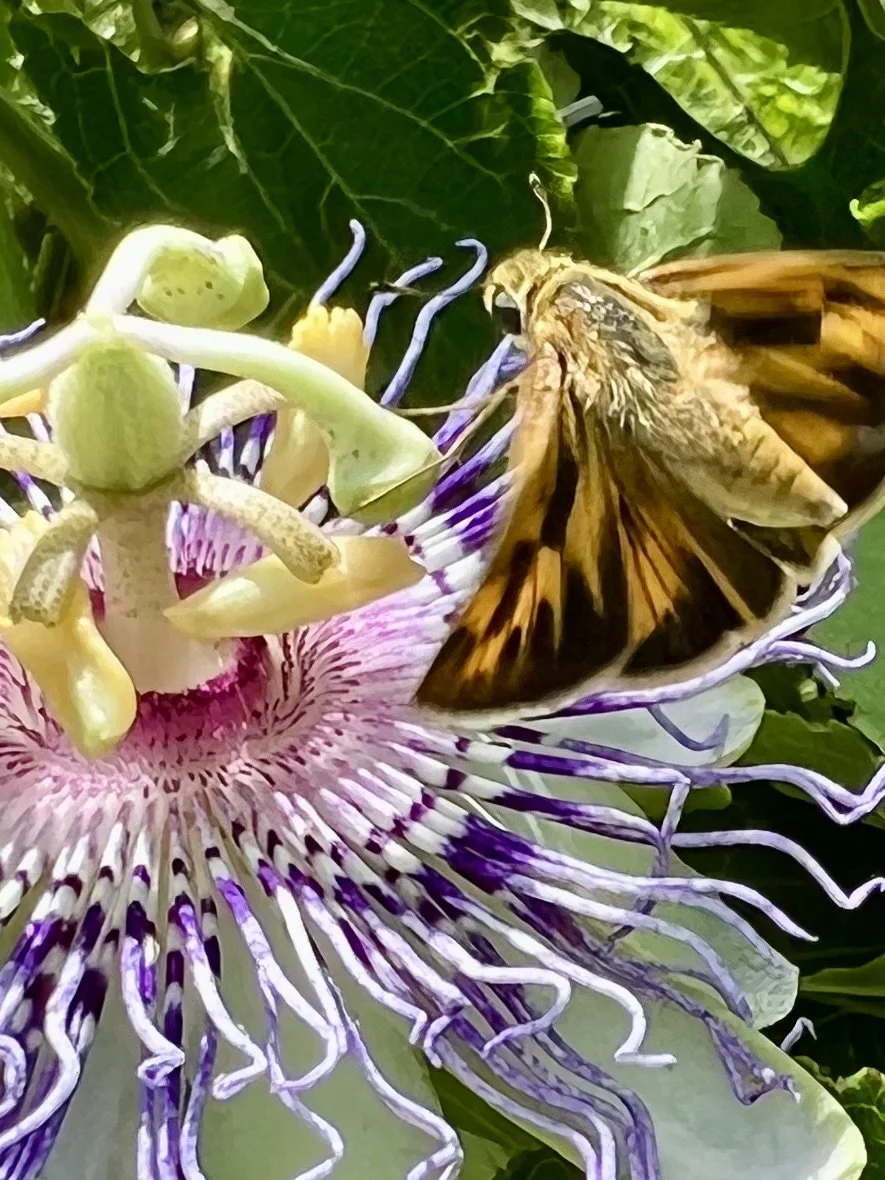
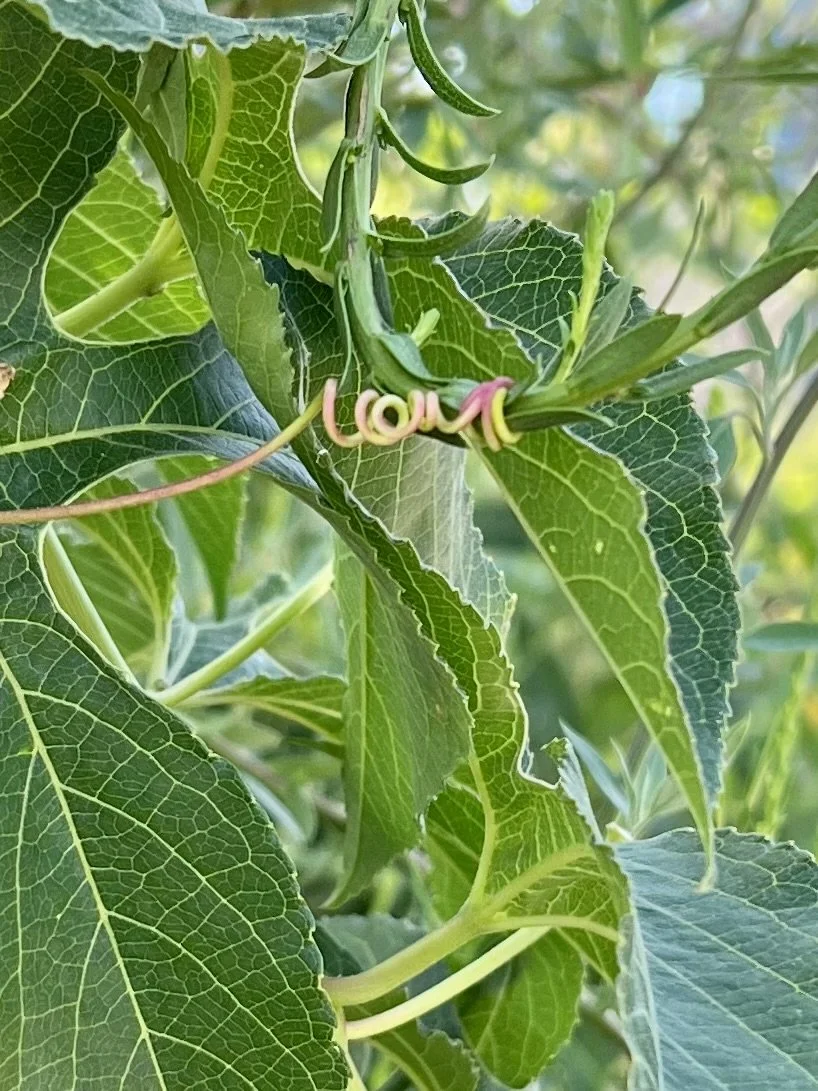
The Stinky Passion flower’s scientific name is Passiflora foetida. It is also known as Fetid Passion Flower, Love-in-a-mist, Wild Maracuja, and running pop.

It has sticky, feathery, leafy bracts that surround the flower and fruit. When an insect tries to eat the fruit, it gets caught in the sticky bracts and dies. The plant then secretes a digestive enzyme and absorbs the nutrients.

Generational Amnesia and Regeneration.

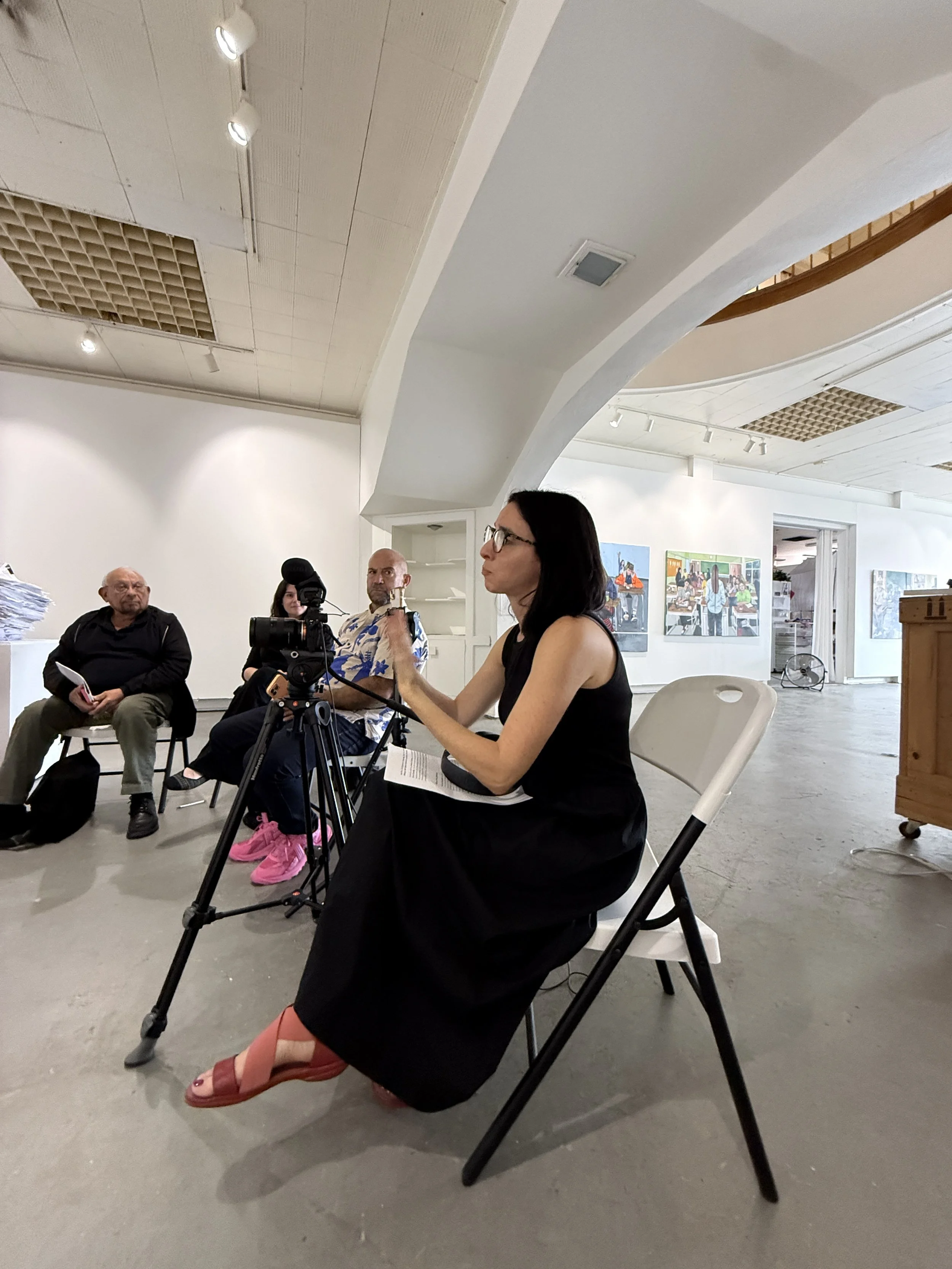
My husband Curtis and I drove to Christoval, Texas for a public hummingbird tagging event. I had been to a private tagging before, but this one was different. The public was invited in. Children were there.

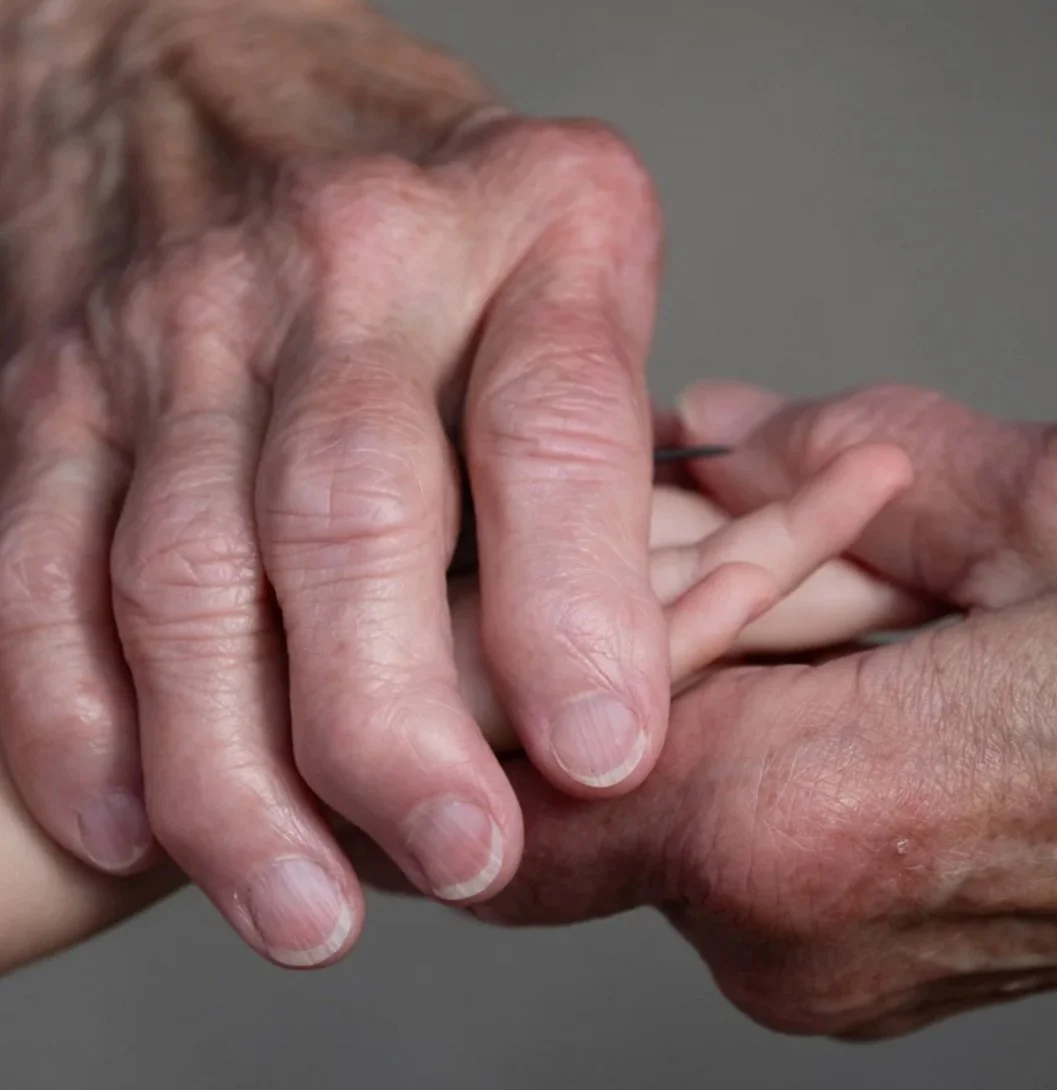
Biologists carefully capture tiny hummingbirds to collect vital information — sex, age, length, weight. After gathering the data, a skilled volunteer carefully cradles each delicate bird in the palm of an observer’s hand.

The tiny creature briefly pauses. You hold your breath. You feel an almost mechanical vibration, like a toy stuck in the “on” position — the rhythm of its heartbeat. Then, in an instant, it is back into the wild.

It wasn’t until I looked at my photos afterward that I saw it — a trusted volunteer placing the bird in a child’s hand. The transfer of knowledge, right there in the frame. A tiny beating heart. A child holding their breath.

That moment — the exchange of a tiny life from seasoned hands to smooth palms — is a living metaphor for what it means to nurture the passing of knowledge and care across generations. It is the story of regeneration.

This is what generational amnesia looks like in reverse.

Generational amnesia — also called shifting baseline syndrome — describes how each generation views the environment they inherit as the normal standard, even if it is significantly more degraded than that of previous generations. We absorb the world we are born into. We mistake it for the world as it is.

In the 1980s in Houston, our garden was filled with hummingbirds. Their vibrant presence shaped our daily conversations, our sense of place, our sense of wonder. They were part of our love story. Curtis proposed and hummingbirds were there. We miss them.

Today’s children in Houston have likely never seen one in a garden. They have no baseline for what’s missing. And that is the whole loss — not just the hummingbirds, but the memory of them.

Breaking this cycle requires hands willing to reach out and moments prepared to receive. It demands nurturing curiosity, empathy, and attention in children and adults alike. It calls for the deliberate passing on of more than just facts — but also the emotions and experiences that bind us to the world beyond ourselves.

The hummingbird’s pause in the palm of a stranger’s hand is brief. But it is enough. This is how we pass down the endangered knowledge of our natural history now — not around a campfire, not through a grandmother’s photo album, but in a field in Christoval, Texas, with a tiny beating heart in your hand and a trusted volunteer saying: this existed. Pay attention


.

The weight of truth

The concept of the “weight of truth” emphasizes the essential role honesty plays in our society and the significant pressures that accompany it. This raises an important question: when does the acknowledgment of new scientific discoveries and truths, particularly those overlooked by community leaders, become an ethical or even a justice issue?

In the fields of soil science and environmental studies, we are witnessing the alarming effects of extreme weather patterns, land subsidence, and the loss of biodiversity. Urban policies shaped by city councils, homeowners associations, and societal norms often worsen these challenges. The focus has shifted from environmentally harmful practices, such as maintaining monocultures of non-native grasses using gas-powered tools—which contribute to air and water pollution and the use of toxic chemicals—to a more regenerative approach.

These decisions not only have profound implications for our health, particularly for children who are at an increased risk for cancer, but they also endanger the fragile wildlife biodiversity that is crucial for the planet’s well-being.

Once again, I ask: when does the recognition of new ecological truths begin to outweigh the legacy of colonial landscapes? It is time that our leaders and institutions bear the weight of truth. Let’s encourage and support them. I'm thinking about the situation in Houston, where our waters drain into the Gulf of Mexico. Homeowners are required to OBTAIN A PERMIT to AVOID using cancer-causing chemicals, and reducing lawn mowing which significantly decrease emissions—up to eleven times more than those produced by a new car. This approach supports biodiversity, helps maintain the water table, and prevents land subsidence. Shouldn’t homeowners who want to use chemicals to maintain their perfect lawns and gas-emitting machinery be required to have a permit?
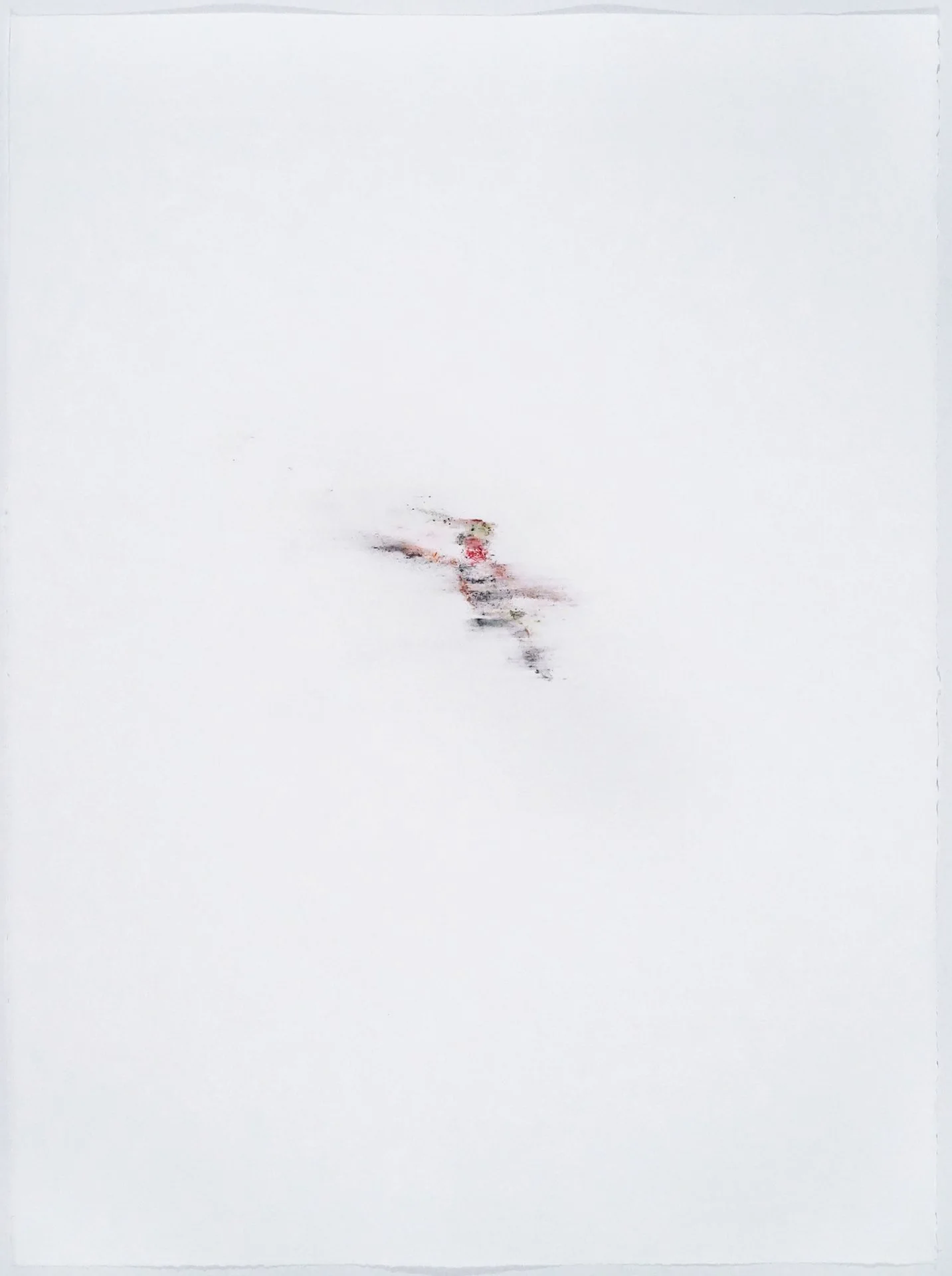
Echoes of Existence-how to engage the students

I am slowly working to find solutions to the problems that will arise when the students implement the installation.

First, how to get students that are not comfortable with nature to want tobe involved. What will draw them in?

Second, a big problem is how to control a group of college kids in a field and have them complete a detailed installation.

Bloomington is a walking city. Every day as I would walk about town and the campus I worried about how I was going to solve these two problem. And like on most college campuses everyone is in their own audio visual world contained between the ear pieces of a headset. And I was the same. The difference was I still wanted to connect to those passing by me with a “good morning” or hi. I found the IU students were very focused on the sounds in their headsets they did not need to make eye contact or say hello.

In a discussion with an English professor, Shannon Gayk, who also teaches a walking class, I learned that a novel idea for students is silent walking. The idea of walking without a headset without sound — silent.

Thinking of headsets and silent - my mind went straight to silent raves then to a silent installation.

Would the concept of a silent installation draw the students in. Could this commitment to headsets be a possible tool for crowd control during the installation?

I love the idea. But that leads to another hurdle. How do I design a silent installation? What technology makes this possible?

With a quick Google search, I found several companies that provide everything you need for a silent event.

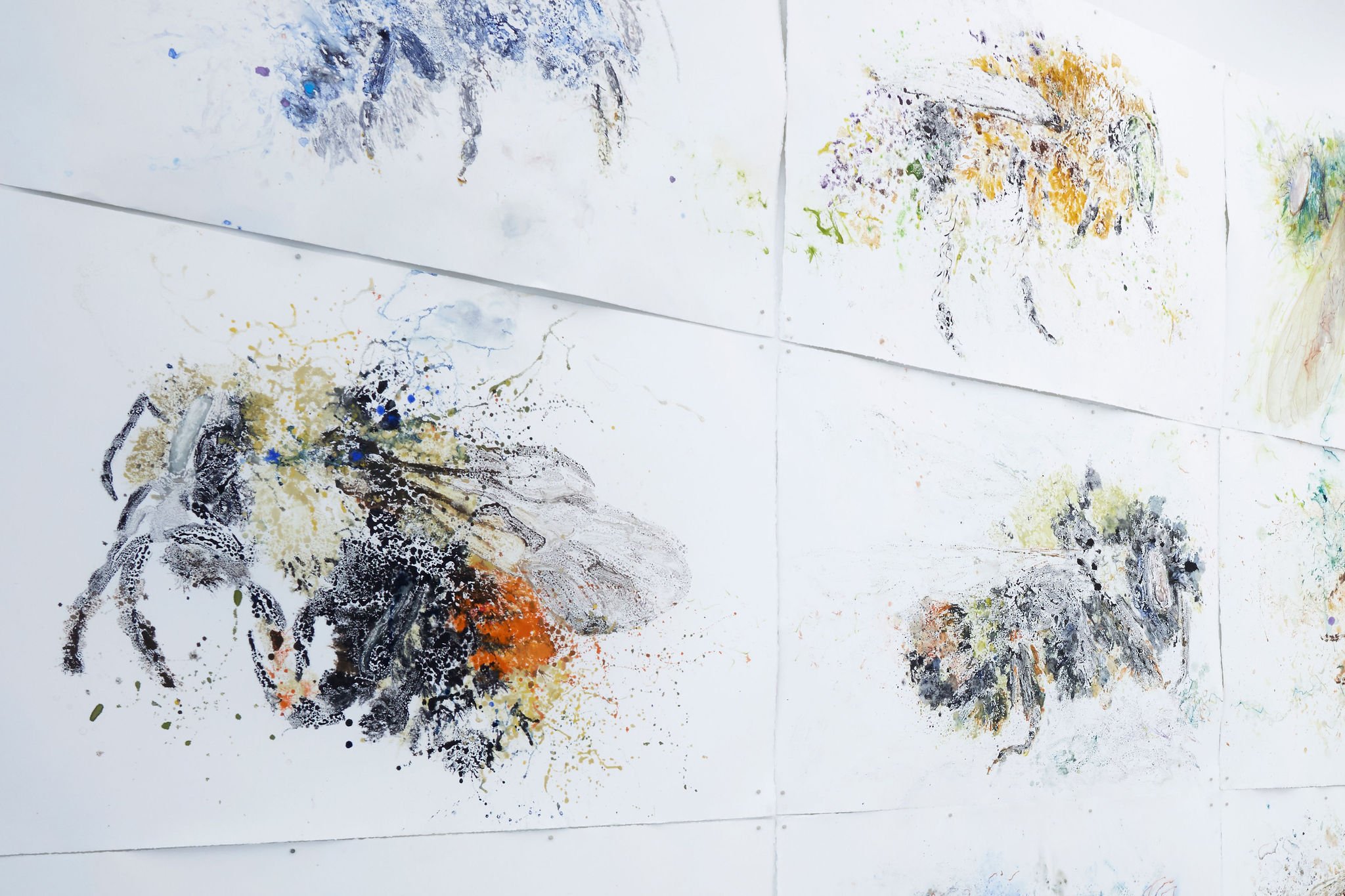
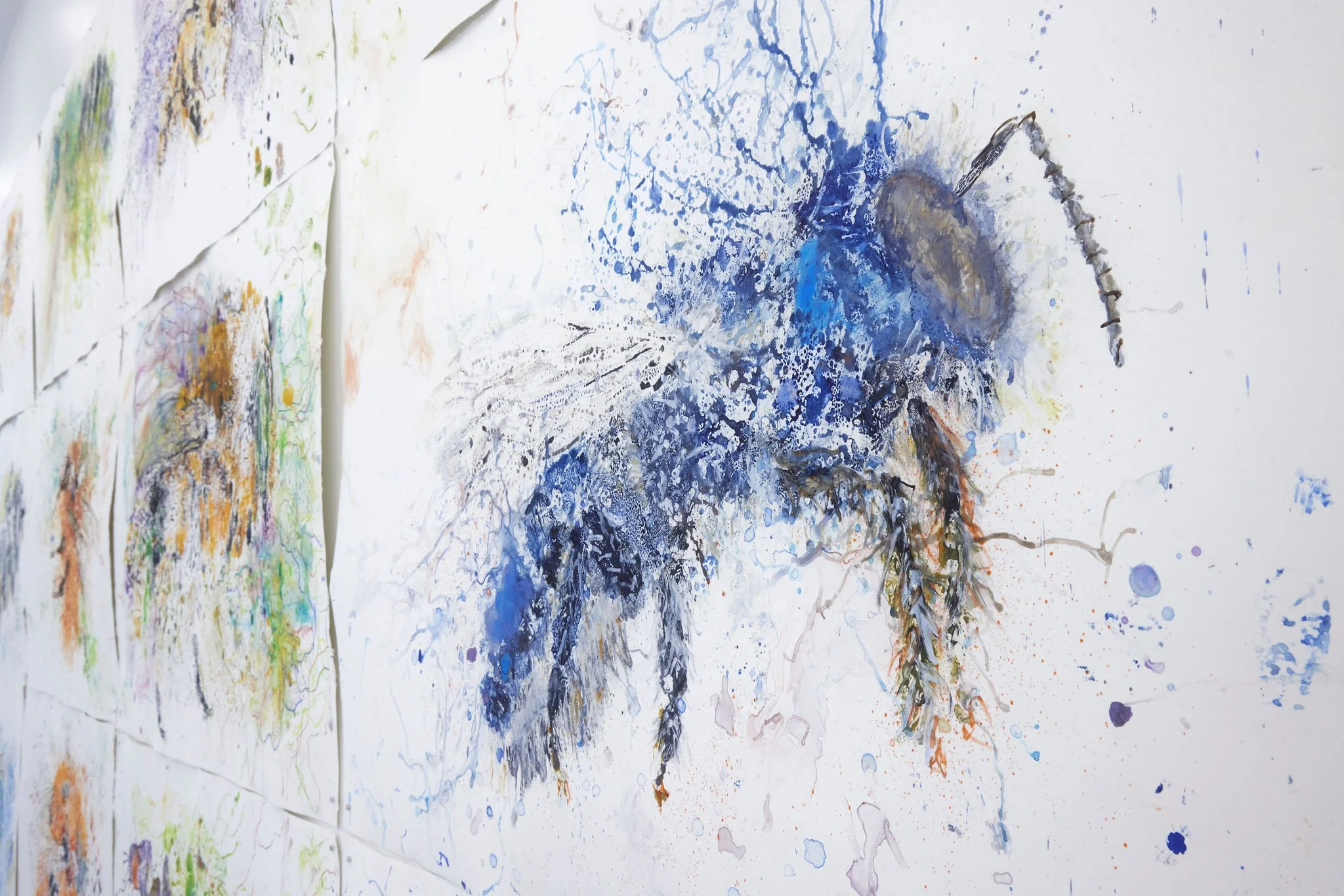
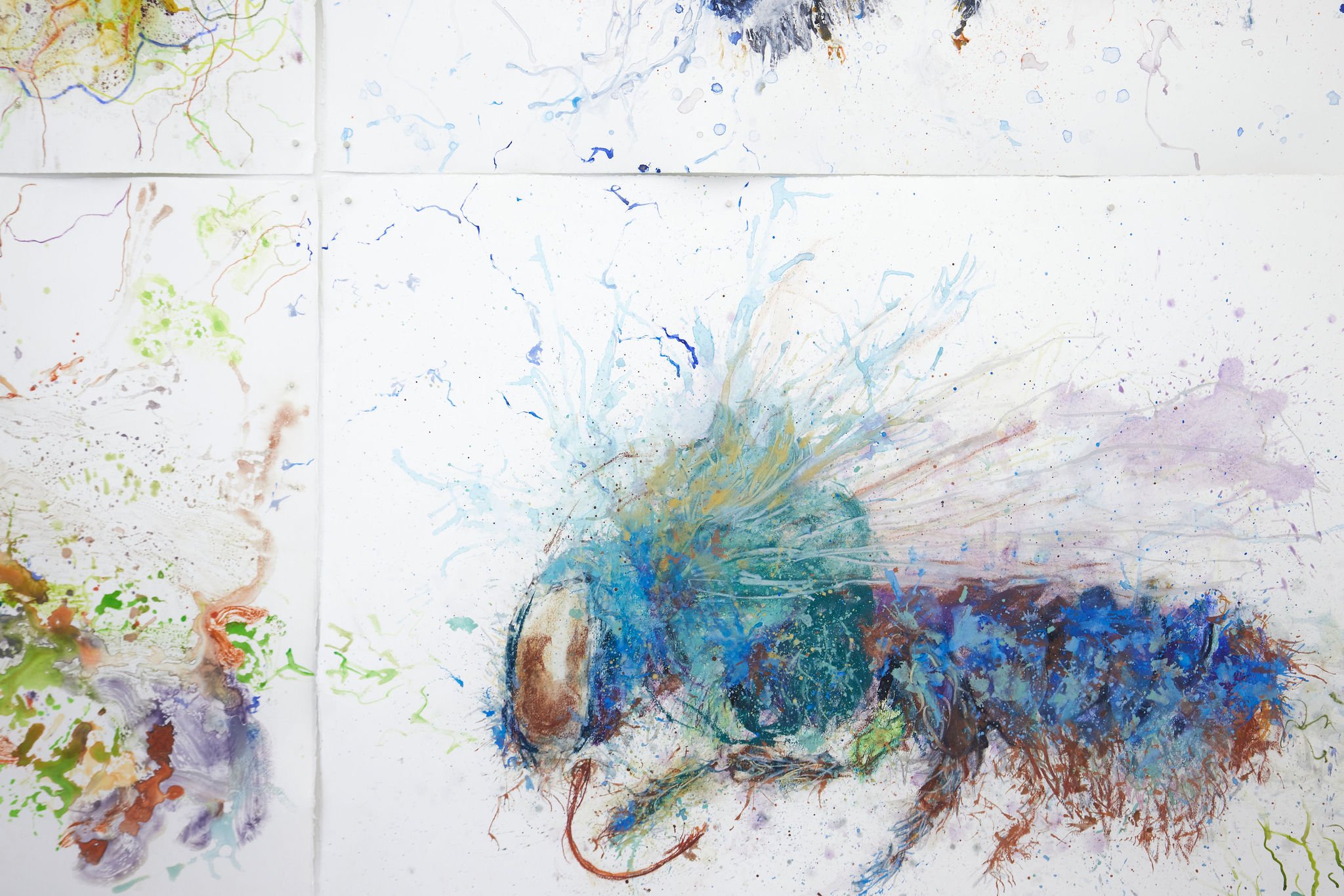
Bombus melanopygus - Black tailed bumble bee.

How the bumble bee got its stripes https://www.eurekalert.org/news-releases/600078

Bombus melanopygu, a captivating bumblebee species that I recently began studying for my body of work, “Rumblings”. As an artist, my process begins with thorough research, delving into the intriguing world of each unique species. Despite the limited information available, I find myself captivated by Bombus melanopygus and its enchanting research qualities.

Incredible breakthroughs have been made by researchers in understanding the color differences within bumblebee species. A recent study, conducted by experts at Penn State, has revealed the presence of a specific gene that drives these variations in color patterns. This discovery not only sheds light on the astonishing diversity among bumblebees, but also provides insights into the evolution of mimicry, where individuals adopt similar color patterns within a given area. The gene resides in a highly conserved region of the genome, which serves as the blueprint for segmentation. This groundbreaking research was published in the renowned journal Proceedings of the National Academy of Sciences on April 29, 2019. -

Heat Dome

“What I propose, therefore, is very simple: it is nothing more than to think what we are doing.”

-Hannah Arendt, The Human Condition

Heat Dome

Watercolor monotype

30" X44"

Bare ground, concrete, asphalt, and astroturf emit 4X radiant heat. Great masses of radiant heat create heat domes. Heat domes prohibit weather from moving across the land. In contrast, surfaces covered in thick layers of plants indigenous to the region store water in the soil. When the day warms, the plants transpire, releasing bacteria with the moisture to form clouds that provide shade and then rain. We each need to carry our ecological weight. We can start by considering new ways to surface our city scapes to cool the planet.

Heat Dome ghost