Unfolding Hope — This Piece and How It's Made
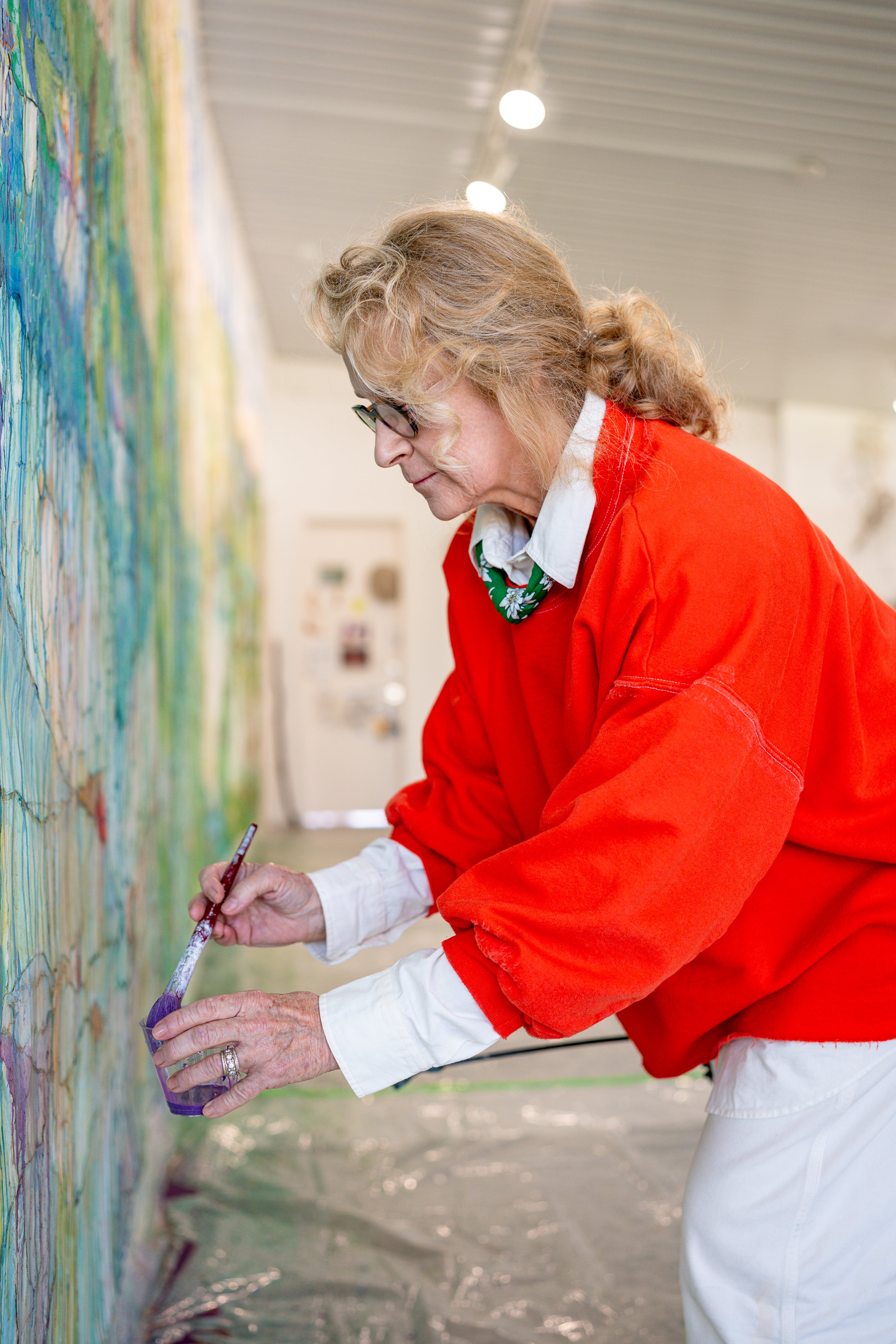
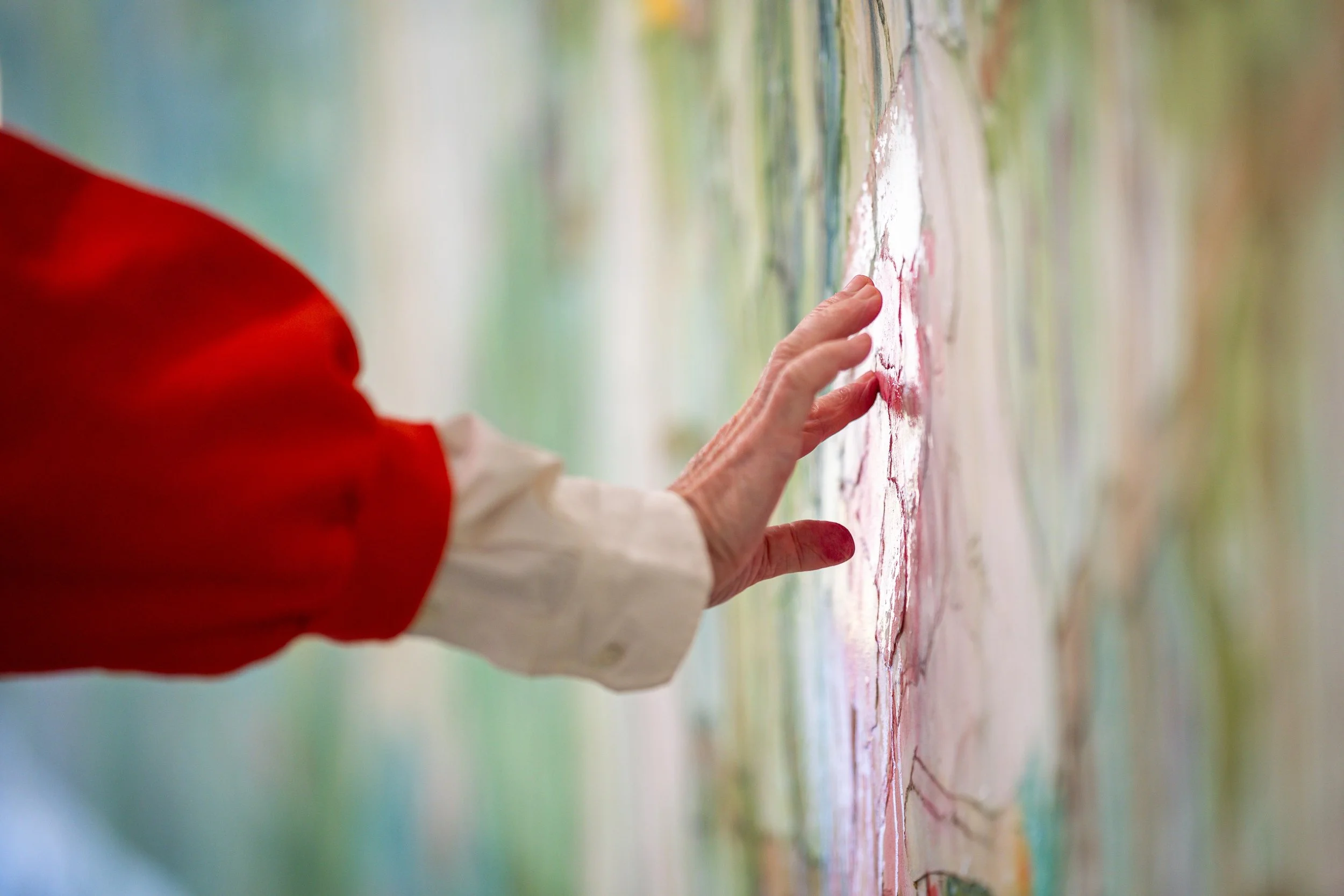
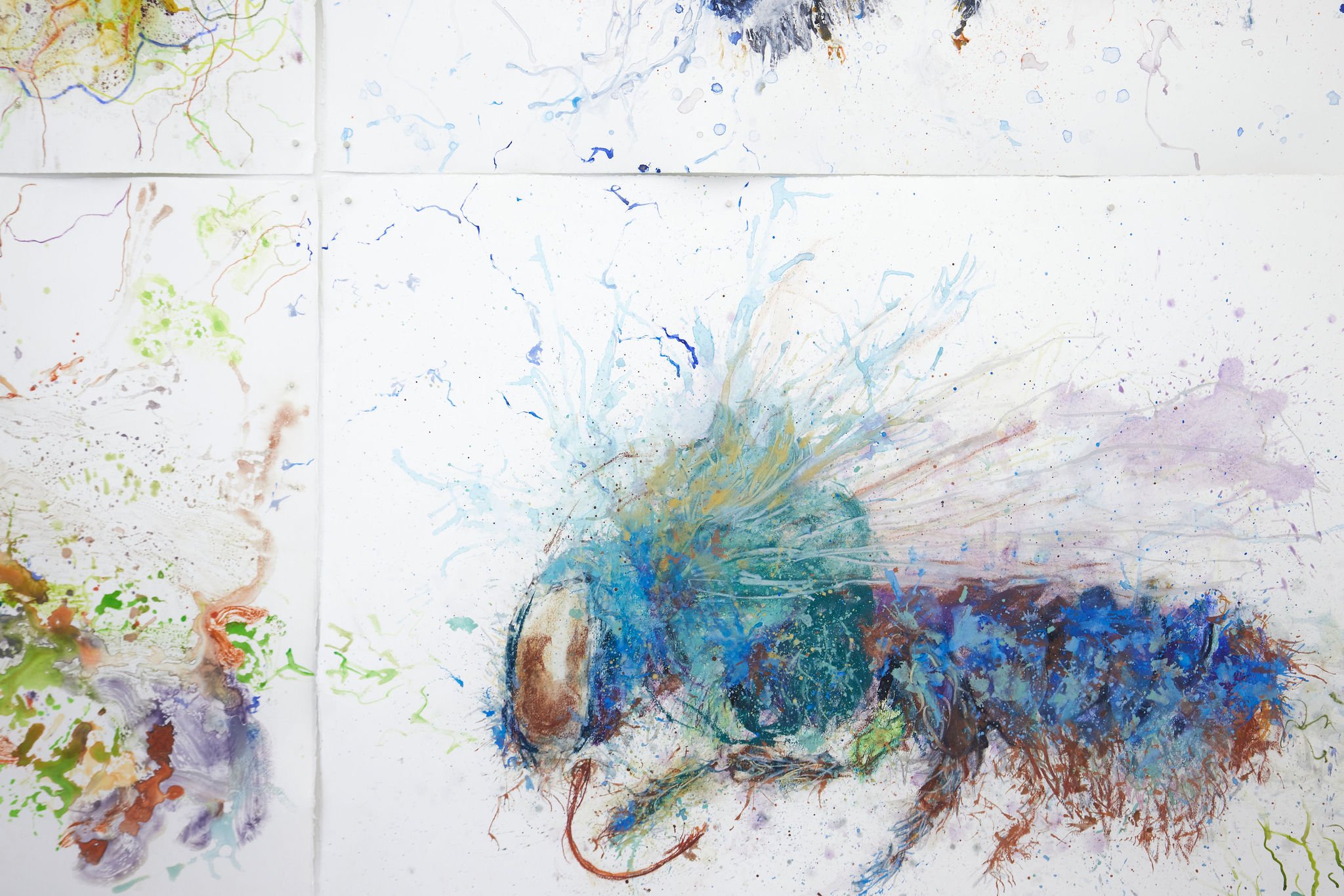
I finished Unfolding Hope last week. These photographs were made about a month ago, when I was still deep in it — crouched on the floor of the gallery, a garden sprayer in one hand and a cup of pigment in the other, watching watercolor run down nine feet of layered paper. That moment still captures the process well: I set things in motion and then pay close attention to where they go.
The Piece
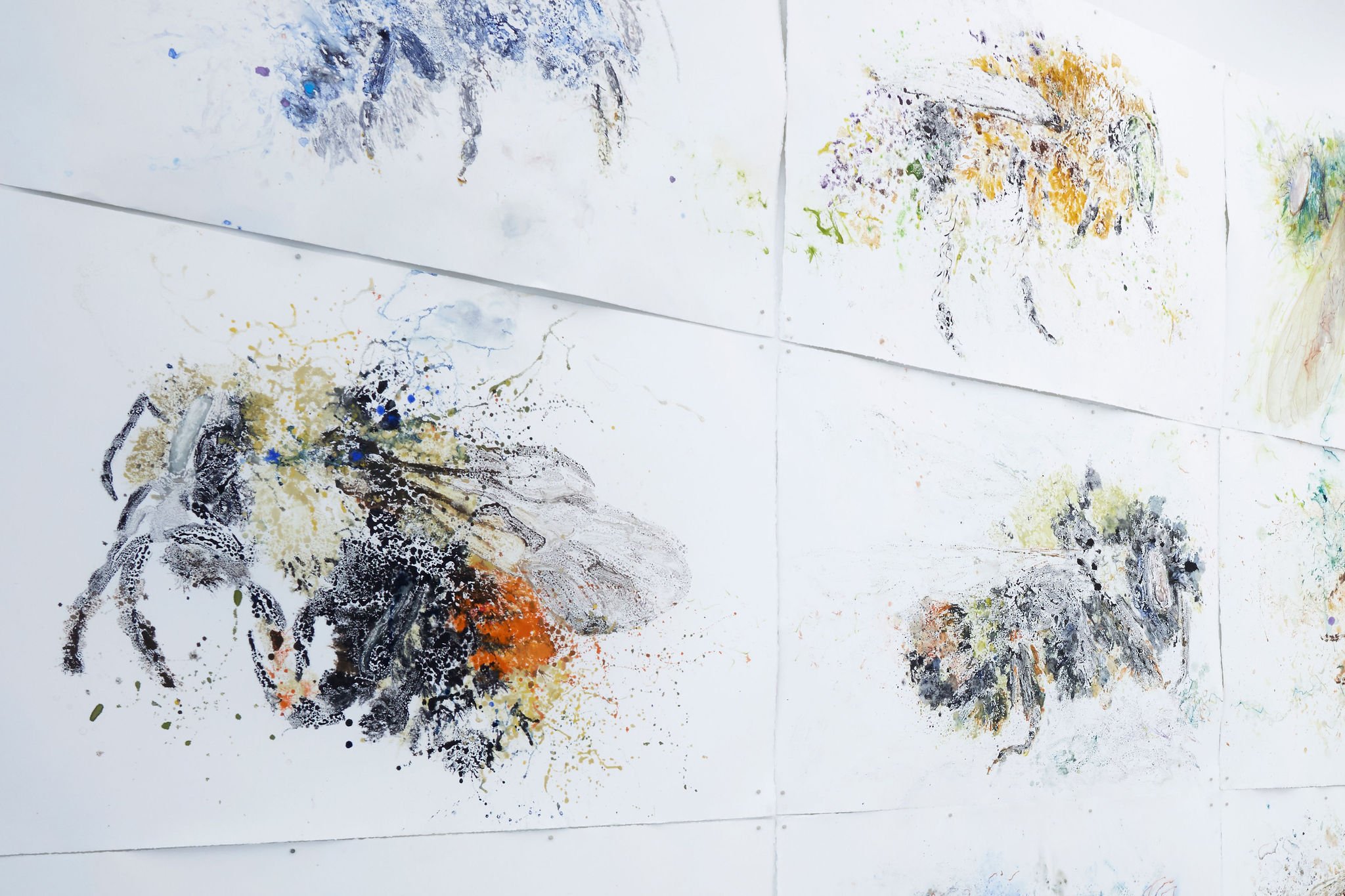
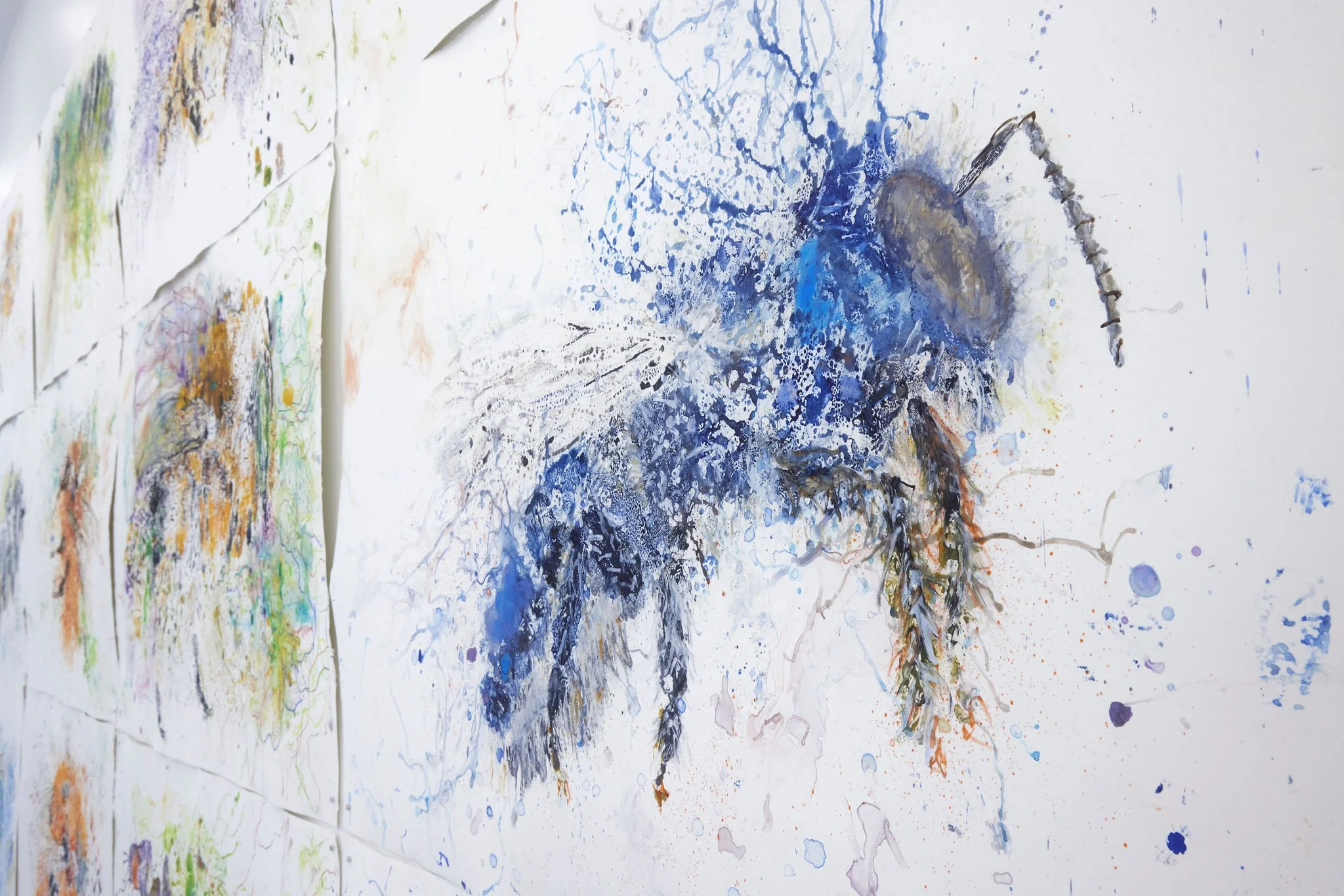
Unfolding Hope is a site-specific quadriptych on paper — approximately 28 feet wide by 9 feet tall — and the piece for my solo show for the Houston Endowment Jones Artist Awards Program 2026. The four panels are: Quiet Estuary, Life's Stubborn March, Courtship Dance, and Knowledge Is The Bridge. Together they move through the story of the sandhill crane — near-extinction in the early 1900s, recovery through the Migratory Bird Treaty Act and restored wetlands, and what that recovery means for how we live now.
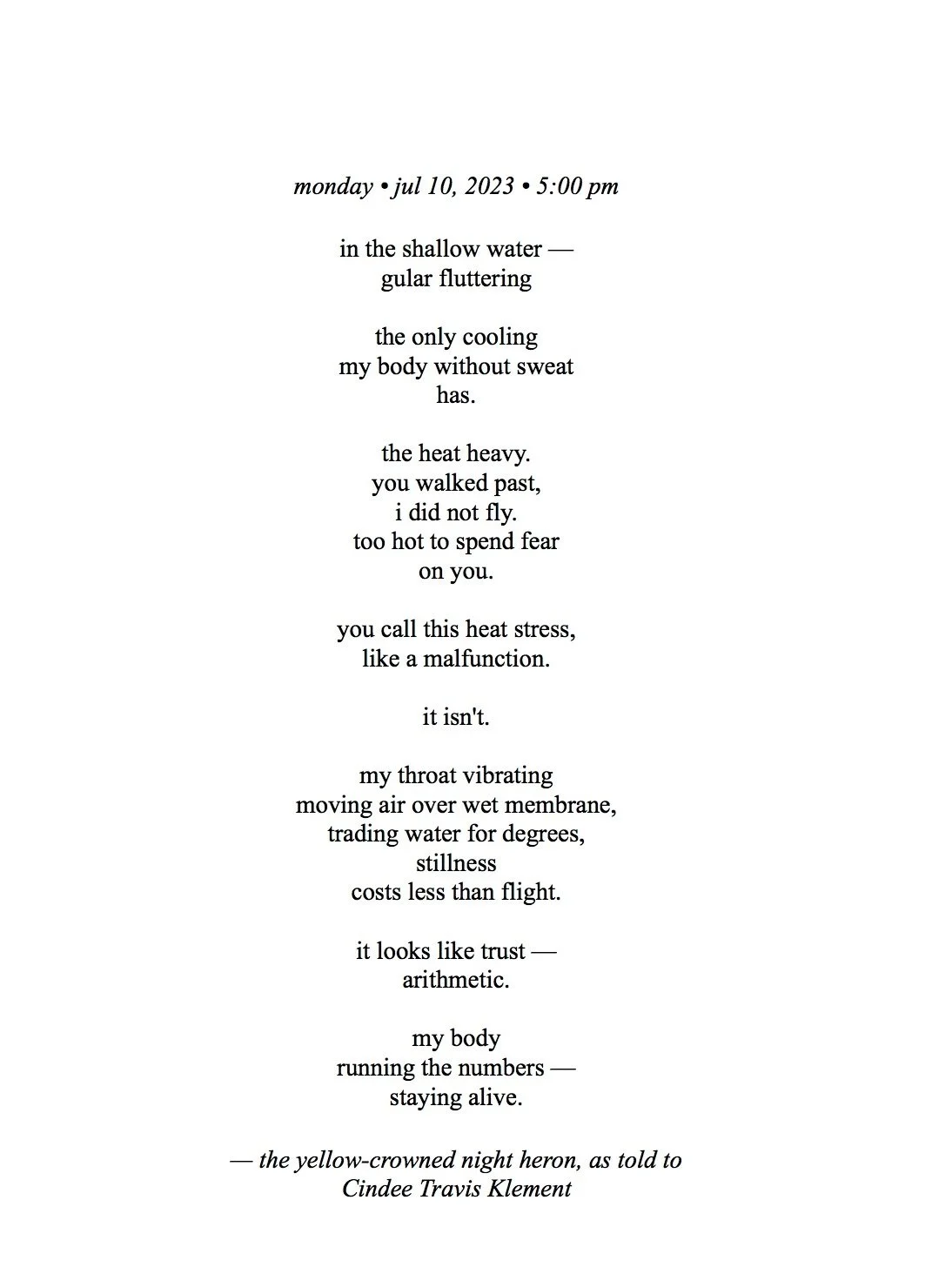
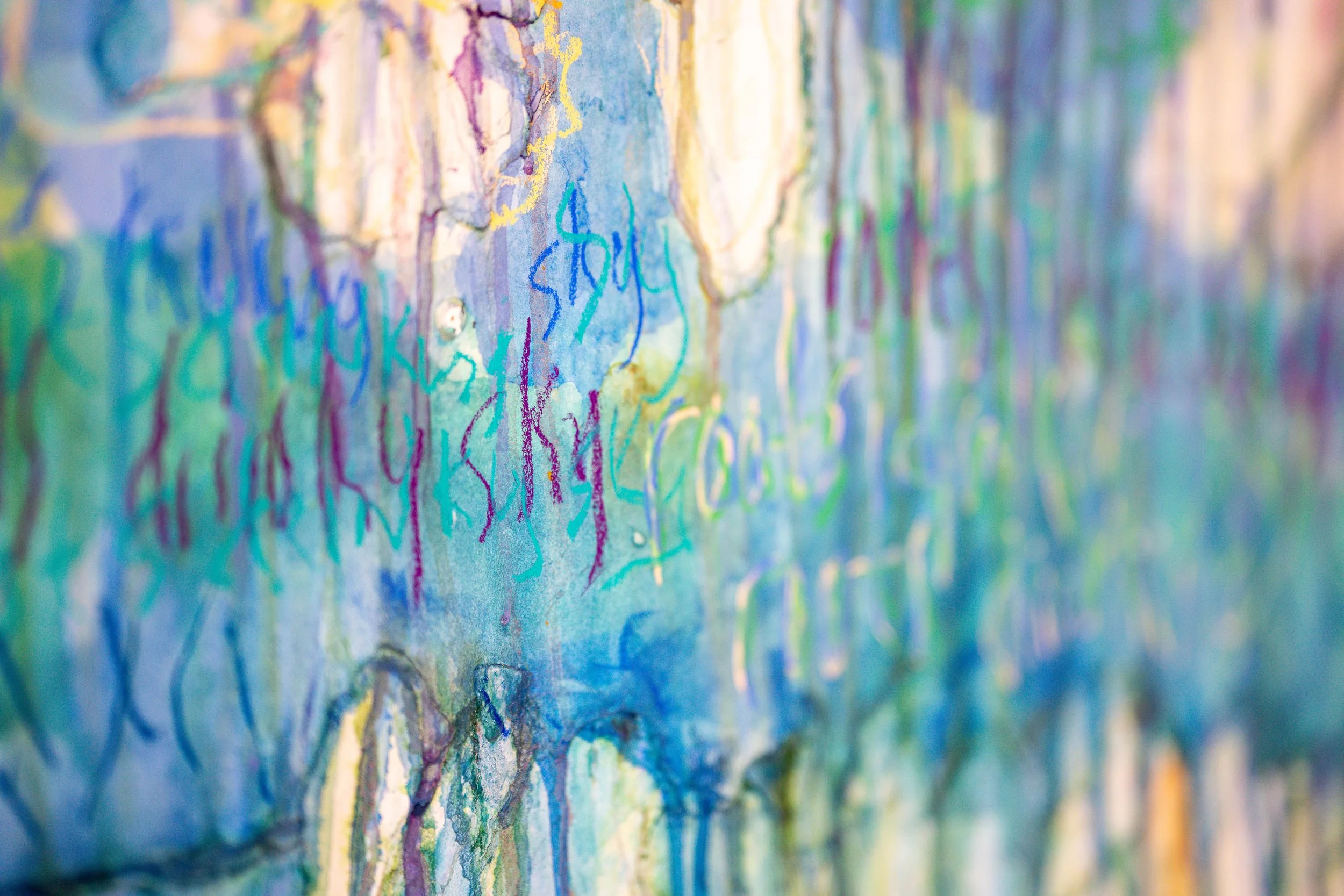
My poem, also called Unfolding Hope, is written directly onto the surface in pastel—layered over itself in multiple colors —so the words almost dissolve into the landscape. Some phrases are readable up close. From a distance, they just look like marks. That's intentional. The seed phrases scattered across all four panels include:
My Process
This is a process I developed in 2025. I start with research — studying the birds, pinning photographs to the wall, making detailed color swatches, doing pencil drawings on Stonehenge paper until I really know the forms. That research matters to me as much as the painting does. I can't draw what I haven't truly looked at.
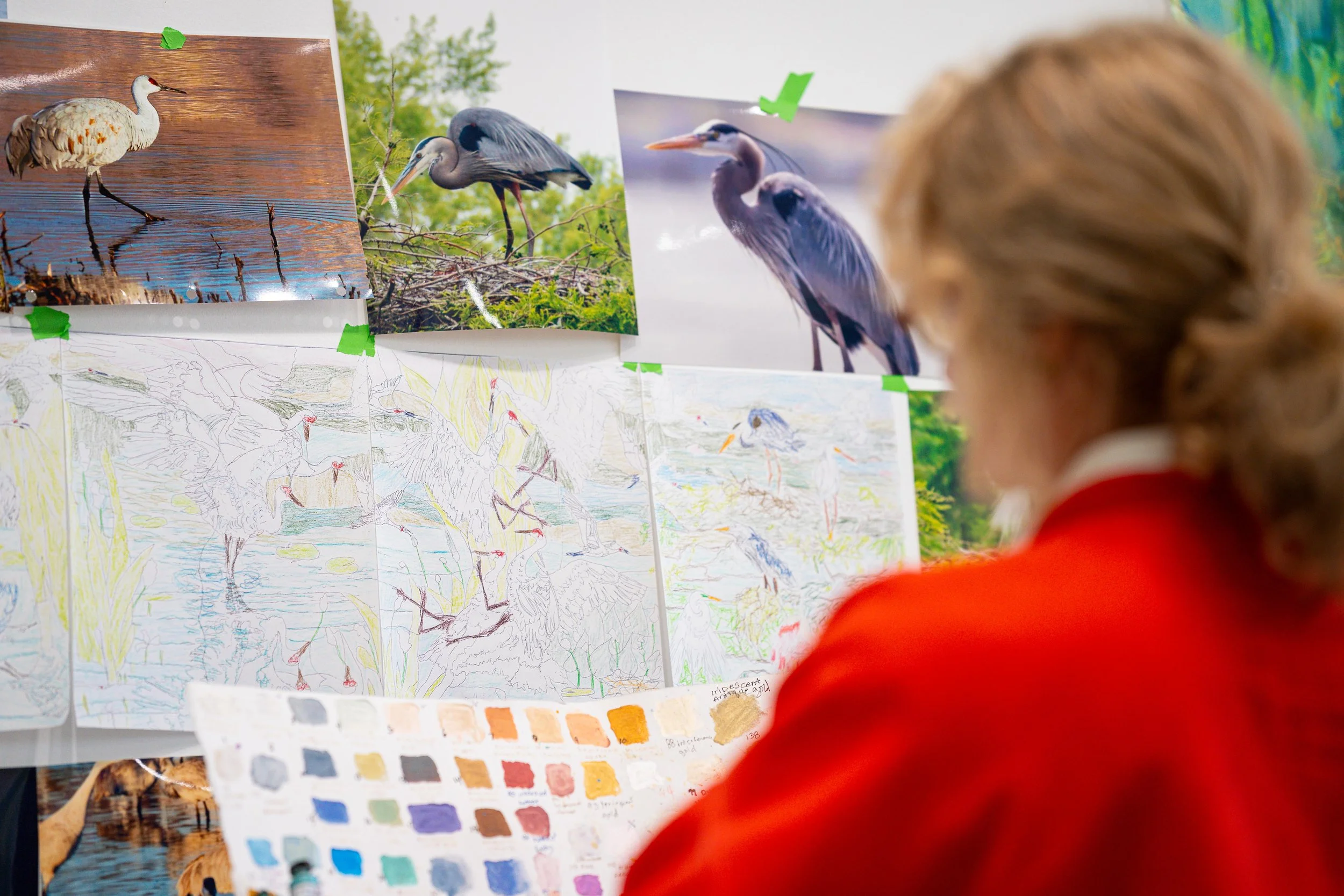
The reference photographs pinned to my wall are mostly my mother’s — Minnie Travis, who is 95 years old and still out there shooting and sending images through Dropbox. I can’t make this up. Some are mine, but honestly, hers are much much better.
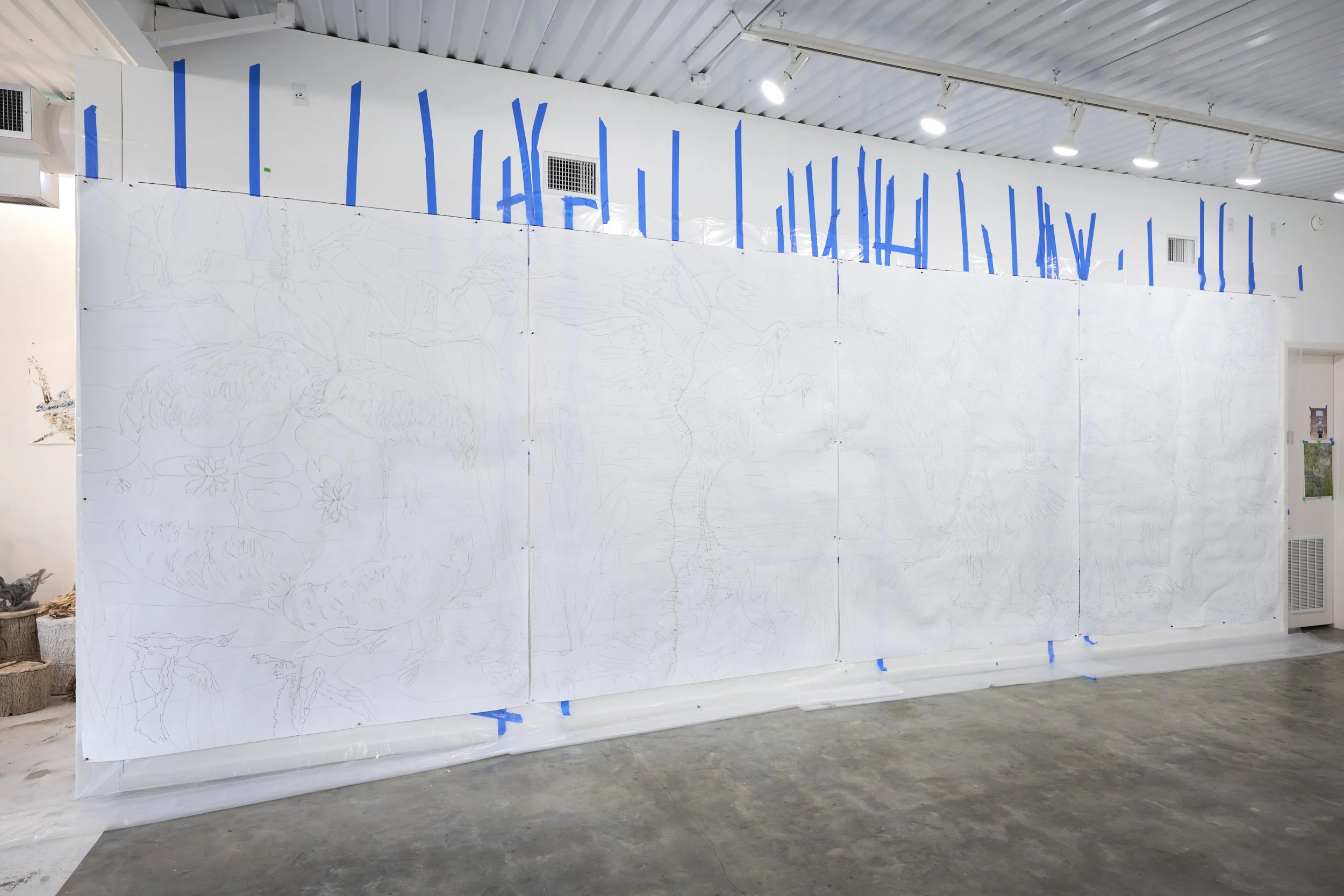
The drawings
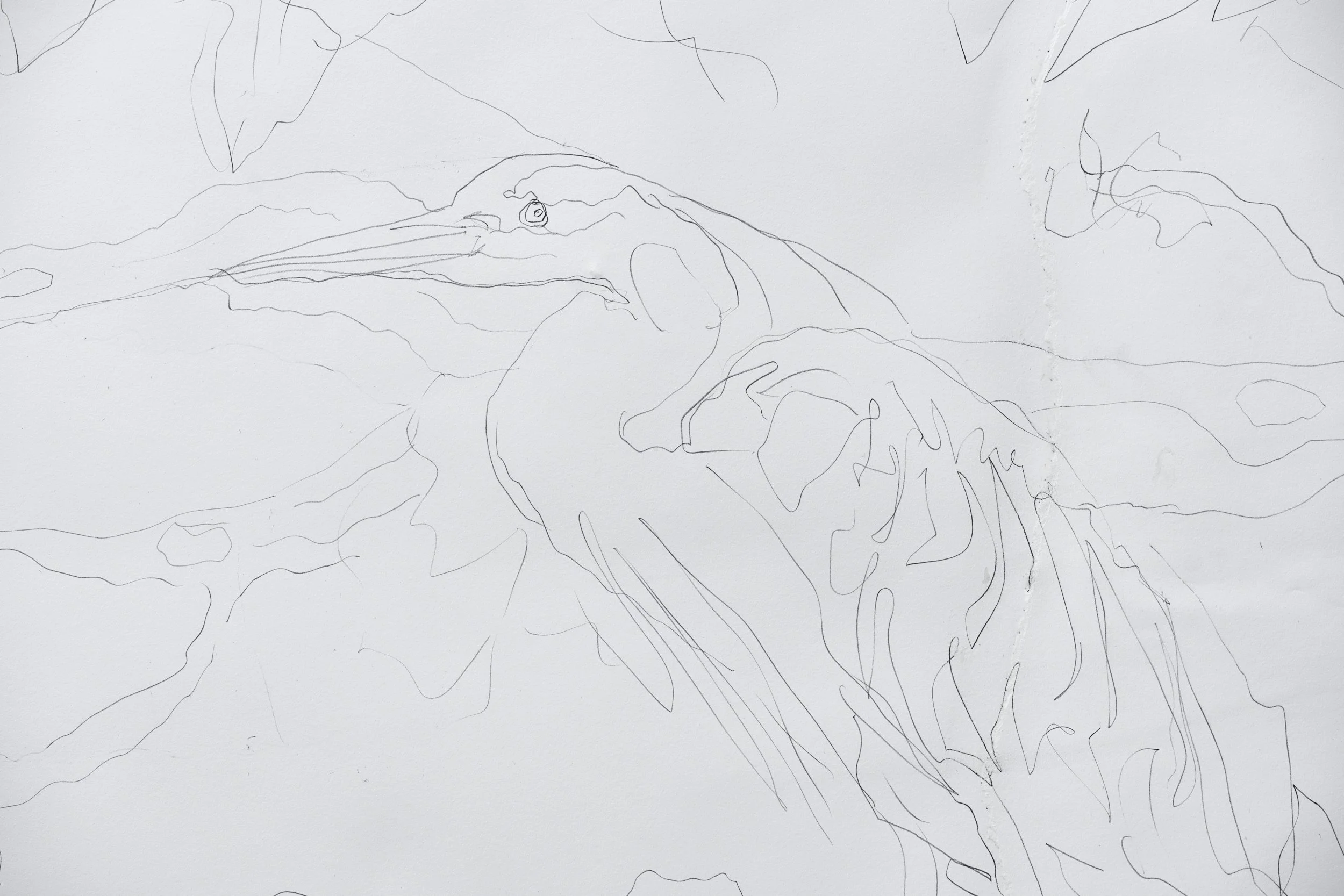
Great Blue Heron- Detail of drawing on the fourth panel Knowledge is the bridge.
Then I tear the drawings apart. Not cut — tear. I collage the torn pieces onto a fresh sheet of the same paper, which creates a layered relief. The torn edges bring energy to the composition and help the birds blend into the environment rather than sitting on top of it.
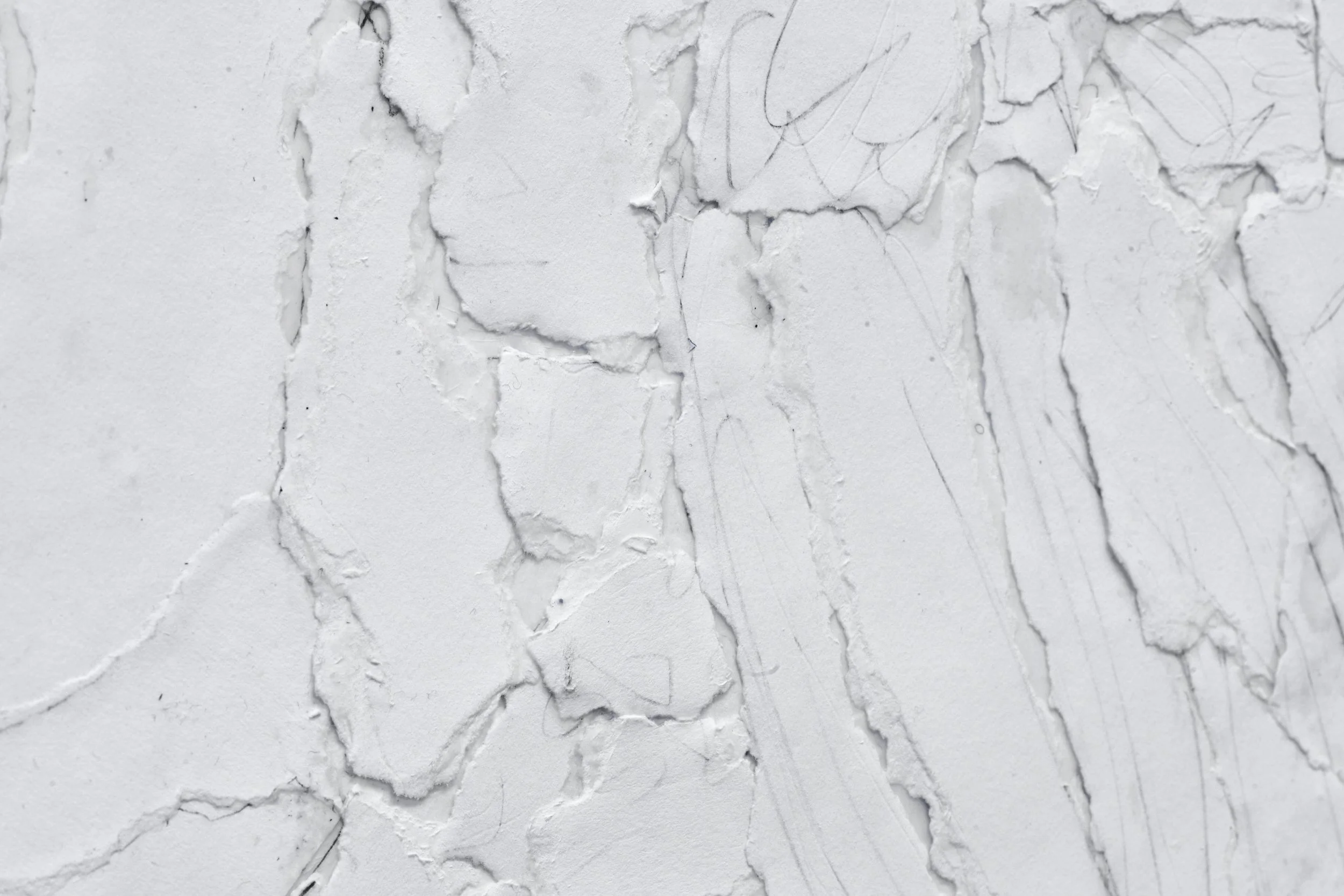
After that, the color. Big washes of watercolor and ink, then the garden sprayer to push wet paint into all the ridges and cracks in the relief. The surface ends up looking almost geological — cracked and stratified, with color pooled in the low spots. I go back in with pastels for line work and detail, spray again, repeat until it feels right.
The finished panels are three to four sheets thick. They're surprisingly durable.
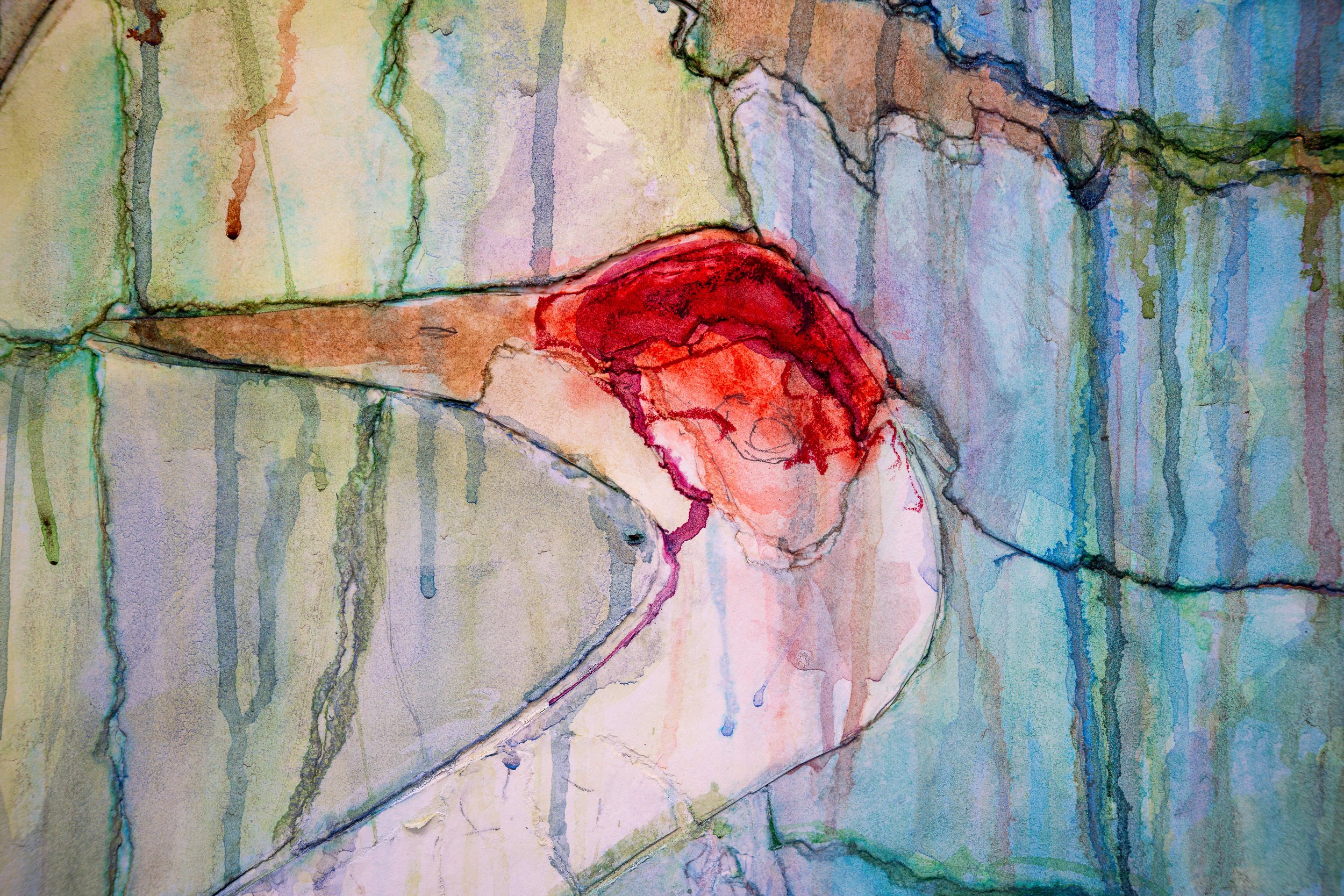
Sandhill Crane detail
Why This Bird
The sandhill crane population was down to 24 birds in parts of their range in the early 1900s. They came back — through the Migratory Bird Treaty Act, through habitat protection, through people deciding they were worth saving. That's the story I keep coming back to. Not because it's a feel-good ending, but because it actually happened. Aldo Leopold heard that prehistoric call at dawn and wrote about it as the sound of evolutionary time — deep, ancient, irreplaceable. I feel that way about the coastal prairie.
Richard Louv's line runs through all my work: we cannot protect what we don't love, can't love what we don't know, can't know what we don't see. This piece is built around that. The birds are specific, the habitat is specific, the history is specific. The more particular it is, the more it matters.
These Images
These shots were taken by Rony Canales (@ronyedin) about a month ago — I'm grateful to him and to Houston Endowment and Weingarten Art Group for their support of this work. The mural takes up the whole gallery wall.
— — —
Unfolding Hope is part of my solo show, made possible through the Houston Endowment Jones Artist Awards Program 2026.
Photography by Rony Canales (@ronyedin).
Presented in partnership with Weingarten Art Group (@weingartenartgroup).
More at www.cindeeklement.com and @cindeeklementart.
One Year Old, Two Feet Tall and Already Working.
Last year I planted two American Fringe Trees — Grancy Greybeard — one on each side of the stone walking path that takes you into Sequel. They are a year old. Two feet tall. They are babies. And they are already teaching me something.
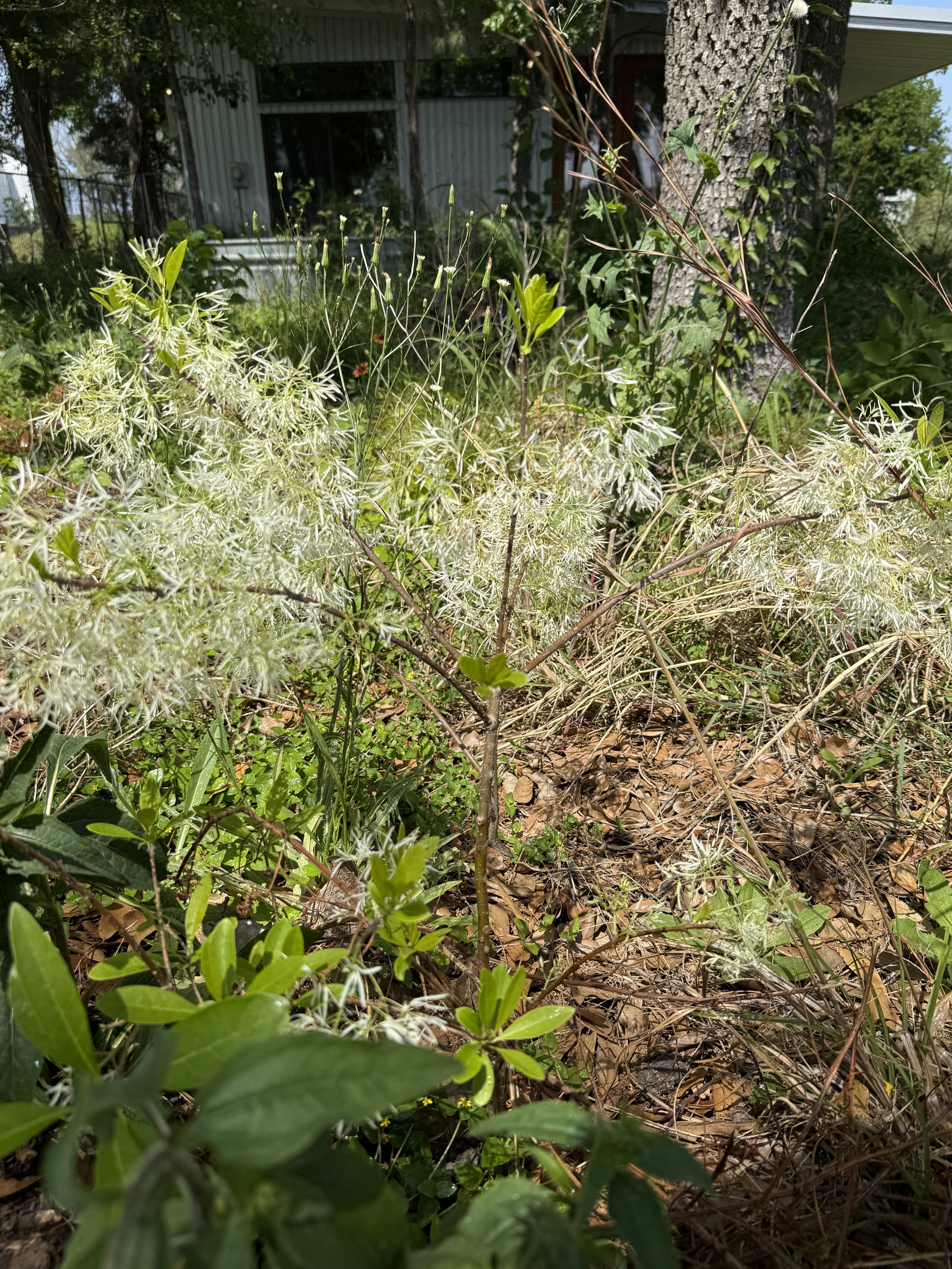
The Eastern tree is thriving. It gets full sun.
The eastern tree is thriving. It gets full sun. The western tree is the smallest — shaded by other small plants that block its access to full sun. It should eventually outgrow them.
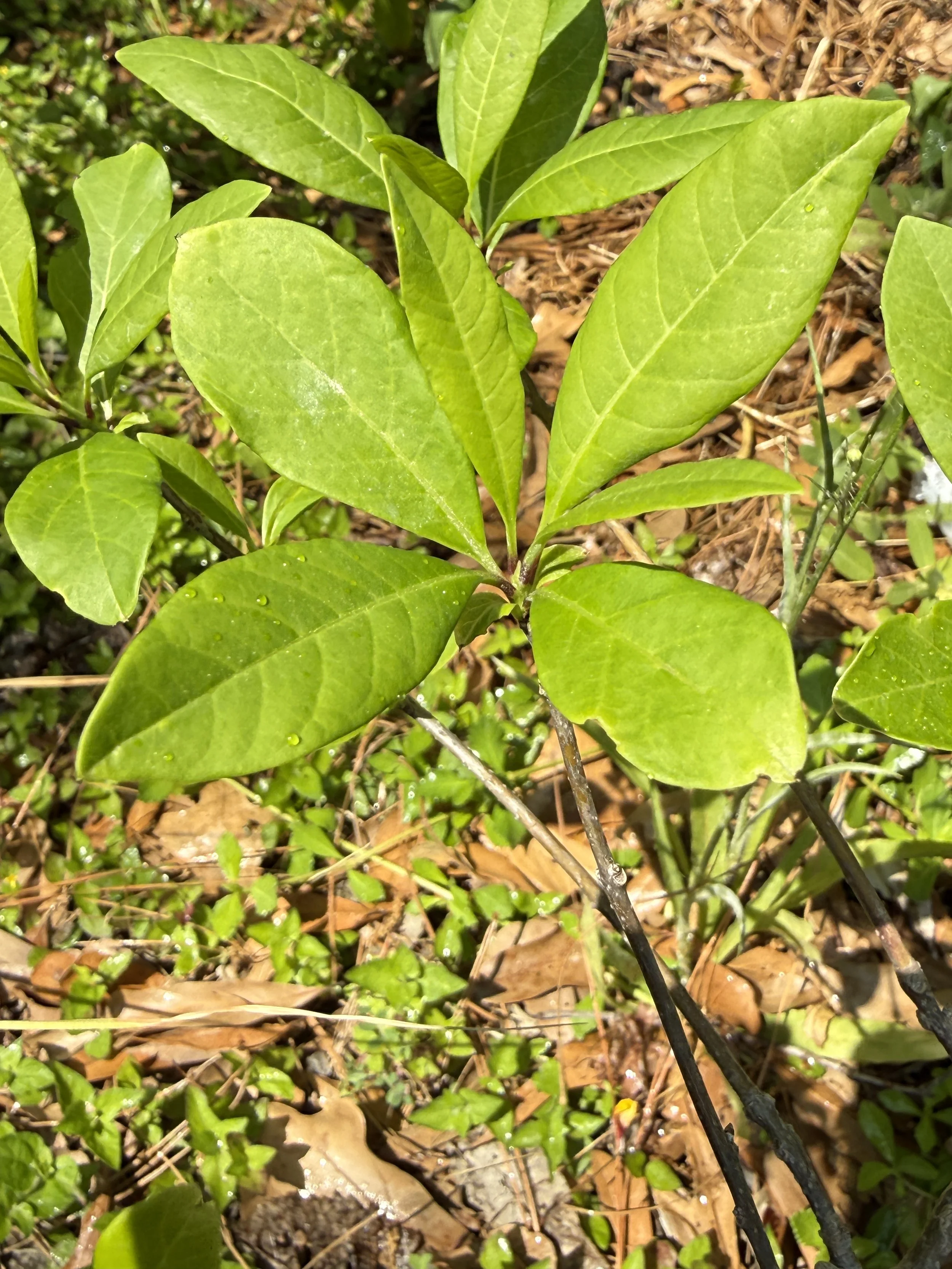
The western tree is the smallest and is shaded by other small plants that block its access to full sun. It should eventually outgrow them.
I chose them deliberately, the way I choose every element in my living sculptures. In Symbiosis at Lawndale, every plant was a decision about relationship — who would it feed, what would it host, how would it move nutrients and carbon through the system. Sequel is the same conversation, carried forward. The fringe trees at its threshold are not decorative. They are a proposition.
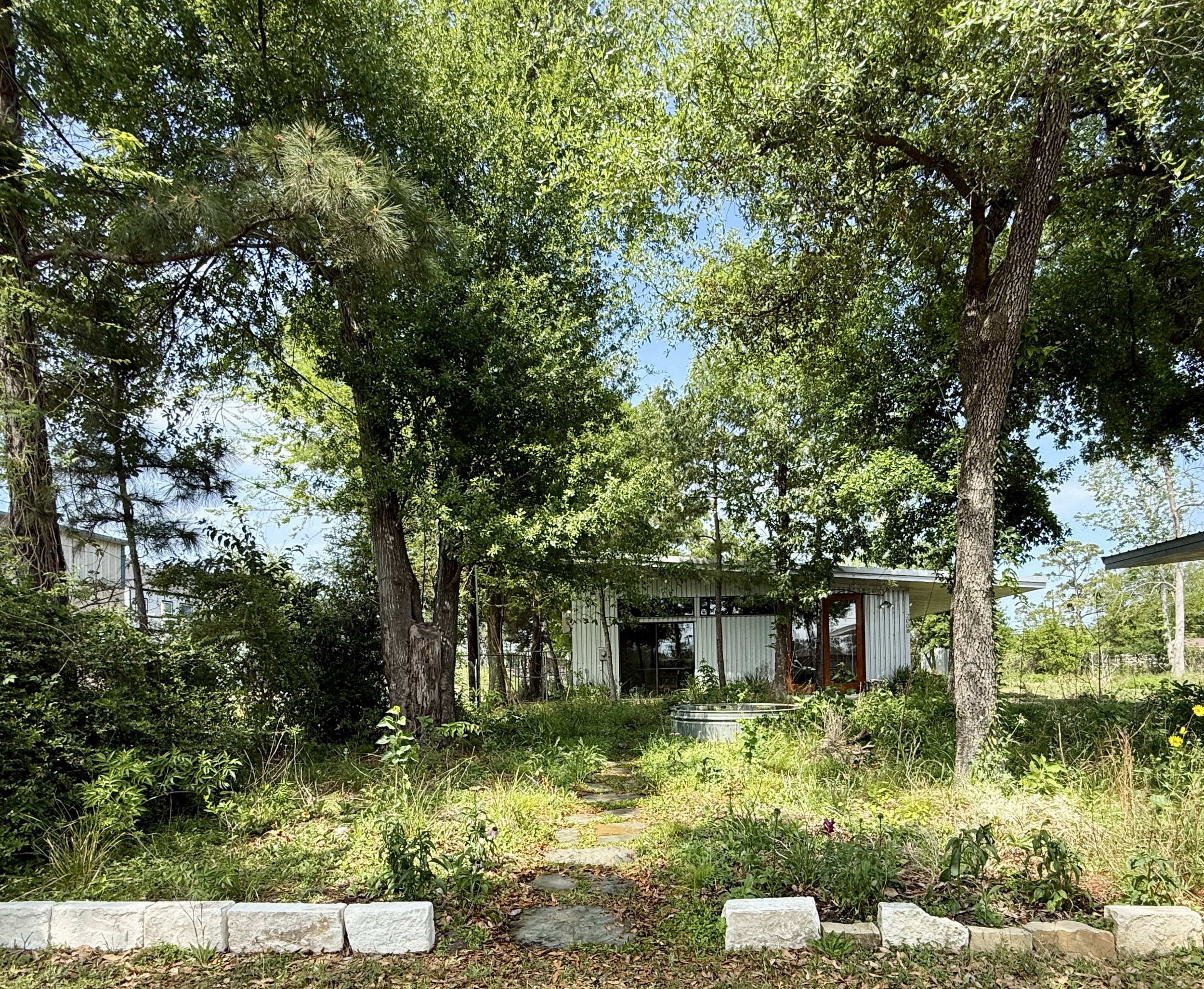
The walkway features the two one-year-old trees, barely visible, standing 10 feet away from the center.
Chionanthus virginicus grows naturally at the edges — along woody draws and stream banks, in the transitional zones where forest gives way to coastal prairie. That is exactly where I placed them: flanking the stone path, at the threshold. You pass between them to enter the work. The living sculpture begins before you know it has begun.
The fringe tree does its most important work in the margins — the places most overlooked, most degraded, most in need of rebuilding. That is where Sequel lives too.
Come April through June the white fringed blooms open — long, thread-like petals cascading like an old man’s beard in a coastal breeze. For native bees and butterflies this is a critical nectar window early in the season when little else is offering. The fringe tree is a larval host for three sphinx moth species. A host plant is not ornamental. It is food infrastructure. Female trees produce dark blue olive-like fruits in late summer — high-fat fuel for migrating songbirds. Their dense multi-stemmed structure creates cover and nesting opportunities for birds. And their roots hold the clay soil at Sequel’s entrance, moving water downward — the same function I have been studying since I first understood how roots cool this planet and absorb what Houston cannot stop flooding with.
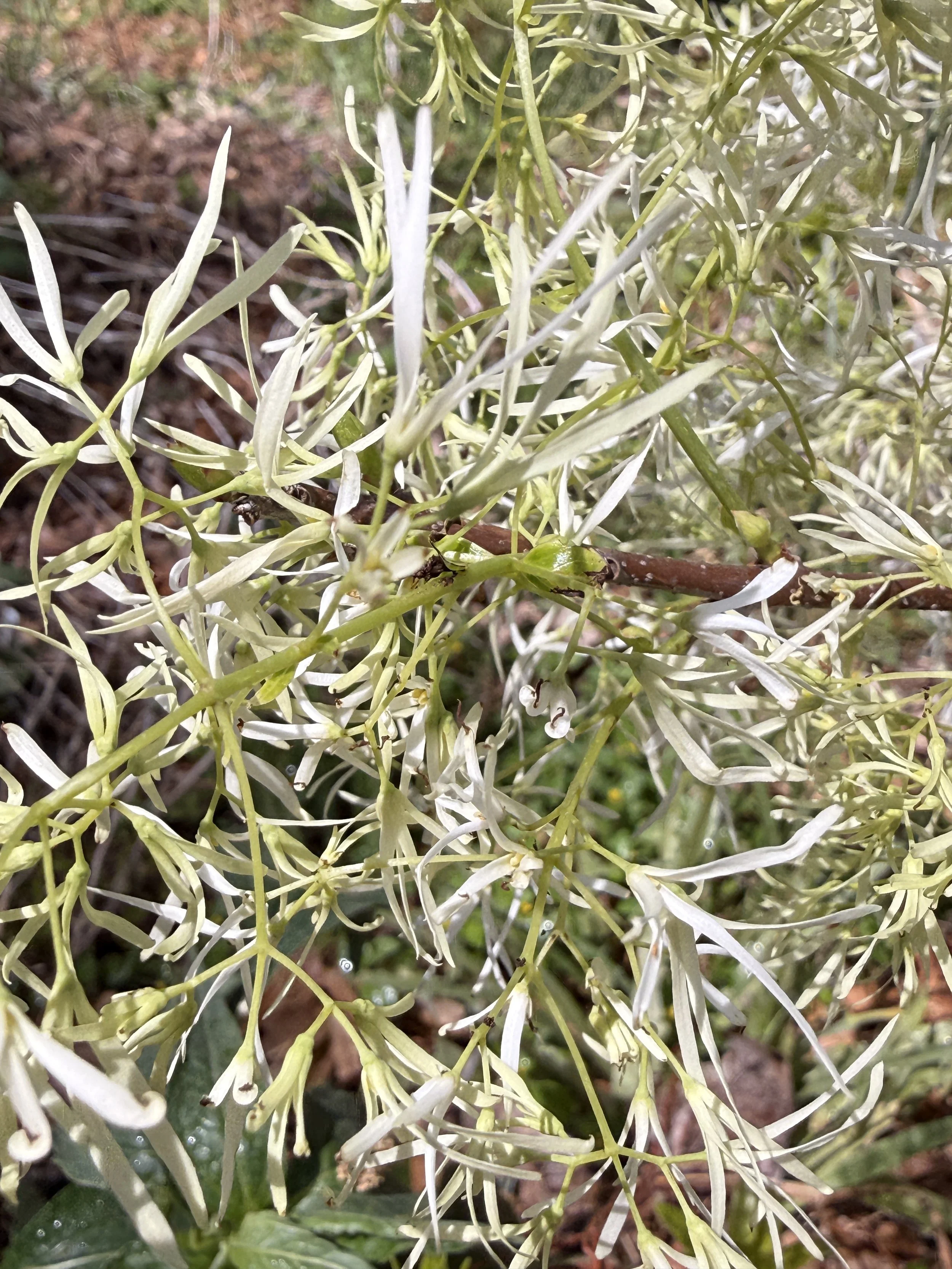
A close-up of the trees soft, airy beard.
A threshold is a sculpture.
When I carved Carbon by the Yard into Lawndale’s turf, the gesture was simple: carve a shape, let the grass grow around it. The relief emerged from contrast. What was taken away revealed what was possible.
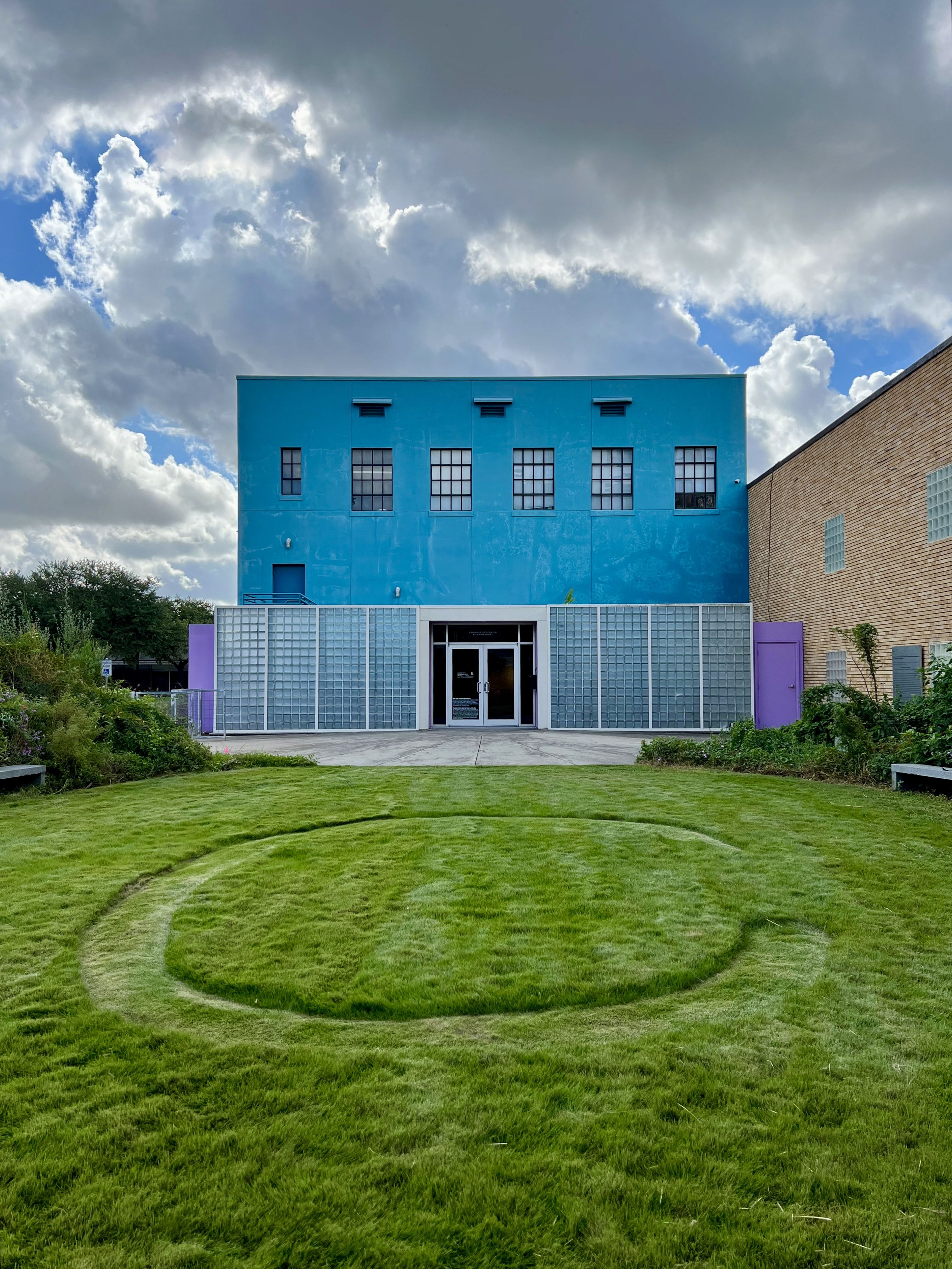
Carbon By The Yard - Lawndale 2021
The two fringe trees at Sequel’s entrance work the same way. They mark the passage from the manicured urban world outside into the living, breathing, intentionally ecological world within. They are the frame. They are also the argument — that two feet of native species, one year old, already threading itself into the insect food web, is doing more ecological work than turf and non-natives could do in a decade.
They are a year old. In twenty years they will be twenty feet tall — cascading white each April, fruiting each September, hosting moths, sheltering songbirds, holding the ground. Sequel will have grown up around them.
That is the whole conversation.
The Tyranny of Tidy
In Defense of the Uninvited — Part II
There is a particular kind of anxiety that lives at the edge of an unmowed lawn. You can feel it from the sidewalk — the low-grade disapproval radiating off a neighbor’s glance, the HOA letter with its careful language about community standards and property values. We all know this pressure. Many of us have bent to it.
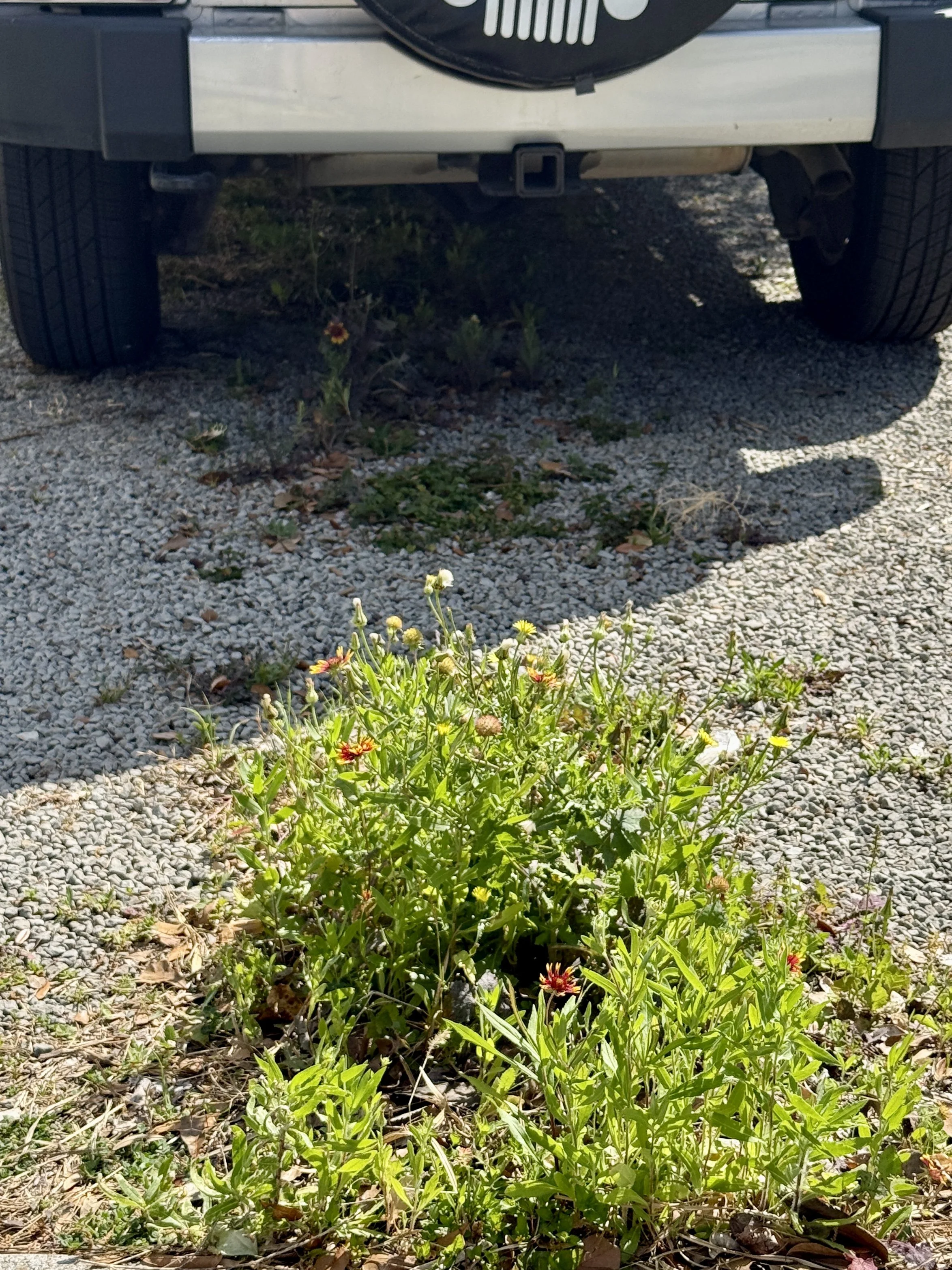
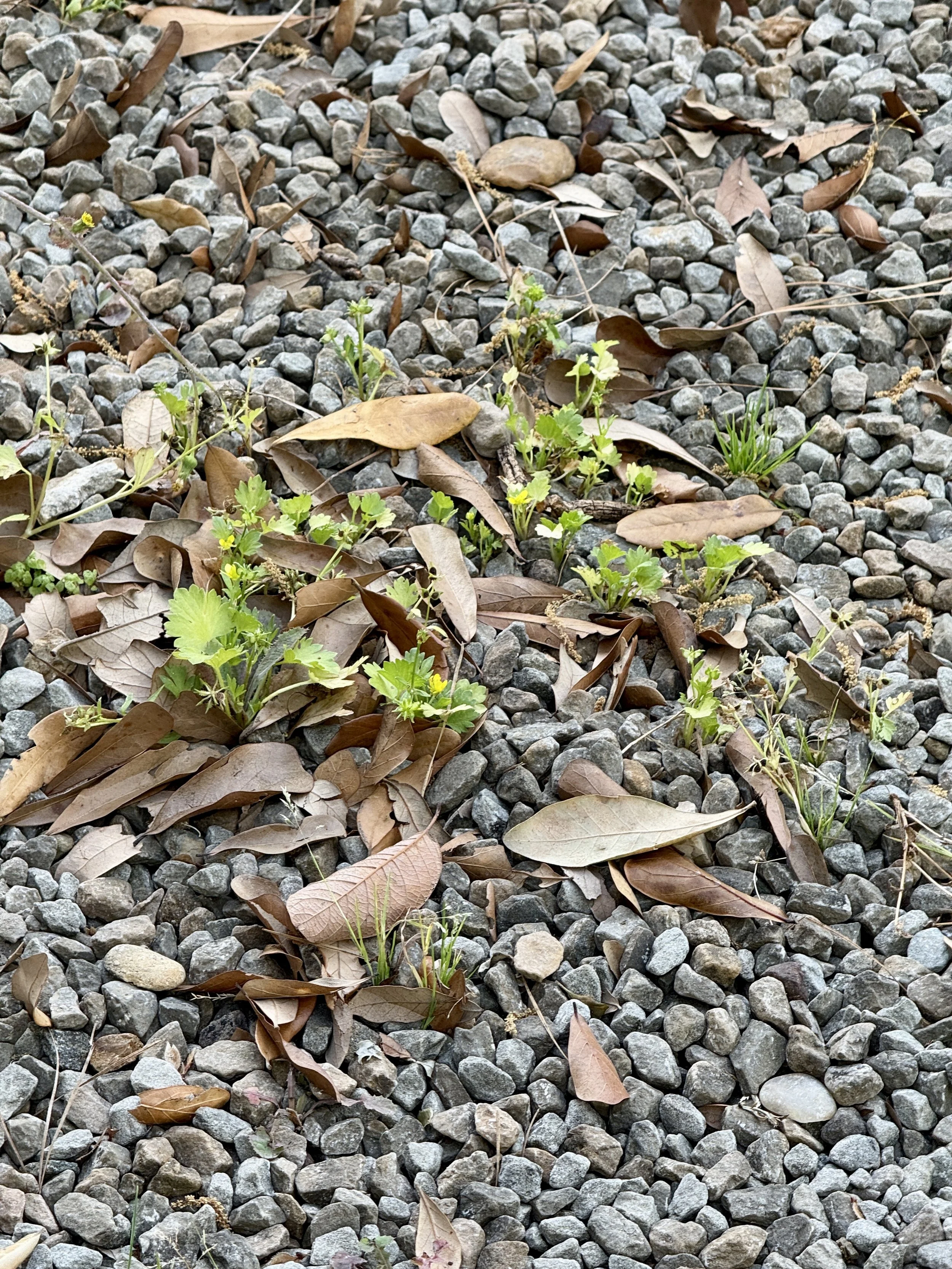
I feel it too. At my own eco-art studio, volunteer plants have started pushing up through the gravel parking lot this spring. In modern aesthetic terms, it looks unkempt. Do I groom it because that is what looks cared for to the human eye — or do I do what I preach? If I did clean it up, how? I won’t use pesticides. Pulling is more work than I can manage. I could burn them with a torch, which releases carbon — leaving the lot neat but barren. I know that option well. It’s what I did all last summer. I feel the pull of it still.
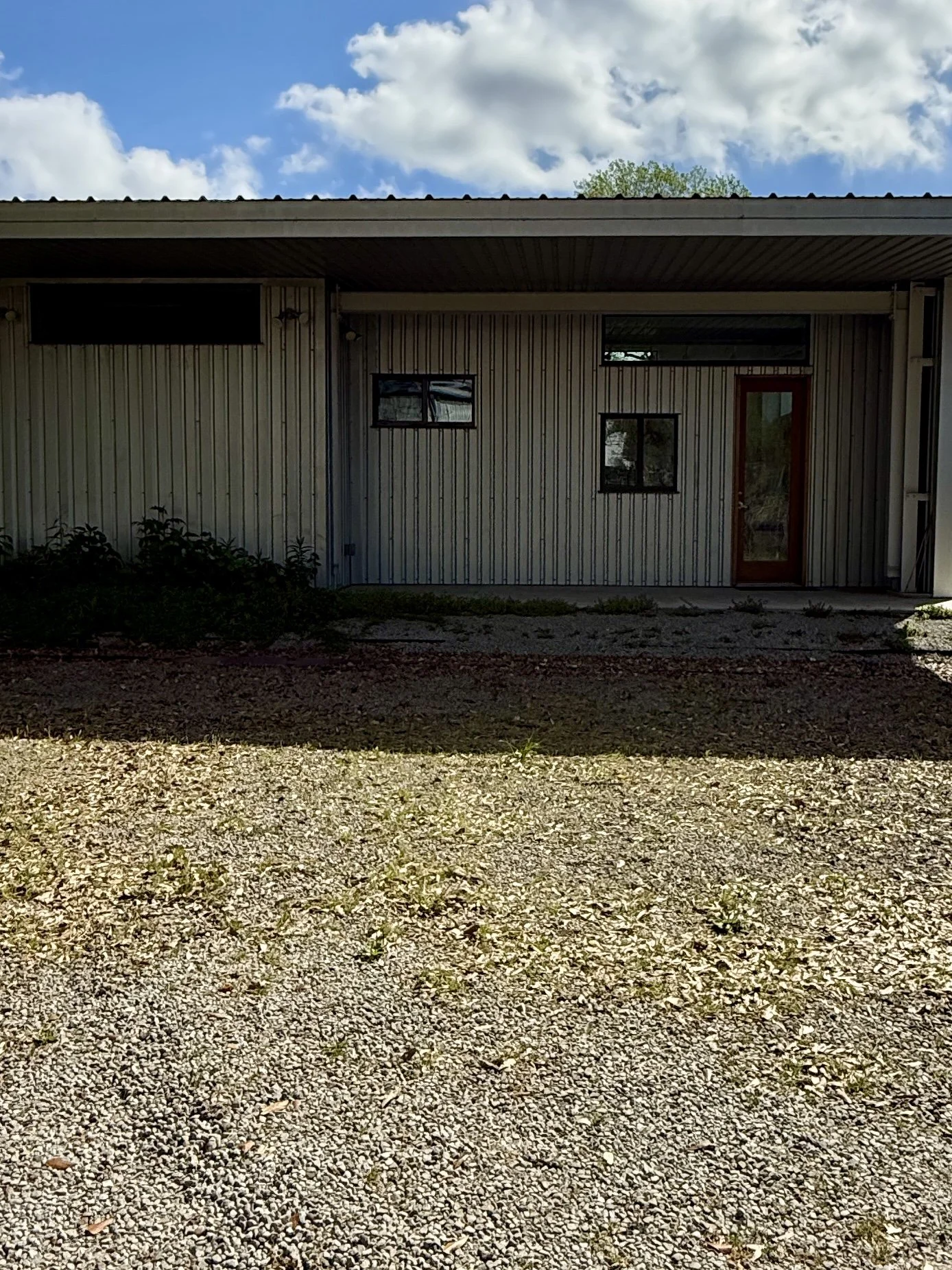
That question — how much tidiness do we owe society before we’re allowed to let something live — is exactly what this essay is about.
The ancient part of your brain that kept your ancestors alive is genuinely afraid of the tall grass. It is scanning for the snake, the bobcat, the thing with teeth. That instinct is old. It is wired in. The impulse to clear, to see, to know what’s out there — it kept people alive across tens of thousands of years. We are not wrong to have it.
But we are living in a different world now, and that old circuitry is misfiring.
Here is what the science shows: living plant systems — their moisture, their transpiration, their cooling and breathing — help move weather across the landscape. Strip those systems out and replace them with hot pavement and monoculture lawn, and you remove the very mechanisms that keep weather moving. Extreme weather increasingly gets stuck. Heat domes park over cities for days, fed not just by hot pavement but by the barren heat radiating off bare ground and fallow fields. The fires. The floods. The Guadalupe on the Fourth of July. Hurricane Harvey. We call these natural disasters — as if nature did this to us, unprovoked.
The danger is no longer the rattlesnake in the grass. The danger is the bare ground.
I know this in my body now — not just my brain. Standing in my parking lot, looking at the volunteers pushing through the gravel, I no longer see a mess. I see first responders. The plants that show up uninvited are the ones that know what the ground needs — to be covered, held, cooled, fed. They are doing the work we stopped doing when we picked up the leaf blower and the herbicide.
What would it take to shift not just individual behavior but the aesthetic itself — to make living, layered, uninvited-welcoming landscapes look like what they actually are: acts of intelligence? Acts of care?
The weeds already know what to do. The seeds are in the soil, waiting. Life is not asking permission. It is ready to come back the moment we stop yanking it out.
The question isn’t whether the land can recover. The question is whether we can — from the idea that control is the same thing as care. That bare is the same thing as clean.
The greatest threat we face isn’t what’s hiding in the weeds. It’s that we cut them all down.
Nature Nurtures: Nurture Nature
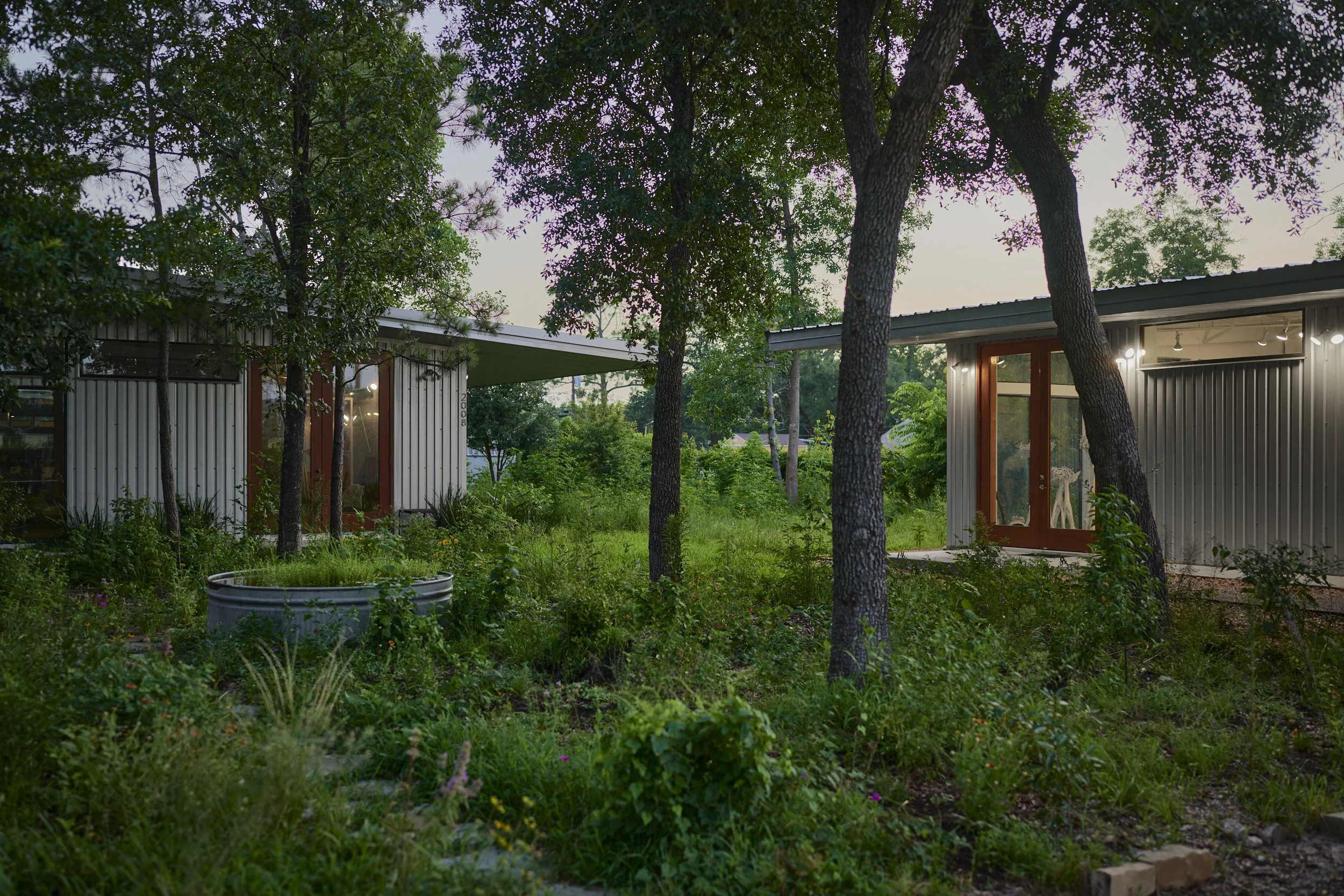
Sequel, 65oo sq. ft living sculpture, Summer Solstice 2024, Image by Jake Eshelman
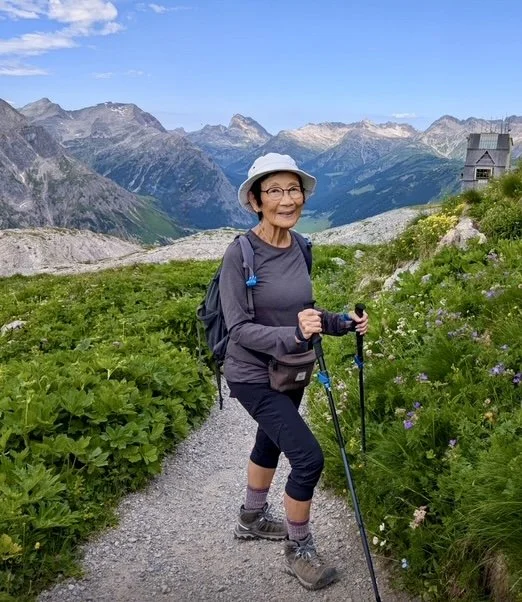

image by Wolf Mac Lean
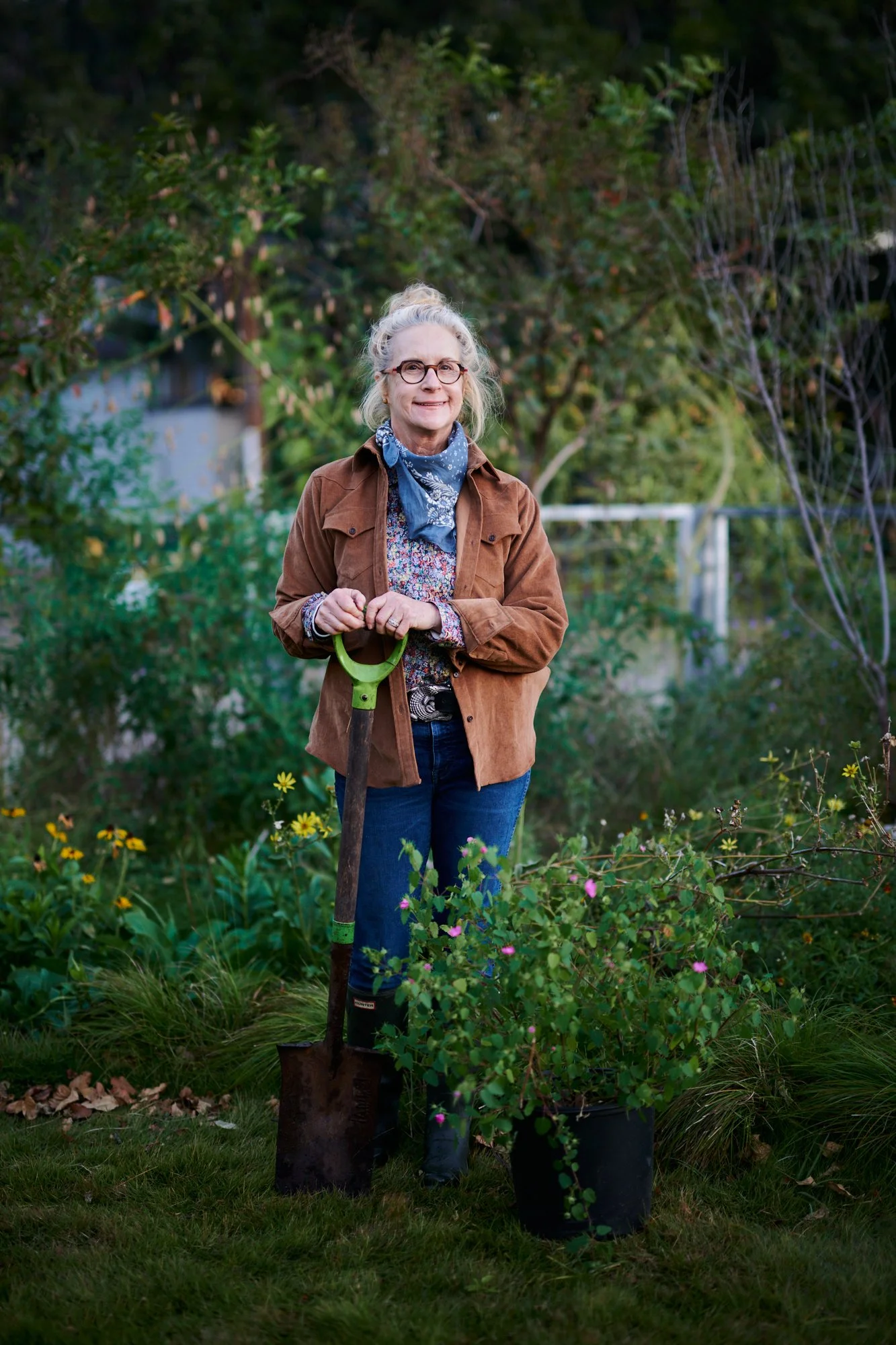
image by Jake Eshelman
Generational Amnesia and Regeneration.
My husband Curtis and I drove to Christoval, Texas for a public hummingbird tagging event. I had been to a private tagging before, but this one was different. The public was invited in. Children were there.
Biologists carefully capture tiny hummingbirds to collect vital information — sex, age, length, weight. After gathering the data, a skilled volunteer carefully cradles each delicate bird in the palm of an observer’s hand.
The tiny creature briefly pauses. You hold your breath. You feel an almost mechanical vibration, like a toy stuck in the “on” position — the rhythm of its heartbeat. Then, in an instant, it is back into the wild.
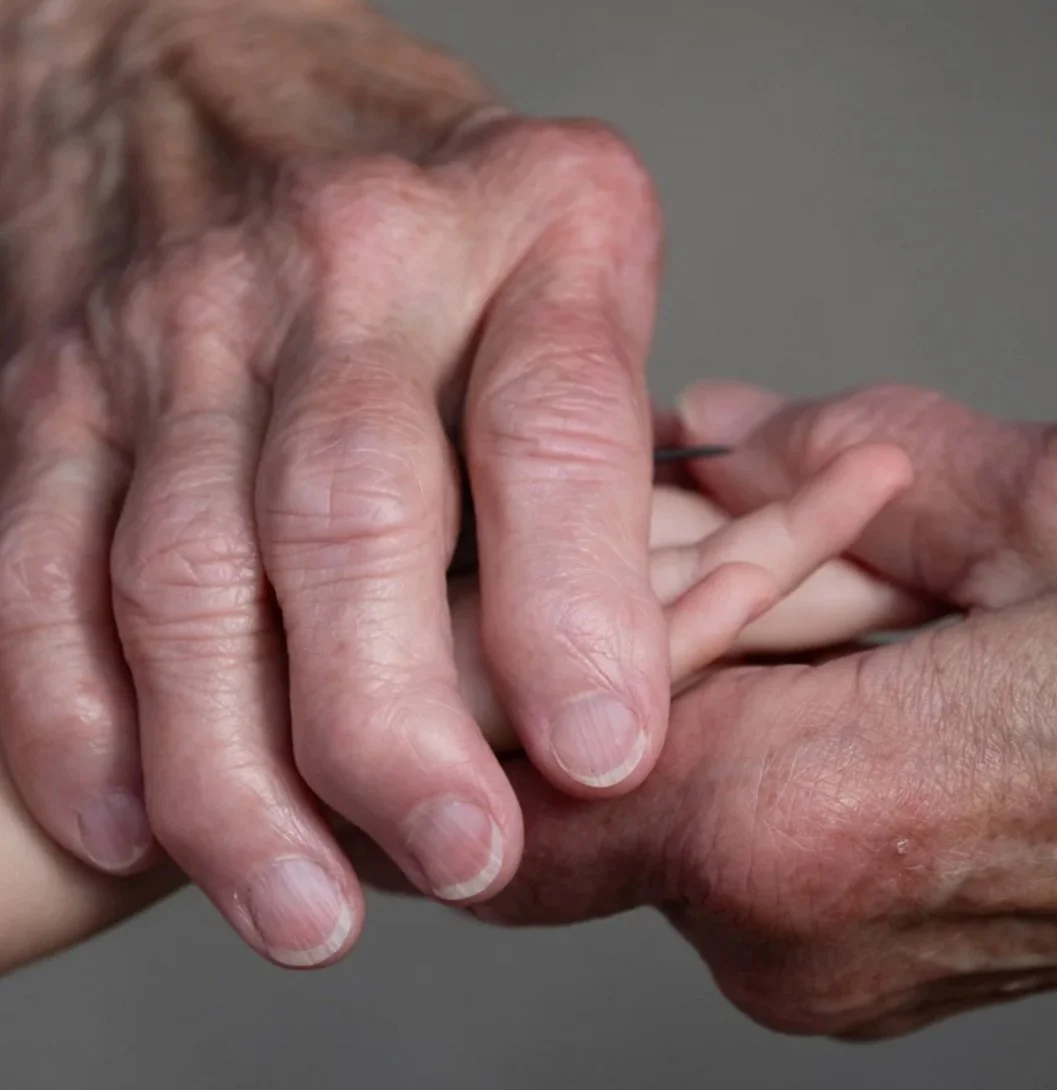
It wasn’t until I looked at my photos afterward that I saw it — a trusted volunteer placing the bird in a child’s hand. The transfer of knowledge, right there in the frame. A tiny beating heart. A child holding their breath.
That moment — the exchange of a tiny life from seasoned hands to smooth palms — is a living metaphor for what it means to nurture the passing of knowledge and care across generations. It is the story of regeneration.

This is what generational amnesia looks like in reverse.

Generational amnesia — also called shifting baseline syndrome — describes how each generation views the environment they inherit as the normal standard, even if it is significantly more degraded than that of previous generations. We absorb the world we are born into. We mistake it for the world as it is.


In the 1980s in Houston, our garden was filled with hummingbirds. Their vibrant presence shaped our daily conversations, our sense of place, our sense of wonder. They were part of our love story. Curtis proposed and hummingbirds were there. We miss them.


Today’s children in Houston have likely never seen one in a garden. They have no baseline for what’s missing. And that is the whole loss — not just the hummingbirds, but the memory of them.

Breaking this cycle requires hands willing to reach out and moments prepared to receive. It demands nurturing curiosity, empathy, and attention in children and adults alike. It calls for the deliberate passing on of more than just facts — but also the emotions and experiences that bind us to the world beyond ourselves.

The hummingbird’s pause in the palm of a stranger’s hand is brief. But it is enough. This is how we pass down the endangered knowledge of our natural history now — not around a campfire, not through a grandmother’s photo album, but in a field in Christoval, Texas, with a tiny beating heart in your hand and a trusted volunteer saying: this existed. Pay attention


.
Dreaming of Melting Mummies.

When you understand the natural systems that regenerate our planet, you understand that snow is both an end and a beginning. Tobi, my Labrador, and I could not wait to check on our plant beings in “Deeper than that” this snow-covered morning. Scanning the installation there are bushy snow puddles of Butter daisies and Bluemist flowers with tiny bursts of color saved only for those who care to listen closely.
Layered in the dust of the morning’s snow the blanket flower draws us closest. The fiery blooms not reaching for the sun but in a motherly huddle. I am grateful that I don’t need to spend money, time, or energy on covering native plants that are genetically designed to thrive in extreme temperatures and weather conditions. The exposed plants create a subtle palette of earth tones rarely seen in urban landscapes, showcasing the various stages of life and regeneration that these resilient species represent. When my eyes focus on the details, hidden colors are revealed, and my brain receives a surge of oxytocin. I understand what hope feels like. As l scan down the street I see homes lined not in winters pallets but boxshrubs wrapped like mummies. For a moment I invision those mummies milting into a street lined with nature’s gentle winter lessons. I image things to inspire children to explore and capture their imagination.
In the quiet of the snow, I reflect on its form—a white-covered blanket—and its relationship with a planet that naturally regenerates for future generations. I consider how the plants that freeze back or remain in place become energy sources and habitats, supporting the foundation of the planet’s food network. It warms my heart to think about how this snow-covered landscape protects the soil life that nourishes roots and promotes spring growth.
There are many lessons that humans can learn from a garden that embraces seasons, regenerates life and provides for a diversity of beings. Imagine how different the world would be if every child’s first classroom was a garden, or if all politicians had to maintain a healthy garden without the use of chemical inputs for four years before they could hold office. They would gain insights into networking and learn about symbiotic relationships in real life.
Lifeblood

Lifeblood
5.75 “ X 6” X 7”
bronze
Image by Jake Eshelman
Lifeblood, Explores of the profound connection between humans and nature, conveyed through the visual metaphor of a root naturally occurring in the shape akin to the human heart. This piece is part of a larger body of work titled "Subterranean Secrets," which delves into the theme of roots. My work aims to invoke reflection on the unseen yet vital networks that sustain both plants and humans. By casting roots directly in bronze, I emphasize their resilience and permanence, highlighting the enduring significance of these natural systems.
The inspiration for "Lifeblood" arose from my studies on regenerative agriculture, focusing on the indispensable role roots play in countering extreme weather. My exploration into the fascinating world of roots began in 2017, unveiling striking visual similarities between roots and the human heart. These parallels reveal both biological and conceptual truths, as roots and the heart function as lifelines, circulating essential nutrients that sustain life.
Through "Lifeblood," I invite an examination of the often-overlooked relationships between human existence and the natural world. The act of casting these roots in bronze imparts permanence to these otherwise ephemeral forms, challenging perceptions of how we value the natural systems surrounding us. This sculpture contributes to the ongoing dialogue about our environment by emphasizing our dependence on nature and reinforcing the deep interconnection between humanity and the natural world.
In the end, "Lifeblood" serves as a call to acknowledge and appreciate the hidden yet crucial systems that support life. I believe that by understanding and valuing these networks, we can cultivate a deeper awareness of our roles within the broader ecological system, sparking actions to preserve and nurture the natural environment essential to human existence.
La Mancha’s Sequel: A Mindful, Climate-Smart Urban Landscape.

January 14th
Today, as I immerse myself deeper into the world of ecological restoration and sustainability, I find myself fueled by an overwhelming sense of purpose. My Climate-Smart Urban Landscape project has truly become a labor of love, growing more meaningful with every leaf gathered. As I collect bags of native Oak leaves from curbs, I'm not just gathering leaves—I'm cradling potential life, the eggs, pupae, larvae, and chrysalises that might be nestled within. Astonishingly, Oak trees are home to over 900 species of caterpillars. These caterpillars serve as a crucial food source for many songbirds and their young across North America. By saving these leaves, I am inadvertently contributing to the survival of these beautiful creatures.
The interconnected benefits of these efforts are profound. First, by fostering biodiversity, I help ensure diverse species can thrive. Second, as the leaves decompose, they transform into a rich, nourishing substance that revitalizes our depleted soil, forming the very backbone of our food network. Third, these leaves provide essential shelter from harsh weather, acting as a protective barrier against heavy rains and cold temperatures and safeguarding the tiny creatures that rely on them to survive.
My inspiration stems from personal experiences and a deep sense of environmental stewardship. Through "La Mancha’s Sequel," my urban landscape project, I aspire to blend art, architecture, and environmental literature in a way that leaves a meaningful impact. My goal is to transform the local community here in Houston and ignite a larger appreciation for ecological interconnectedness. By sharing this journey, I hope to inspire others to commit to regenerative practices within urban environments.
With every leaf collected and every small step taken, I am moving toward a more harmonious world. This journey reminds me that each of us holds the power to make a difference in our neighborhoods, communities, and beyond. Together, we can create a future where sustainability and biodiversity thrive hand in hand.
#rain #soil #abstractexpressionism #houstonart #ecoart #socialsculpture #cindeeklementart #art #texasart #sculpture #contemporaryart #modernart #regenerativeart #sequel #acreshomes #foodnetwork #foodchain #regeneration #regenerativeart #artandscience #agriculture #agriart #foodnetwork #foodweb
Prairie Rhythms: Predators and Pastoral Stewardship

As I prepare for my upcoming living sculpture titled "Sequel," I had the opportunity to explore the prairie ecosystems at Pierce Ranch. The morning started with collecting prairie seeds, which is a vital step in bringing my sculpture to life. To enhance my understanding of these ecosystems and find the most viable seeds, I reached out to a local prairie conservationist who has been instrumental in restoring numerous prairies, notably preserving the Katy Prairie. Collecting seeds is much like eating crawfish, proven to be a catalyst for engaging and enlightening dialogue.
The insights I gained from this exchange confirmed my concerns regarding land preservation. It might surprise and disturb you to learn that the most vibrant and diverse prairies aren't necessarily those that are protected. Rather, they are the prairies that have embraced a more dynamic relationship with the land through careful ranching practices and thrive with life and diversity.
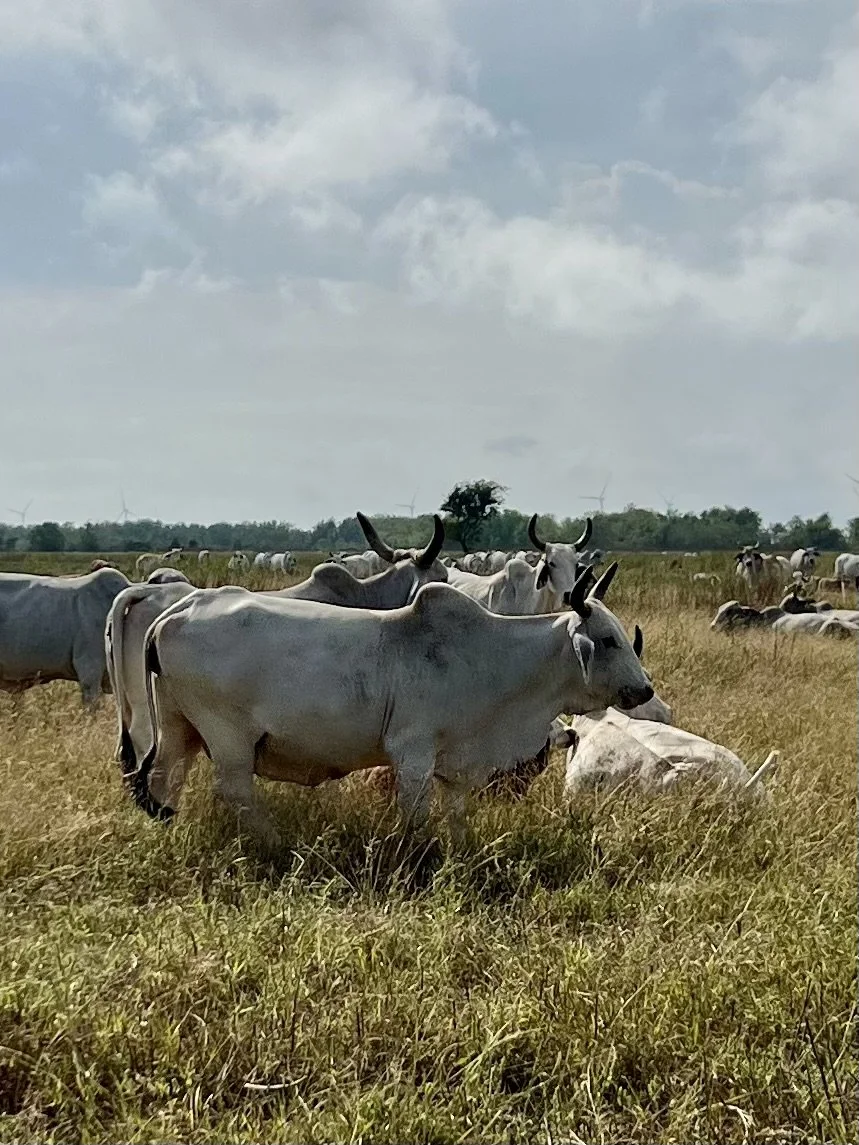
Historically, the natural balance between predators and prey shaped these ecosystems. Predators once hunted freely, guiding the movements of herbivore herds, naturally managing the consumption of vegetation (energy) and the dispersal of organic matter in the form of dung, returning energy back into the soil. However, human intervention led to the decline of these predators, overgrazing, and the desertification of ranchlands. Modern-day ranchers have learned to adapt by using portable fences to mimic these natural movements. This modern adaptation sustains the prairie as a healthy ecosystem, supporting numerous bird species and wildlife.
Through this blog post, I hope to reach an audience unaware of the critical role of ruminants in preserving and revitalizing prairie ecosystems. It's not merely about protecting a static image of nature but understanding and fostering the dynamic relationships that sustain it. The prairies are a testament to the resilience and complexity of life when allowed to interact naturally, even within the framework of sustainable human practices.
It's exhilarating to see how this knowledge aligns with my artistic vision. The conversations I've had and the observations I've made will undoubtedly enrich the narrative and structure of my living sculpture. The prairie seeds are not just components of my work; they symbolize a deeper understanding of ecological balance and the beauty of a thriving ecosystem. They are a source of energy and knowledge, a way to repay the planet.
As I continue this creative process, conversations with friends and experts will remain the cornerstone of my inspiration. In sharing these insights, I hope to foster a broader appreciation for the nuances of prairie conservation and the subtle yet profound ways we can contribute to preserving our natural world.
I leave you with questions that modern society must consider: How can ruminant populations be managed in the absence of predators? What are the consequences of not culling herds? What does the future cycle of life entail?

Echoes of Existence-how to engage the students
I am slowly working to find solutions to the problems that will arise when the students implement the installation.
First, how to get students that are not comfortable with nature to want tobe involved. What will draw them in?
Second, a big problem is how to control a group of college kids in a field and have them complete a detailed installation.
Bloomington is a walking city. Every day as I would walk about town and the campus I worried about how I was going to solve these two problem. And like on most college campuses everyone is in their own audio visual world contained between the ear pieces of a headset. And I was the same. The difference was I still wanted to connect to those passing by me with a “good morning” or hi. I found the IU students were very focused on the sounds in their headsets they did not need to make eye contact or say hello.
In a discussion with an English professor, Shannon Gayk, who also teaches a walking class, I learned that a novel idea for students is silent walking. The idea of walking without a headset without sound — silent.
Thinking of headsets and silent - my mind went straight to silent raves then to a silent installation.
Would the concept of a silent installation draw the students in. Could this commitment to headsets be a possible tool for crowd control during the installation?
I love the idea. But that leads to another hurdle. How do I design a silent installation? What technology makes this possible?
With a quick Google search, I found several companies that provide everything you need for a silent event.

Weingarten Art Group - Reseeding

I am delighted to be included in the spring 2024 exhibition at CityCentre, “Reseeding”, which prompts deep reflection on humanity’s influence on the natural world. The exhibited artwork urges us to envision a utopian future where our impact is positive and mindful choices lead to a harmonious coexistence with nature, inspiring a collective commitment to a sustainable future. The exhibition was thoughtfully curated by Olivia Kimbrell of Weingarten Art Group.
On exhibit until September 2024, the lobbies at CityCentre are open to the public M-F, 8 AM – 6 PM
CityCentre 2 Front – Christian Eckart
CityCentre 2 Back – Cindee Travis Klement
City Centre 3 – Dornith Doherty
CityCentre 4 – Bruna Massadas
CityCentre 5 – Rachel Livedalen
Photography by Nicki Evans



Indiana University artist in residence— conceptualism, the site, archeology and anthropology.

October 11th was the end of the first leg of my residency. The experience truly supports the statement you don’t get what you want but you always get what you need. I did not seek out the residency but I can see how it is helping me take my Social practice to the next level.
It is giving me the opportunity to use; the symbolism of a labyrinth, the regenerative symbol of a bison, the turfgrass of an institute of the US collegic system to change societal habits. These features alone are rare and hard to come by resources.
Exploring the campus and discussing my plans with all who would listen resulted in IU providing me with the opportunity to add a few more layers to the work. Specifically conceptualism, archeology and anthropology.
Conceptualism- The Eskenazie Museum on IU’s campus has one of the three complete collections of Marcell Duchamps readymades. Seeing these pieces of Duchamp the father of conceptualism from the 60!s and 70’s gave me the idea that my work at Indiana would be more impactful if it is conceptual.
As I began to plan the labyrinth design and installation I began to see how beautifully Conceptualism works with Social sculpture. If I create the concept and the design the steps to install it and the students implement my concept and design it becomes theirs. It won’t be my art they assist me with it will be their actions taking meaningful steps.
The last Monday at IU in a meeting discussing the actual installation process with one of the professors and directors of the Hilltop Gardens it was suggested I work with the anthropology department and Archeology departments when I return. Archeologists will be enlightening when it comes to installing the grid. The Anthropology department can help facilitate a possible relationship and sharing of culture between the students of the First Nations and the students who do not have a deep connection to the land. I would like the installation to be a catalyst for the two groups to develop a unified way forward, a new tradition or ceremony that will give them all together a personal connection to the landscape and the biodiversity it will support.
The next step is to get the University wheels to approve a site. To be the most successful the site needs to be a sea of turfgrass, have full sun, be spacious enough to accommodate the 85’ X 54’ bison, and accessible to the students and community.
I am thrilled to announce that in late January 2024, IU selected a sloped plot of The Hilltop Gardens for the installation.


Related blog posts
A labyrinth of what shape? http://www.cindeeklement.com/blog/2023/10/2/what-kind-of-labyrinth-a-seed-a-beautiful-design-a-bison-that-is-the-question
The design
http://www.cindeeklement.com/blog/2023/10/8/the-labyrinth-design-how-will-it-be-installation
From 8” X 10” to 53’ X 85’
http://www.cindeeklement.com/blog/2023/10/7/how-do-you-build-a-labyrinth
Language and Perception

In the above image the wrench represents industry and the butterfly the natural world.
For those with philosophical minds, it’s fascinating to explore how language shapes our understanding of the world. The power of words extends beyond mere communication; it molds our perceptions and influences the way we interpret reality.
Consider how our dominant cultural values can impact our vocabulary and ultimately shape how we perceive things. If our society places highest importance on industry and financial gain without regard for environmental consequences, our language will reflect that mindset.
Our perception of the image and the world is shaped by our language. If our main focus is on achieving economic success at any ecological cost, then our vocabulary reflects these thoughts, and these thoughts in turn influence how we value ecology. Take a moment to consider this image of a butterfly and a wrench.
What do you perceive — a wrench supporting a butterfly or a butterfly struggling to withstand the pressure from a wrench?
We can use this knowledge to change society – by analyzing the relationship between language and perception, we can start to question and challenge these dominant narratives. We can choose to broaden our vocabulary, incorporating words that prioritize environmentalism and regeneration.
Imagine if everyone shifted their linguistic focus towards promoting regenerative practices, valuing nature, and taking responsibility for ecological well-being. This change in vocabulary could create a shift in perception – from viewing nature as something to exploit for financial gain to recognizing its inherent value, fragility and it’s power.
So let me ask you again: How do you perceive the image of the butterfly and the wrench? We have an opportunity to reflect on the power of language, challenge conventional thinking, and work towards creating a more regenerative future for ourselves and generations to come.
#ecoart #socialsculpture #wrench #butterfly #language #womanartist #texas #houston #cindeeklementart
Heat Dome
“What I propose, therefore, is very simple: it is nothing more than to think what we are doing.”
-Hannah Arendt, The Human Condition

Heat Dome
Watercolor monotype
30" X44"
Bare ground, concrete, asphalt, and astroturf emit 4X radiant heat. Great masses of radiant heat create heat domes. Heat domes prohibit weather from moving across the land. In contrast, surfaces covered in thick layers of plants indigenous to the region store water in the soil. When the day warms, the plants transpire, releasing bacteria with the moisture to form clouds that provide shade and then rain. We each need to carry our ecological weight. We can start by considering new ways to surface our city scapes to cool the planet.

Heat Dome ghost
Moving Forward

Moving Forward
67” X 15” X 18”
Image by Jake Eshelman
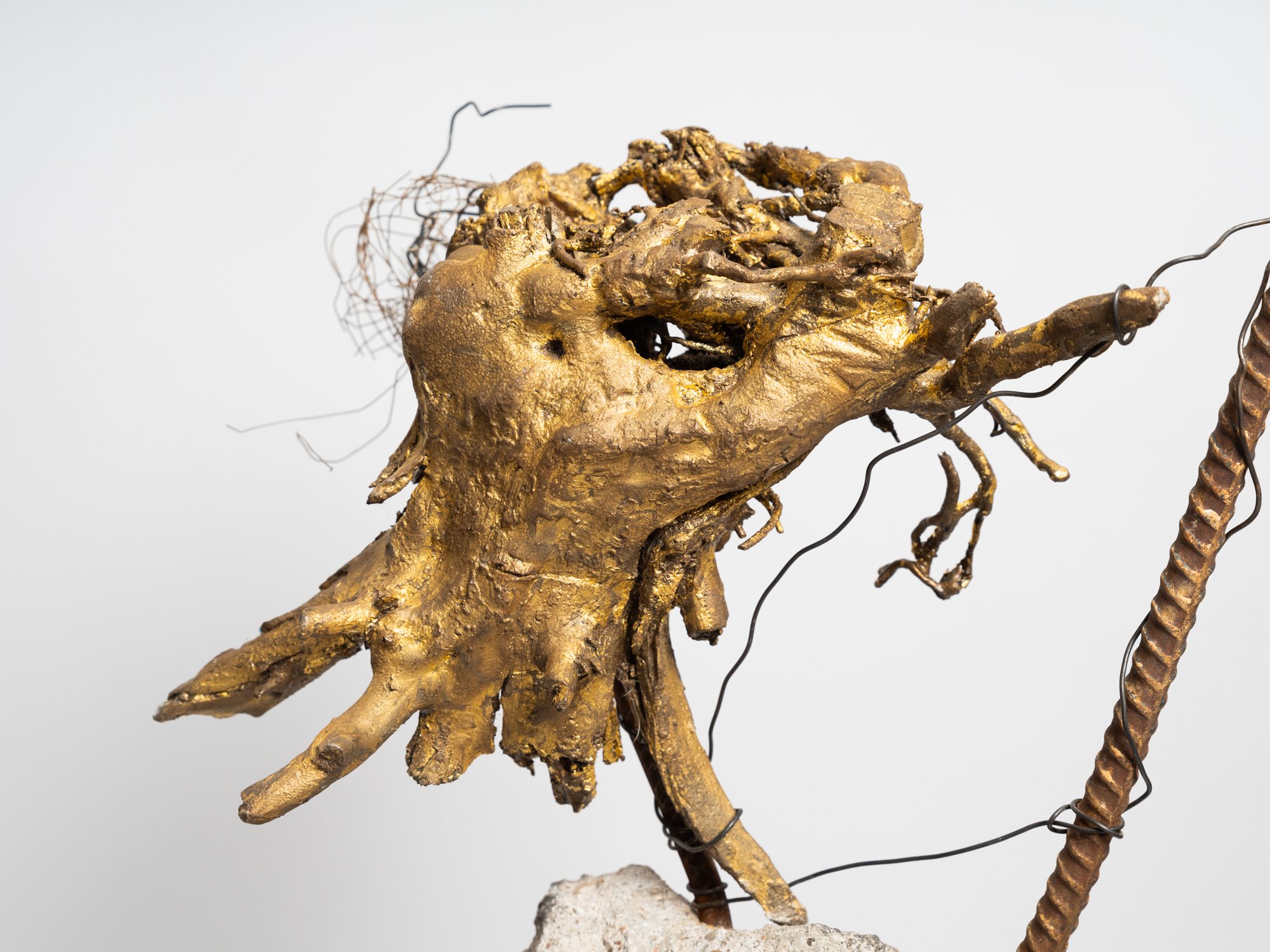
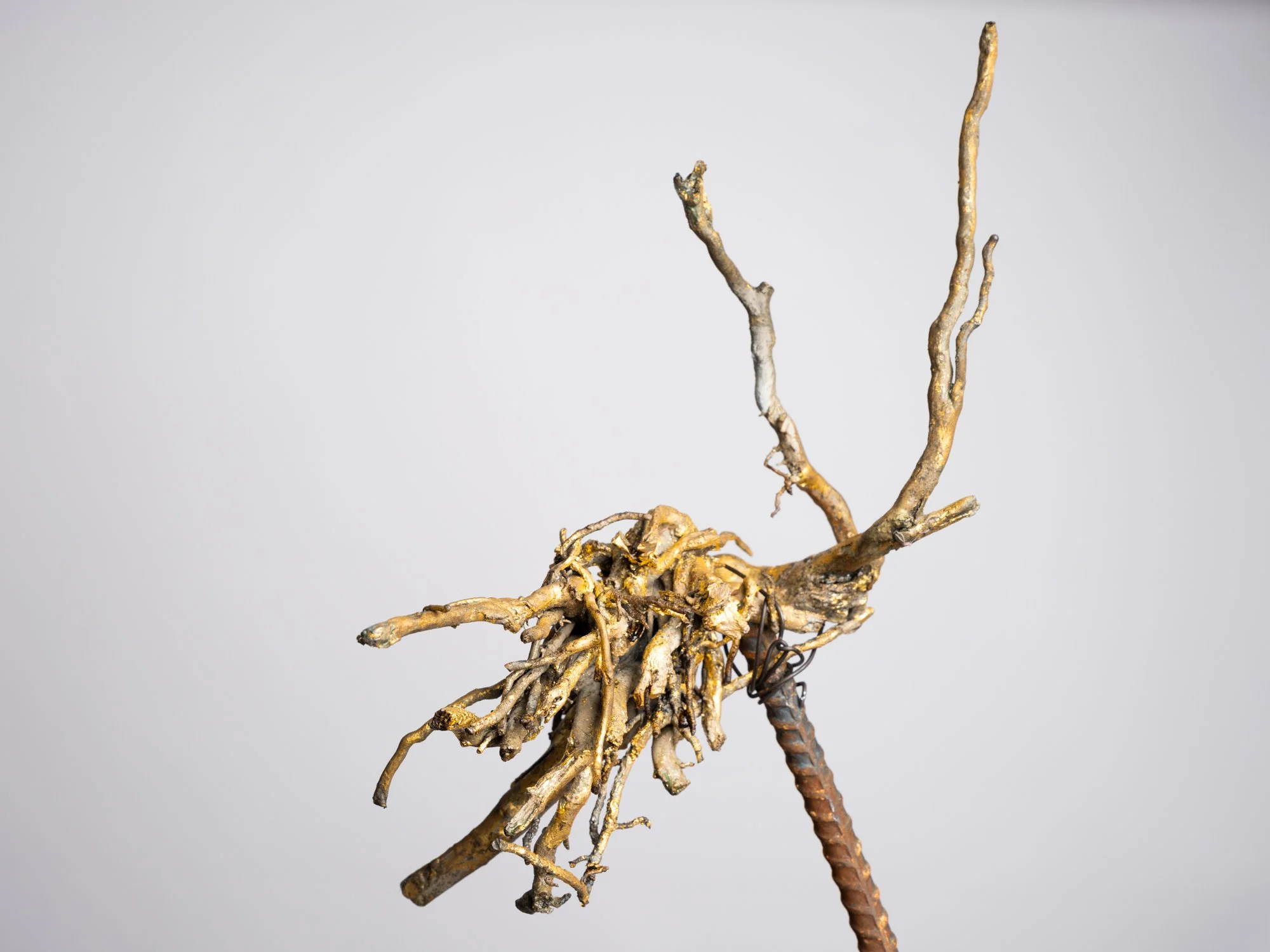
Found object concrete and rebar curbing fragment, rusted steel, bronze, and gold leaf.
Moving Forward consists of two rectangular concrete curb fragments and two cast bronze roots, the latter with gold-leaf patinas. These objects are tethered like irregular beads strung on a wire of rusty rebar falling to the earth.
The fractured concrete and the more extensive root land at the forefront in a forward strutting anthropomorphic structure. Growing behind the long-necked bird-like form, a stem of rebar twice the creature's height reaches for sunlight. The meandering stem is counterbalanced with the smaller root in a lyrical passed sunflower shape.
The weighted composition invites viewers to reimagine the relationship between our engineered landscapes and ecological systems to support wildlife and forge a path toward a regenerative future.


Interdependence

Interdependence
60” X 10.25” X 10.25”
Image by Jake Eshelman
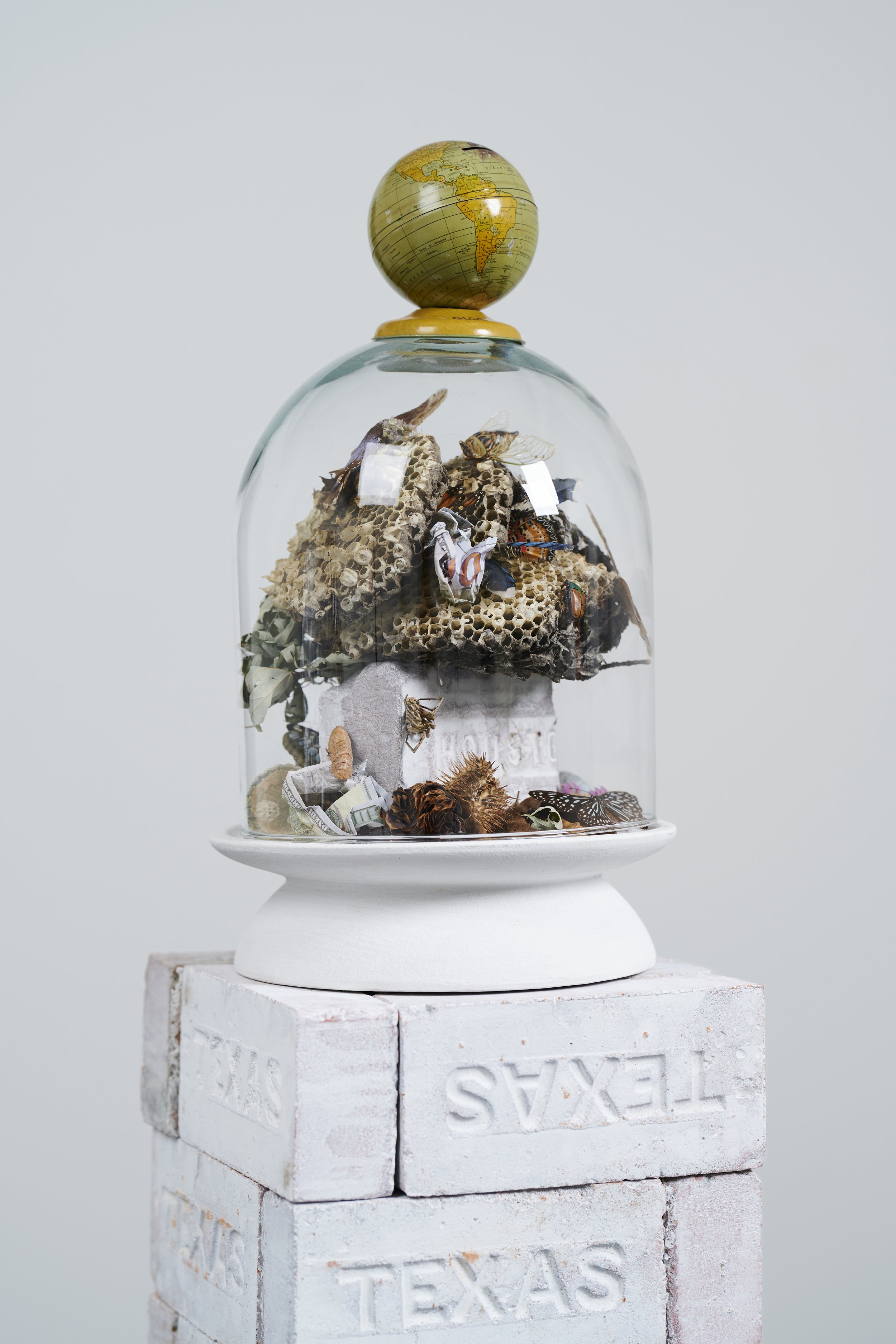
Texas Bricks, Paint, Plastic Dome and Base, Vintage Globe Bank, Prop $100 bills, Coins from a diversity of economies, Paper Wasp’s nest on Maple tree leaves, Seashell with barnacles, Red swamp crayfish, bird nest, feather of a Pileated Woodpecker, Blue jay feathers, Mantis, Cicada, Great Purple Hairstreak, Tropical Checkered Skipper, White Peacock, Red-spotted Admiral, Monarch, Red lacewing butterfly, June Beetle, Eastern Carpenter bee, Wolf Spider, Beebalm, Sacred Datura, Bundleflower and various dried leaves.
Artist Statement
Interdependence is built from a collection of TEXAS-stamped bricks washed with a white patina. In a staggered stacked square skyscraper form, the bricks shoulder a transparent dome and base, crowned with a vintage Globe Bank finial.
Within the transparent dome is a still-life collection of intricately connected elements from natural and human-made systems. They wreath a "Houston" stamped brick fragment.
By using everyday materials that we typically associate with urban environments, the work conveys that the collective actions of Houstonians, living in a dense population center with a sprawling footprint and long growing seasons, have far-reaching implications for global economies. It is a reminder that our choices impact not just our immediate landscapes but global eco-systems as a whole.
This sculpture is not a warning. It presents a solution. I employ systems thinking to suggest that embracing economic systems is necessary to recover biodiversity. Economic systems dominate our culture and intimately impact natural systems. Houston's ecology and commerce can potentially create a new economy - an ecotourism industry. Houstonians can transform the negative impact of industrialization, commerce, and urbanization into a source of beauty, wonder, and economic growth by advocating for our natural habitats.
Interdependence invites us to rethink our individual relationship with the planet’s biodiversity, recognize the value of our natural heritage, and embrace the idea that supporting wildlife is a global responsibility dependent on a collection of individual acts.



A Turn of Events: My Dream Installation on hold.
This summer, I was presented with an incredible opportunity. A curator asked me to propose my dream installation, a chance to showcase something meaningful. The site owner was willing to support and fund the work.
After much contemplation, I decided on a proposal that filled me with passion and urgency. However, last week, it all came to a halt.
I am sincerely grateful for the curator’s interest in my work and the site owner’s support. Their initial inquiry inspired this proposal, and I cannot thank them enough for that. I believe that everything happens for a reason, I have an idea and I am hopeful that I will find the project a site and funding.
First a little background. While at Indiana University, I became aware that integrating ecological recovery with natural systems is a new academic direction and numerous educational institutions are interested in this area. After all, universities and school systems are the largest landowners in any city and having research students involved would be a great asset. Transforming the proposed installation into an art/environmental science installation would significantly enhance the social sculpture’s reach and benefit a university and society.
Below is my proposal.
Introduction-
Global warming, food security, drought/flooding, wildlife habitats, economic instability, and health – these problems are not new to humankind. The archeology of ancient civilizations has recorded connections between the longevity of civilizations and the health of their soil. The United Nations reported in 2014 that the world's topsoil would only last 60 more growing seasons. Soil scientists around the globe agree that solutions to these issues are rooted in our treatment of soil—the skin that covers our planet.
In a moment of global uncertainty, I ask myself, what materials and forms would I use to create the greatest impact on society and the environment? As I think of ancient civilizations' architecture, art, and spiritual practices, pillars and vessels played an important role in shaping their understanding of the world. Much of my previous work has been about conservation issues, looking specifically at Earth’s natural systems of bees, at waterways, at bison, at native plants, at recovery from Hurricane Harvey, and now at the underground systems of Earth. And so, I would use roots as my material and pillars as my vessel.
standingGROUND
In standingGROUND, I propose a four-stage installation of 5’-10’ tall pillars of various shapes grown from the roots of long-rooted prairie plants.
These pillars will be created by stacking various shapes of clay vessels commonly purchased from home and garden stores. The vessels with the bottoms removed will be stacked and centered on a steel pole cemented in the earth with a small footing for stability. The pots will be filled with a leaf-mold compost and seeded with native grasses and plants known for their root depth. They are to be nurtured and watered for approximately twelve months or until the plants are rootbound in the clay pillars. The clay will then be delicately broken away and the above-ground plant material removed, leaving freestanding pillars of delicately intertwined roots bound in the shapes of the stacked vessels. The root pillars will stand erect on the hidden steel posts.
Drawing inspiration from the rhizomatic root structures of native grasses that give structure to Earht’s underground life, these sculptures, woven by natural systems, standing above ground, will bridge the gap between sky, earth, water, and modern humanity. These pillars offer a glimpse into the intricate workings of an underground prairie ecosystem, the upside-down rainforest for carbon sequestration of North America.
Four Stages
The first phase of standingGROUND will focus on the sculptural aesthetics of the work. I will carefully build the pillars composed of ready-mades to be strong sculptural elements on their own. Once a site is selected, I will choose a paint color that harmonizes with the surroundings and emphasizes the sculptural qualities of the pillars. Lighting will play a crucial role in showcasing the sculptures in relation to their environment. I will paint the pots before the installation, touch them up, and paint the joints afterward. Information on the site will discuss the ecological and social aspects not yet revealed.
The second phase will be to install the pillars into an immersive experience. The towering yet human-like pillars will be positioned strategically to create an intimate and inviting space for viewers. Within this space, a stone or stump will be placed as a reflective seat, provoking thoughts on how our actions impact climate and biodiversity and how humanity can find harmony within natural systems.
The third phase of standingGROUND is when I physically chisel the ceramic vessels away to reveal the social sculpture aspect, the delicate white lace-like intertwined roots bound in the shapes of the stacked ready-mades bridging the gap between sky, earth, water, and humanity.
The fourth phase encapsulates the cycle of life, decay, and regeneration. This crucial phase is essential for ensuring life on Earth. The root sculptures will gradually erode and disintegrate when exposed to the elements. Once the installation has reached the end of its visual lifespan, I will carefully remove the root sculptures. The poles and footings will be relocated from the site. This stripping away of the remnants will leave behind a cavity in the ground previously occupied by the footings. Remarkably, this void will serve as a space where the roots can be placed to rest-regenerate and give birth to new life.
I started experimenting with the shapes in their root form last week. I initially created six sketches in the form of watercolor monotypes. Then, I researched more pot shapes with larger mouths and created four more in round 2. The images of these sketches are below. I will continue experimenting with these shapes as I work on a site.

standingGROUND II
Watercolor monotype
30” X22”

StandingGROUND VI
Watercolor monotype
30” X22”

standingGROUND round 2 #1
Watercolor monotype
30” X22”
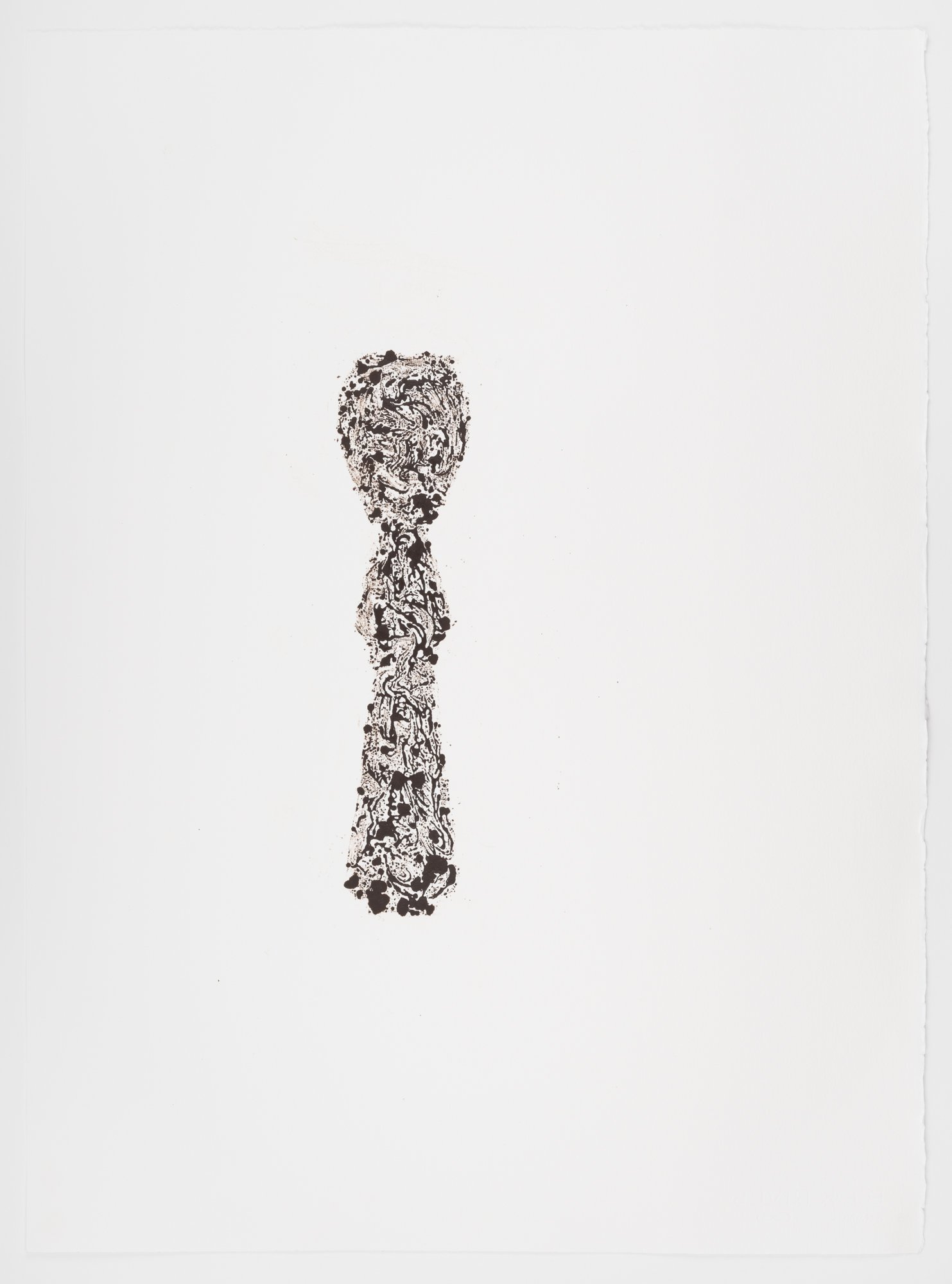
standingGROUND IV
Watercolor monotype
30” X22”

StandingGROUND round 2 #4
Watercolor monotype
30” X22”
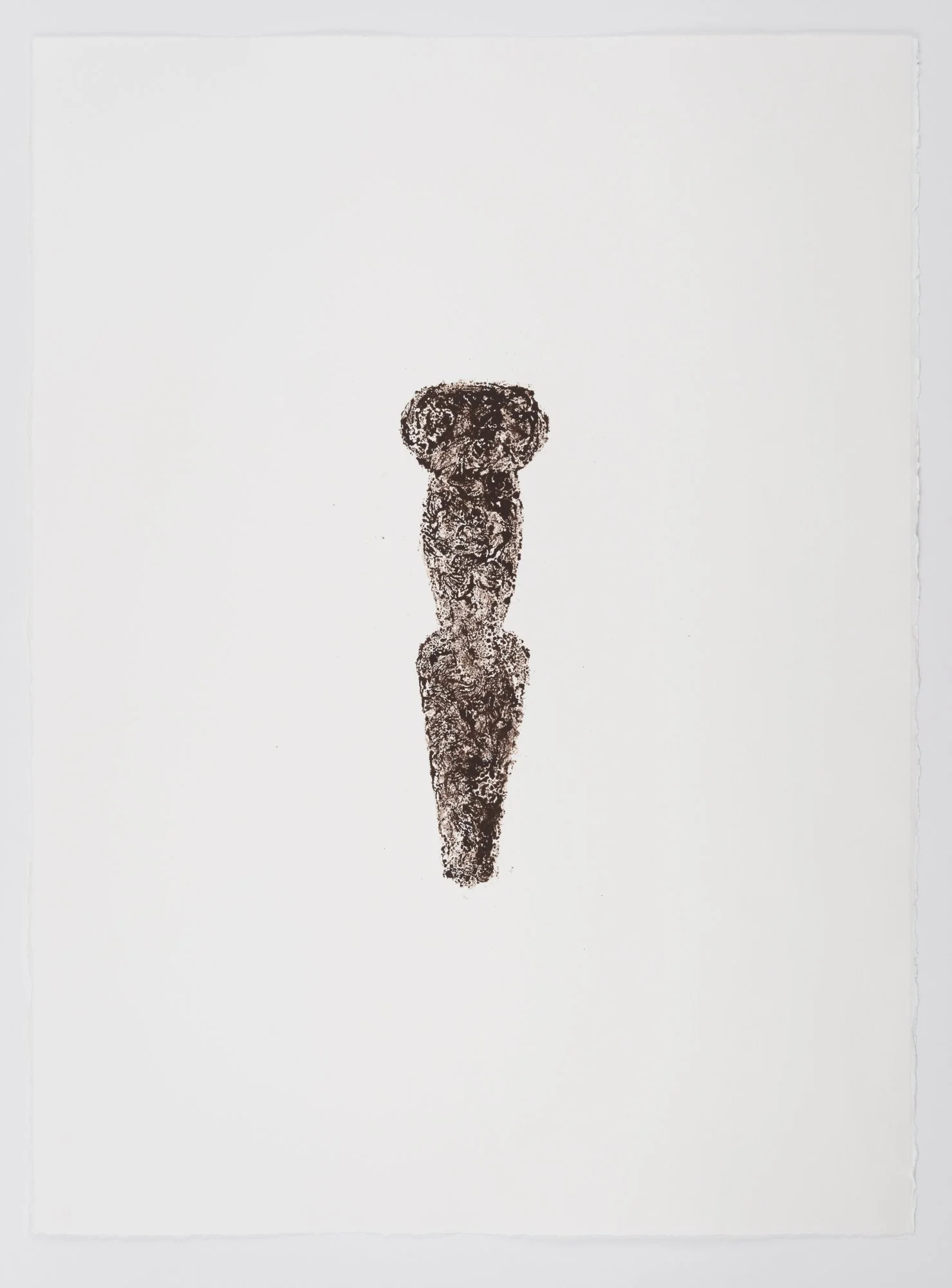
StandingGROUND round 2 #3
Watercolor monotype
30” X22”

StandingGROUND round 2 #2
Watercolor monotype
30” X22”

standingGROUND V
Watercolor monotype
30” X22”

standingGROUND III
Watercolor monotype
30” X22”
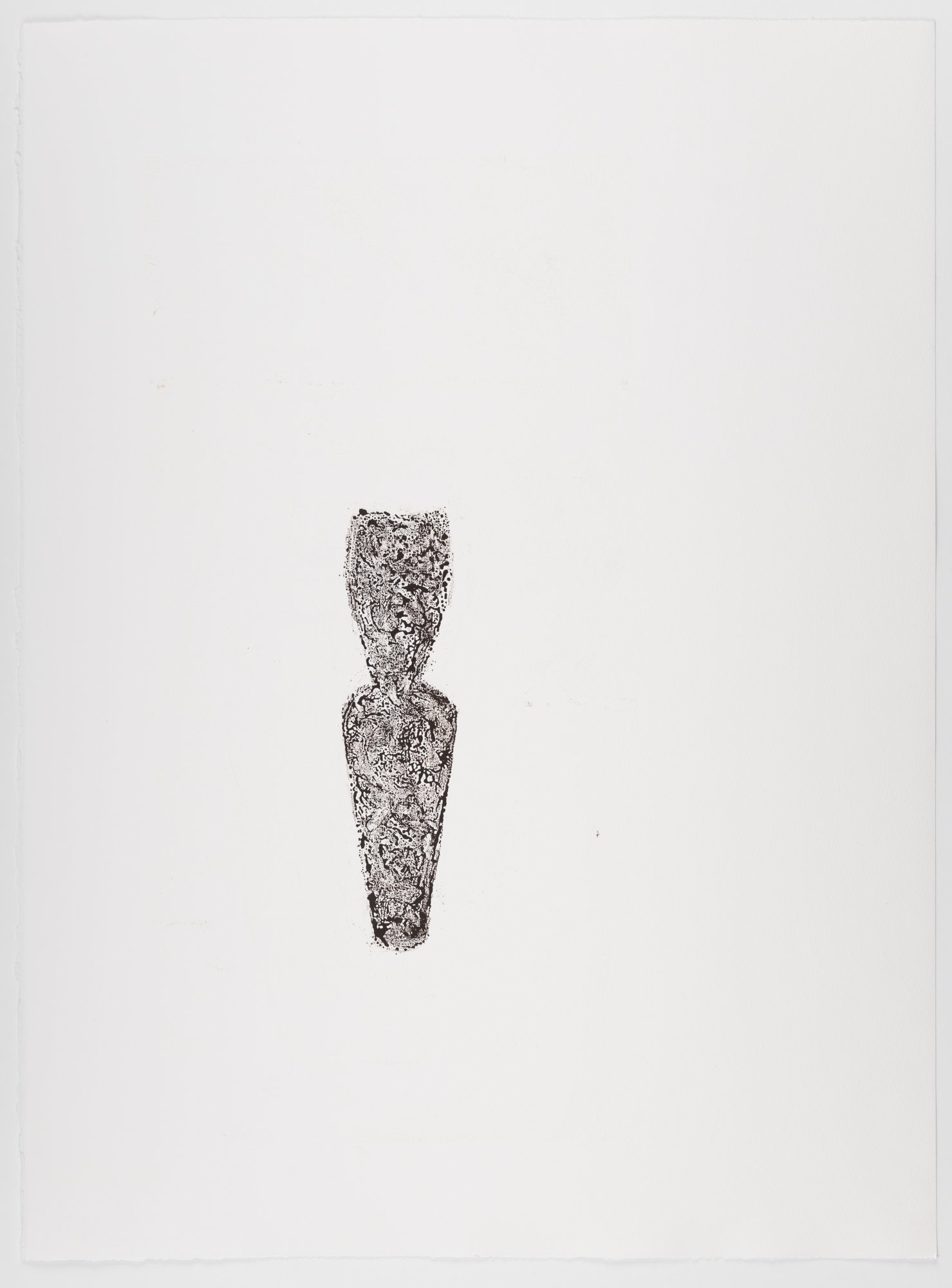
standingGROUND I
Watercolor monotype
30” X22”
Hats and Storytelling.

Indulging in a morning of thoughtful stitching and reflection. Since my youthful days in the 70s shaping hats at my father's feed and Western Wear store, hats have held a profound meaning for me. They possess a unique ability to tell stories.
Recently, I acquired an extraordinary green hat from the talented artisan Edgar Alvarez at Gran Central Hats. Their craftsmanship captures the essence of customization, allowing ribbons, feathers, and all manner of embellishments to adorn your own hat. I made the decision to handle my own stitching, and I must admit, piercing through the resilient felt material is no easy task.

As I sit here, needle in hand, I find myself musing about the idea of incorporating elements inspired by the prairie grasses and the thriving ecosystem that thrives through the consumption and waste patterns of bison. It's a fascinating, how their actions actually contribute to the renewal of life. For instance, birds benefit from the ecosystem by consuming pests that break down bison dung. These birds utilize bison fur to construct their nests, as the fur provides antiviral properties, fortifying their eggshells. Furthermore, the grasses that flourish due to the bison's eating and waste habits offer nesting materials and shelter from predators.
I am hopeful that when finished this hat will be something more than a mere fashion accessory; it possesses the potential to be a powerful catalyst for conversations, stimulating discussions about our individual roles in the process of regeneration.

To Leave
The ephemeral beauty of nature lies not just in living organisms but also in their inevitable decay.
This morning, while examining “deeper than that” a private living sculpture art installation featuring indigenous plants, I was struck by the fading loveliness of the Rosinweed leaves as they withered. Contemplating the homophones “leaf”, “leave” and “leaves”, I pondered how societies historically understood the ecological value of allowing foliage to persist even after senescence. Is that why we call these objects a verb?
Leaves that have left a plant continue to nourish the soil and its microbial inhabitants even in death. Their decaying forms hold moisture, shade the living organisms in the ground, and provide nutrients as they return to earth, building a balanced ecology that sustains urban landscapes. They are an important material natures uses in its engineering of the water table.
Though a single leaf may seem a small, ephemeral thing, in aggregate and over time, the leaves left behind establish and uphold the very foundations of life.
Their decay is not an end but rather a beginning - a quiet, essential recycling of energy and matter that allows new growth to emerge.
In both the noun and the verb there are layers of beauty, and layers of ecological purpose, in the leaves left to molder where they fall. An ecosystem thrives on this gift of decay, using the ephemeral to fuel the eternal. Such is the profound, poignant cycle that the installation’s Rosinweed specimens, even as they bend and brown, help perpetuate. Out of seeming loss, abundance; out of death, life.
Leave your leaves and be grateful for their beauty as nouns and as verbs.

Quisque iaculis facilisis lacinia. Mauris euismod pellentesque tellus sit amet mollis.