underMINE

The American Lawn, AI, and What We Have Been Conditioned to Unsee
The American lawn.

40 million acres. 2 trillion gallons of water a year. The largest irrigated crop in the country — more than corn, wheat, and fruit trees combined.

Is that a lot? What is a lot? The press tells us U.S. AI data centers consume too much — roughly 17.5 billion gallons of water in 2023.

Here is the truth.

The lawn uses 100 times more water than AI.

Lawns at 2 trillion are good and AI at 17.5 billion is bad? Where is the logic? And water is just half of it. We mow it on Saturdays — burning 800 million gallons of gas a year. Americans spill 17 million gallons just refueling their equipment — more than was spilled by the Exxon Valdez.

In 2021 I carved the carbon symbol into 35 feet of Zoysia turfgrass at Lawndale Art Center — Carbon by the Yard — to make visible what those 800 million gallons deprive us of. In 2022 I replaced a section of that same turf with native plants, living soil, and deep roots — CARBONsink — to show what the same ground could store instead. Carbon. Water. Life.

That is how I know how ridiculously easy it is to change.

The lawn is not the problem. What we have made it into is the problem. Forty million acres of chemically dependent monoculture sitting on top of some of the most populated land in the country. Land that could be absorbing rainwater, cooling the air, sequestering carbon, feeding pollinators, restoring the biodiversity we have been losing for a century.

For every one percent increase in organic matter per acre, soil can hold an additional 20,000 gallons of water. Native plant roots reach eight to fourteen feet deep — sequestering carbon like an upside down rainforest. The coastal prairie that Houston sits on once soaked up everything the sky sent down. We replaced it with turf. Harvey showed us what that costs.

But the ecological argument, as urgent as it is, is not the most powerful thing the lawn could do.

The most powerful thing is this: lawns exist in the largest population centers in the world. They are the daily interface between modern humanity and the living world. If we change what happens on that interface — in front yards, street medians, corporate campuses, school grounds — we change how millions of people understand their relationship to the planet. That is a social transformation. The ripple effects are incalculable.

Which brings me back to AI.

The comparison between lawn water use and AI water use is not meant to let either one off the hook. It is meant to show that we are already wasting at a scale that dwarfs what we are alarmed about — and that the solution to both problems might be the same solution. AI saves us time. It makes us better. What if it also helps us see what we have been conditioned not to see?

What if the lawn became part of the answer to AI’s water problem? Native landscapes absorb and store water in the ground. Deep roots recharge aquifers. Living soil filters and holds what falls from the sky. More than 160 new AI data centers have been built across the U.S. in the past three years — many of them in water-scarce regions. A Meta data center in Newton County, Georgia uses 500,000 gallons a day — 10% of the entire county’s water supply.

What if the landscapes surrounding those data centers were living systems instead of turf? What if regenerative landscaping — on the scale of cities — could recharge the aquifers that AI is draining?

I don’t know if that is possible. But I know that the first step is to stop treating the lawn as decoration and start treating it as a living system connected to everything.

Writer and botanist Robin Wall Kimmerer observed that in the wild, the solution is often found near the problem. The remedy grows where the wound is. The lawn uses 100 times more water than AI — and the lawn is also the solution to AI’s water crisis. The same 40 million acres. The same ground. The problem and the answer occupying the same space.

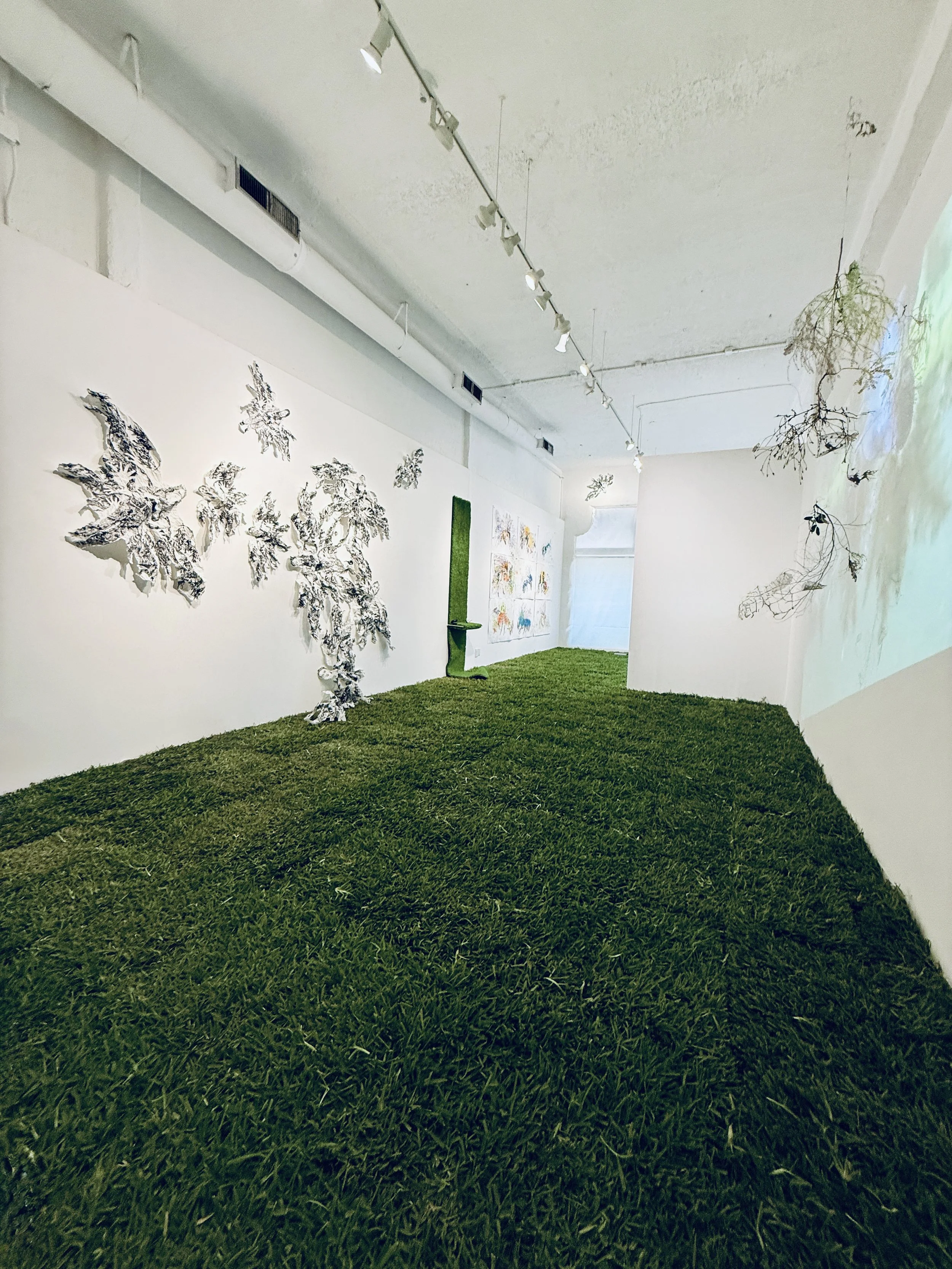
Tomorrow the gallery floor disappears under 600 square feet of sod.

I thought about attending the opening barefoot. Then I thought about the chemicals that must have been applied to grow this perfect mono-crop of sod. I won’t be barefoot on it.

That is the point. We have made the most abundant surface on the planet — 40 million acres of it — something you cannot safely stand on in your bare feet. Something that poisons the people who maintain it. Something that sheds the rain, kills the insects, and heats the ground it covers.

And we call it a lawn. We call it beautiful. We mow it on Saturdays.

underMINE is 600 square feet of that lawn, brought inside. What we have been conditioned to unsee — you walk by it every day — now you are standing on it.

Now imagine it differently.

AI changes instantly when it receives better information. Society takes forever — even when the difference is 100 times more gallons of water. However for society, baby steps are how it starts. One gallery floor. One front yard. One school ground. One corporate campus.

What if AI saves us enough time that we have time to garden? To grow our own food? To tend the land instead of manage it against itself? Think of the ripple effects of that idea.

The lawn has enormous potential.

The first step is to stop underMINEing. Start seeing.
IU - How do you build a labyrinth? From 8”X 10” to 83’ × 54’

How to go from an 8” X 10” paper to a field, Is the question ruminating in the back of my mind every day.

Unfortunately Bloomington is in between art supply stores. As a result I could not buy locally any paper larger than 8” X 10” . While I waited for an order to come in I pieced together 8 - 8” X 10” pages and scaled it up 2X.

Here I started thinking about how to take the design from

When I scaled it up 2X I started seeing that I could take it to any size I wanted by using (X, Y) coordinates. I am using a 20” scale.

8- 8” X 10” paper to a make a 18” X 30” sketch.

How I could get a 83' × 54’ rectangular grid with right angles on a field was a big concern.

An idea came to me when I toured the charming Wylie House, a fascinating piece of history nestled just off campus. This historic gem, built in 1835, was once the cherished home of Andrew Wylie, the inaugural president of Indiana University.

The Wylie House master bedroom.

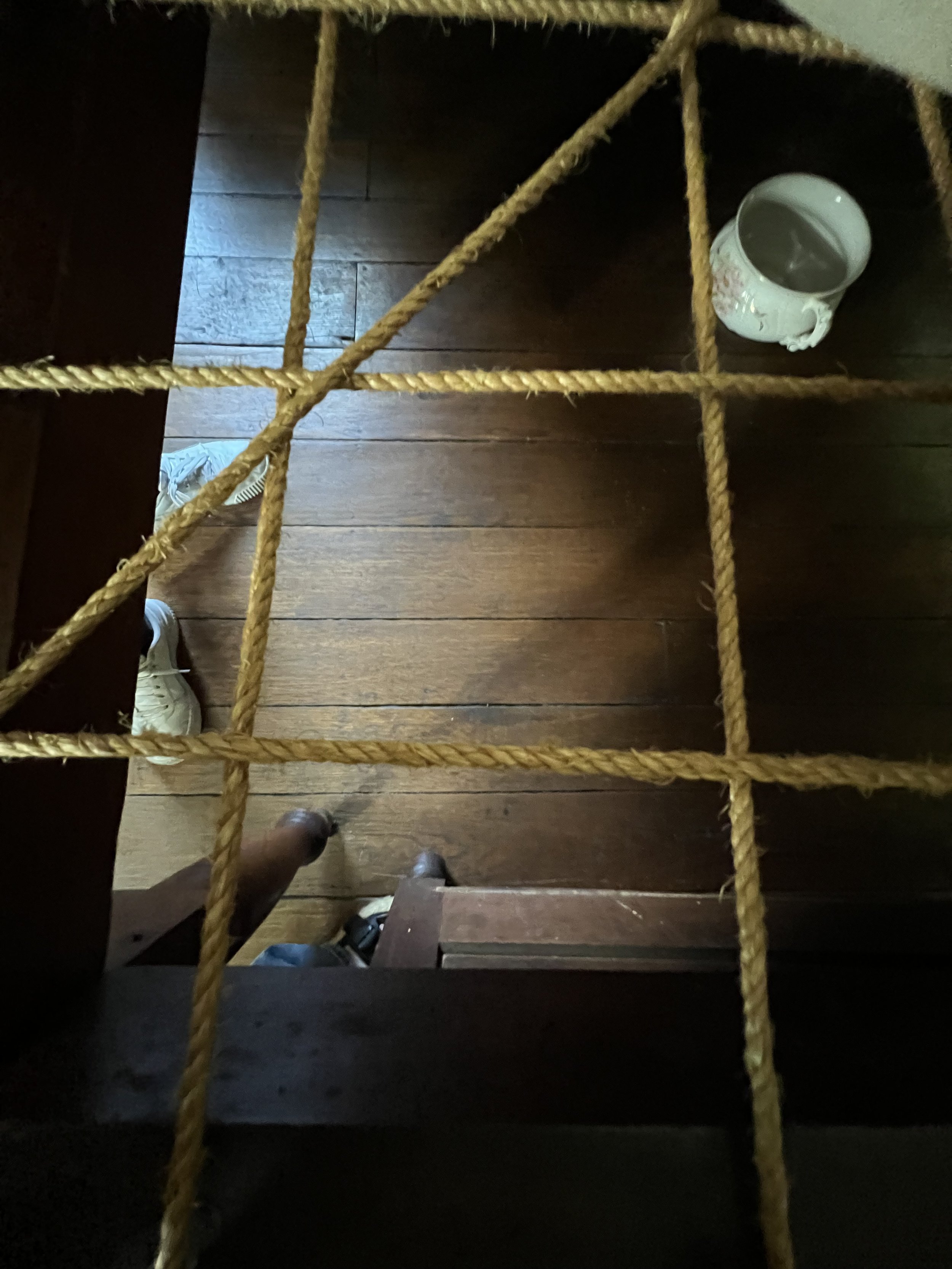
During my visit, the knowledgeable docent unveiled a captivating detail - the simple rope framework that upheld the mattress.

The antique bed’s rope framework that supports the mattress. What looks like a cup is the chamber pot.

A rope grid might be the answer to getting a proper rectangle With right-angled corners and grid onto a field.

This visual solidified my strategy for bringing the labyrinth design from paper to reality in an open field. The framework I need is 83’ × 54’ the vertical and horizontal ropes that cross every 20”. We can twist tie the coordinates together making the rectangle form.

Artist in Residency at Indiana University - Living the Dream Installation — Labyrinth

Living the Dream as an Artist in Residence at Indiana University!

I couldn't believe my luck when I was offered the opportunity to be an artist in residence at Indiana University. Not only would I have access to all the incredible resources and opportunities of a renowned research university, but it could provide the opportunity to fulfill one of my monumental artistic visions.

As part of my two month residency, I'll be giving artist talks, exploring local artist studios, landscapes of southern Indiana, and creating a special piece to be exhibited at the University or in the beautiful town of Bloomington.

During my interview for the residency, I couldn't help but ask about the size of the campus. And just as I suspected, it is massive. I imagined it with expansive fields of turfgrass. I remember feeling my heart swelling with excitement and hope. Could Indiana University be the site for the monumental installation I dream of?

Let me explain - This summer seeing CARBONsink develop within Symbiosis at Lawndale Art Center and watching the community enjoy entering it made me think. I wondered if the CARBONsink relief was a step to create a larger piece using the same process but with a deeper meaning and making a bigger impact. A little bit of research regarding Greek philosophers and labyrinths and these thoughts turned into a dream. I have a vision of completing a living labyrinth.

I began studying the designs, meanings and histories of mazes and labyrinths. I was lured by labyrinths pretty fast. Mazes are puzzles and meant to confuse you. Labyrinths check all ny boxes.

-A labyrinth is a meditation. —

-There is 1 way in and 1 way out. What seems like the end is also the beginning. It is the perfect metaphor for inspiring ecological - societal perspectives.

-As an artist whose work in the simplest form looks at time and movement a labyrinth is a logical and interesting medium.

-A living labyrinth to convert fields of turfgrass into a living sculpture to regenrrate life.

Typically in an artist in residency one would take some time getting to know the University and the City before propsing their work. I could not contain my excitement so asked if the University would be interested in a site specific living labyrinth? It would be a social sculpture in the form of a relief that demonstrates the steps for turning the largest crop in the US - turf grass into the largest CARBON sink in the US. Ed the Associate Vice Provost for Arts and Humanities responded with great enthusiasm in his voice. Every summer the University and the city of Bloomington celebrate the life and writings of Kurt Vonnegut with the Granfalloon Festival. A living labyrinth would be a fitting art installation in conjunction with the festival.

For inspiration on my drive to Bloomington, I listened to Cat’s Cradle and Slaughter House Five.

IU - Exploring the Intersection of Art and Humanity To Tackle Climate Change? Insights from Artists Miles and Melanie.

"If you hit a wrong note, it's the next note that you play that determines if it's good or bad." — Miles Davis

In humanity's quest to harmonize natural processes with industrialization and tame the beast of extreme climate, I consider problem-solving approaches from my artistic practice and the artistic world.

As a master of improvisation Davis embraced musical mistakes as valuable chances for growth—an approach we can apply to all aspects of life. How we respond to so-called errors ultimately shapes the final outcome. Humans have the unique ability to transform something "wrong" into something "right."

How does this apply to our environmental issues? Consider that as a species homosapien is a young species. Having thumbs instead of hooves our brains have evolved to create, and invent, to problem solve to make us not mammalian beasts but human.

Mountain Moving
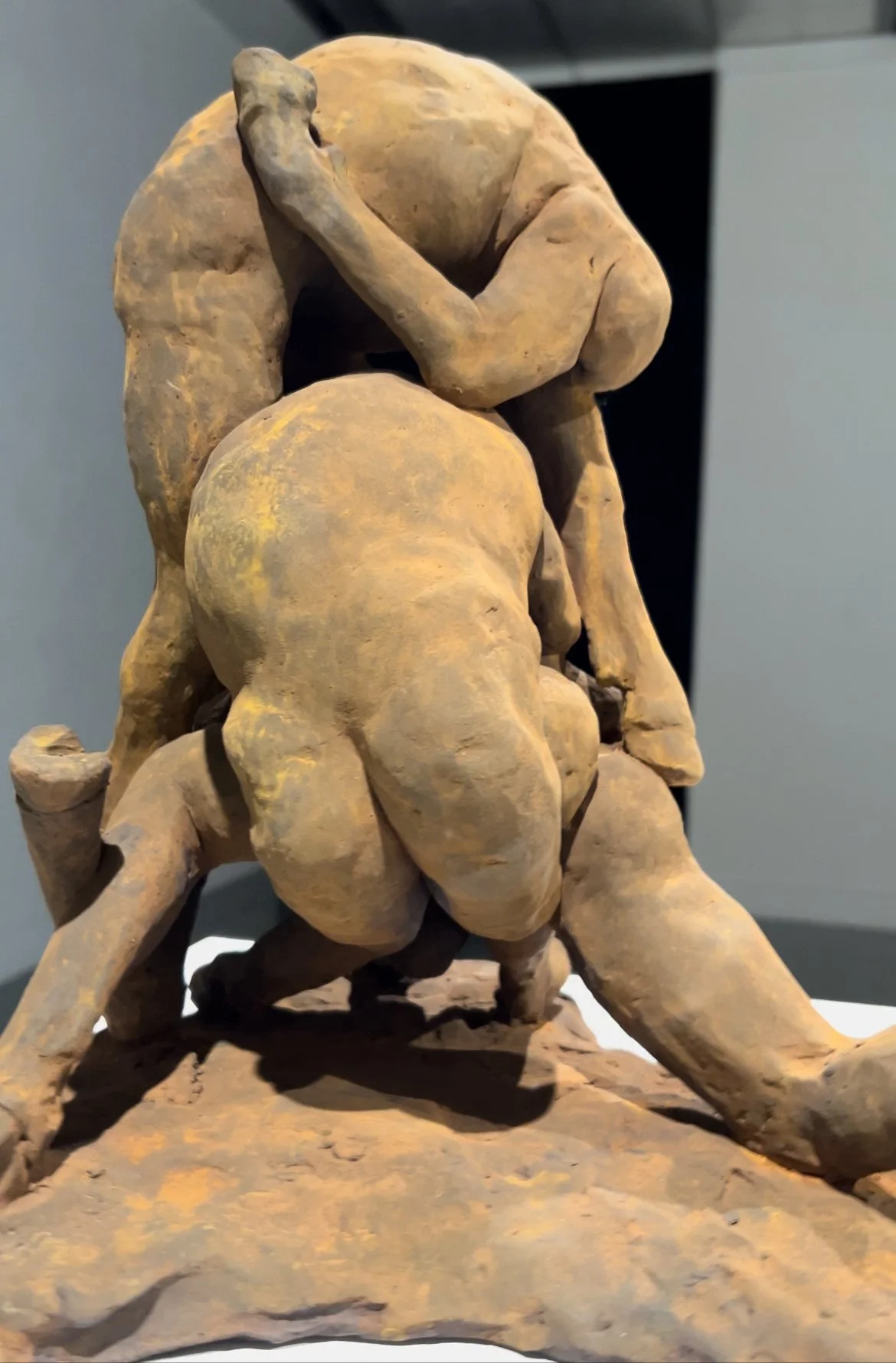
On exhibition in the GRUNWALD GALLERY of ART IU.

The artist Melanie Cooper Pennington teaches Sculpture at Indiana University.

One of homosapien’s greatest inventions is industrialization. We are now clearly seeing and feeling the impact of industrialization on our ecosystems. The most important question humanity has to answer is — will industrialization be a “bad” note?

By adopting Miles’ mindset, we can discover new and innovative ways to address climate change and find harmony between nature and industry. As an eco-artist I consider problem solving perspectives that I use in my creative practice to visualize and transcend conventional thinking to create a better world.

I am engaged in an artist in residency program at Indiana University direct by the Arts and Humanities Department. The university recently launched an Environmental Resilience Institute, as well as a new A&H laboratory dedicated to Environmental Futures. They created a research platform to allow arts and humanities scholars at every level of education—to connect.

My first visit at IU was with Melanie Coooer Pennington. Melanie, creates mammalian sculptures to investigate the borders between the human/animal body and its psychological states. Melanie’s work provides an emotional visual to the power of thumbs by replacing them with hooves. Thumbs changed everything.

I saw Melanie’s Mountain Moving, thought provoking sculpture the day I started writing this post about Miles Davis and his creative process.

I believe through art and culture, we can move the industrial mountains facing humanity — our next note can create a masterpiece.