
The American Lawn, AI, and What We Have Been Conditioned to Unsee
The American lawn.
40 million acres. 2 trillion gallons of water a year. The largest irrigated crop in the country — more than corn, wheat, and fruit trees combined.
Is that a lot? What is a lot? The press tells us U.S. AI data centers consume too much — roughly 17.5 billion gallons of water in 2023.
Here is the truth.
The lawn uses 100 times more water than AI.
Lawns at 2 trillion are good and AI at 17.5 billion is bad? Where is the logic? And water is just half of it. We mow it on Saturdays — burning 800 million gallons of gas a year. Americans spill 17 million gallons just refueling their equipment — more than was spilled by the Exxon Valdez.
In 2021 I carved the carbon symbol into 35 feet of Zoysia turfgrass at Lawndale Art Center — Carbon by the Yard — to make visible what those 800 million gallons deprive us of. In 2022 I replaced a section of that same turf with native plants, living soil, and deep roots — CARBONsink — to show what the same ground could store instead. Carbon. Water. Life.
That is how I know how ridiculously easy it is to change.
The lawn is not the problem. What we have made it into is the problem. Forty million acres of chemically dependent monoculture sitting on top of some of the most populated land in the country. Land that could be absorbing rainwater, cooling the air, sequestering carbon, feeding pollinators, restoring the biodiversity we have been losing for a century.
For every one percent increase in organic matter per acre, soil can hold an additional 20,000 gallons of water. Native plant roots reach eight to fourteen feet deep — sequestering carbon like an upside down rainforest. The coastal prairie that Houston sits on once soaked up everything the sky sent down. We replaced it with turf. Harvey showed us what that costs.
But the ecological argument, as urgent as it is, is not the most powerful thing the lawn could do.
The most powerful thing is this: lawns exist in the largest population centers in the world. They are the daily interface between modern humanity and the living world. If we change what happens on that interface — in front yards, street medians, corporate campuses, school grounds — we change how millions of people understand their relationship to the planet. That is a social transformation. The ripple effects are incalculable.
Which brings me back to AI.
The comparison between lawn water use and AI water use is not meant to let either one off the hook. It is meant to show that we are already wasting at a scale that dwarfs what we are alarmed about — and that the solution to both problems might be the same solution. AI saves us time. It makes us better. What if it also helps us see what we have been conditioned not to see?
What if the lawn became part of the answer to AI’s water problem? Native landscapes absorb and store water in the ground. Deep roots recharge aquifers. Living soil filters and holds what falls from the sky. More than 160 new AI data centers have been built across the U.S. in the past three years — many of them in water-scarce regions. A Meta data center in Newton County, Georgia uses 500,000 gallons a day — 10% of the entire county’s water supply.
What if the landscapes surrounding those data centers were living systems instead of turf? What if regenerative landscaping — on the scale of cities — could recharge the aquifers that AI is draining?
I don’t know if that is possible. But I know that the first step is to stop treating the lawn as decoration and start treating it as a living system connected to everything.
Writer and botanist Robin Wall Kimmerer observed that in the wild, the solution is often found near the problem. The remedy grows where the wound is. The lawn uses 100 times more water than AI — and the lawn is also the solution to AI’s water crisis. The same 40 million acres. The same ground. The problem and the answer occupying the same space.
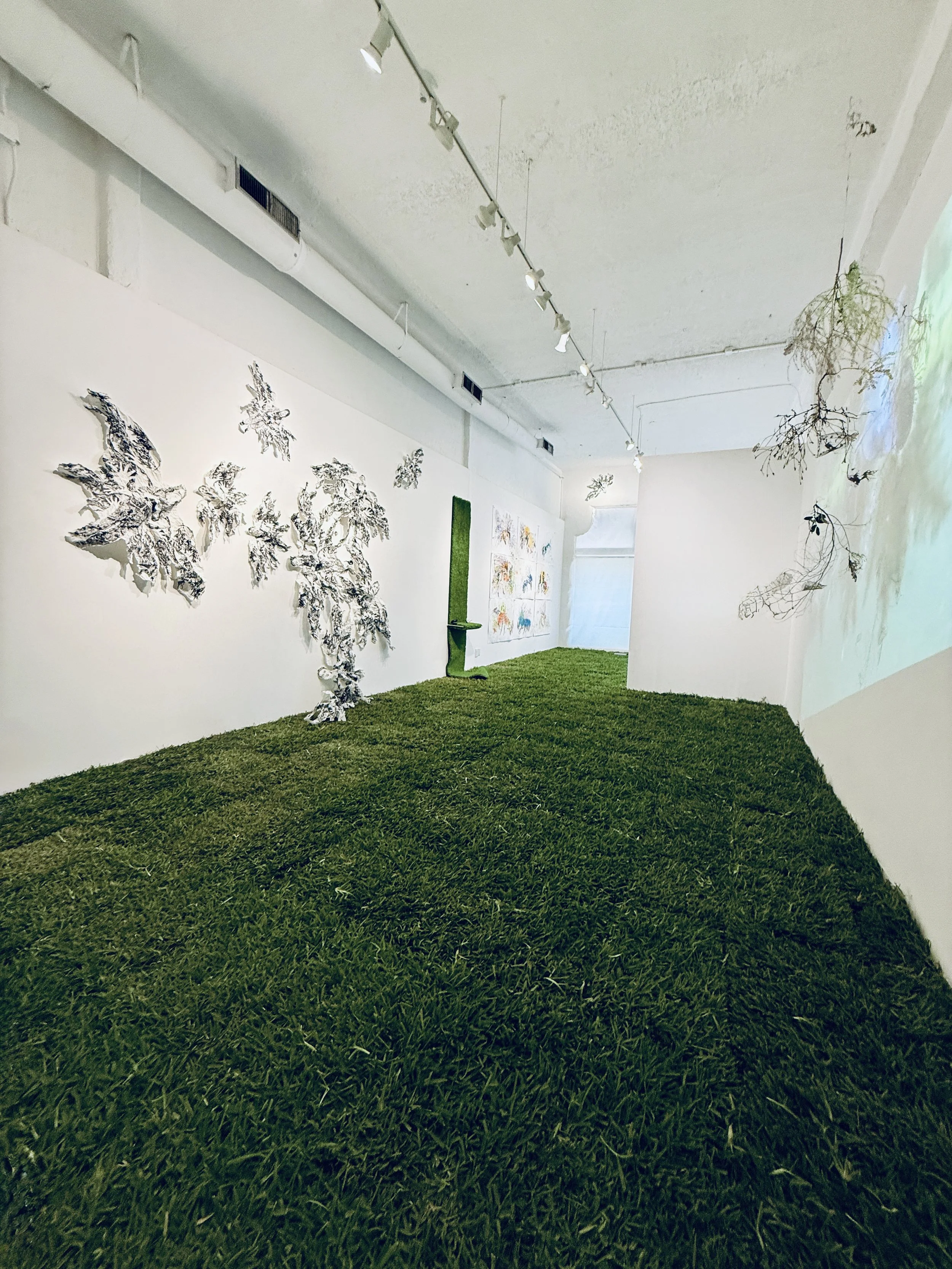
Tomorrow the gallery floor disappears under 600 square feet of sod.
I thought about attending the opening barefoot. Then I thought about the chemicals that must have been applied to grow this perfect mono-crop of sod. I won’t be barefoot on it.
That is the point. We have made the most abundant surface on the planet — 40 million acres of it — something you cannot safely stand on in your bare feet. Something that poisons the people who maintain it. Something that sheds the rain, kills the insects, and heats the ground it covers.
And we call it a lawn. We call it beautiful. We mow it on Saturdays.
underMINE is 600 square feet of that lawn, brought inside. What we have been conditioned to unsee — you walk by it every day — now you are standing on it.
Now imagine it differently.
AI changes instantly when it receives better information. Society takes forever — even when the difference is 100 times more gallons of water. However for society, baby steps are how it starts. One gallery floor. One front yard. One school ground. One corporate campus.
What if AI saves us enough time that we have time to garden? To grow our own food? To tend the land instead of manage it against itself? Think of the ripple effects of that idea.
The lawn has enormous potential.
The first step is to stop underMINEing. Start seeing.
