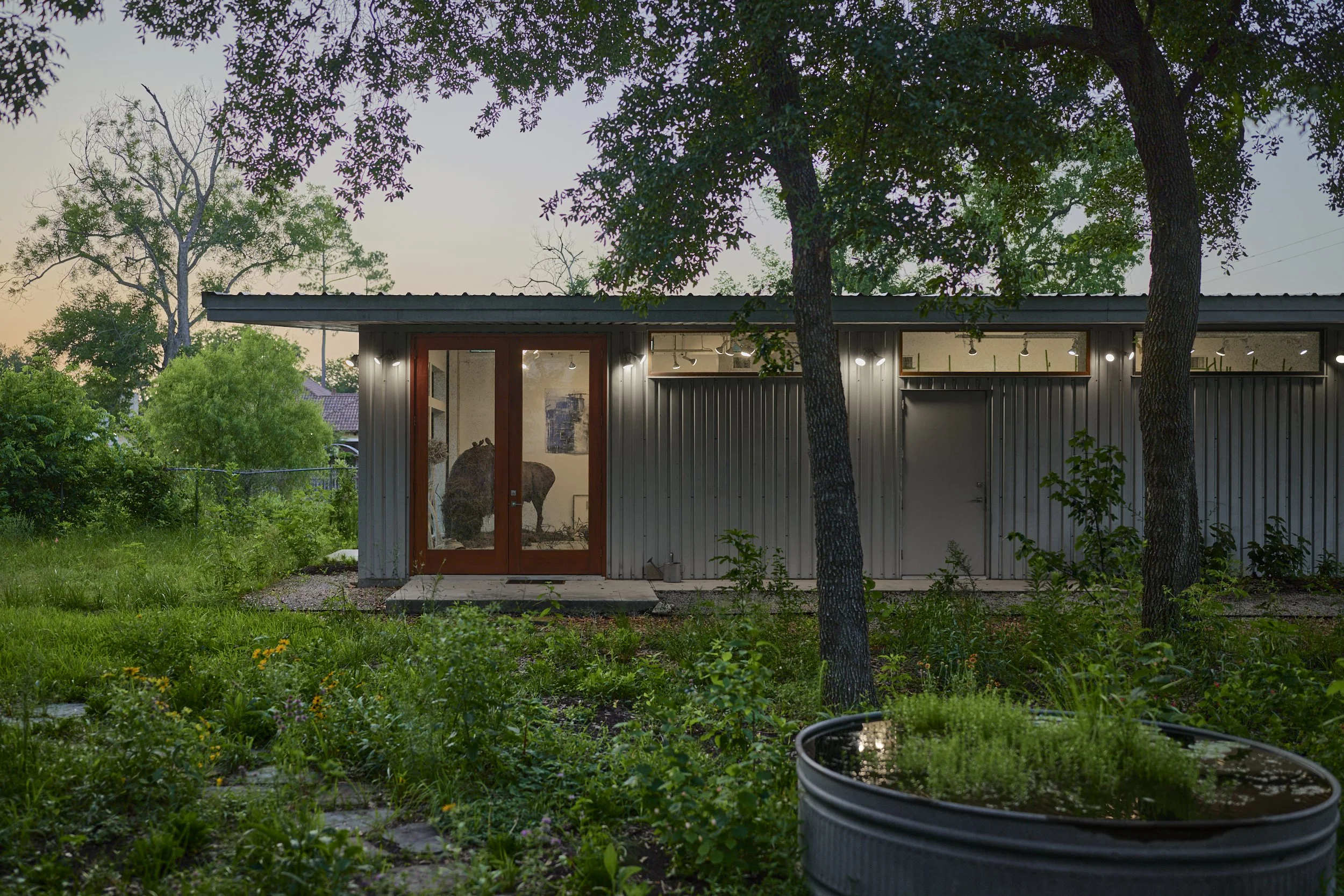
LIVING SCULPTURES
La Mancha’s Sequel: Restoring Ecological Memory in Acres Homes.
6,500 square feet in Houston, Texas. Coastal prairie, once. Then a colonial lawn — soil compacted, compressed, managed into silence.
This is what one growing season looks like when you stop.
A five-year record, year one. Video documentation by Beatriz Bellorin
Through four living sculptures — Symbiosis, Carbon by the Yard, CARBONsink, and Deeper Than That — I built a practice around one question: how do we restore ecological balance in Houston? Sequel is where that question comes home.
The Lands History
The 6,500-square-foot lot in Acres Homes sits on land that was once coastal prairie, with a small wetland where cranes rested — a landscape where trees belonged primarily near water, holding the bayous. Now it is laced with them and anchored by two buildings. Before I arrived, it was a monoculture, the colonial lawn in full force: nature controlled, subdued, made silent. The answer to that silence is Sequel.
This garden belongs to my neighbor, the artist Terrell James, next door to my studio. Sharing a commitment to ecological restoration, she invited me to reimagine it. It is a lifelong project.
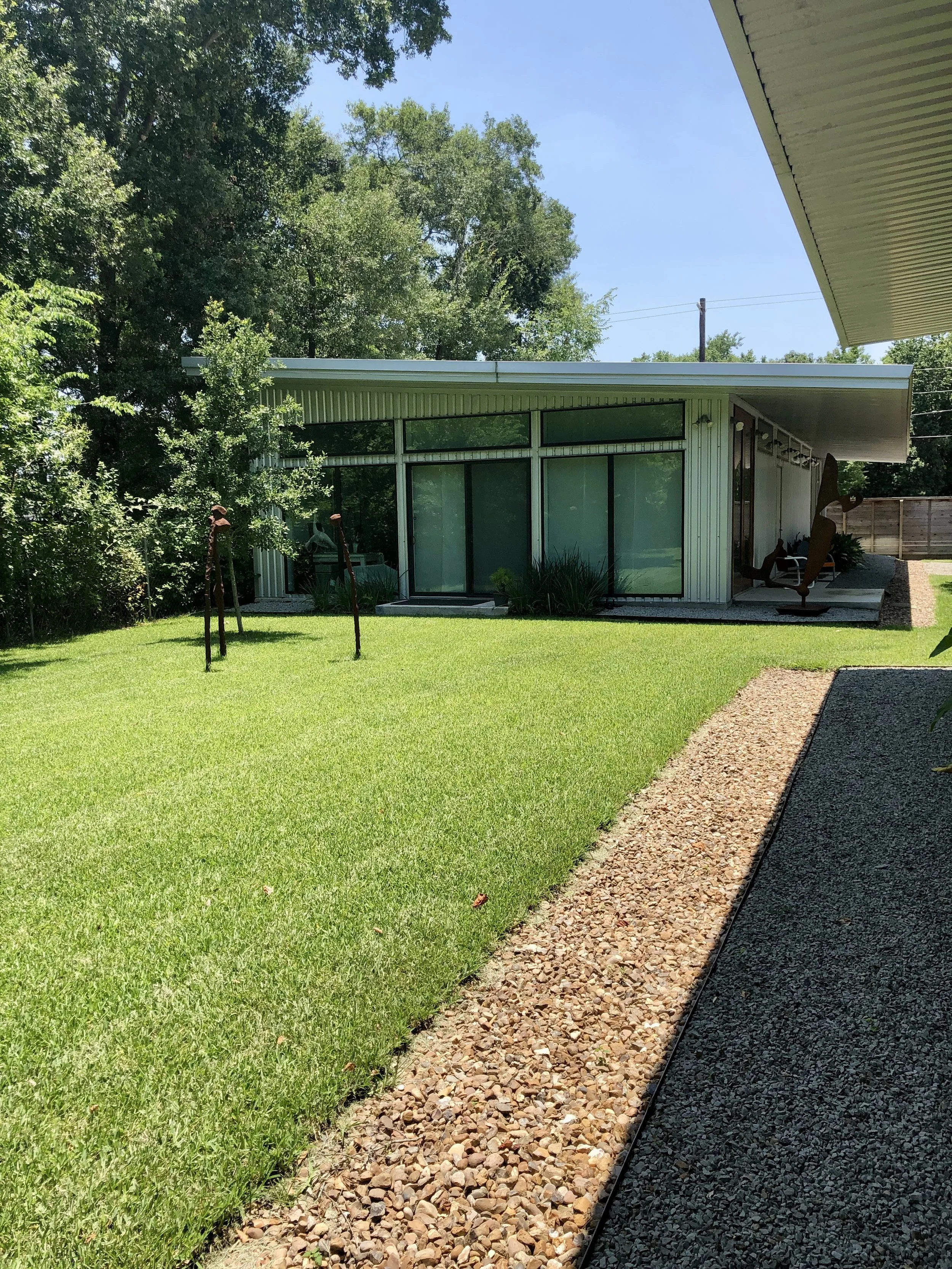
2004 West Tidwell, approximately in 2016
A traditional colonial landscape monoculture of turfgrass, dependent on chemicals to maintain it.
How I Listen
Every day I sit with it and listen — with my eyes, my whole body. Much is instinct. From past works, I have learned to hold two thoughts: stay out of the way and let the land heal itself, or offer something — a plant, a pathway, a presence — that helps undo what was done. The Savory Institute’s principles of holistic regenerative agriculture guide how I think about that offering: keep the soil covered, maintain living roots, minimize disturbance, mimic nature’s own patterns. Not a checklist — a way of seeing. A reminder that the ground beneath us is already working, and my job is mostly to protect that work and get out of its way.
An Intelligence Larger Than Our Own
The trees and buildings complicate this. As the sun travels lower and higher season to season, light is blocked differently. Native seeds will adjust, will find their way on their own terms, in their own time. When I distributed seeds and planted native plants, I used randomness as much as humanly possible — abundance scattered without a fixed plan — recognizing how difficult it is to anticipate how nature adapts to human-made conditions. Much would not work. But much would find a way. Letting go of control is not passivity — it is how we make room for an intelligence larger than our own.
What Volunteered
I document the land’s changes through photography and video, witnesses to what the ground is quietly becoming.
In the first growing season, that monoculture became a sea of shade-loving plant diversity — the first step toward a climate-smart ecological habitat. The plants that volunteered were primarily those that remediate lead and arsenic from the soil. I installed some native pollinator plants, but blooms were few in the shade. The clearest successes were the pipevine swallowtail hosted by white-veined pipevine, and the gulf fritillary with passion vines. Bumblebees and hummingbirds were rare. A few birds have found the trough pond — doves, sparrows, cardinals — a fraction of the diversity that this land once held and could hold again. It is a beginning, and only that.
What I am for
Humans are part of the animal kingdom. In living systems, animals are the dispersers of seeds and the movers of nutrients — through consumption, through waste, through the simple fact of moving across the land. That is our ecological role. Industrial civilization forgot it, or chose to abandon it, replacing participation with control. The colonial lawn was that forgetting made visible: land stripped of its function, animals excluded, the cycle broken.
The garden has taught me to stop seeing it as a single place and start feeling it as part of a vast living system — the planet itself, breathing, circulating, healing. The way our own bodies are not one thing but many: organs, systems, bacteria, organisms working in concert without a conductor. I am part of that body too. So are the pipevine swallowtails, the cardinals, the soil microbes remediating what industry left behind. Sequel is not a garden I tend. It is a living system I am learning to belong to — and through belonging, to remember what I am for.
Not a vision. A fact. The land continues. I continue with it.
Sequel is a leap of faith, a belief that humanity will get it right.
What the Ground Is Becoming: the first growing season, October 2024- December 2025
Below are images taken at 7:00 am from four different angles during the Fall Equinox, Winter Solstice, Spring Equinox, and Summer Solstice.
“This is the solstice, the still point of the sun, its cusp and midnight, the year's threshold and unlocking, where the past lets go of and becomes the future; the place of caught breath, the door of a vanished house left ajar.” — Margaret Atwood
Sequel from between our studios from 09 2024 through 09 2025
Sequel from the north fence line 9 2024 through 9 2025
Sequel from the west fence line from 09 2024 to 09 2025
images by Feast Day Studio

Sequel
Summer solstice 2025
Quisque iaculis facilisis lacinia. Mauris euismod pellentesque tellus sit amet mollis.