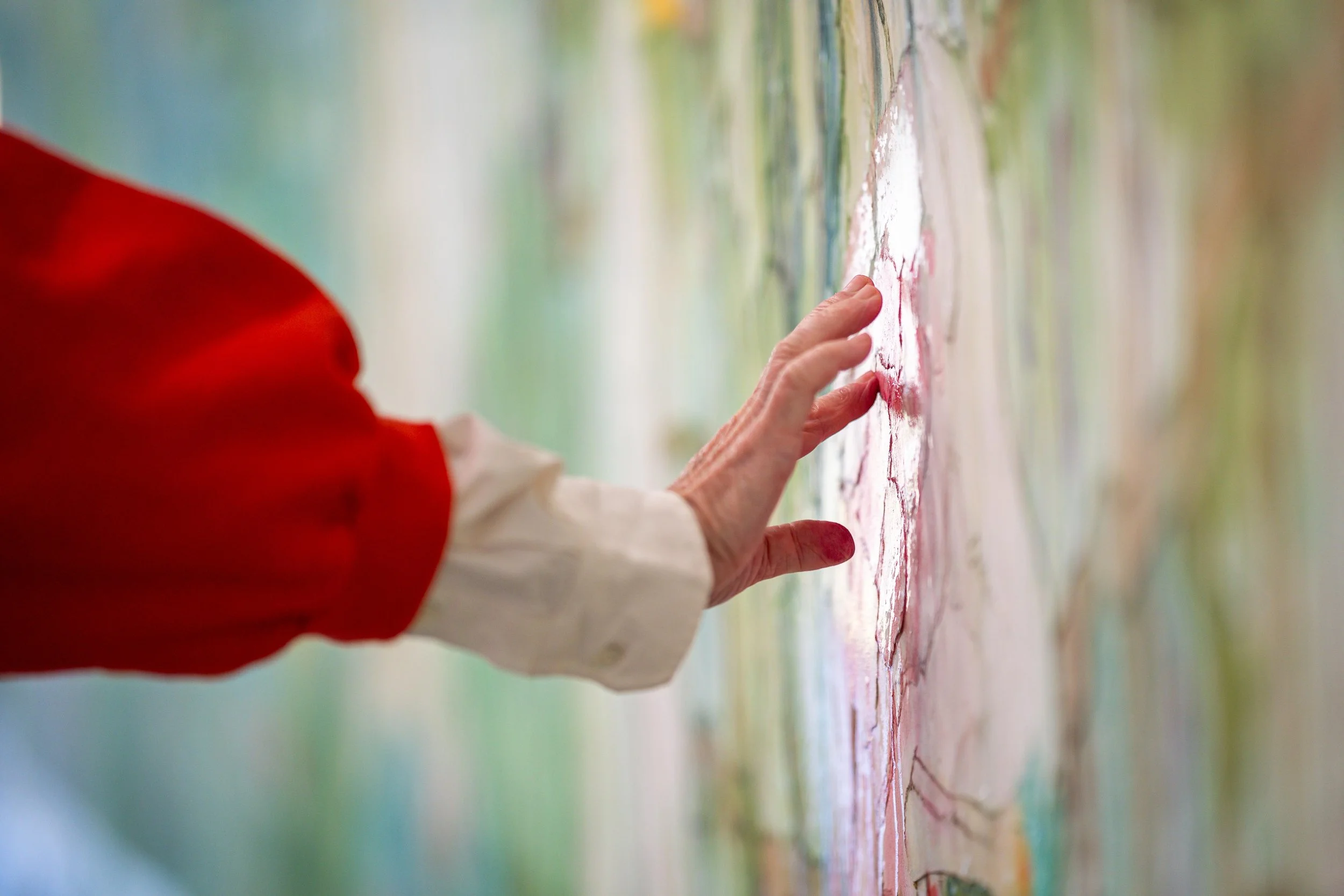
Two and fifteen hundred
On a Texas highway between Austin and Houston, I was listening to Ed Yong's An Immense World for the third time. It is dense with science, and it gives more with each pass. I have been setting down poems told to me by other species, and I was scouring the book for anything that would help me hear them on their own terms, without my imagination speaking over them. I wanted to understand why every species experiences the world in its own way, and how. Then something surfaced.
A blue whale diving for krill can slow its heart to two beats a minute. An Etruscan shrew, a mammal lighter than a dime, runs hers at up to fifteen hundred.
Between those two numbers sits every warm-blooded heart on Earth, including mine. A human heart at rest keeps sixty to eighty. A hummingbird in flight passes twelve hundred, then on a cold night lets its heart fall to a fraction of that and waits for first light.
We tend to read these as records: the biggest, the fastest, trivia for a museum placard. I read them as clocks. Each heart is a metronome setting the tempo of a life, and the tempo of a life sets what that life is able to perceive. Every species is an instrument keeping its own time. Together they don't play in unison. They play a polyrhythm, the music of Earth's evolution, with no one tempo as the standard. Least of all ours. I had begun to suspect that speed itself is a barrier. Some voices move too fast for us to hear. Others move so slowly we mistake them for silence.
Every animal keeps its own clock
The heart is the clock we can hear. The nervous system is the one that sets the frame rate of the world.
Biologists measure that frame rate with a flickering light. Speed it up until the flicker blurs into steady glow, and you have found an animal's critical flicker fusion frequency: how many moments it can tell apart in a second. Humans fuse at around sixty. Some flies resolve more than two hundred and fifty. To a fly, the hand coming down on it is slow.
In 2013, Kevin Healy and colleagues compared this measure across a wide range of vertebrates. Smaller bodies and faster metabolisms meant finer slices of time. They suggested that how an animal perceives time is its own overlooked dimension of ecological niche. A species does not only occupy a place. It occupies a tempo.
A century earlier, Jakob von Uexküll called each animal's perceptual world its Umwelt. He showed that a snail treats a stick tapping it about four times a second as a single solid surface. Its present moment is wider than ours. The shrew's is narrower. All are right. Each is a world.
The dark under the dark
Our blind spot runs in both directions. The insect's world moves too fast for us, so we see a swarm where there are a thousand decisions. That error is small. The costly one runs the other way.
Most of what keeps a landscape alive moves in whale-time or slower still. Soil forms at the pace of centuries. Fungal threads trade sugar for phosphorus underground for the life of a tree. Water climbs a trunk over hours, not beats. A prairie assembles itself across generations of grazing, dung, seed, and fire. A bison herd redraws a watershed over hundreds of years.
Because we cannot see these things move, we decide they do not. We call the prairie a field, the root a stick, the soil dirt. We misread slowness as stillness, and stillness as absence. What is absent can be paved, plowed, or bought.
This is the deeper reason we struggle to see in systems. Relationships are invisible not only because they happen between things. They happen at tempos we were not built to perceive. But we were built to learn.
The same billion
Across mammals, small and vast, a heart beats roughly a billion times in a lifetime. The shrew spends hers in a year or two. The whale lets hers fall across most of a century. Fast or slow, the allowance is about the same. What differs is the spending.
Humans are the exception. Our hearts get roughly two and a half to three billion beats, close to triple the mammalian share. The margin is old. Long life evolved with us: hunter-gatherers who survive childhood commonly live into their seventies, and elders carry what the young have not yet learned, and language hands it on.
My own heart rests at seventy beats a minute. Over sixty-nine years, that comes to roughly two and a half billion beats. I have already outlived the mammal's billion twice over.
The extra is not evidence that we stand above other animals. It is what the pattern gave us room to become: an animal that can hold knowledge and history in mind, carry other lives and deaths in memory, and learn from its own mistakes. Two billion extra beats is time enough to come to know the shrew and the whale.
That is the gift.
Humane
Two months after my first Thanksgiving turkey harvest, on January 19, 2020, I returned to Roam Ranch for my first bison harvest.
The herd was grazing at a distance as it always does, the animals drawn forward by the scent of fresh greens, the morning winter-crisp, warm sun on their backs, side by side. Nothing in the air told them to be afraid. The ranchers, Katy and Taylor, made sure of that. The shot had to be perfect, so the bison would never know fear or pain. The marksman waited, a hundred to a hundred and fifty yards away, keeping the herd's slow time until the moment came.
One shot. The bison dropped in shrew time.
The herd gathered, closing a circle around the one that fell. The animals licked their noses and lips, wetting them to read the wind. They would have smelled the blood soaking into the hoof-pressed January ground.
The herd had lost a heartbeat.
Whatever the animals felt, they mourned in their own language, not ours: in scent, in the circle, in the wind. Then the fence to the next pasture opened, and they loped off toward fresh grass. They did not look back.
When she fell, I cried. My chest went tight, as if my heart had swelled too large for it. In silence, we walked out through knee-deep pasture grass and made our own circle around her stilled body. Her spirit was already gone. I felt that absence. She was no longer a being but fur, muscle, bone, fat, organs, and meat. We mourned in our own language.
She had been chosen because she had never borne a calf; she would not carry the herd forward. Without natural predators left on the land, a few animals are selected each year to become food.
The herd is there to heal the land. Roam Ranch was sold as unsalvageable and lifeless after a century of plowing; the bison's grazing, dung, and hooves are building its soil back. That work is paid for by the people who eat from it. Without the harvest, there is no herd, and without the herd, no prairie.
After a respectful time and words of gratitude, we moved her from the field. Experts broke her body down, and the rest of us helped. Nothing would be wasted.
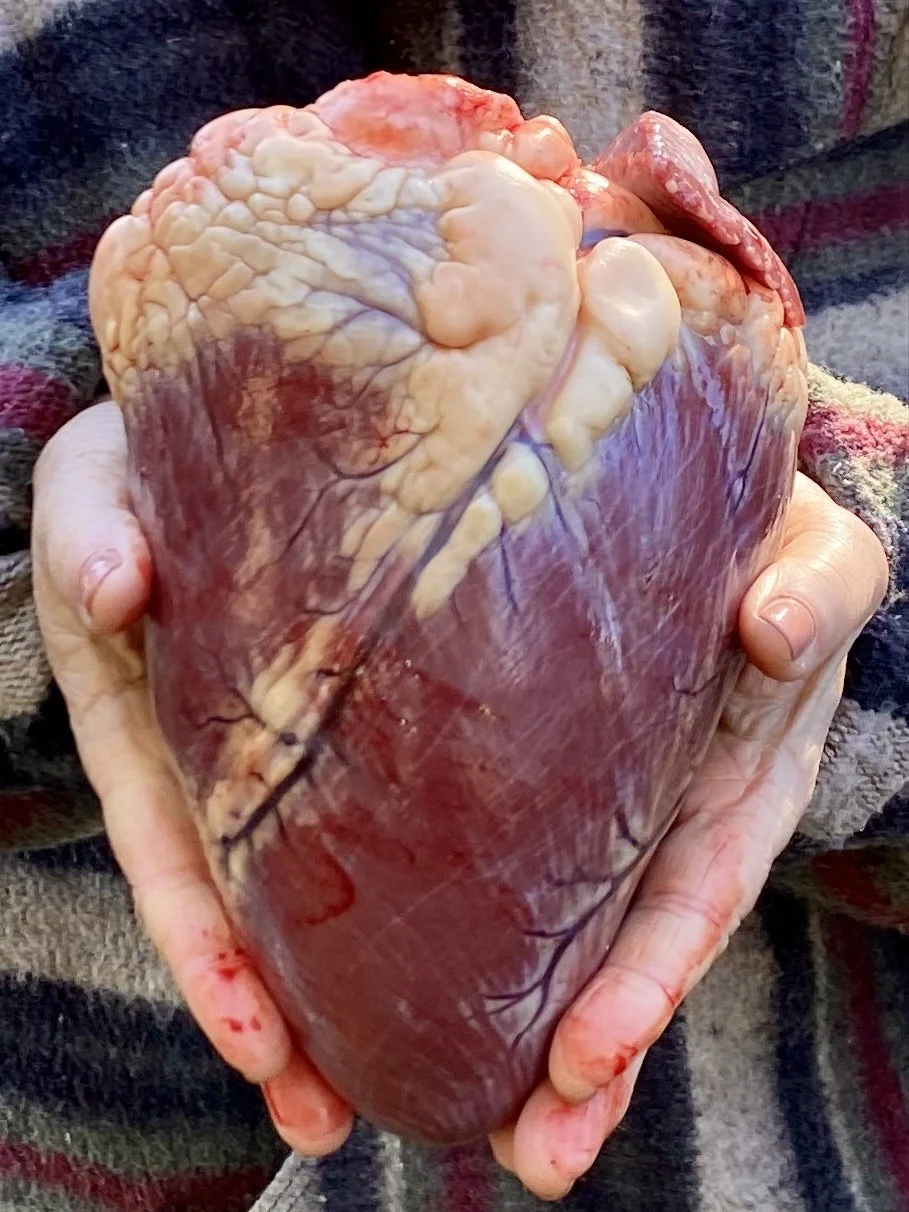
bison heart at 2020 bison field harvest
Then I held her heart. It filled both my hands, butter-yellow fat at its crown, coronary vessels branching across the muscle like roots. Like every mammal, she had been given about a billion beats. Her lifeblood was not spent. It was passed on.
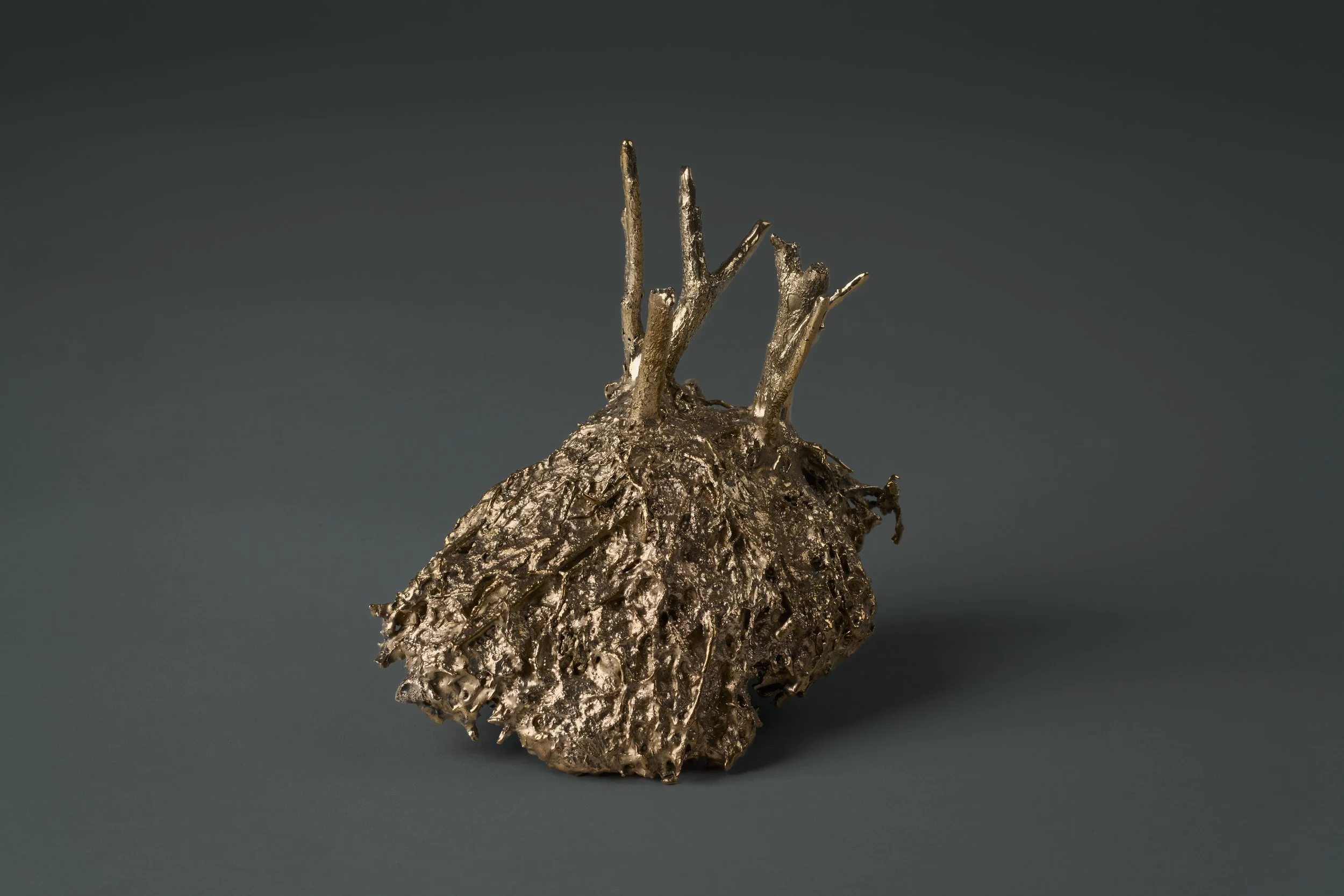
Lifeblood
5.75” X 6” X 7”
bronze
image by Feast Day Studios
Years later, I cast a root in bronze, and it came out of the fire in the same shape.
In English, humane grew out of human. For centuries they were the same word, until the second split off to mean kind. Our extra time is what makes that second word possible.
A third heart
I have not bought a store-bought turkey since that first November. Harvesting an animal changes you. In my house, no one wastes an ounce of meat. The bones become broth, the carcass becomes turkey-bone gumbo, and I make whistles from the leg bones. The bird still has a voice. Each year I go back to Roam Ranch for our Thanksgiving bird, a heritage breed, grown on pasture at the pace of its own kind.
A heritage turkey takes twenty-eight weeks or more to reach its weight, time enough, the breeders say, to grow a strong skeleton and healthy organs before the muscle comes. The Broad Breasted White on most American tables takes twelve to fourteen. We doubled the speed of its life to fill a holiday platter, and its heart pays for it: fast-grown birds can die suddenly, their hearts enlarged, their aortas torn. The veterinary remedy is to slow them down.
I have held many bird hearts, cutting a whole chicken in my kitchen for a family meal. This November I will hold a third heart, and I will see it differently. The bison's heart filled both my hands. This one will be a muscle strong yet tiny, held between my finger and my thumb, its life already gone.
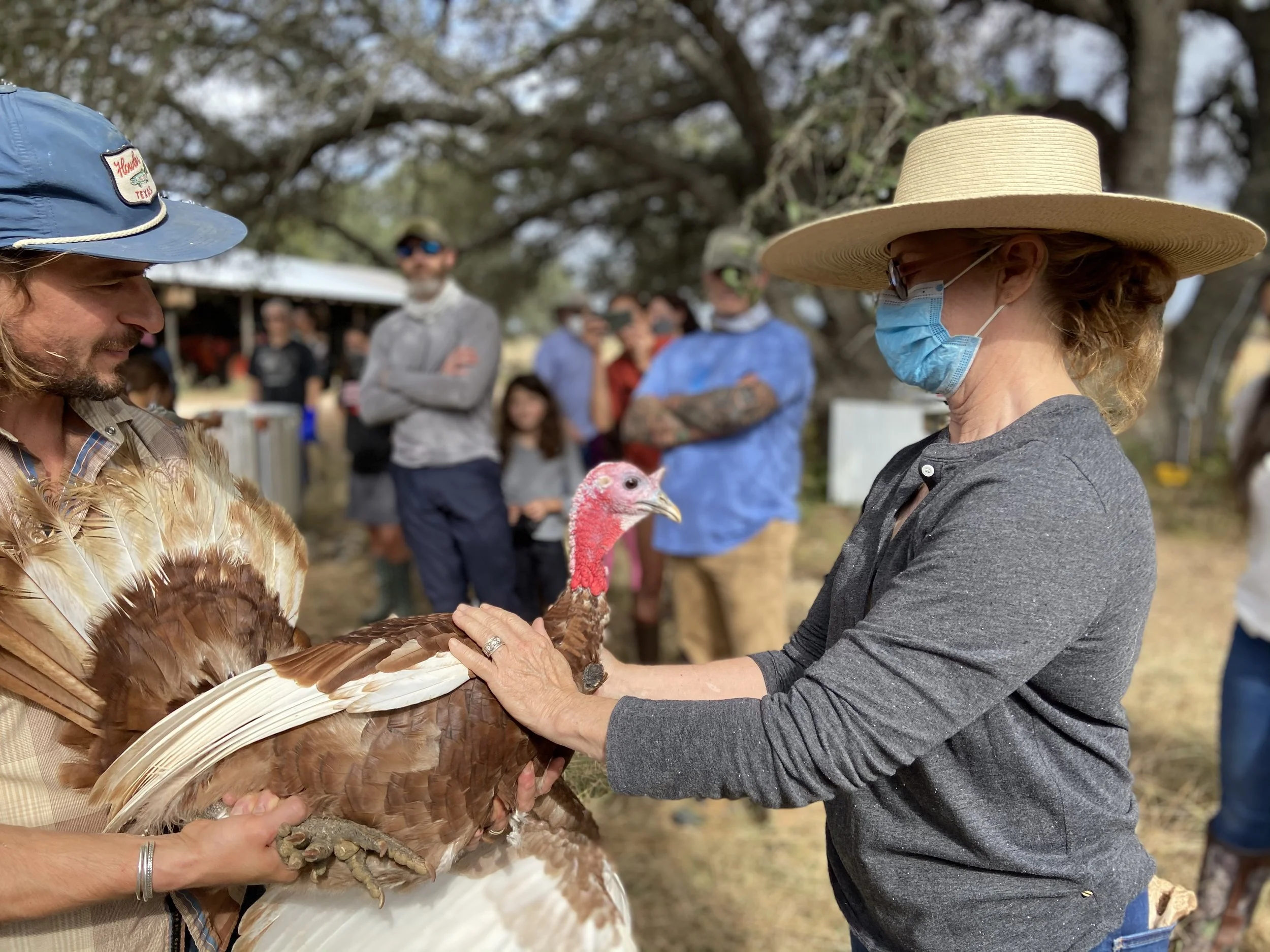
Turkey Harvest 2020
I dread it every year. It is different when you hold the bird in your arms, then take the life yourself. But I know that feeling, that loss, and the hurt is what makes me care so much. That, too, is the gift.
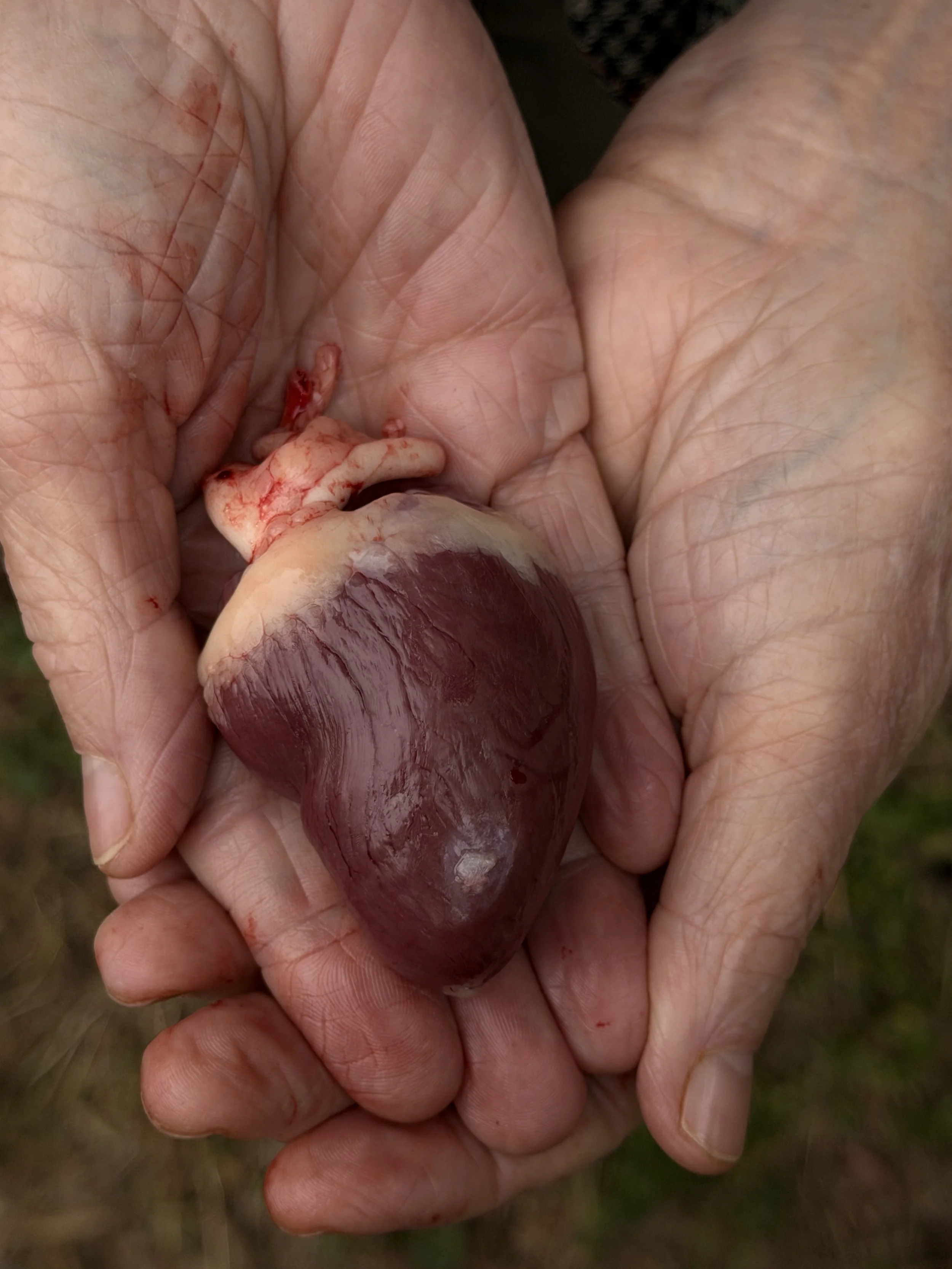
Turkey heart at my 7th turkey harvest, November 2026
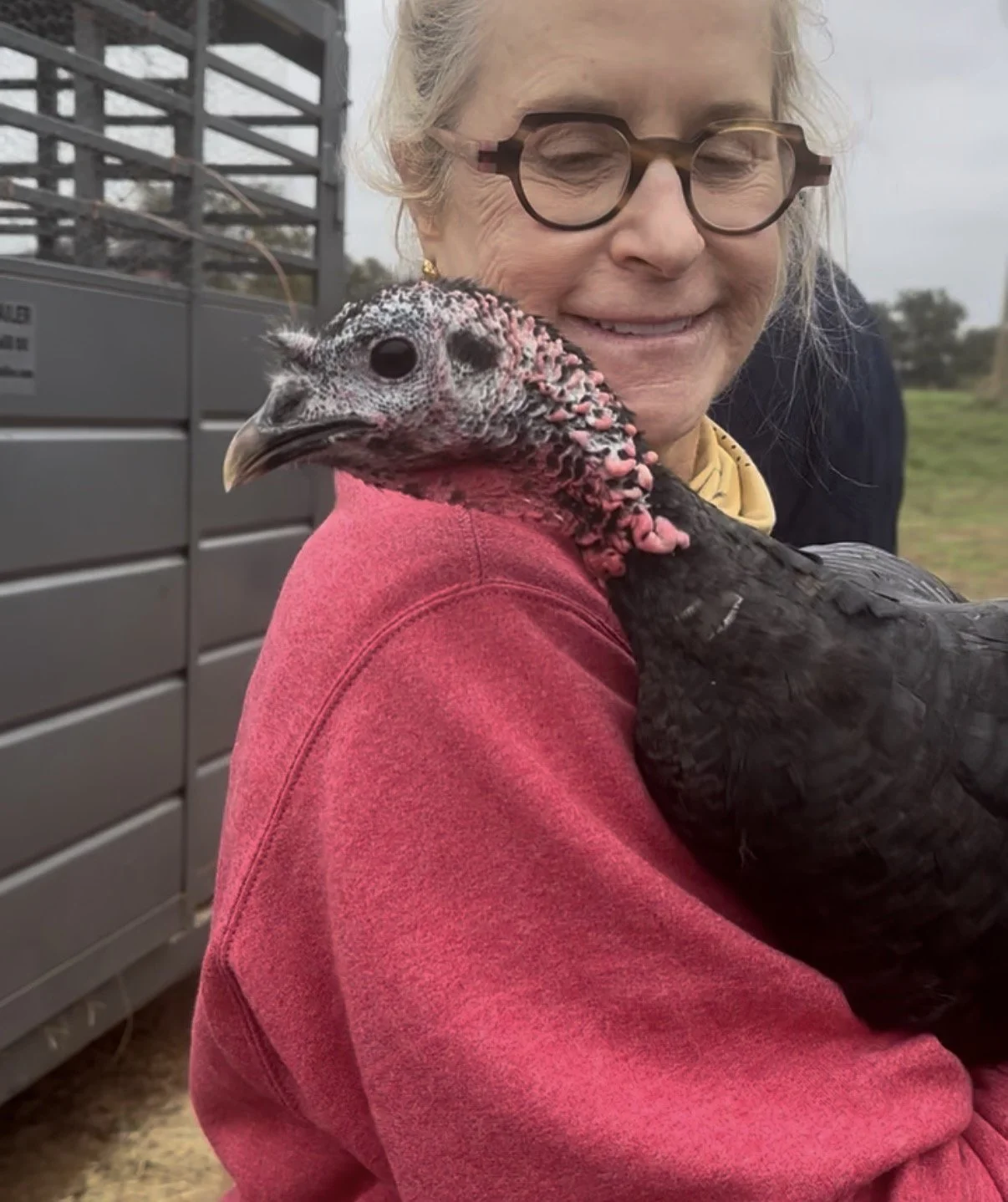
Holding her close before the harvest, so her last moments are calm. Roam Ranch 2023
A heart that grew in its own time, not ours.
Humane, I am learning, means letting another life keep its own time.
It means one more thing. As far as I know, we are the only animal that can take a life from a distance, in a single moment, before the other ever knows fear. A wolf cannot, nor a hawk. A predator kills the only way it can, with tooth and talon, and that is not cruelty. Cruelty requires a choice. We are the animal with the choice, and it cuts both ways: the same choice built the twelve-week turkey. Perhaps that is why kindness carries our name.
❧
I am still listening.
enough to hold
the shrew
and the whale
Poems from this listening
• lifeblood, as told by the heart
• before the fence line, as told by the prairie
• the predator, as told by the yellow-crowned night heron
• monday • jul 10, 2023 • 5:00 pm, as told by the yellow-crowned night heron
• i am dragonfly, as told by the dragonfly
• it is not beauty, exactly, as told by the bullfrog
• vertical pupil, as told by the green tree frog
Sources
• Goldbogen et al., first recording of a blue whale's heart rate, Stanford, 2019
• Jürgens et al., Etruscan shrew heart rates up to 1,511 bpm, Journal of Experimental Biology, 1996
• Hummingbird torpor, Science News Explores
• Levine, "Rest heart rate and life expectancy," JACC, 1997
• Gurven & Kaplan, "Longevity Among Hunter-Gatherers," Population and Development Review, 2007
• Heritage Turkey definition, The Livestock Conservancy
• Hemorrhagic Vasculopathy of Turkeys, Merck Veterinary Manual
