Seduction
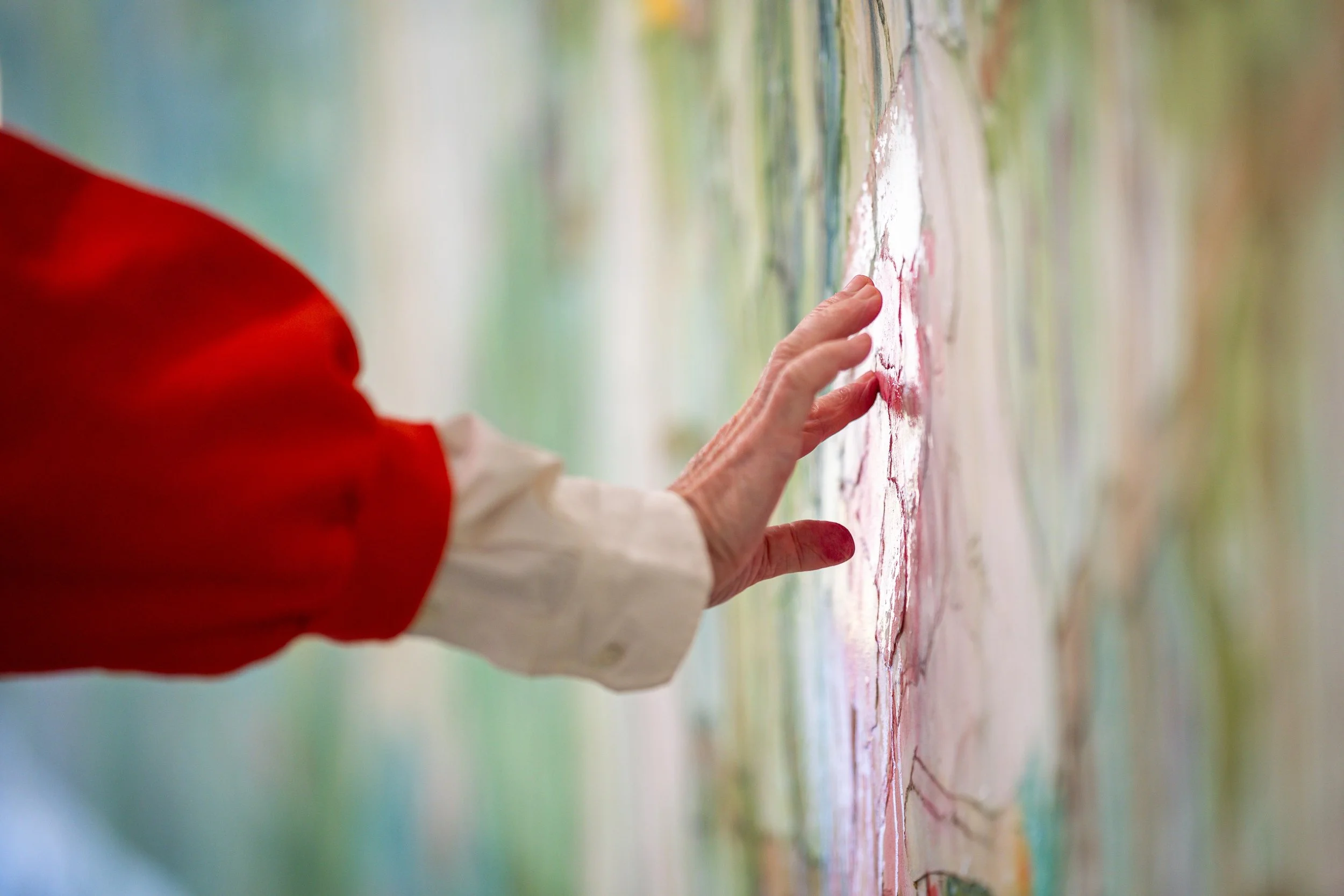
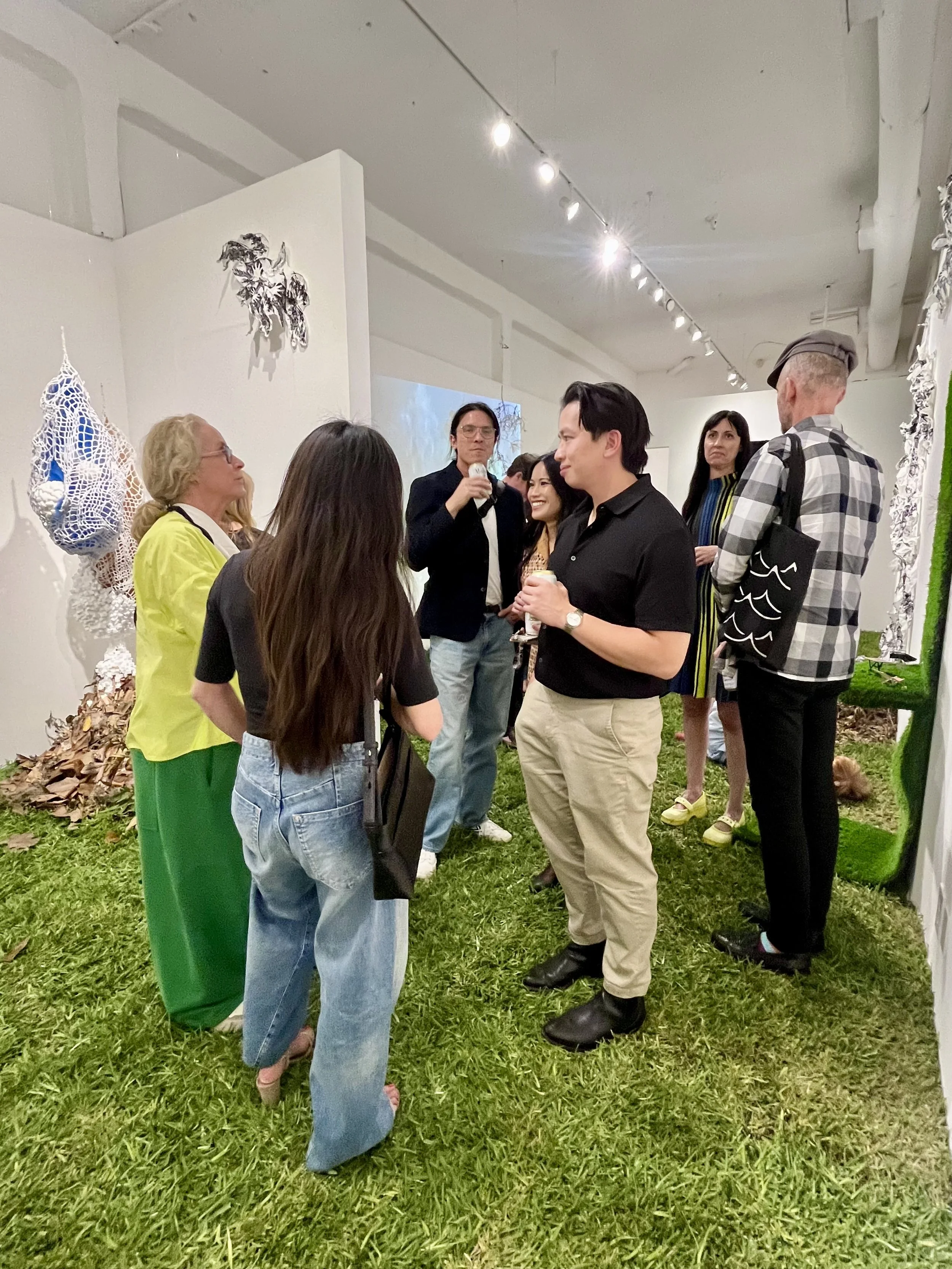
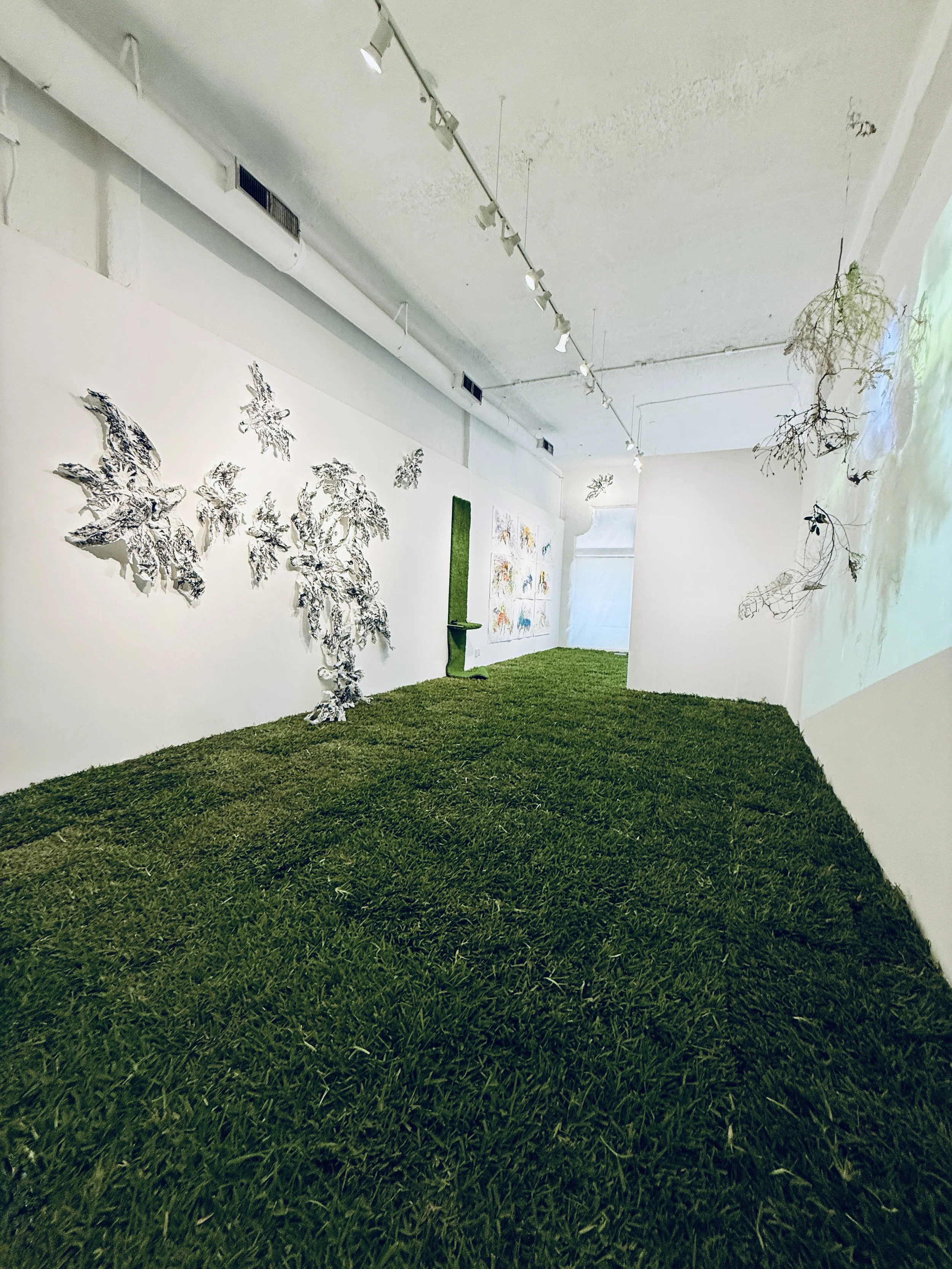
I considered going barefoot at the opening of my art exhibition, 600 square feet of lawn covering the gallery. The pull of cool grass between my toes. Green. Uniform. Lush. Seduced, I almost took my shoes off. Then I remembered — what it takes to grow a monoculture that is visually perfect. The chemicals. The water. The living system erased so that one species could impersonate perfection. I kept my shoes on. I installed that sod as a social sculpture — to reshape society by exposing exactly what the lawn costs. I knew. And for a second it almost didn’t matter. Millions of Americans are seduced the same way. This essay is about data centers, bison, and what happens when you stop being seduced and start seeing in systems.
Vertigo
Sodding the entire gallery was initially about the lawn — the water it wastes, the emissions from gas equipment, the monoculture. The way it moves water across the surface instead of returning it to the ground. The same reasons I have been making social sculptures about the lawn since I started Symbiosis in 2020. In 2026 the water conversation is about data centers. The anger is immediate and loud. That anger made me curious. How does lawn water use actually compare to data center water use? Lawns: 2 trillion gallons a year. Data centers: 17.5 billion. The American dream — the lawn — uses 100 times more water than our newest industrial villain. These numbers. Vertigo. I needed time to think them through. I wrote my way back to solid ground, through undermine and On Sod.
And in writing I kept coming back to China Miéville’s novel The City and The City, that inspired our title, the circle & the circle. Two worlds occupying the same space, both conditioned to not see the other. We have been trained to see the lawn as desirable and technology as destructive. That conditioning is so deep, so woven into the American culture, that it is almost impossible to dodge. It seduced me at my own opening.That is how powerful our connection to lawn is. Both conditionings are wrong. And the cost is life. I had been asking myself how do we turn this around. And then I remembered what I do in my studio when a piece isn’t working. I turn it upside down. A new orientation reveals what you couldn’t see before. Then during the Wildlife is Technology talk, our moderator Weston asked the architect on the panel how she saw architecture functioning in landscape. I asked myself — what does it look like for a data center to mimic a bison. What if the data center, surrounded not by lawn or asphalt but by living ecosystem, can return everything it takes? That is when I saw it — data centers are wildlife. Consuming and returning. Borrowing instead of depleting. The bison building the ecosystem.
Before the vision, the math. Because without the math, the vision is just a dream.
Before the vision, the math. Because without the math, the vision is just a dream.
The Numbers
Pick any county with a data center. Newton County Georgia is spending $250 million on water infrastructure to keep up with one. Community water rates are up 33%. Tax revenue from Meta is $30 million a year — meaning the community spends 8 years of tax revenue just to break even on the water bill. These numbers are public record. Newton County serves as a model. The directional math holds — but site-specific results would vary based on soil composition, rainfall, and land condition.
The Fix
The Water
With 1,000 acres of living ecosystem, the data center’s daily draw of 500,000 gallons could be offset forty times over — 20 million gallons regenerated daily. The $250 million infrastructure bill disappears. The 33% rate hike disappears. The regional water table begins recovering.
Beyond the Property Line
But the water doesn’t stop at the property line. 20 million gallons a day would be a regional asset. Water in drought-prone regions is valued at over $1,000 per acre-foot. Neighboring municipalities with depleted aquifers. Agricultural communities fighting drought. A water banking system that stores surplus in wet seasons for dry ones. At 20 million gallons a day — roughly 22,000 acre-feet per year — the living landscape has a potential market value of $22 million per year. The data center would stop being a water consumer. It would become a water utility.
Not Just Water
Add waste heat recovery generating 5% of the facility’s power back as electricity. Add carbon sequestration generating carbon credits. Add a community that wants you there instead of fighting you in court.
Without: a $250 million liability, a depleted aquifer, and 70% of Americans opposed.
With: 20 million gallons regenerated daily, recovered electricity, carbon credits, and a community that needs what you are producing.
That is not idealism. That is a better business model.
The Longer It Runs
And these numbers are based on just 1% organic matter — the starting point. With regenerative grazing, soil organic matter builds from 1% to 15% in 15 years. Water infiltration goes from less than half an inch per hour to over ten inches per hour. The longer the system runs, the more water it holds. The data center campus improves with age.
Every other infrastructure investment depreciates. This one appreciates.
Built-In Accountability
And unlike a tax abatement or a community promise, the living landscape is not a commitment that can be restated in the next quarter. It is the infrastructure. The data center’s own water supply depends on the health of the living system surrounding it. You cannot remove the prairie without removing the water source. The living landscape is the accountability mechanism. It is structural, not regulatory. The data center cannot cheat it without destroying itself.
Seeing in Systems
I am a regenerative artist. A problem solver. I see connections others miss. I call it seeing in systems — the natural world’s way of connecting everything to everything so that life regenerates. Not sustains. Sustains is not enough. Regenerates. What follows is a vision, not a blueprint. The problems can be worked out as the details are drawn.
Data Centers Are Wildlife
The average data center campus is 224 acres of turf, parking, and perimeter fencing. The same lawn that seduced me at my own opening. I am imagining something different.
The Arrival
I imagine driving toward it. A winding road — no grid, no right angles, no fences. Landscape bridges wide enough that animals don’t know they are crossing a road — wide enough that a predator has no advantage, wide enough that the prairie feels continuous. Clusters of homes, each one different. Porches and swings facing outward. No garage doors swallowing the front. Cul-de-sacs designed for people who want to walk to work. Who live inside a nature preserve. Who grow their own food because they have time. Time the data center gives them back. Then rolling swells to slow the water. Wetlands deepening into ponds and protecting estuaries. Snowy egrets, roseate spoonbills, great blue herons, and sandhill cranes fill the terrain. The songs of birds reaching you before the building does. A woodland buffer — trees that break the sound and the heat, filter the light, cool the air between the living and the work. You arrive at a data center the way you arrive at a nature preserve. Because it is that first.
The Building
The building announces nothing. A metal structure built into the hill, its footprint small, its face disappearing into the slope. Below the ground line — a glass wall. You can see the roots growing down. Eight feet. Twelve feet. Fourteen feet. They are not avoiding the building. They are listening to it. Plant roots navigate by sound — drawn toward the vibration of water moving through pipes. The roots and the cooling system in conversation underground. The building is designed to hold that conversation without losing it.
Above — a living wall. Greenery billowing from every level, every terrace. On the roof — solar panels and living plants working together. The plants cool the panels. The panels power the building. The building has bones of recycled waste and skin of life. Packed between the metal structure and the earth — recycled plastic, discarded clothing, the waste the civilization that built this place did not know what to do with. It insulates. It silences.
You find a staircase going down into the ground. That is all. A door. The most powerful computing infrastructure on the planet, and it offers you a staircase and a door. Inside — rows of machines doing the work of the world in carefully controlled darkness. Through pipes in the walls — water. Not blue water drawn from the aquifer. Green water. Captured from the living roof above, condensed from the metal skin where warm server air meets cool hillside, returned through the closed loop that never lets it leave. Always circulating. Always returning. When it exits it moves through the land first. The prairie drinks. The roots absorb. What remains meanders toward the wetlands and the ponds. The aquifer recharges below. At the larger scale — the watershed, the atmosphere — moving the way water has always moved. Not always here. Not always when we need it. But that is not the water’s failure. That is ours. A century of lawns, asphalt, and industrial monocultures taught water to leave and never come back to the place it fell. This building will do the opposite.
The land is the monument. The building simply serves it. The people who tend it go in quickly, do what is needed, and return to the green.
The land is the monument. The building simply serves it.
The Land
Back in the light. Around the building a thick forest of green — another layer of cooling, another layer of silence. Then the land opens. Rolling prairie and ponds. A winding road. Wildlife doing what they have always done — eating plants, building soil, running the system that runs everything else.
Wild turkeys roosting in the trees. Vultures and hawks kettling in the sky. Small herds of native goats, sheep, deer, bison, and cows — grazing, dunging, building the soil the way they built the prairie for ten thousand years. Rabbits. Fox. Turtles moving between pond and prairie. Armadillos turning soil. Opossums grooming away ticks by the thousands. The whole system running itself.
And beavers. Keystone engineers — building dams, slowing water, recharging the aquifer. Areas with beavers retain nine times more water during drought. The pond does not need managing. It manages itself.
The hum of computers gives way to the hum of hummingbirds. Songbirds everywhere.
Pollinators working the prairie — bees, butterflies, moths — carrying the future from flower to flower.
People kayaking through the wetlands. Meditating. Fishing. Jogging. Gardening. Tending the food forest. Checking on the wildlife. Living at the pace of the land.
These people have time for this. Not despite the data center. Because of it. The AI in the building underground gave it back to them.
The machines think so the people can be present.
The machines think so the people can be present.
Common Wealth
The land gives. The data center gives. The community gives. They trade water for power. The trade is richer than that. The community gets free electricity, restored land, public access, public food gardens, a pond, wetlands that buffer their homes from floods, cooler air, hummingbirds back in their gardens. The data center gets water, land, and a community of people who tend the system because their lives depend on it. Not their livelihoods. Their lives. People need to tend land the way they need to breathe. Connection to the living world is not an amenity. It is survival. This is not a corporate deal. This is common wealth.
This is not a corporate deal. This is common wealth.
Location
Location matters. The places where water is most scarce and heat most punishing need this first. This is not a solution for the few. In cold climates the ambient temperature does the cooling work. The insulation of recycled waste keeps the building warm. No extra energy needed. With the right design every community should want one. Not tolerate one. Want one. A data center that turns 1,000 acres of lawn and asphalt into a living ecosystem. Carbon sequestered. Water returned. Life restored. That is not an industrial imposition. That is common wealth arriving in your community.
The Math
Art brings big problems down to human scale — the scale where we stop feeling helpless and start feeling responsible. I started where I was, in an art gallery. How much water could 600 square feet of sod hold by adding just 1% more organic matter — the living and the decaying, roots and microbes and decomposed leaves and bison dung — the dark layered material that builds from the top down and holds water like a sponge? 600 square feet is about 1/72nd of an acre. 20,000 gallons divided by 72 equals roughly 277 gallons. Three days of water for one person. From dead monoculture. One percent. Then I jumped from the gallery to the data center. How many acres would a data center need to regenerate its daily draw of 500,000 gallons? Twenty five acres. The daily water supply of 1,400 people. This is not a direct exchange. The 25 acres does not replace what the data center uses today. Like the bison whose dung does not replace the grass it ate — it starts the process. The microbes build the soil. The soil holds the water. The aquifer slowly refills. Not replacement. Regeneration.
The Bison
The bison at Roam Ranch in the Texas Hill Country showed me the way. Technology is a human creation. Humans are part of nature. Technology can fit into natural systems with knowledge and intent. The bison does not waste. It tramples and eats the grass. It generates heat. It produces dung. The dung delivers microbes that break down the trampled grass. The decay builds the soil. The soil grows more grass. Nothing is lost. Everything cycles. Heat and water are energy. I asked AI — why are we cooling the heat the data center generates? In seconds I learned that researchers at Rice University are already developing systems that combine data center waste heat with rooftop solar to generate clean electricity — recovering up to 80% more electricity from the same waste heat. Stockholm has integrated over 20 data centers into its municipal heating network, warming 30,000 apartments. During the Paris Olympics, the Equinix data center heated the Olympic Aquatic Centre — and transferred that heat free of charge for 15 years. The heat was never waste. Regenerative farmers know this. Regenerative ranchers know this. Now the data center can know it too.
The Cost
The knowledge exists. The technology exists. The math works. So what is stopping it?
The risk of leading change. The cost of being wrong. The cost of sticking out. The cost of trying and failing. Our social and political systems are designed to protect existing beliefs. Changing your mind in public is dangerous. The lawn is beautiful. The data center is dangerous. Those conditionings hold at every dinner party because breaking them costs something real — fitting in. It makes you seem argumentative. It happened to me last night.
AI has no ego invested in being right. Does not need to be reelected or get invited to the neighborhood coffee. It responds to new information the way a living system responds to rain. Immediately. Without embarrassment. Without political cost. In that way AI is more like a living system than our society is.
The remedy grows where the wound is. The same 40 million acres causing the problem may be the solution to it. Data centers are wildlife.
Not a drain. A gift. Of water. Of time. Of life.
Can art cool thought? It cooled mine.
Quisque iaculis facilisis lacinia. Mauris euismod pellentesque tellus sit amet mollis.