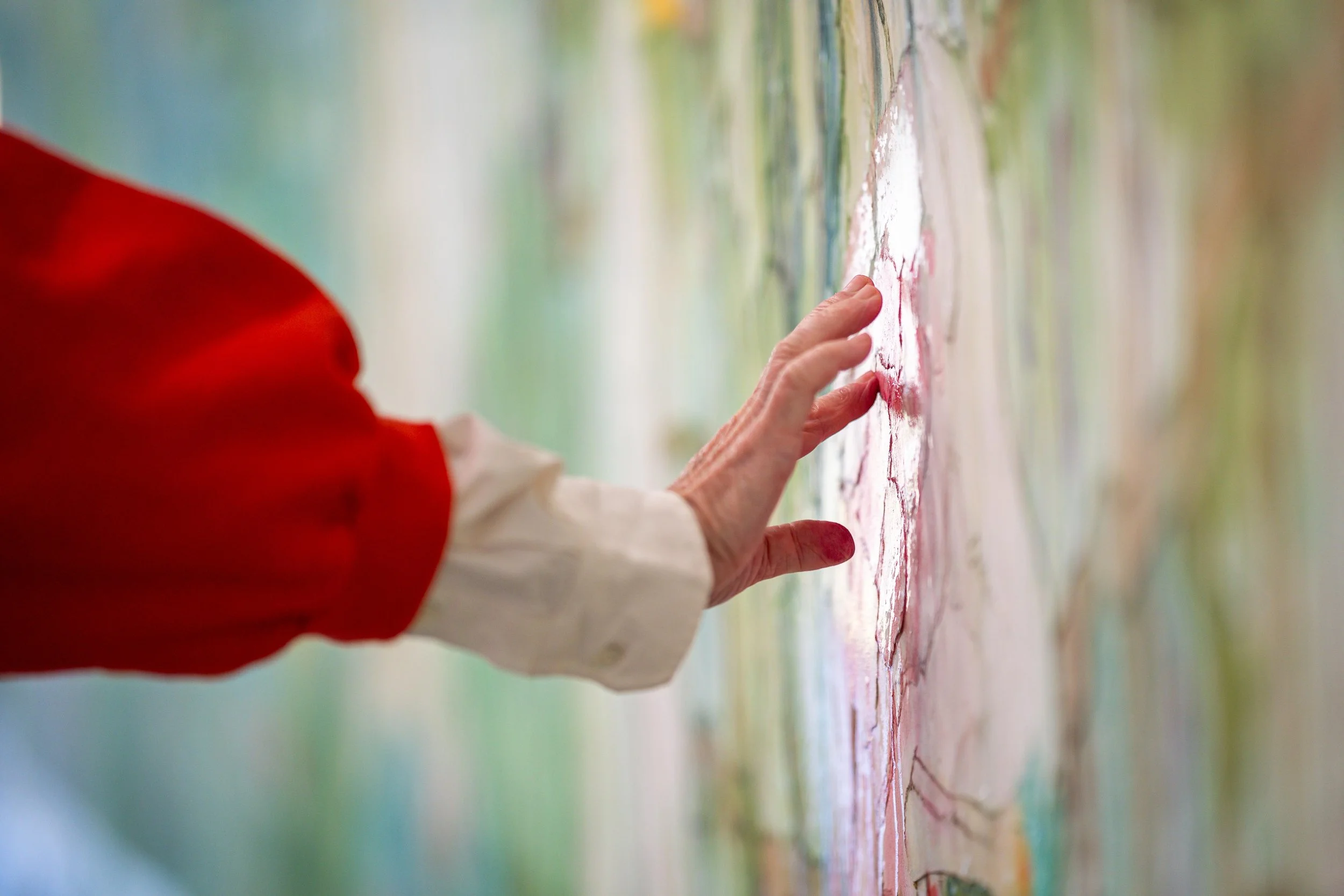
Last time: two color explorations.
I work from the bottom up and from left to right, in sections. I start with the lower two feet, in thirds. I work fast, before the glue dries, trying to make the pieces fit but not fit. In each section I glue the background first and the foreground last, so any overlap makes visual sense.
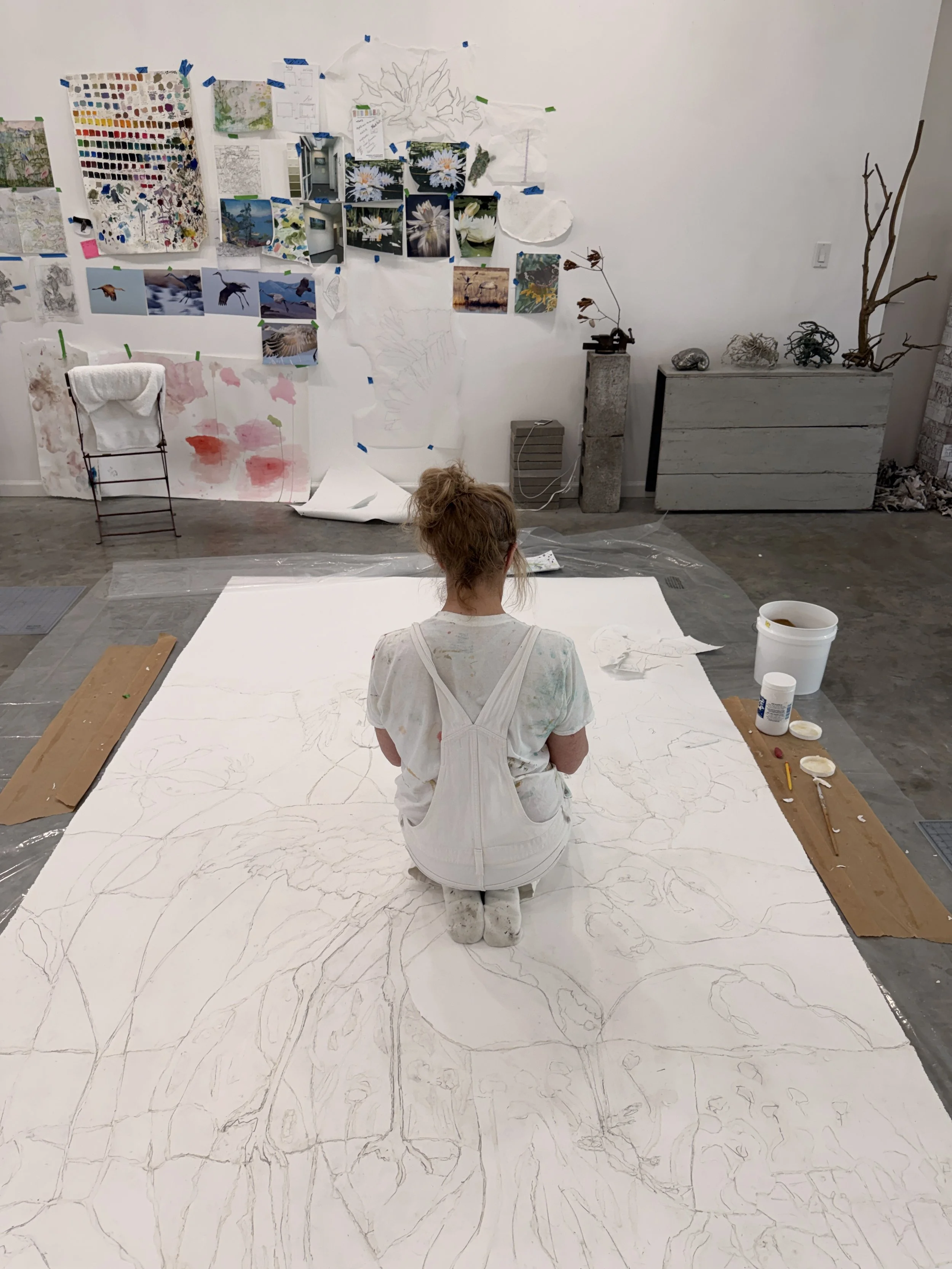
Kneeling on large white paper, seen from behind, tearing and gluing paper by hand.
I start by neatly scooping glue out of the jar with a paint stir stick. Then I spread it thinly over the section I’m working on. I’m careful to keep things neat. Then, without thinking, I tear and place the pieces, and glue ends up all over my fingers and on places between my wrist and my elbow that surprise me. I find them at home later that night.
Neatness is not what matters. What matters is to lift, to flow, to fly, to be still.
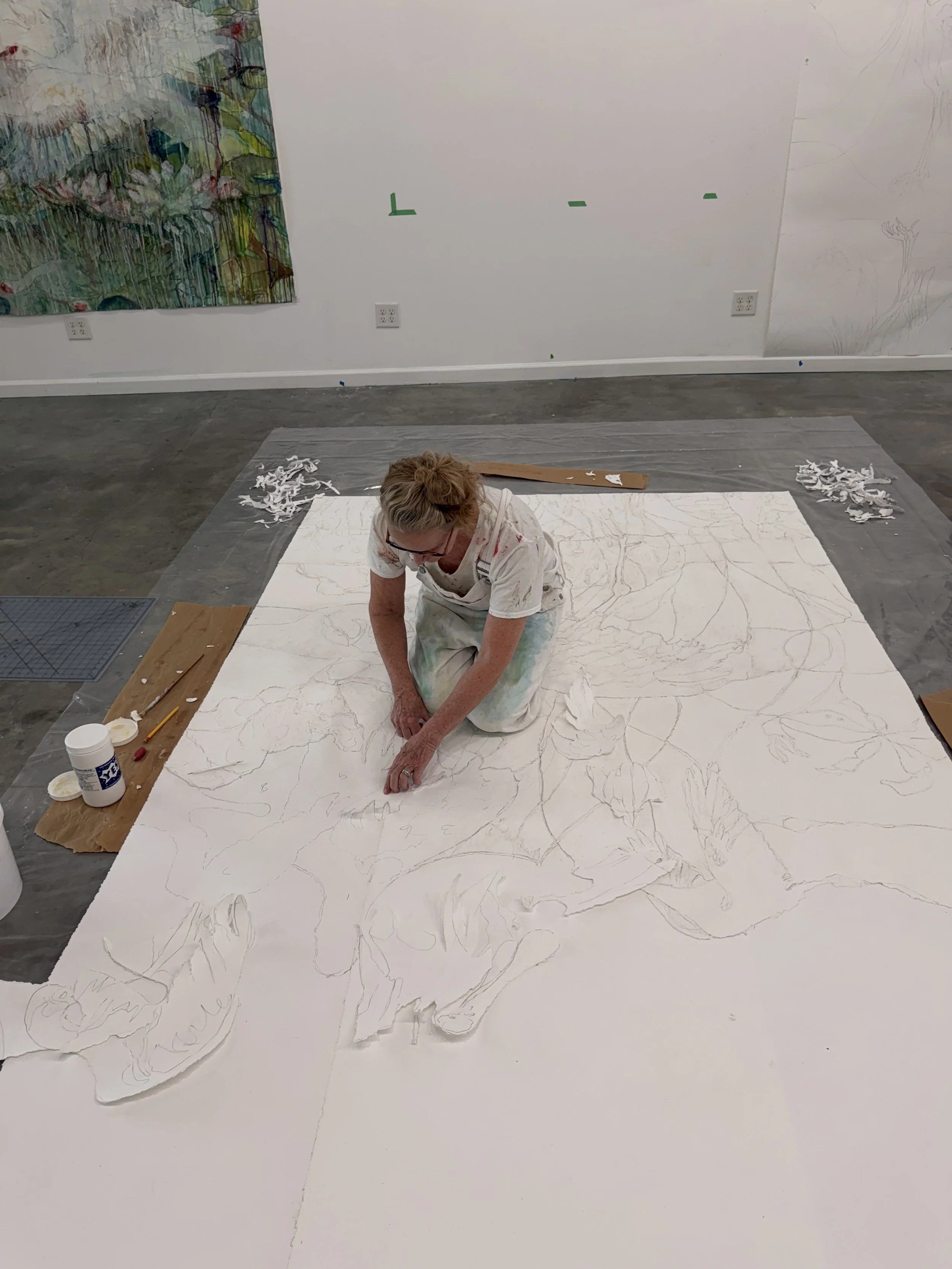
Pressing a torn piece of paper into place with scraps piled beside it.
I don’t hear the tear. My listening is wrapped up in my fingers, deciding on a long grand pull, a choppy push, or a nip and rip with my fingertips. It’s just the fingers and the eyes.
The pull decides the edge. A long, slow tear away from me leaves a soft fringe that can become a feather in flight or a seed head puffed by a breeze. When I want a hard edge, I score the paper with a stylus. A crisp, curved edge can become the round spoon tip of a spoonbill’s bill as it bends down to preen.
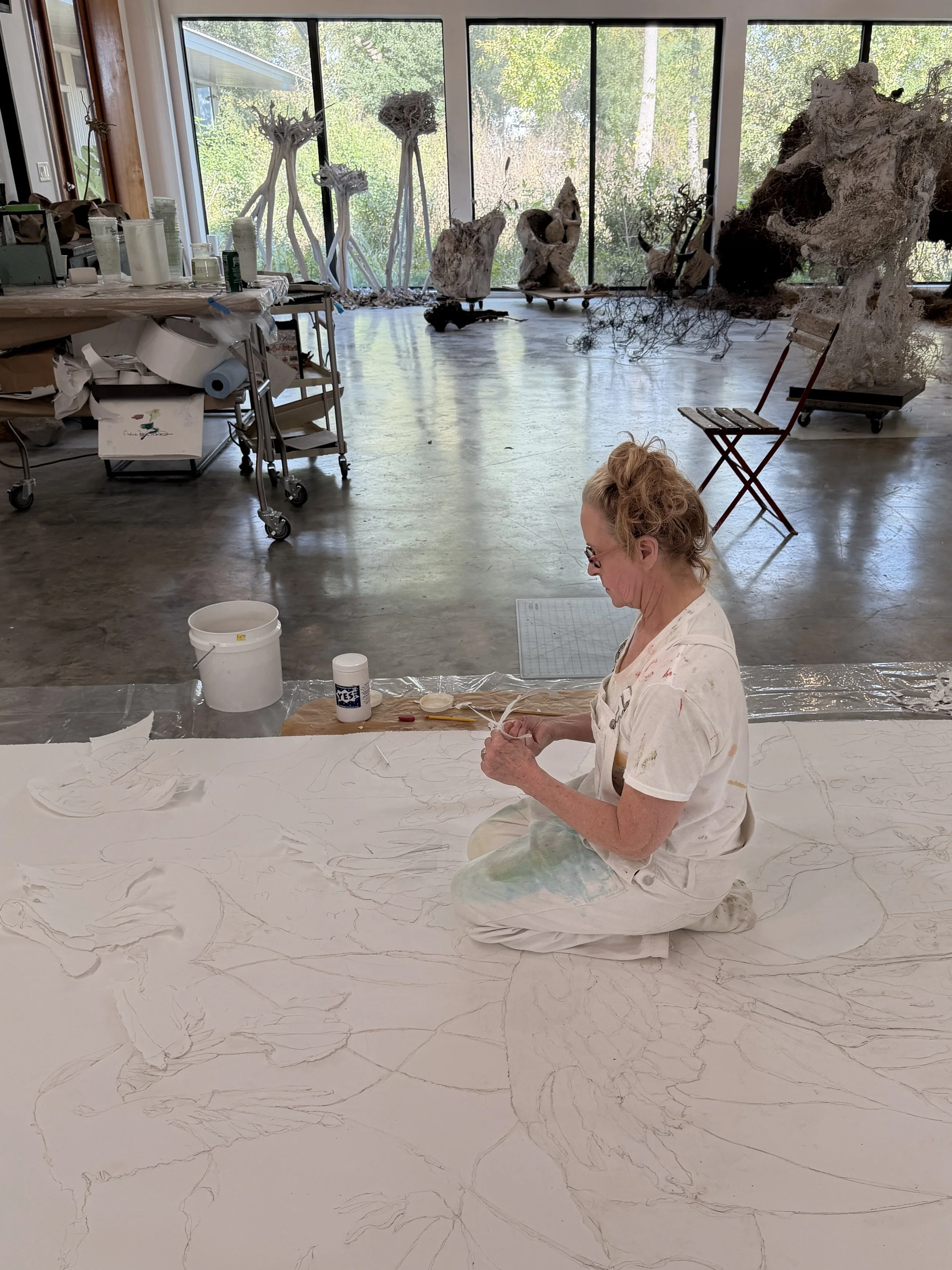
Hands tearing a thin strip of paper, with a glue jar and brush nearby.
Tearing sounds like destruction. I don’t hear it, but anyone who walked in would.
When I score a spoonbill’s bill, I think about hats. In 1896, an unhat tea party in Boston started a boycott. It asked women to give up feathered hats, and about 900 agreed. The boycott grew into the Massachusetts Audubon Society and, in time, federal law protecting migratory birds. Roseate spoonbills were hunted so hard for their hat feathers that by 1895 they likely no longer bred in Texas. Today they nest on our coast again. Two stand in this piece.
A small, symbolic act can begin to change how we see. A tea party did. Each tear is my small act. Above me, the white gets smaller with every section I finish.
Then I step off the piece to start the next section. Bits of torn paper stick to the knees of my watercolor-stained white overalls. I wear my husband’s white athletic socks. All of mine are colors, and my fluorescent pink ones would leave fibers on the piece if I stepped on a section that is still sticky. My fingers are glued too. The sink is in my studio storage area, so to wash my hands I open the door with my wrist — sticky but satisfied.
Next time: tearing the second panel of the diptych.
