
Conscience is a mammal thing
A post crossed my feed this week claiming Darwin learned his ethics from the Yahgan people of Tierra del Fuego. He didn't. But half of it was true, and that half drew me in.
In The Descent of Man, published in 1871, Darwin argued that the moral sense is not handed down from above. It grows up from below, out of the same social instincts that make a ewe call for her lamb. In his words:
"Any animal whatever, endowed with well-marked social instincts, the parental and filial affections being here included, would inevitably acquire a moral sense or conscience, as soon as its intellectual powers had become as well developed, or nearly as well developed, as in man."
Conscience is a mammal thing. Care, with memory. Darwin went further. He wrote that our sympathies become more tender and more widely spread until they reach all sentient beings, and he called humanity to other animals one of the noblest virtues we have.
Then he put that wide circle of care at the top of a ladder. He called it "one of the latest moral acquisitions," a prize of civilization, with Europe standing on the highest rung.
The cloth torn into strips
Nearly forty years earlier, Darwin had met the Yahgan from the deck of the Beagle. He was not kind about them. He wrote that he "could not have believed how wide was the difference between savage and civilised man."
The crew handed a Yahgan man a piece of cloth. It was torn into strips and passed out until everyone had some. Darwin read this as the problem: "The perfect equality among the individuals composing the Fuegian tribes must for a long time retard their civilization."
A people living at the bottom of the world, in wind and sleet, on mussels and seal and whatever the sea allowed, divided a gift so no one went without, and wasted none of it. Darwin saw people waiting to be civilized. I see people whose civilization was written into the life of the shoreline.
He was looking at the ethic he would later describe as the height of moral development. He saw it in a canoe and called it backward.
He had a point. A whole cloth can become a sail or a roof, and a strip cannot. But Darwin could only imagine it kept whole by a chief, someone powerful enough to own it. He never considered a third way: keep it whole and hold it in common. I explored that idea in Can Art Cool Thought?
We are misreading too
We have our own version of Darwin's mistake, and it starts in the meat aisle.
Feedlots and broiler houses have taught a generation that eating an animal is an act of cruelty. In those places it is. Animals packed past their nature, fed what their bodies were never built to digest, ended without ceremony and shipped as parts. Their bodies sold as fuel, and depleted fuel for ours.
The feedlot is the food chain run for profit, with the relationship cut out. And when we let the industrial model stand in for the whole, we start to see every act of eating as a wound, and every predator as a villain.
Energy moves through bodies. The hawk eats the vole, the vole eats the seed, the seed grew from soil built of dung and the dead. Eating is how the planet circulates itself. Remove it and nothing stays alive.
The bison and the grass
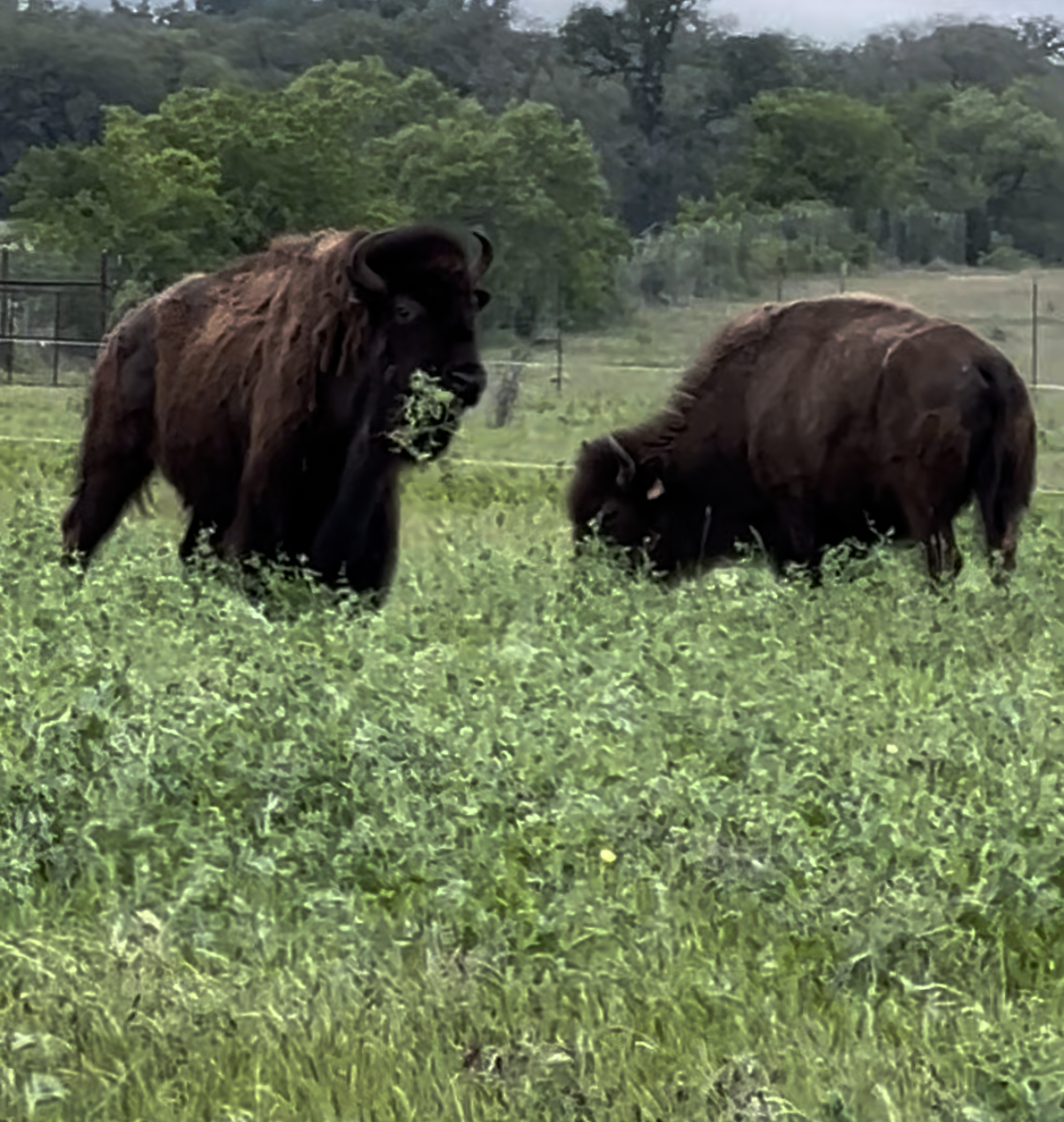
Bison grazed the tallgrass prairie into being. Prairie grasses keep their growing points low, at the crown, so a grazing mouth takes the leaf and leaves the plant. Hooves press seed into soil. Dung and urine return nitrogen. A herd moves on, and the grass comes back thicker.
The grass is not killed when the bison eats. A ruminant turns cellulose, which we cannot digest, into food we can, and the plant it ate is still alive.
The word regenerative now appears on packages of meat that are nothing of the kind. I am not defending pasture in general. A field of planted Bermuda grass grazed all year is a monoculture with cows on it. What I am describing is regenerative rotational grazing: a herd moved often across diverse native grassland, the way bison once moved ahead of wolves, with each patch given long months to recover.
Done well, it rebuilds the whole web from the bottom up. Dung beetles bury the manure and feed the soil microbes. Wildflowers and native grasses return, and the insects return with them. Grassland birds follow the insects. Hawks, owls and coyotes follow the birds and the rodents. The herd is the engine that restarts the land.
Not bison alone. Goats to take the brush the grazers leave. Sheep behind them. Turkeys and chickens following the herd for the insects and the dung. A Mardi Gras of species, each one eating something different and leaving something behind for the next.
There is a harder question. In 2003 the animal scientist Steven Davis argued that a diet including pasture-raised ruminants might kill fewer animals overall than a diet of row crops, because harvest machinery kills mice, rabbits, snakes and ground-nesting birds by the field. The philosopher Gaverick Matheny answered that, counted per calorie, a mostly plant diet still comes out ahead. The researchers have not settled it.
But both sides of that debate count the deaths at harvest. I would count what happens before it. A mouse killed by a combine is one death. A field that has been corn, and only corn, for forty years is a place where the mouse, the meadowlark, the bumblebee and the milkweed never get to live at all. Miles of single crops held up by herbicide, insecticide and synthetic nitrogen are not habitat. They are the absence of it.
The largest global study of biodiversity agrees. The 2019 global assessment by IPBES, the international biodiversity panel, named land-use change as the single largest driver of species loss on land, and agricultural expansion as its most widespread form. And much of that corn and soy goes to feed the animals in feedlots, which means the industrial plate does its damage twice.
One bison, a thousand pounds or more, raised by rotational grazing on native grassland and taken with care, can feed one person for a year or more. Many small lives, or one large one honored. That is a real choice, and the industrial system has hidden it from us.
Food grown in living soil
How food is raised changes what it carries. In 2022 the soil scientist David Montgomery and his colleagues compared crops from regenerative farms with crops from conventional farms next door. The regenerative crops averaged about a third more vitamin K, roughly 15 percent more vitamin E, and around 20 percent more phenolics, the defensive compounds plants make and we benefit from. Beef from one regenerative farm carried about three times the omega-3 of conventional beef, with a far healthier balance of fats.
The authors call the study preliminary. It confirms what I have seen in my own soil since 2007. Living soil, full of fungi and microbes, feeds plants minerals that dead soil cannot. Almost no one has grown food for nutrient density instead of yield. We do not yet know how nourishing food could be.
In 2018 researchers watched a wounded leaf send a calcium wave through the whole plant, carried by glutamate, the same molecule that fires our own nerves. That discovery became my poem glutamate. Plants sense injury, signal it, and defend themselves. Whether they feel it, no one knows. There is no clean line to stand behind. Every meal is taken from something that was answering the world.
The same soil that feeds the food also holds the water. Every one percent rise in soil organic matter lets an acre hold roughly 20,000 more gallons. Rain that once ran off hard, bare ground into ditches now soaks in, recharges the aquifer, and stays in the root zone through the dry months. Living plants pull that water back up and release it as vapor, which cools the land around them.
So a well-grazed prairie does more than feed us. It softens the flood, outlasts the drought, cools the ground. Microbe to beetle to grass to bison to hawk, and back down into water and soil again.
Nothing wasted
The Yahgan tore the cloth so no one went without. The Plains nations used nearly every part of the bison: meat, organ, hide, sinew, bone, horn. Respect and nutrition, in the same act.
A single bison liver weighs ten pounds or more, and ounce for ounce it carries several times the vitamins and minerals of a steak: B12, vitamin A, copper, folate, iron. Heart, tongue and kidney follow. The bones give gallons of broth. The industrial system sells the muscle and renders the rest into pet food and feed. It treats the most nourishing part of the animal as a byproduct.
In the city, the same ethic can grow on walls. A sunlit, south-facing building in Houston can carry pole beans, squash, maypop and mustang grape climbing warm brick, watered by rain caught off the roof. Those walls shade the building, slow the storm runoff, and feed bees and birds. A food wall is also habitat. Cities can feed us the fresh, fragile food. The prairie and the herd, the dense food. City and country, each feeding the other.
Remembering
I agree with Darwin that conscience grew out of care, and that care was shaped by survival. I part ways with him on what belongs at the top of the ladder. The ethic of taking only what is needed, wasting nothing, and honoring what feeds you was not invented by civilization. Industrial civilization is what forgot it.
Everything eats. What sets us apart is that we can see the consequences of how we eat, and choose. A hawk cannot be cruel or kind. We can be either. That choice is the human part of the system, and it is where conscience belongs.
So the way forward is a remembering. Soil built instead of spent. Herds moving across native grass. Whole animals honored. Walls heavy with beans, squash and maypop. The planet already knows how to balance life. Our work is to stop interrupting it.
Quisque iaculis facilisis lacinia. Mauris euismod pellentesque tellus sit amet mollis.