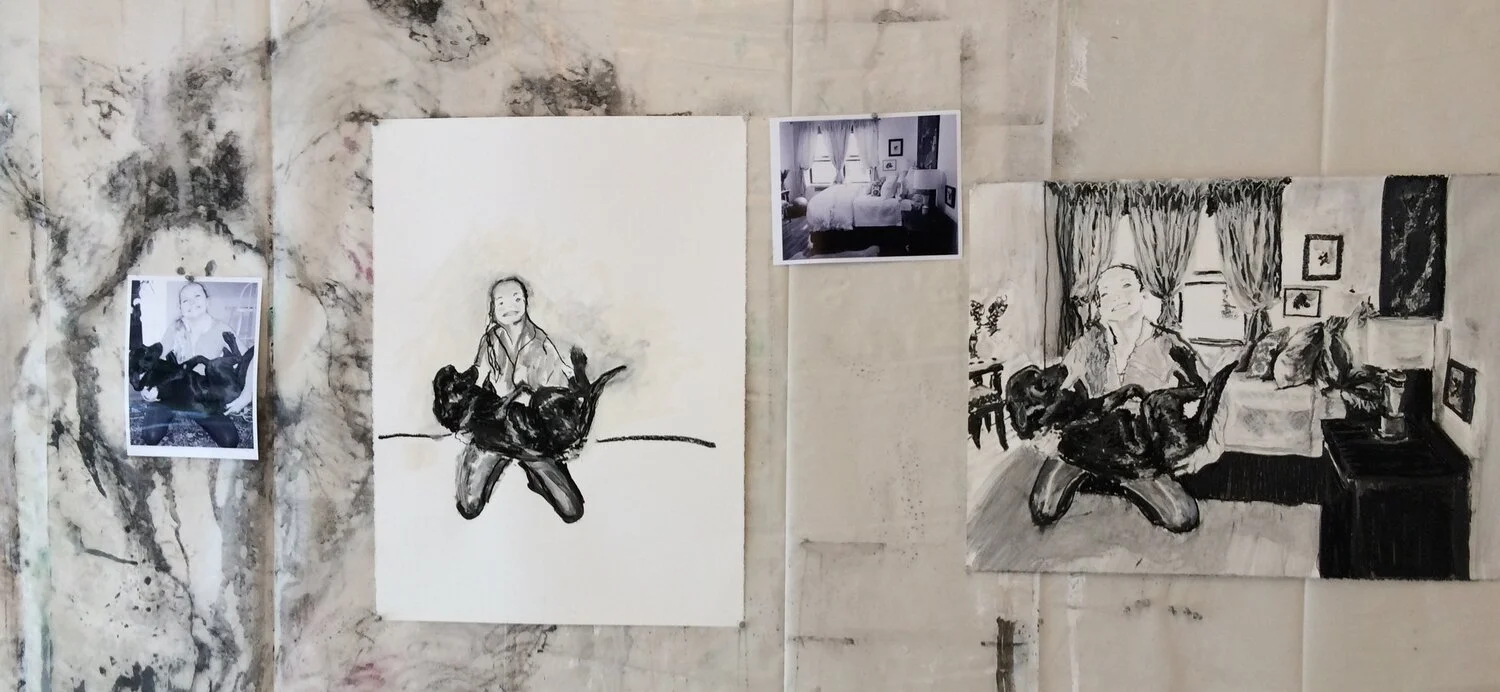
Done! My gloves are proof. For weeks, my schedule was jam-packed with proposals and large-scale projects that needed my attention. Amidst all the chaos, I was also starting a brand new sculpture for the Mayor's Office of Cultural Affairs' Earth Day Celebration. I thrive when I can hyper-focus, but this time I almost let something slip through the cracks. "Earth Moves" was in danger of being incomplete by the deadline. With less than a week left to finish, I knew I had no choice but to push myself harder than ever before. I woke up at 5:00 am every day and worked tirelessly until 4:00 pm, without taking a lunch break. I felt every muscle in my arms and shoulders ache, but the feeling of being fully present and working towards something important was truly exhilarating. I couldn't disappoint Necole Irvin and let "Earth Moves" fall short of its potential. After countless hours of welding and crafting, today the sculpture was finally installed on the 3rd floor of the Julia Ideson Library. The end result is a, call for action work of art made from welded steel, lath, indigenous clay, grass, and glass beads. It was a true labor of love that I poured every ounce of myself into. #earthday @lanolalady #mayorsofficeofculturalaffairs #houstonmayor #cindeeklementart #work #gloves #drive

Expecting a grandchild- sunflower
It is a heart warming privilege to craft something from the heart for two special souls my son Griffin and our precious daughter in law Alex both who have deep ties to nature.
Around each giant sunflower bloom lies bountiful tiny creatures and details designed specifically for their new born’s imagination. Being able share my joy as these parents-to-be anticipate the birth of their little one makes me feel truly honored!
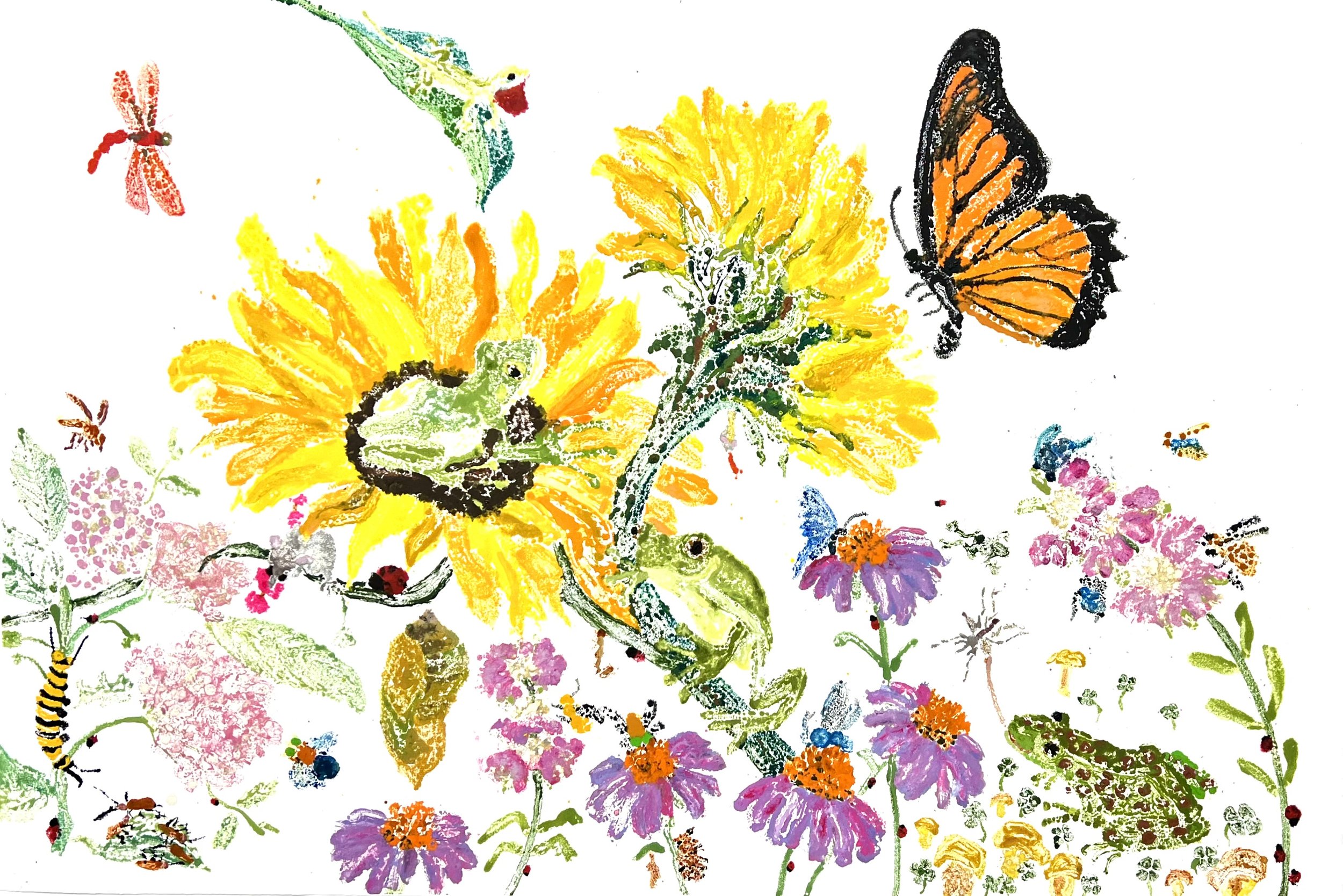
"Baby klement’s Ecosystem"
watercolor and pastel monotype
30" X 44"

A Field mice enjoying a snack of American beauty berry
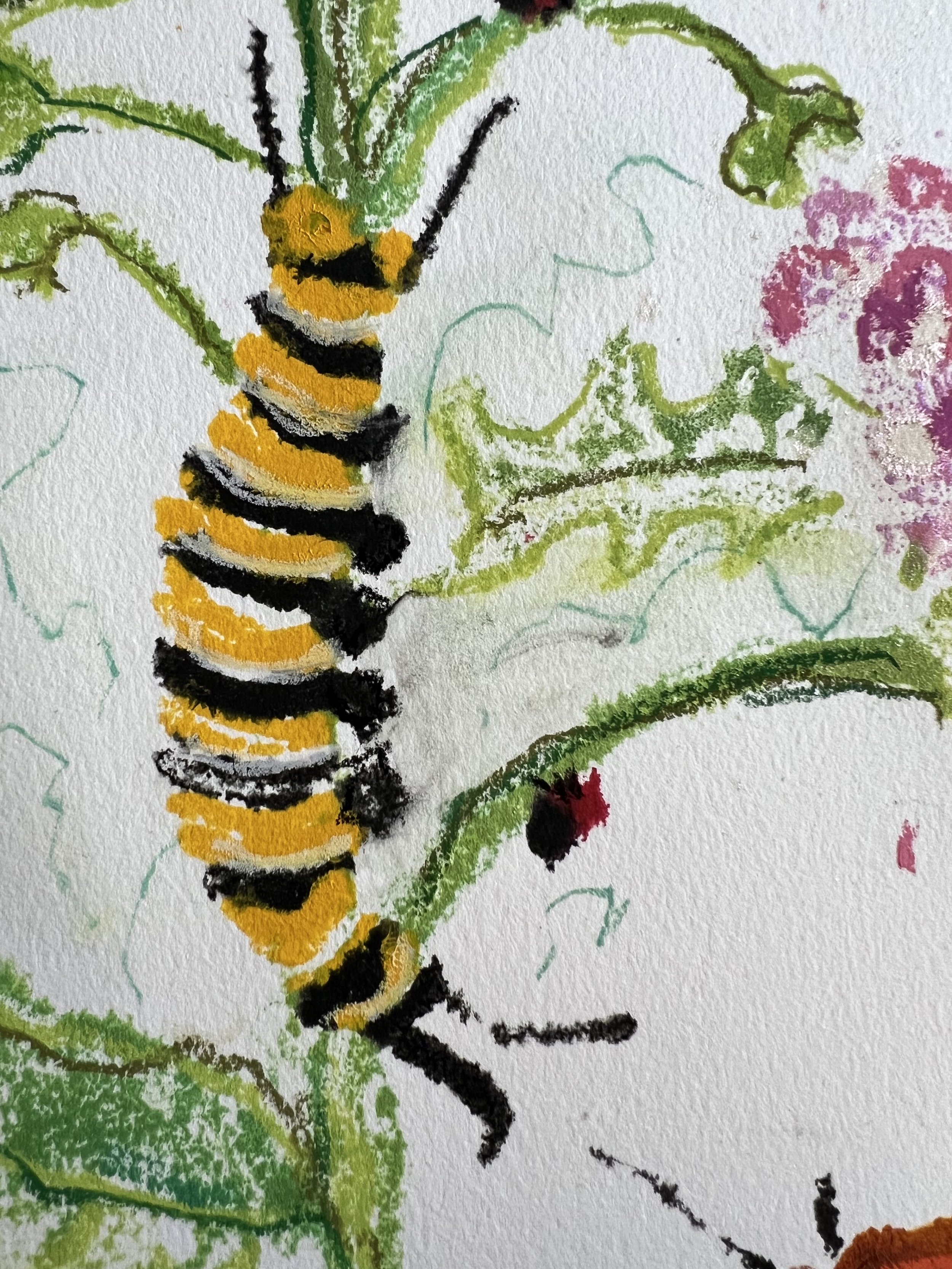


Gulf Fritillary caterpillar in the “J” stage of metamorphosis.

Monarch caterpillar, aquatic milkweed, Monarch chrysalis, Purple coneflower, wasp, dragonfly


On a personal note- Griffin and Alex have not picked a name so I think of our future granddaughter as Sunflower.
Cabinet Oak Project- Contemplation from start to finish
Spring of 2022, on Cafe (Call for entry), I saw a call for the Cabinet Oak Project. The call was to donate work to support the restoration of the Texas White House and start an artist residency program.
The call is a good fit for my work. It perfectly connects my past works, Heritage and Gust, with my present eco-art work and social sculpture. LBJ wore the same Stetson Open Road I used in both pieces and I support the mission of the fundraiser. Interestingly, LBJ often wore his Stetson with the brim flipped up. It is an unusual way to wear a hat and reflects his unique personal and political legacy.
After receiving the acceptance and with the stump in my possession, I studied the history leading to Johnson’s presidency, the state of the country, and his presidential legacy. Contemplation is the result of that research.
The rest of this post follows my process of creating Contemplation.

Contemplation
29.5” X 18” X 14”
Bronze, The Cabinet Oak stump, concrete, paint
Contemplation humbly records the imagined solitary moments of Lyndon B. Johnson. The Cabinet Oak stump, carved with deep thoughts, is paired with his hat and cigar, reflecting flaws and imperfections, bringing to life the knowledge, passion, and determination that shaped 'The Great Society.' A reminder that nature can inspire great acts.

My proposal-
My practice is inspired by researching natural systems in Texas'ecological history that build soil health, absorb water and sequester carbon.
My work reimagines urban landscapes, proposing holistic restoration of ecological balance — awakening urban consciousness to our kinship with living systems and restoring what is lost. Through sculpture and activism, my work incorporates time and movement. Adapting these processes, including organic and living materials, I create works to inspire urban land conservation and therefore extend our time on this planet. I believe that widespread environmental change begins with envisioning (and making visible) the wisdom inherent in the natural world.
I envision taking a rotting stump full of wormholes and marked with evidence of the ecosystem the ancient tree limb once supported as representative of our Texas natural history. I willrest on it as a symbolic witness of the many discussions, arguments, and enlightenment under the great oak. This symbol is a well-worn, cast bronze Stetson Open Road hat, often worn by Lyndon B. Johnson. I have worked in cast bronze hats since 2013. Heritage is in the Houston City Collection. In 2020 I completed Gust, which is on my website. I would be honored to be included and willing to donate 100% of my work to this cause. Depending on the wood, I may cast the stump and hat together.
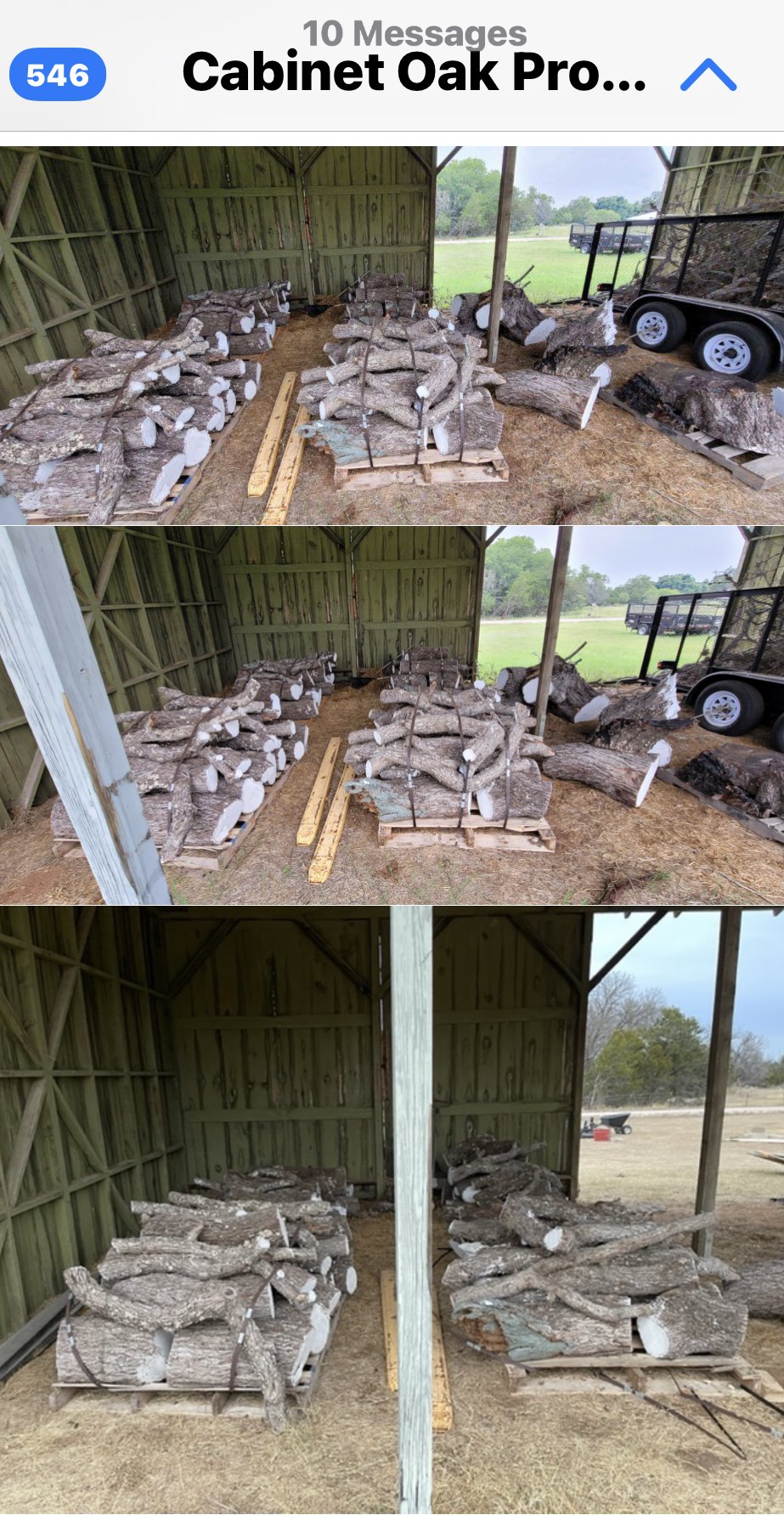
It is hard to pick the perfect stump to reflect the man, his unique policies, ability to get things done and the ecological history.
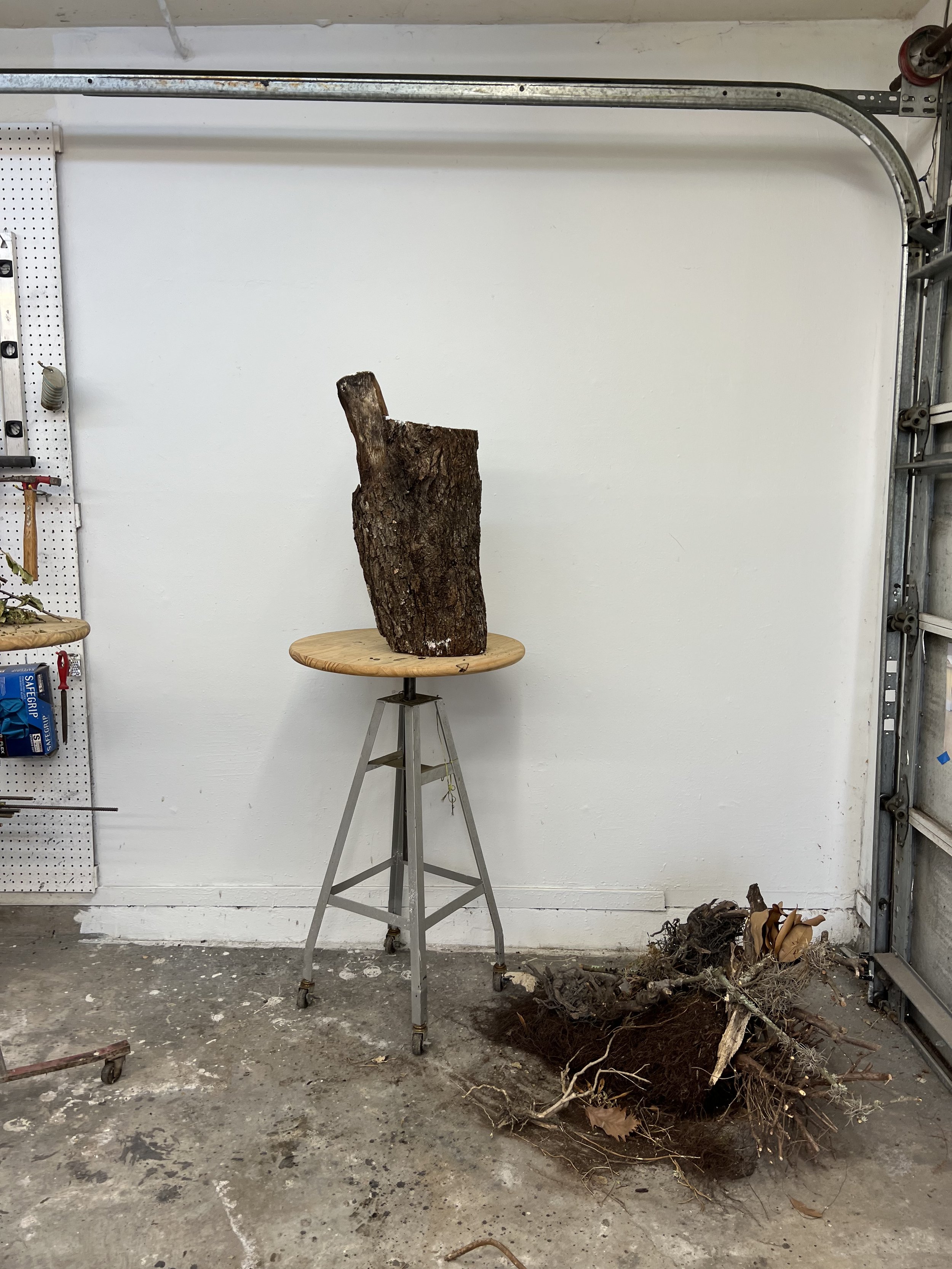
I picked a stump with a likely spot that LBJ might have rested his hat on under the shade of the big oak tree.
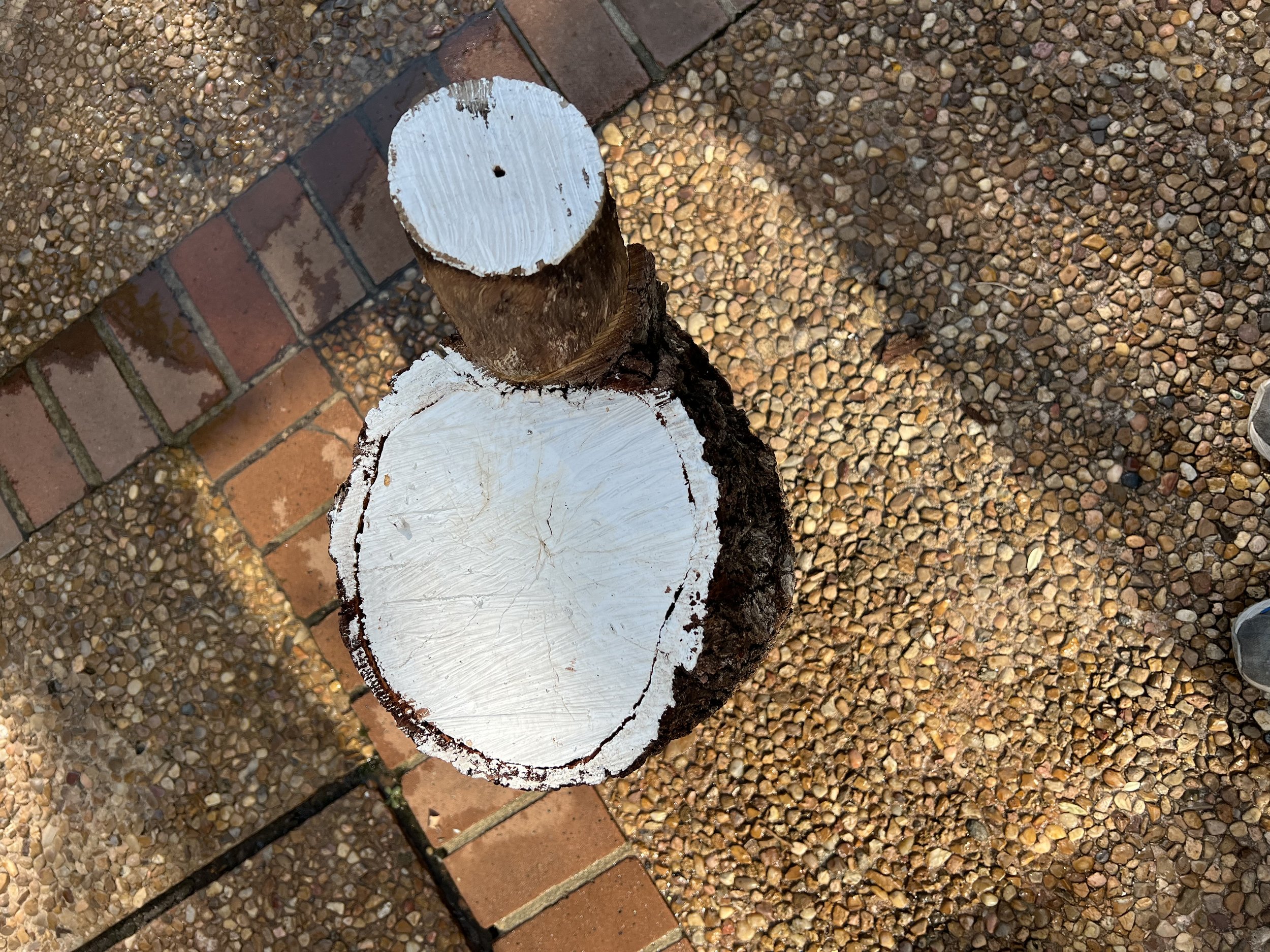
An employee of the LBJ Ranch Park painted the ends of all the stumps white to prevent insects from nesting in them.
They have not heard that we have entered the Anthropocene and insects are significantly declining and need rotting wood for habitat.
The park could consider implementing a program to provide a habitat for insects. It might be an excellent opportunity here.
.

White paint gone -

When cast in bronze, the new hat will reflect the wear and tear of running a ranch in Texas and the mental stress of running a country in the ’60s. The stump is not what I had hoped it would be. The piece needs more. Knowing many men smoke cigars when they go to their ranches and that President Johnson smoked an occasional cigar, I decided to add detail a precariously placed half smoked on a cigar. It will still need more and there is time to figure it out.
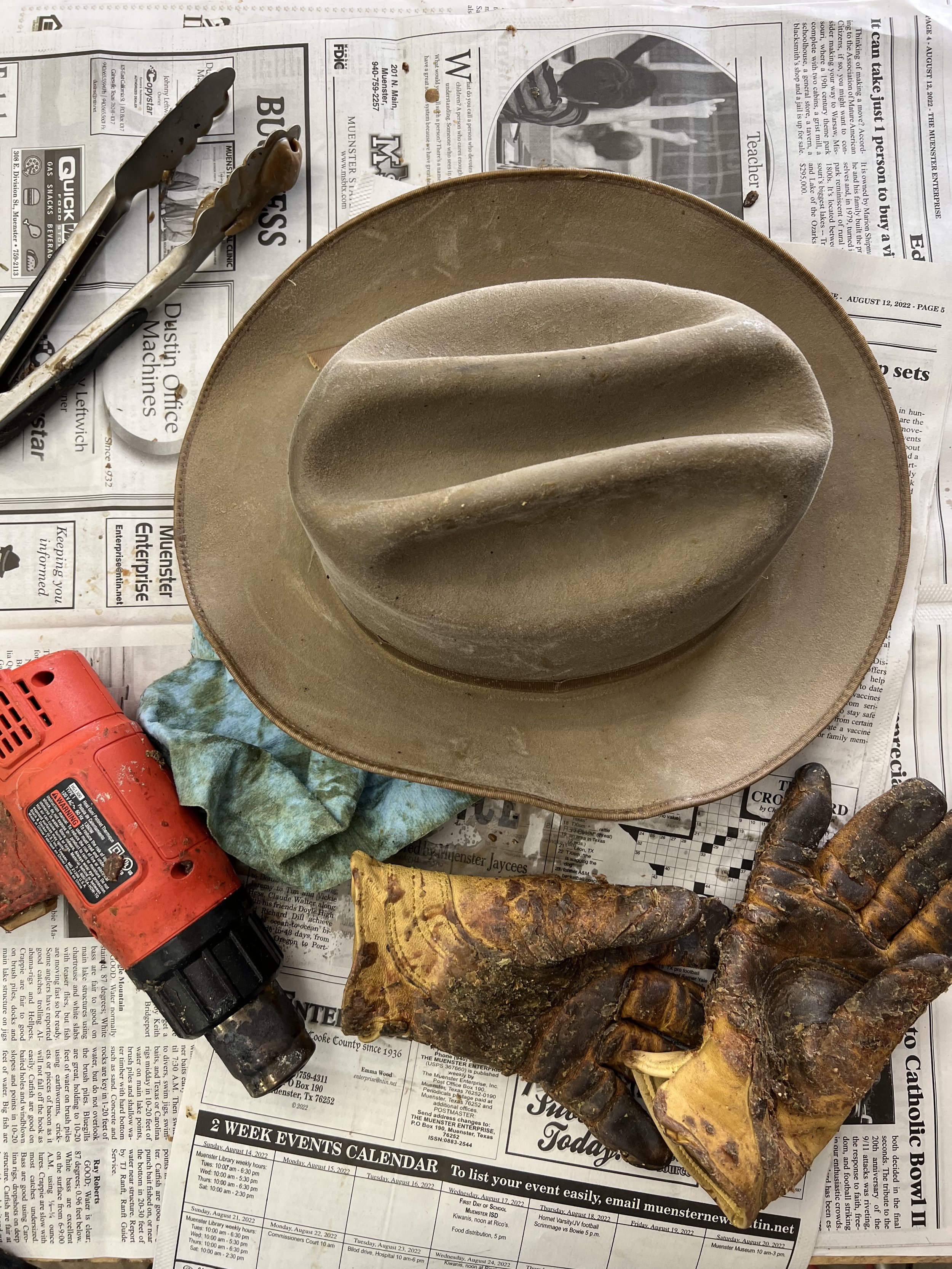
I apply wax to the entire surface so the hat will not absorb the slurry that will build the shell. I use a heat gun to milt of the wax to builds up too much and I shape it to show wear.

The bronze cast cigars and hat are ready for chasing. I cast a few cigars so I would have choices.
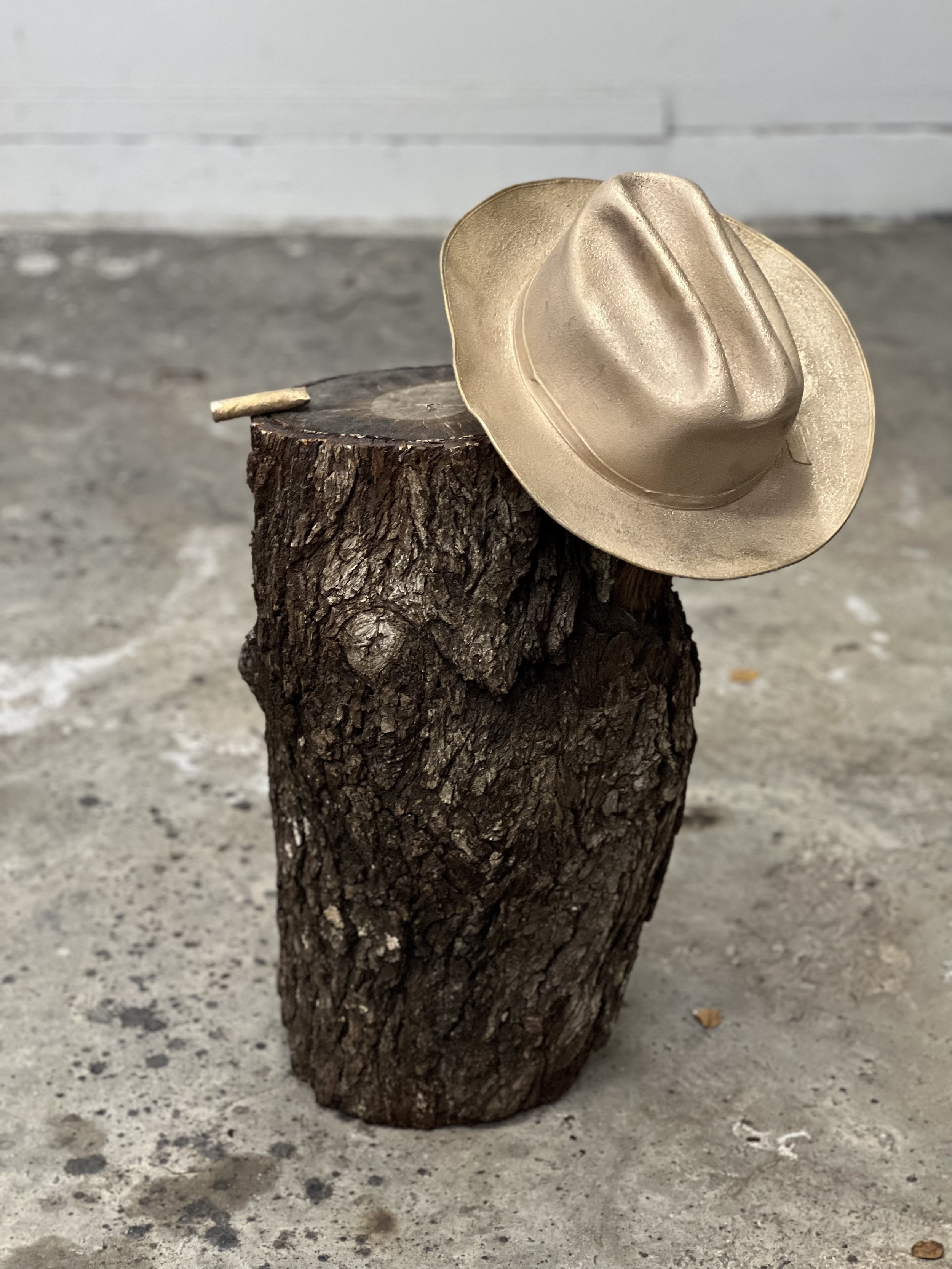
Metal chasing done. The bronze was so heavy it made the stump tip over. I cut the opposite side under the stump to balance the bronze. It is missing something……..

How can I bring this sculpture to life while capturing the essence of the man, the political climate, and his bond with nature, while still remaining authentic to my artistic style? He was one of our more accomplished Presidents, passing the first bills that address issues we are still struggling with today. I need more research into his policies. That is the detail I need to make the piece meaningful.
I envision Johnson holding meetings beneath the Old Oak, arriving early to ponder and whittle down his ideas into actionable plans, navigating through the complexities of government. I can almost see him, alone in the shade, puffs of smoke escaping his lips carving his best ideas into the heart of the Oak, contemplating every move.
The wood looks too fresh. In order to give it an aged look I watered down an almost empty can of house paint and washed it over the delicate bark.
Next up the patina.

It took fierce passion to pass bills to combat poverty, rejuvenate the environment, and embrace diversity - all while rekindling civil rights and nurturing the arts. The more I work on this piece, the more I love it.


I love research based art. It was a good fit right?
Rumblings - Agapostemon virescens
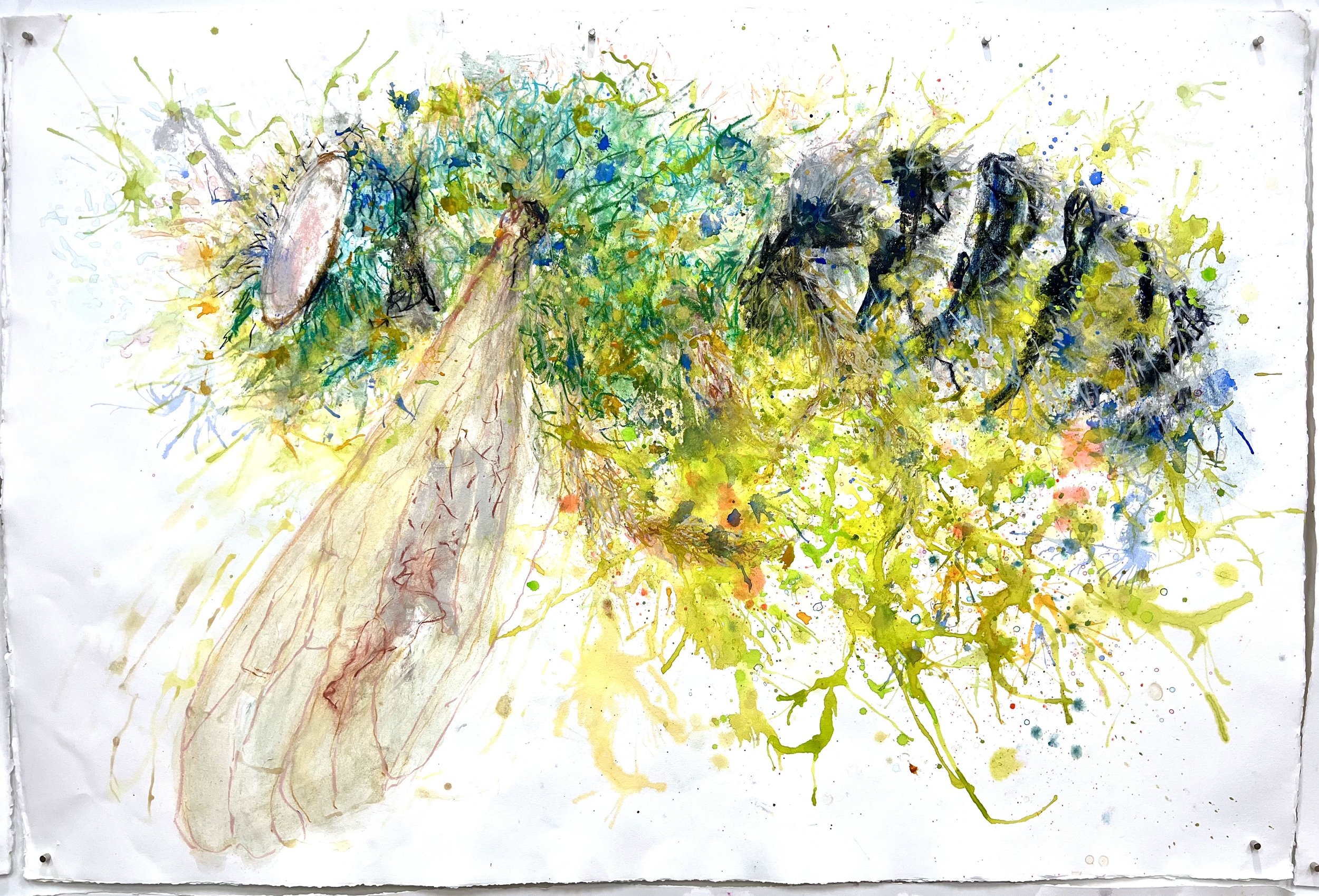
Agapostemon virescens lead a very unique lifestyle - living in underground communal nests, with up to 30 individual females sharing the same space. These tricolored metallic bees have an intricate defense system which consists of assigning roles; while some female bees explore and gather food, at least one always stays behind as gatekeeper! Interestingly enough, this species cleverly protects their nest from predators by making sure that they always has someone on guard duty.
During late-July to early-August, a second generation of A. virescens emerges that is both male and female. With no place in their natal nests for the males to go, they seek shelter elsewhere - hosting bee slumber parties where huddles are formed! The females take advantage of this time by sipping on flowers like New England aster, goldenrods and sneezeweed so as to survive winter without having any need build nests or lay eggs during fall season. Sadly though when temperatures drop these mated females enter hibernation while males die selflessly protecting them until spring arrives again next year.
Symbiosis - Hairy water clover incorporates time and movement
Since the beginning of my artistic journey, I have consistently explored elements of time and movement within both two-dimensional and three-dimensional works. With "Hairy Clover," an element in Symbiosis this exploration takes on another layer of complexity - exploring how the water cycle creates motion that stores carbon, ultimately building the planet's energy.
Marsilea species are an extraordinary group of ferns, displaying a fascinating phenomenon known as nyctinasty - the daily movement of leaf orientation. During daylight hours they reach out to capture sunrays and then at night fold inwards into vertical positions due to pulvinus joints located towards the base of each stalk which adjust based on water flow into motor cells. This adaptation ensures that these plants remain attuned with their environment by regulating transpiration through stomata opening and closing cycles - remarkable!
I have read that this Texas native is endangered in many states. :(

Marsilea vestita, southern water fern
8” X 8”
Ink
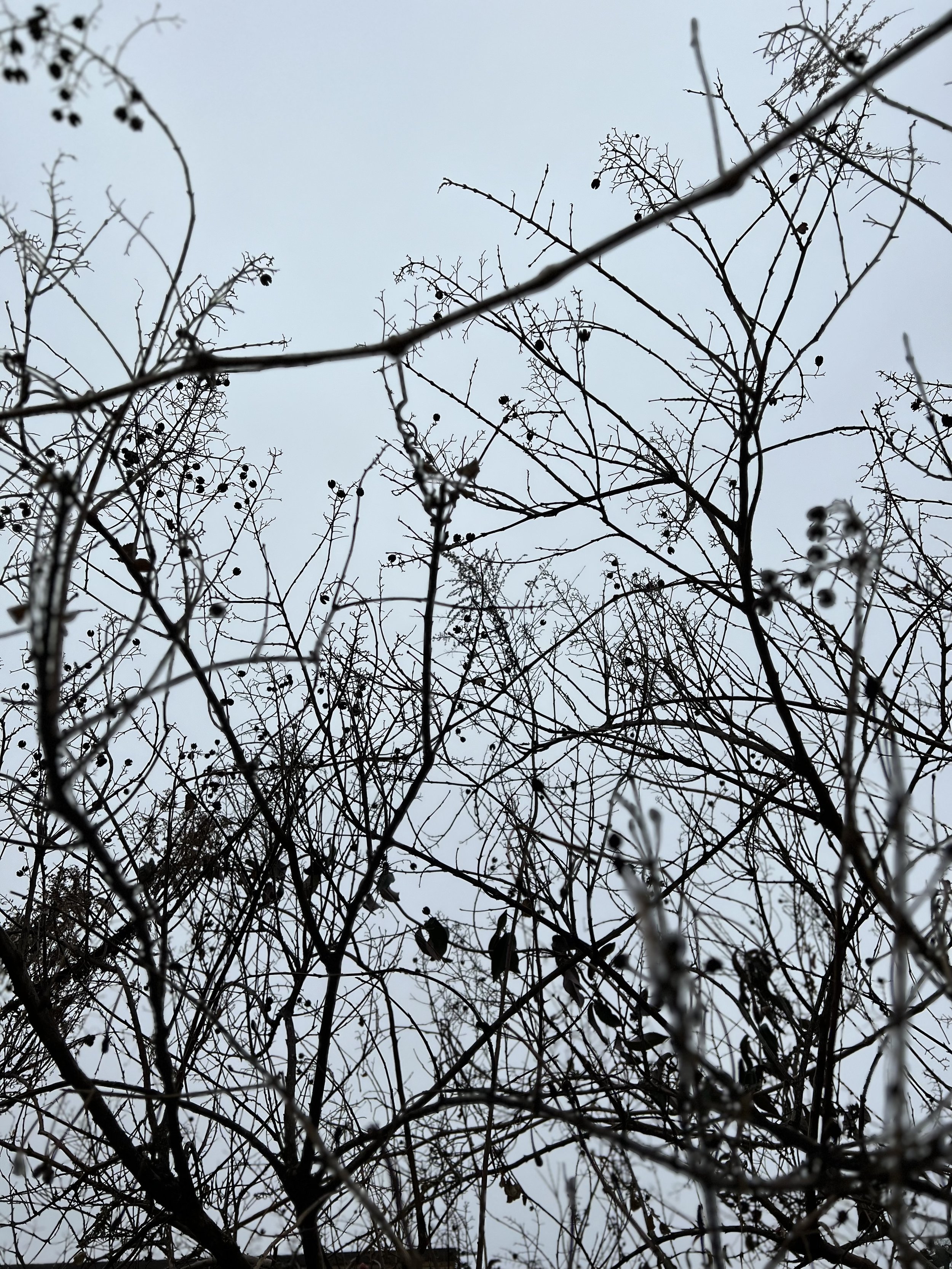
Symbiosis- Goldenrod Winter’s String Section
Goldenrod is more than just a weed- it’s the ethereal string section in natures visual symphony capturing the eye with its undulating dance.
From late summer to early fall, these radiant yellow spikes flourishe in roadside ditches and fields. As winter moves in their color fades to dark shadows against winters gray sky.
The sturdy stalks provide shelter from icy winds so precious birds can rest through cold days ahead as Goldenrods' undulation brings joy throughout all seasons instead!
I'm still struck by goldenrod's graceful dance on even the slightest breeze. It truly is a remarkable sight that gives me much joy throughout all seasons.
Call of The Crane
“When we hear his call we hear no mere bird. We hear the trumpet in the orchestra of evolution. He is the symbol of our untamable past, of that incredible sweep of millennia which underlies and conditions the daily affairs of birds and men.”
– Aldo Leopold on the call of the sandhill crane
During my Christmas day stroll with family and Tobi, I came across a crumbling old stump harboring an exquisite feathered creature. The majestic bird looked to be either a Whooping Crane or Sandhill crane - the two largest birds of North America.
While North America has many struggling ecosystems, it's so important that we remember the stories of hope and recovery too. The Sandhill crane is one such story - once endangered, their numbers have rebounded thanks to determined humans working to save them. Getting to know these creatures better can only inspire more hope for future environmental recoveries. I'm looking forward to learning more about the whooping cranes on my trip south this February with Curtis. If you know any other inspiring stories of environmental recovery please share them with me?
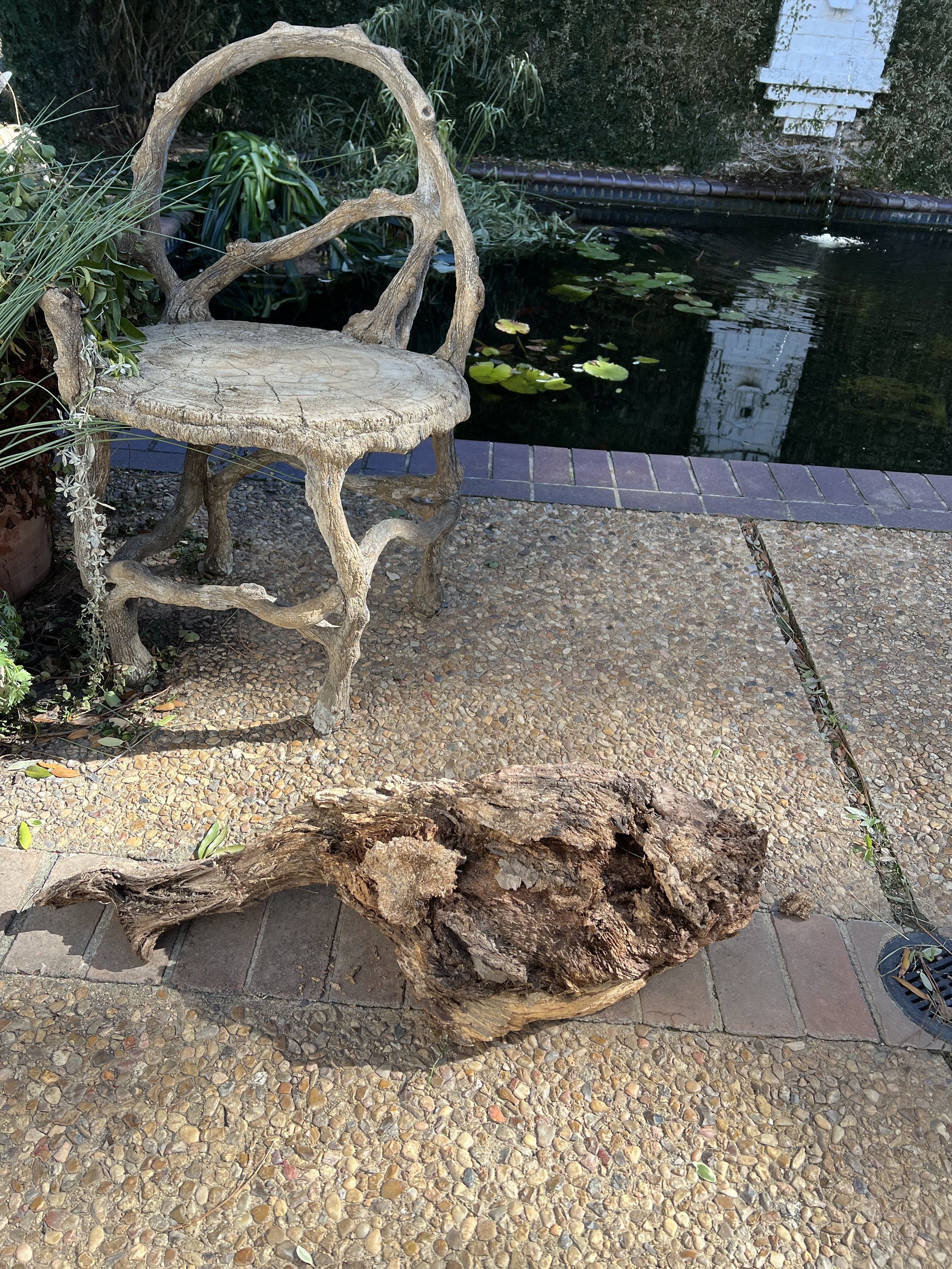
As found on Christmas day with it's natural patina.
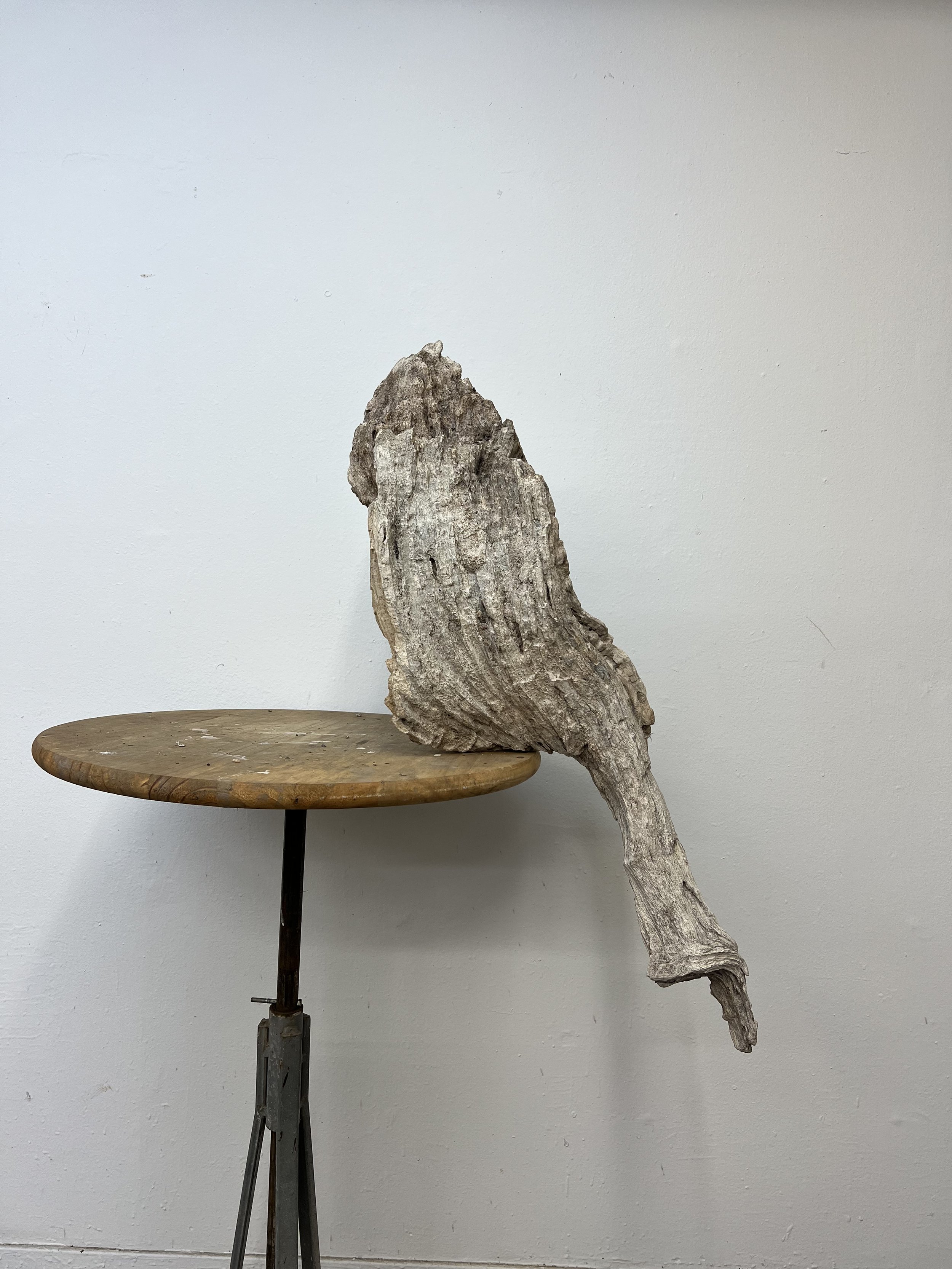
In my garage studio after giving the bark a little wash to highlight the movement in the wood.

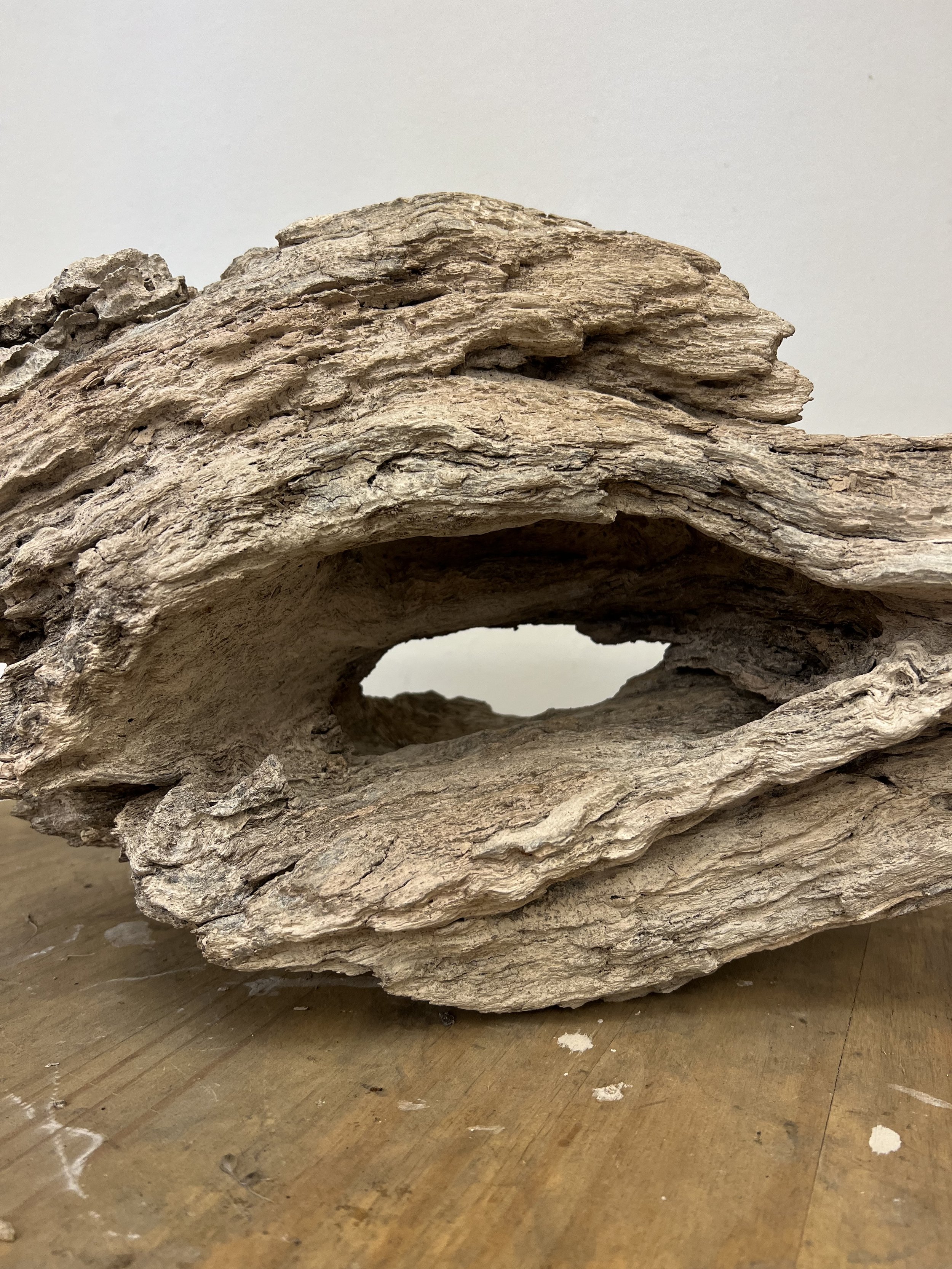
Detail
We need these stories of recovery our society needs to believe we can do this.
Camouflage, fire ants and anole
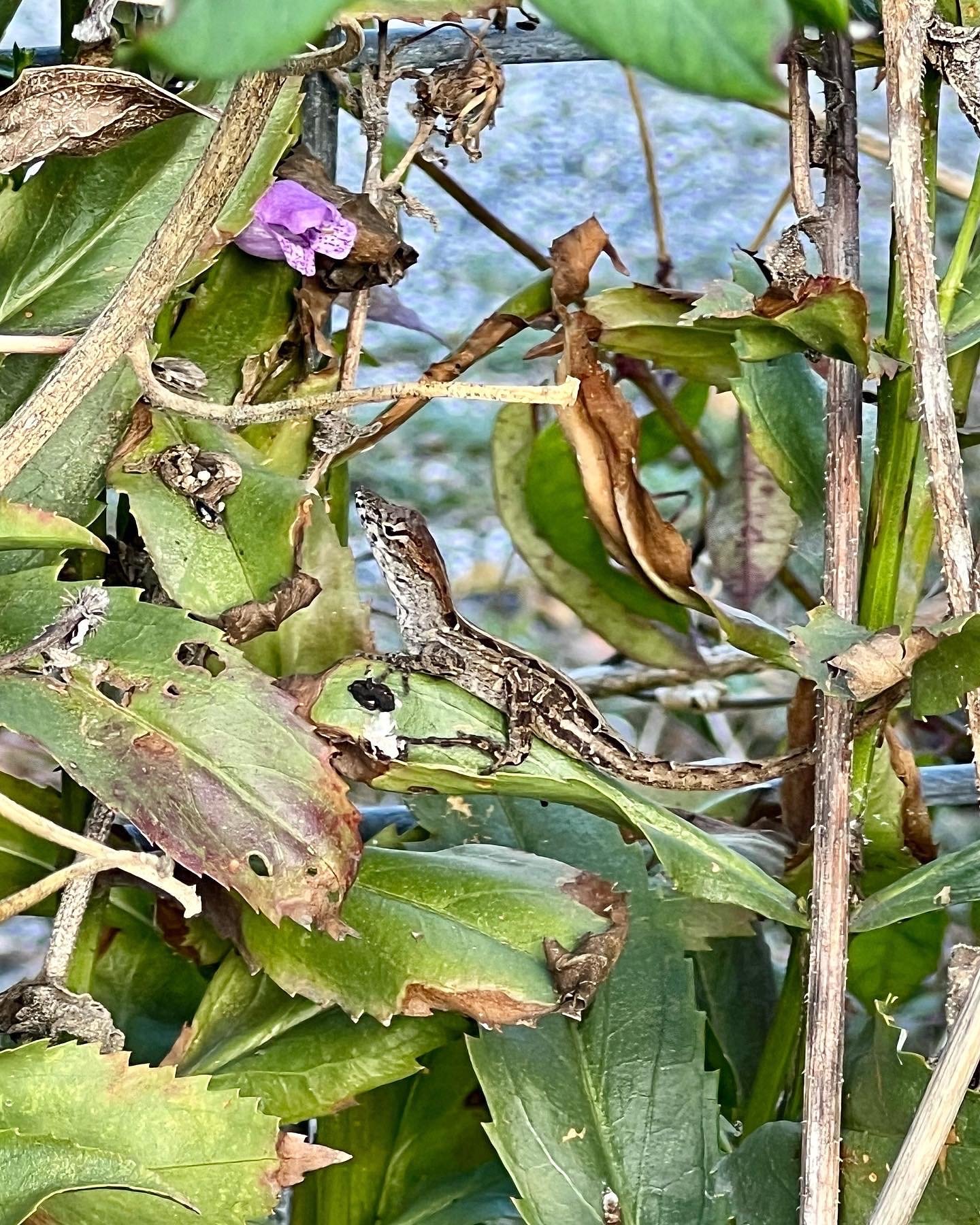
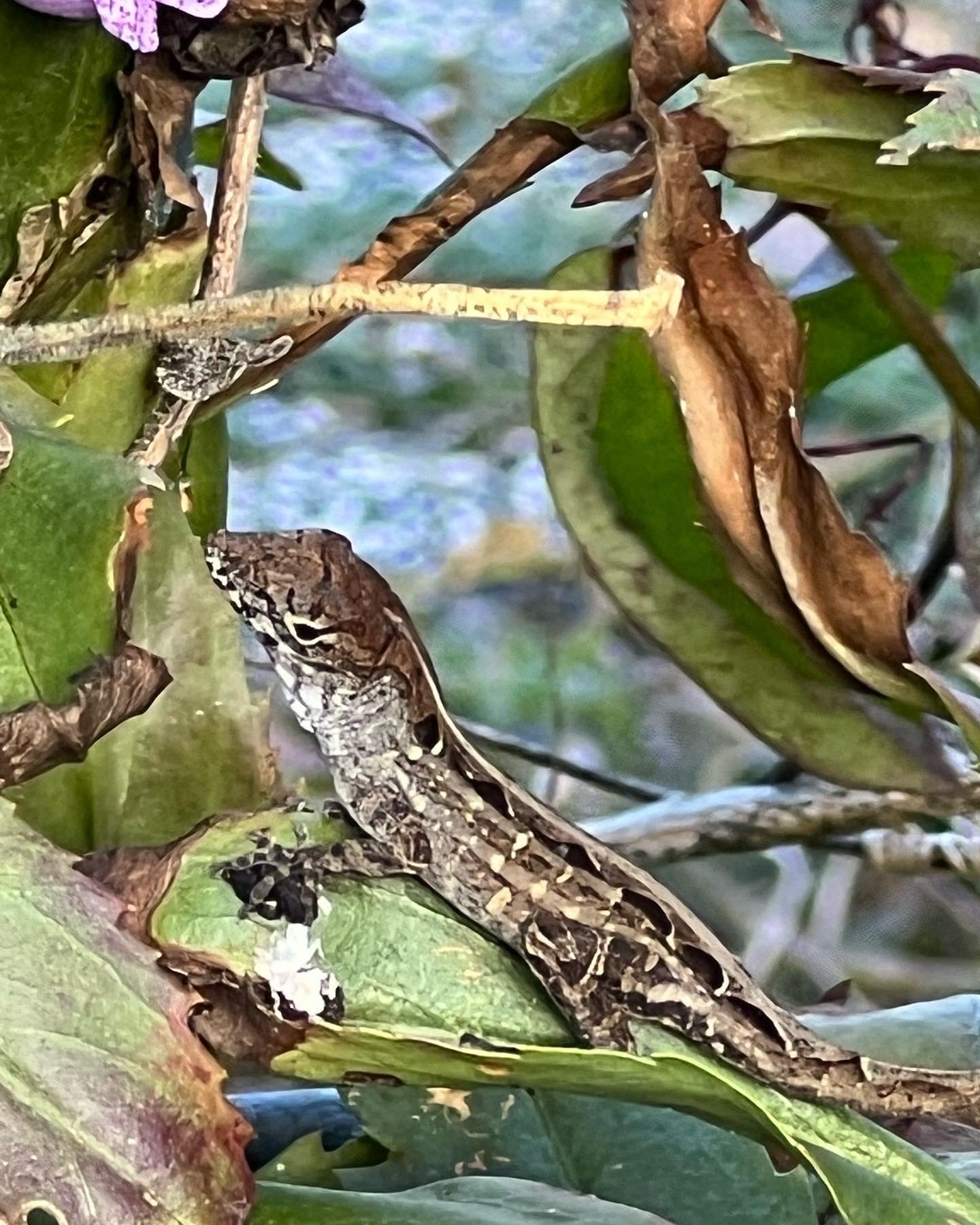
When maintaining “Symbiosis” and when I observe urban landscapes, I see the beauty in decaying plants and the tiny creatures they protect. This brown anole is a garden beneficial, keeping fire ants and other insects in check. Without camouflage, they are prey for birds, snakes, and some spiders. As an artist I find beauty through systems thinking and a balanced ecosystem.
Can you find him/her mimicking a dried, twisted leaf?

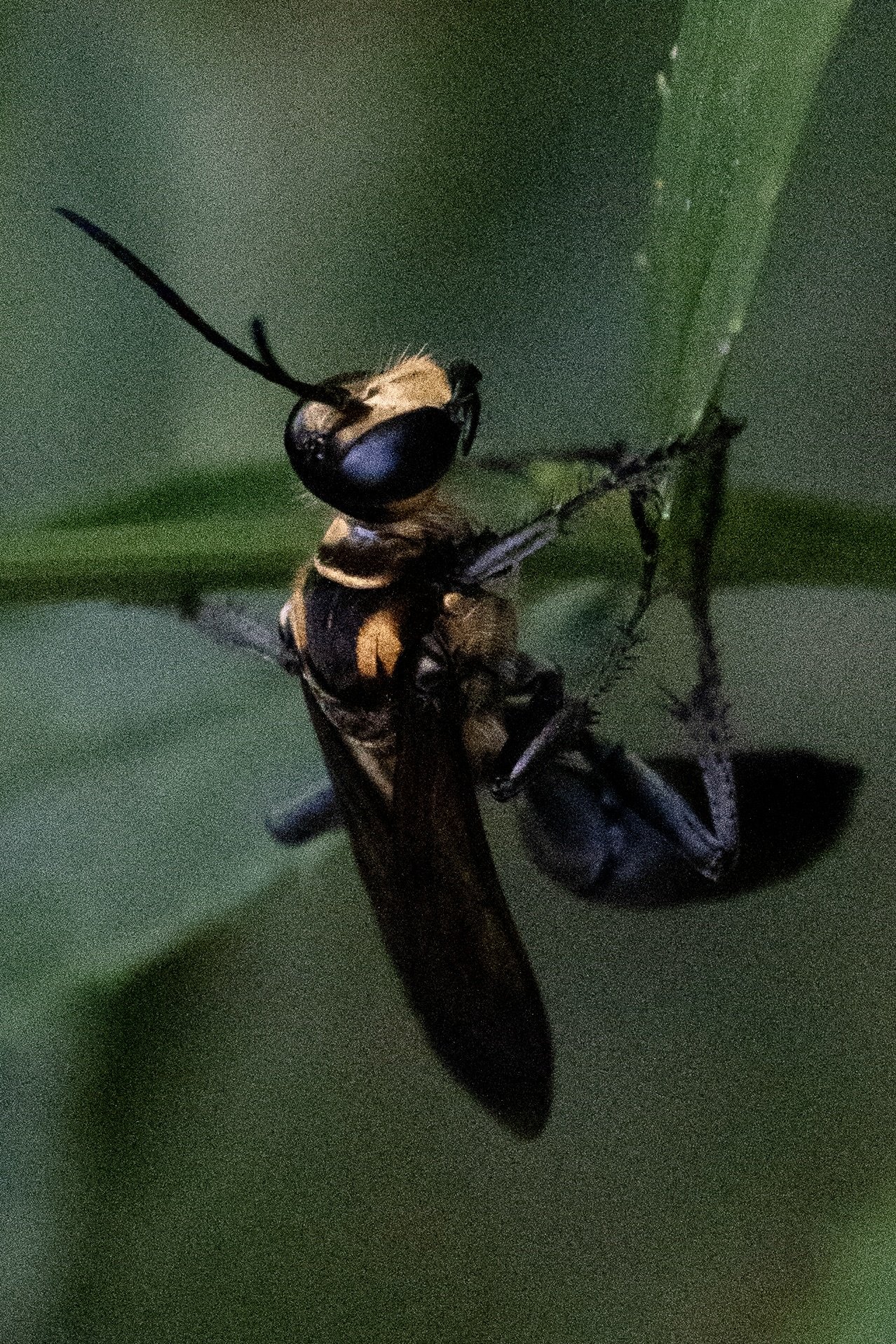
Golden-reined Digger Wasp - fascinating and gentle despite its sinister appearance.
Planet Popsicles — and spam
I received a spam email this summer with a bold photo of a popsicle asking, “How do you cool off in the heat of the summer?” I immediately thought about how the planet cools off. That spam email inspired these ephemeral sculptures, I used the materials mother nature uses to cool the planet.
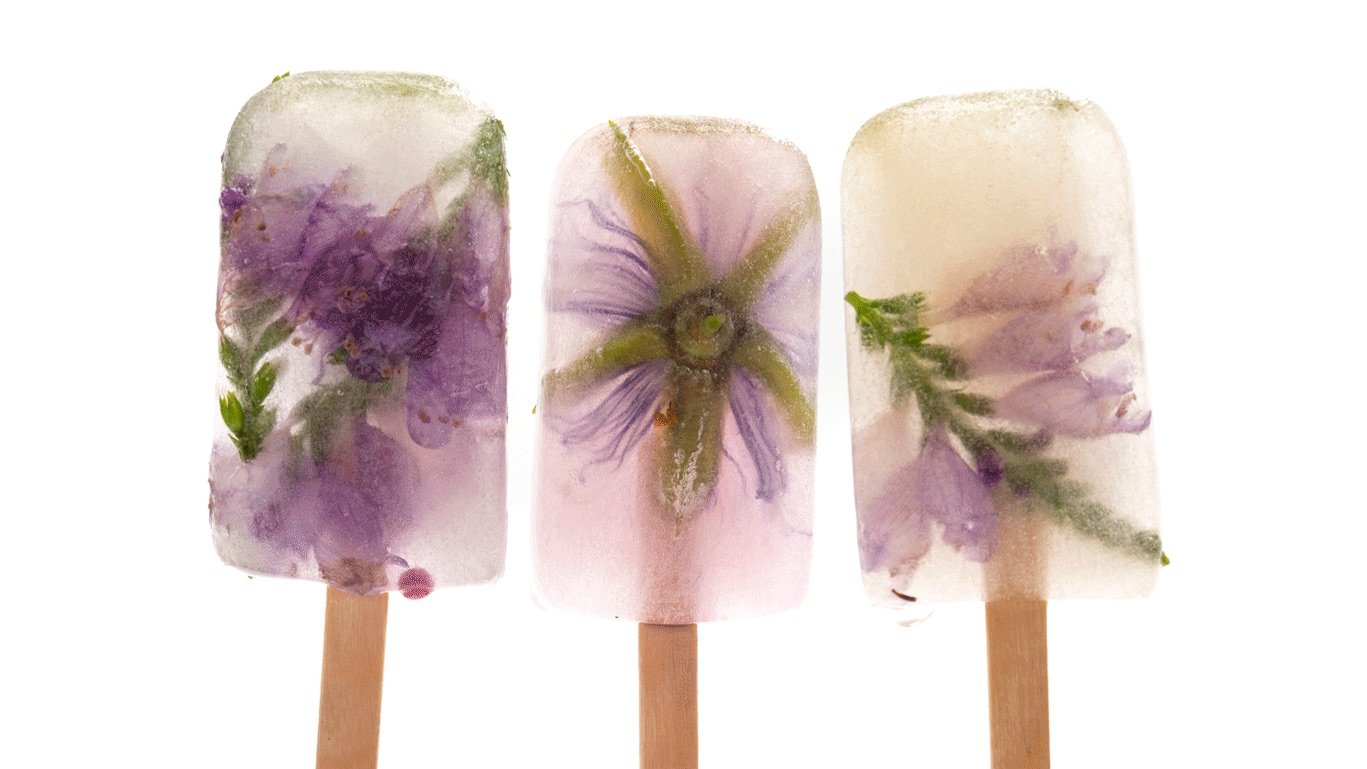
PLANET POPSICLES
6” X 1” X 12” ephemeral
Sticks, H20, Passionflower, Fall obedient plant, and American Beautyberry
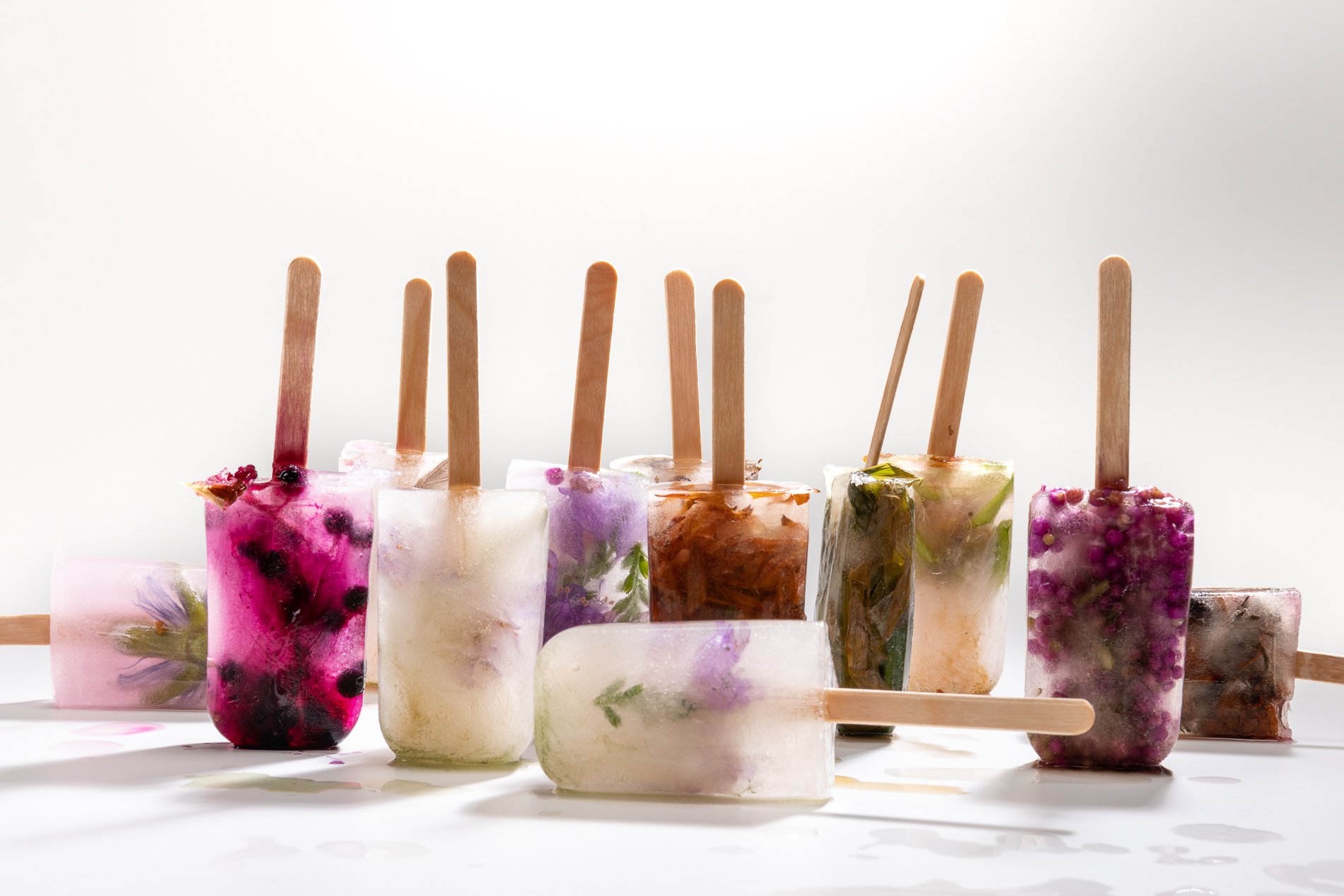
PLANET POPSICLES
6” X 6” X 24” ephemeral
Sticks, H20, Passionflower, Fall obedient plant, and American Beautyberry, Beatles, Pokeweed, Scarbs, Golden Rod, passed butterflies, and passed moths
Symbiosis Relationships 10/2022

New World Giant Swallowtail and Milkweed and the health of Monarchs. This tropical mikweed HAS to be cut down November 1. The Milkweeds are the host plants for Monarchs. They need to move south by November and won’t head south if Tropical Milkweed is available as a host.

Monarch and Climbing Hempvine. Climbing Hempvine is an aromatic delight. It reminds me if warmed sweet honey. The Monarchs agree.

Purple Coneflower and the Gulf Fritillary Butterfly.
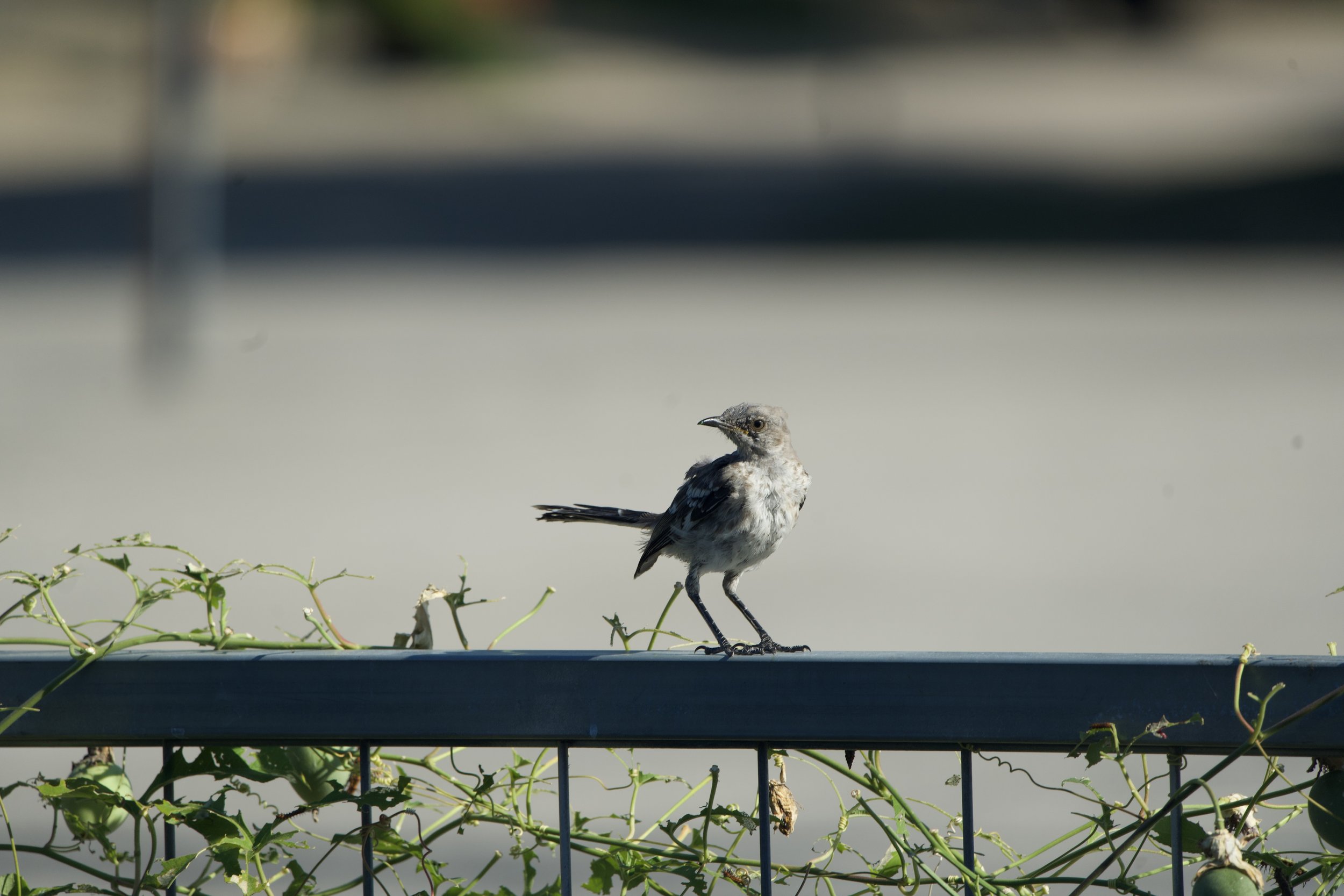
Mockingbirds and the fence. I have learned that birds need habitats with multiple elevations. The fence is a popular place for birds to look for insects and tiny toads to eat while keeping an eye on predators.

Monarch and Climbing Hempvine.

Ask upper of the Hesperiini family
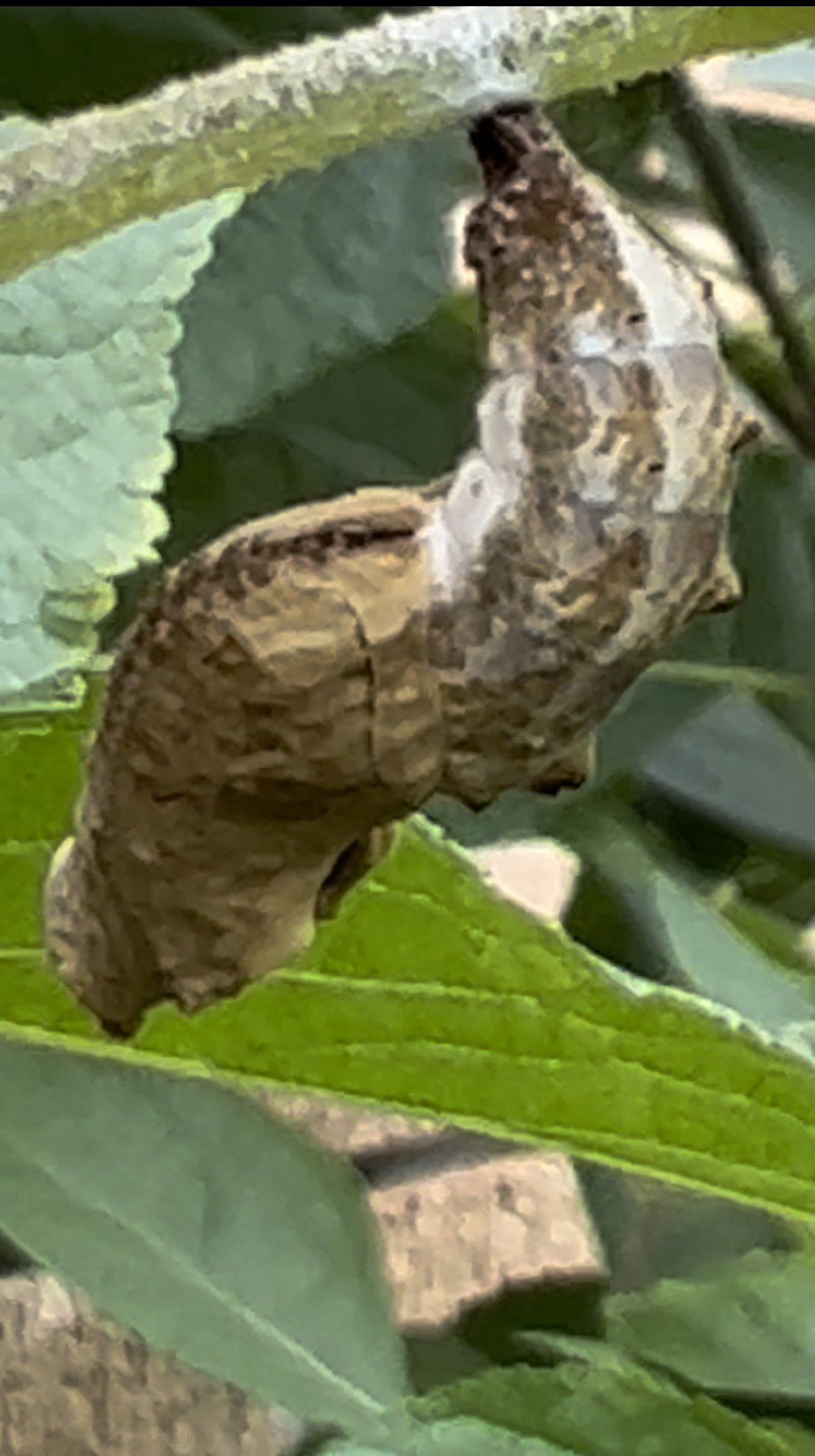
Gulf fritillaryon American beauty berry.

GulfFritillary on Marsh fkeabane pictured below.
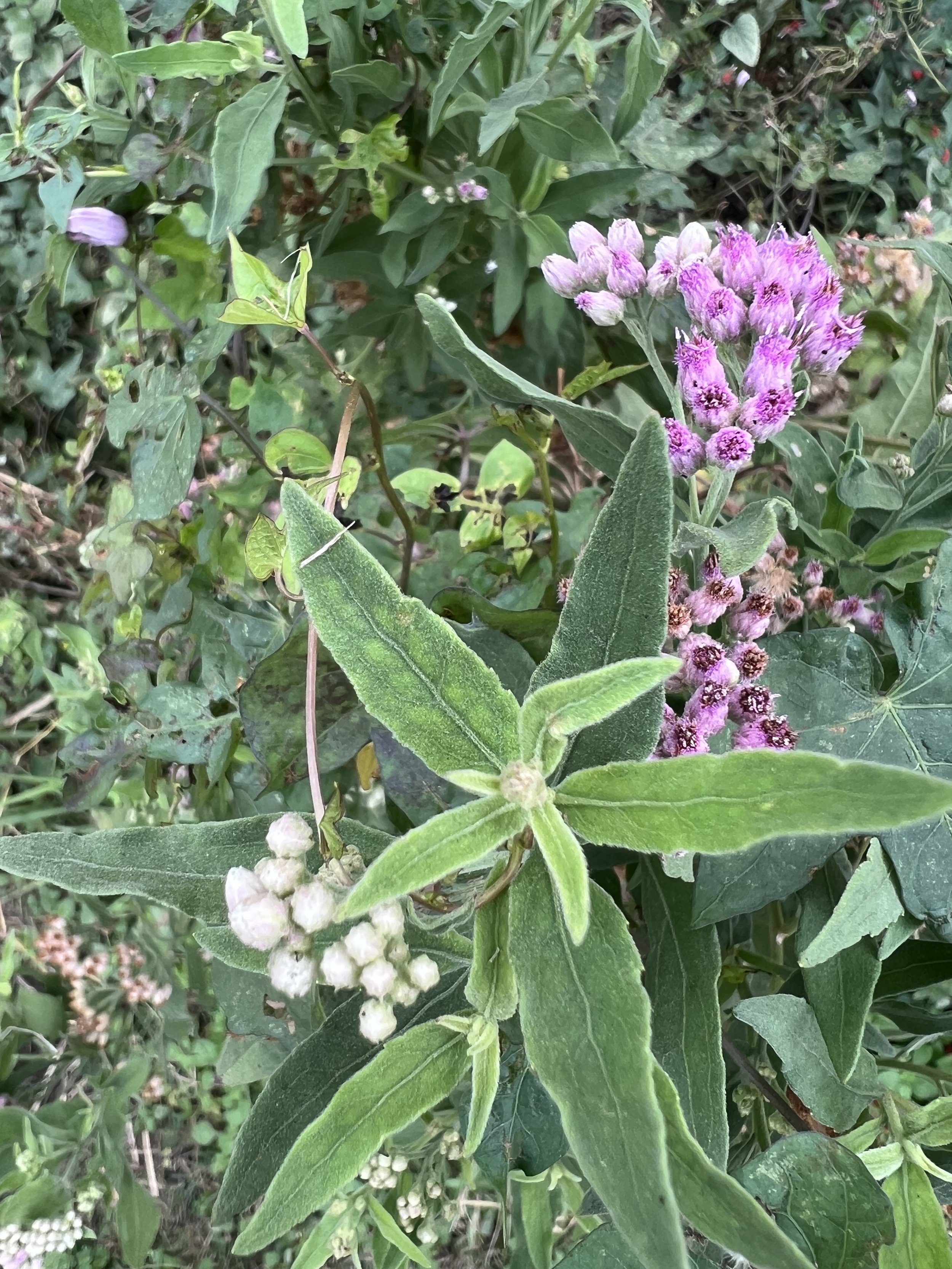
Marsh fleabane
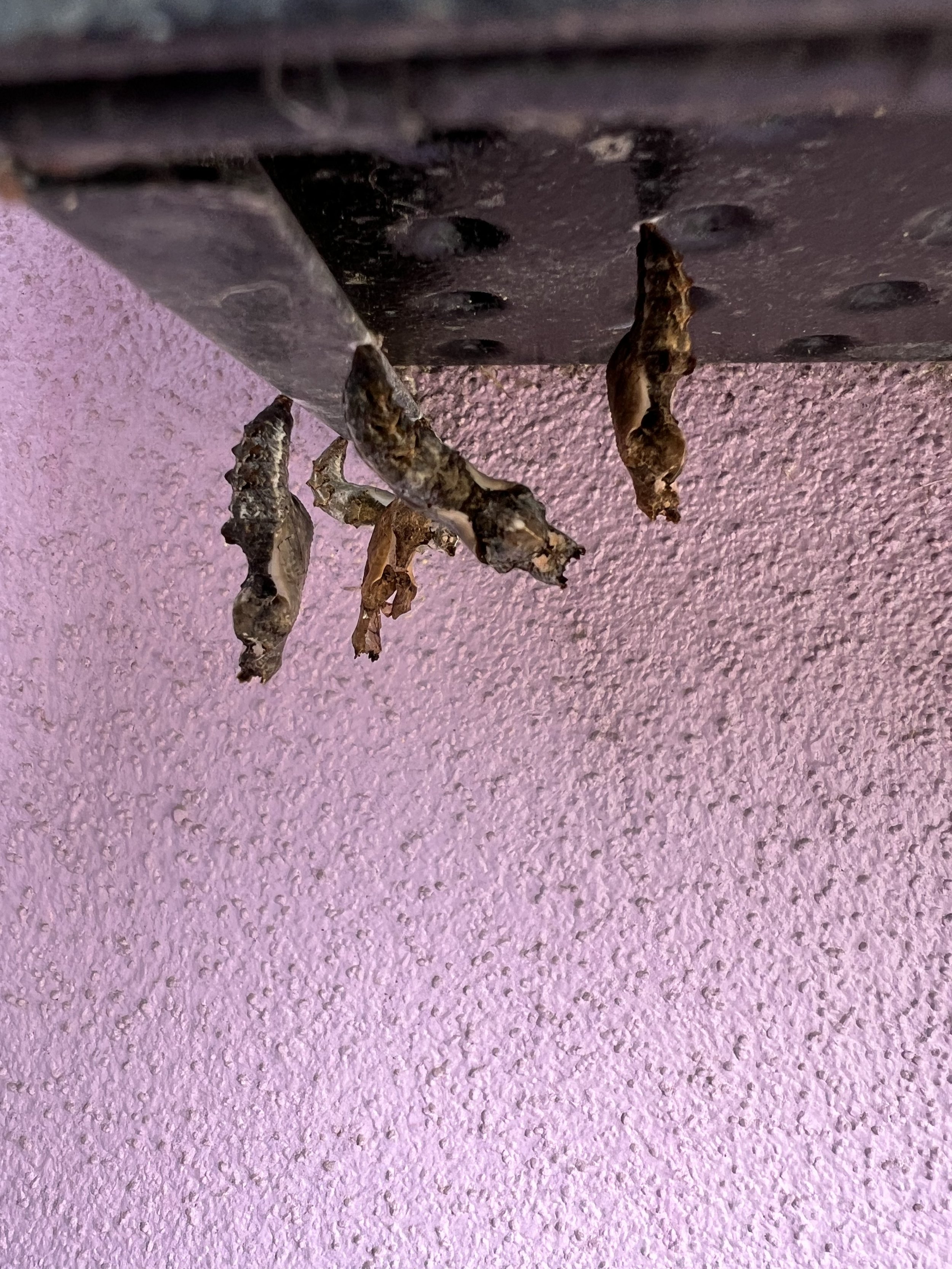
Gulf fritillary and Lawndale’s mailbox. Over a few weeks the count in the doorway climbed to over 200.

In identified mushrooms.
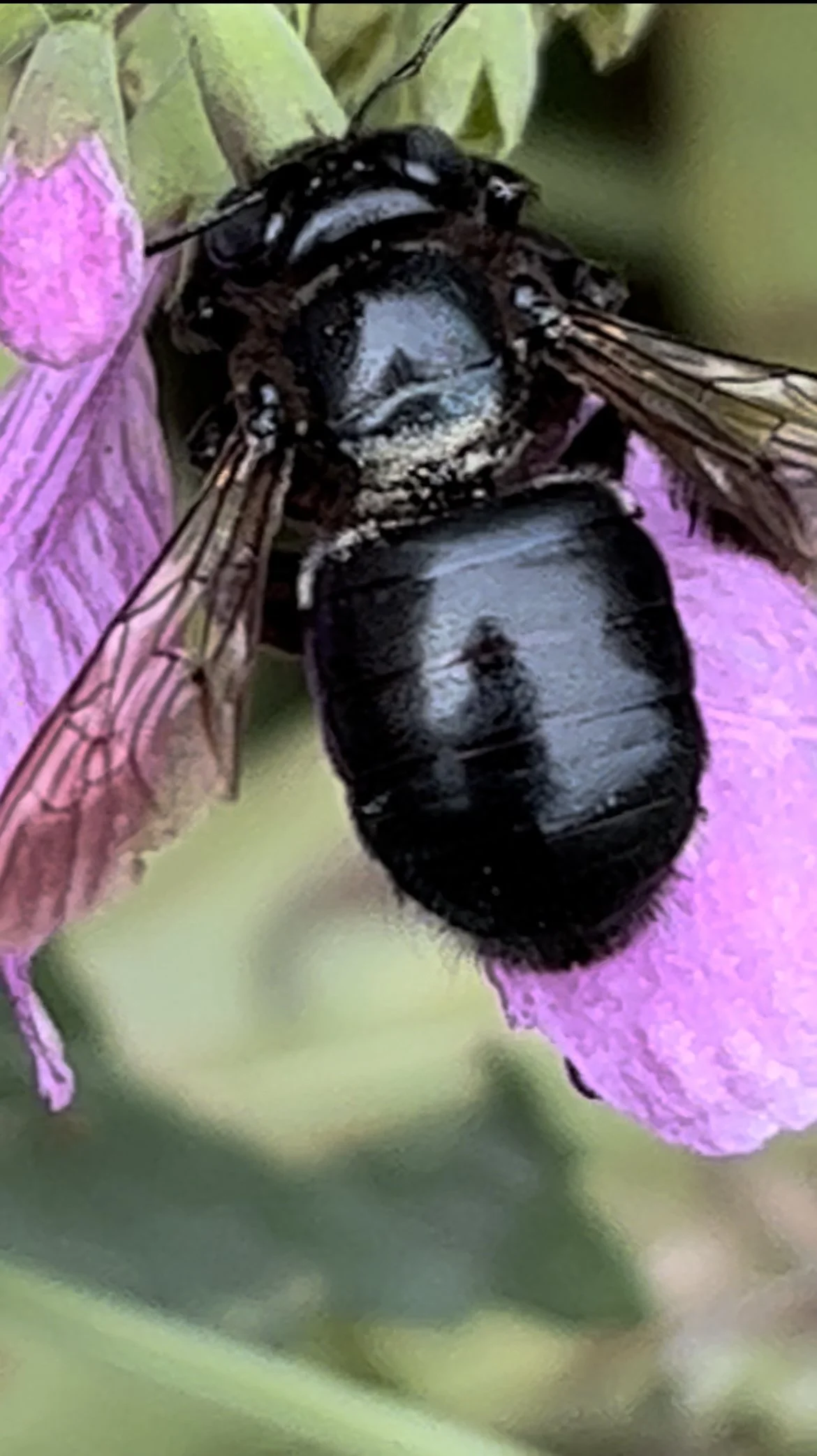
Carpenter bee

Gukf Fritillary are eating everything

How nature arranges itself
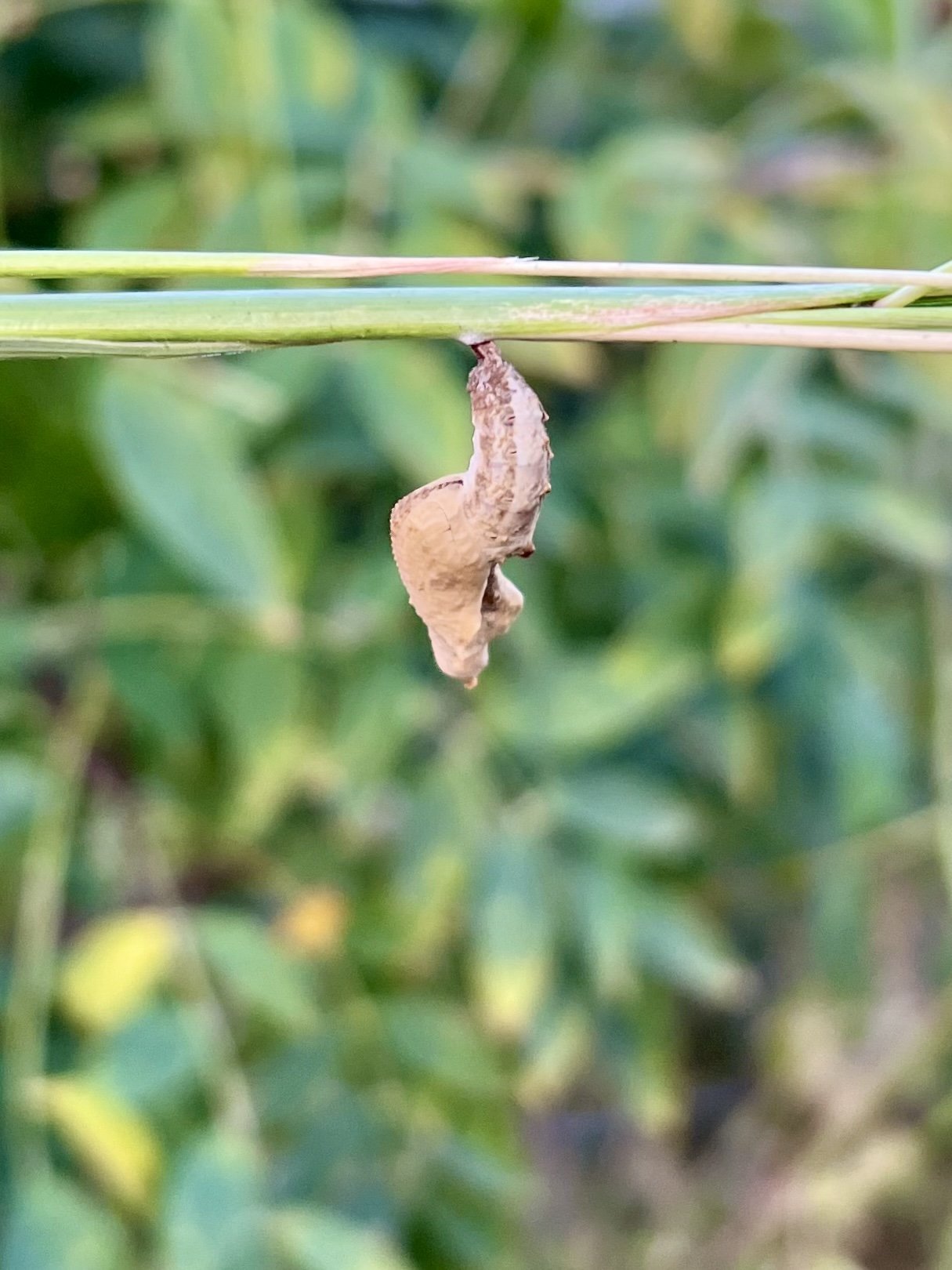
Chrysalis on crabgrass stem

Morning glory, mile a minute vine.

Carpenter bee and Obedient flower

The White viened pipevinesis is the host plant for the Pipelvine swallowtails. I wish I had more. The caterpillars devoures it, and then it comes back.

Cloudless Sulphur and Turkscap

Hemiargus ceraunus, it blue ceraunus,an d pasted native plants.

Monarch and Blue mist flower

Northern Mocking bird perched on the fence.

Northern Mockingbird and trough pond
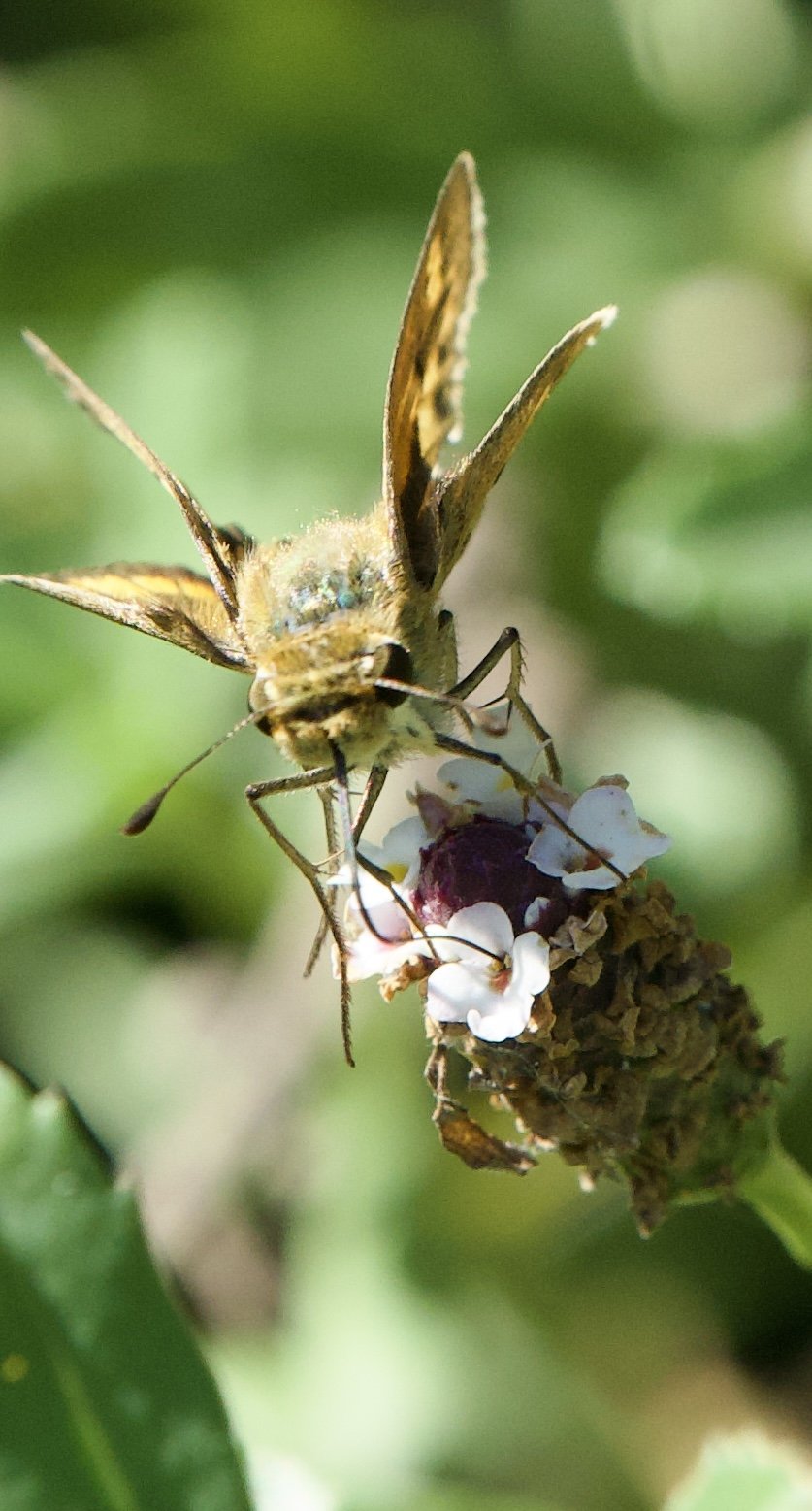
Hesperiina And Frogfruit

Pushfly and Passiflora leaf

True Sparrow stays in messy bush like spaces for safety and for a source of caterpillars

American snout butterfly
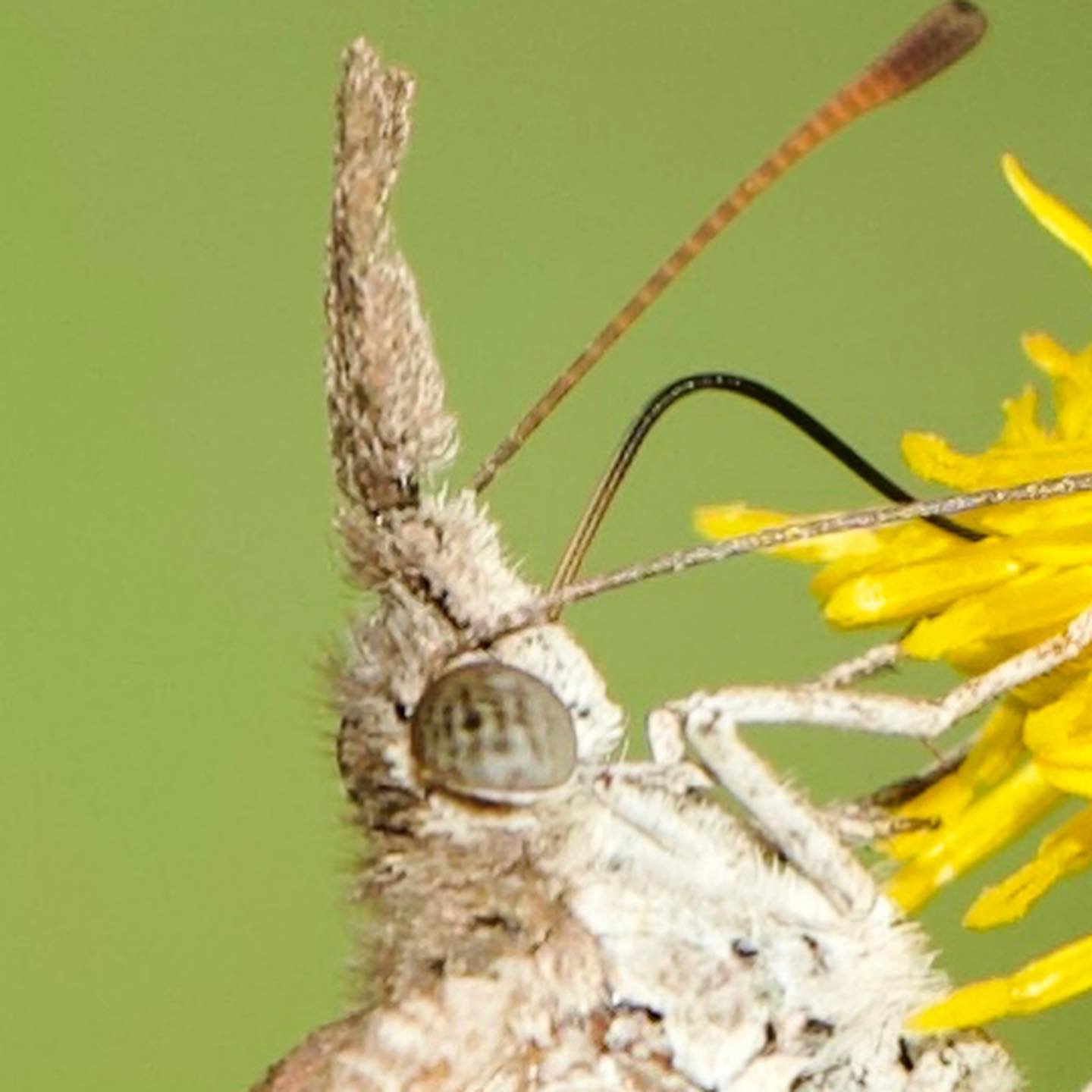

Gulf Fritillary with OE
“Ophryocystis elektroscirrha (OE) is a debilitating protozoan parasite that infects monarchs. Infected adult monarchs harbor thousands or millions of microscopic OE spores on the outside of their bodies. When dormant spores are scattered onto eggs or milkweed leaves by infected adults, monarch larvae consume the spores, and these parasites then replicate inside the larvae and pupae. Monarchs with severe OE infections can fail to emerge successfully from their pupal stage, either because they become stuck or they are too weak
to fully expand their wings. Monarchs with mild OE infections can appear normal but live shorter lives and cannot fly was well as healthy monarchs.
Although recent research shows that tropical milkweed can lower OE replication within infected monarchs (due to high levels of cardenolide toxins), this might not benefit the monarch population. In
fact, this could actually promote disease spread by allowing moderately infected
I PROJECT MONARCH
HEALTH
monarchs that otherwise would have died quickly following eclosion to live longer and spread more parasite spores.“- monarch parasites.
Symbiosis — Gerhert Prairie Rescue plants
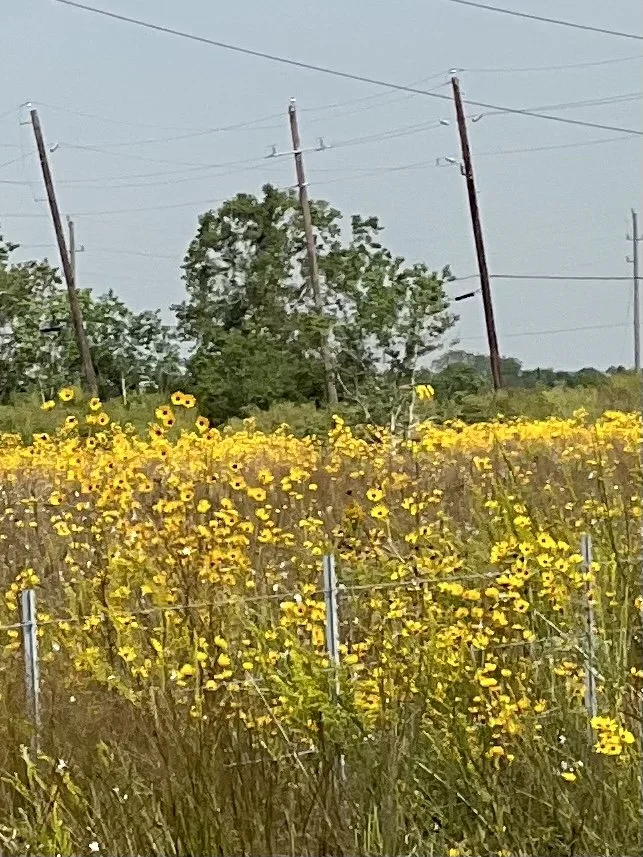
Gerhart Prairie in a drought
On October 7th, I was invited to participate in rescuing prairie plants from the Gerhart Prairie south of Houston. The Prairie, I believe, is part of the Texas Nature Conservancy. A manufacturer has a fenced-off area on the property. They will put in a road through the prairie to service the fenced-in operations. We were rescuing the plants in the designated place on the future road. Several Master Naturalists identified plants, as did Mark Morganstern of Morningstar Nursery. Mark kindly reaches out to me when free and needy plants are available.
That Saturday, I received an amazing list of the plants I rescued.
1.) Helianthus angustifolia (aka Swamp Sunflower)
this is the tall 'sunflower' plant with the very narrow leaves that have the edges rolled under.
(I think I may have inadvertently referred to this as Maximillian Sunflower, which is not what this is)
2.) Baptisia sphaerocarpa (aka Yellow Wild Indigo or Yellow False Indigo)
this plant is a small subshrub in the Fabaceae (Pea Family); it has trifoliate leaves without subending bractlets and it has bright yellow flowers borne on erect inflorescences. Its fruits are round, hence the Latin name sphaerocarpa which literally means 'round fruit'. It will bloom in the spring.
3.) Euthamia leptocephala (aka Bushy Goldentop)
This plant is in the Asteraceae (Sunflower Family) and is closely related to the goldenrods (Solidago spp.). Euthamias have round-topped inflorescences rather that the 'open-spray'-shaped inflorescences of the goldenrods. There are two species of Euthamia in our area -- the other is Euthamnia gymnospermoides (aka Texas Goldentop) -- it have longer and much narrower leaves than does E. leptocephala.
4.) Croton lindheimeri (aka Woolly Croton or Lindheimer's Hogwort)
This plant is a member of the Euphorbiaceae (Spurge Family). It has very small unisexual flowers surrounding by a yellowish tomentose hairs; the female flowers are borne near the base of the inflorescence while the male flowers are bunched near the apex of the inflorescence. This seeds of this species are an important food source for quail and dove and the plant is a larval host for several species of butterfly.
5.) Neptunia pubescens (aka Tropical Puff)
A member of the Fabaceae (Pea Family) in the Mimosoid clade (or subfamily) which means it does not have typical pea-shaped flowers. The flowers are bunched onto a round receptacle or head, each with a small inconspicuous corolla, but the numerous long stamens are quite showy. Neptunia pubescens sprawls along the ground. It is larval host plant for the ceranus blue (Hemiargus ceranus) butterfly and its seeds are consumed by many wildlife species.
6.) Lythrum alatum var. lanceolatum (aka Winged Loosestrife)
This member of the Lythraceae (Loosestrife Family) grows to be about 3-4 ft tall and produces long racemose infloresceces with smallish lavendar (pink,purple) flowers. It is a special value to native bees and is also used by hummingbirds and butterflies.
7.) Eupatorium serotinum (aka Late-flowering Boneset)
A member of the Asteraceae (Sunflower Family) which has rayless sporting only white disc florets. It is a perennial that emerges early in the year, but does not bloom until August - November. While it's flowers are small there are many of them, so that the plant is a real show-stopper in the fall. It is of special value to native bees and its nectar attracts butterflies and many other insect species and it seeds are eaten by many bird species. The plants you dug up were fairly small (maybe due to the drought this year; the species usually grows 4-5+ feet tall.
8.) Agalinis heterophylla (aka Prairie Agalinis, Prairie Geradia, False Foxglove)
This is a member of the Boraginaceae (Borage or Broomrape Family). There are several species found locally, but the most common is Agalinis heterophylla, easily distinguished by its deeply lobed calyx. It is a larval host for the Buckeye butterfly and attracts numerous insect species, including bees and bumblebees.
9.) Ludwigia octovalvis (aka Mexican Primrose Willow)
A member of the Onograceae (Evening Primrose Family), this plant likes its feet wet, so a low spot that collects water is a great place to plant it. It is fast growing and reseeds readily. It is a nectar source for butterflies and other insects and is a larval host for the water primrose hornworm moth (now there's a mouthful!).
10.) Conoclinium coelestinum (aka Blue Mist Flower)
Another member of the Asteraceae whose flowerhead do not have ray florets, but the long stigmas of the disc florets make for a showy flowerhead nonetheless. This species is NOT an annual (as I misinformed you yesterday, sometimes things stick erroneously in your mind), but rather a perennial that dies back to the ground each year and also spreads readily by seed. It attracts many late-season butterflies. It can be a bit 'bossy' as Mary Spolyar put it, but as I have found with vigorous natives a bit of pruning/thinning doesn't hurt them in the least.
I look forward to watching them thrive in Symbiosis.

The rescues
Symbiosis Relationship 9/2022

Skipper and Pokeweed


Endangered bumble bee and Salvia
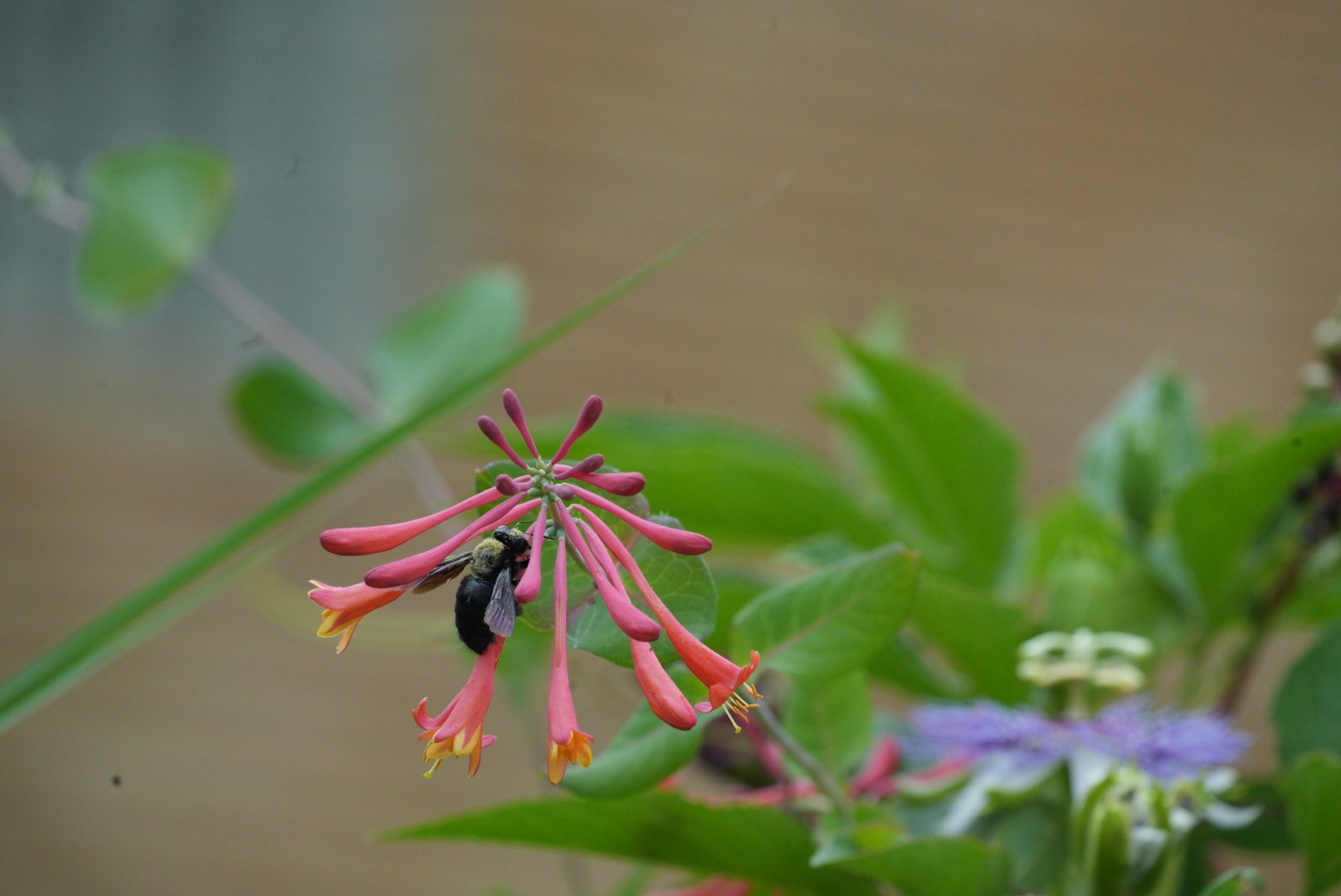
Coral honeysuckle and a native bee.
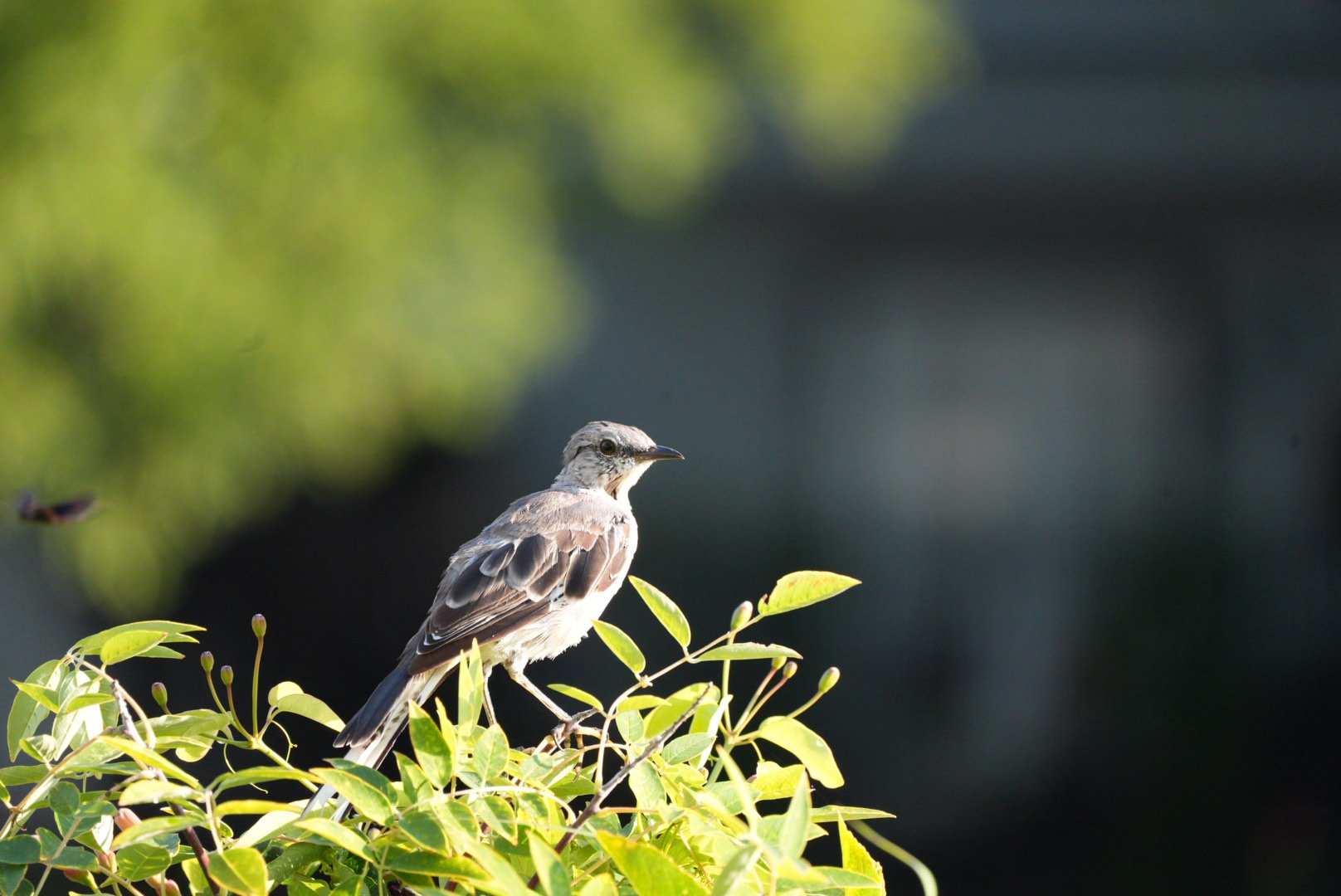
Mocking bird using an American Westeria vine as a lookout for insects to eatt.

Passiflora incarnate and carpenter bee.

Turkey tail mushrooms breakdown rotting trees recycling the nutrients.
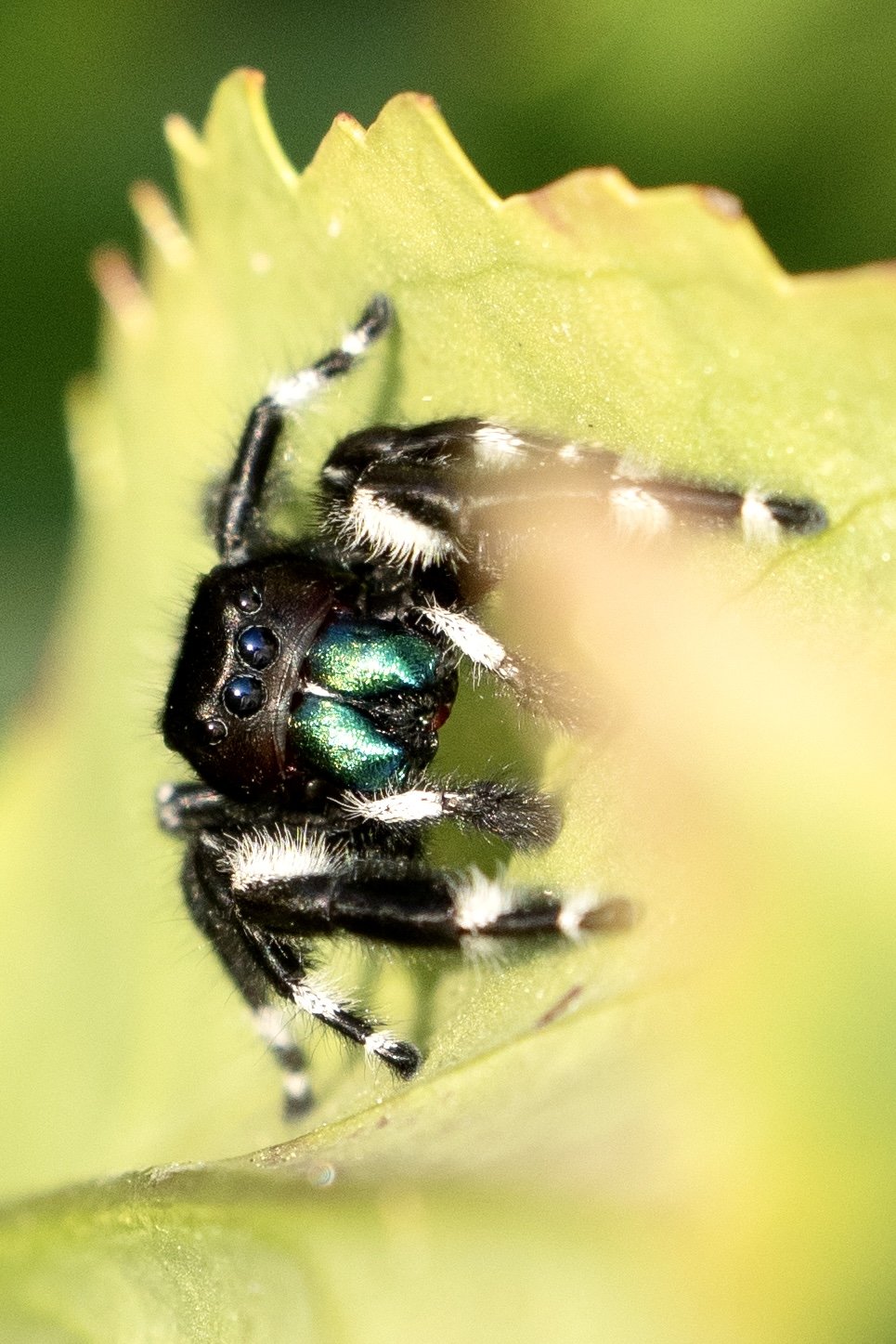
Jumping spider
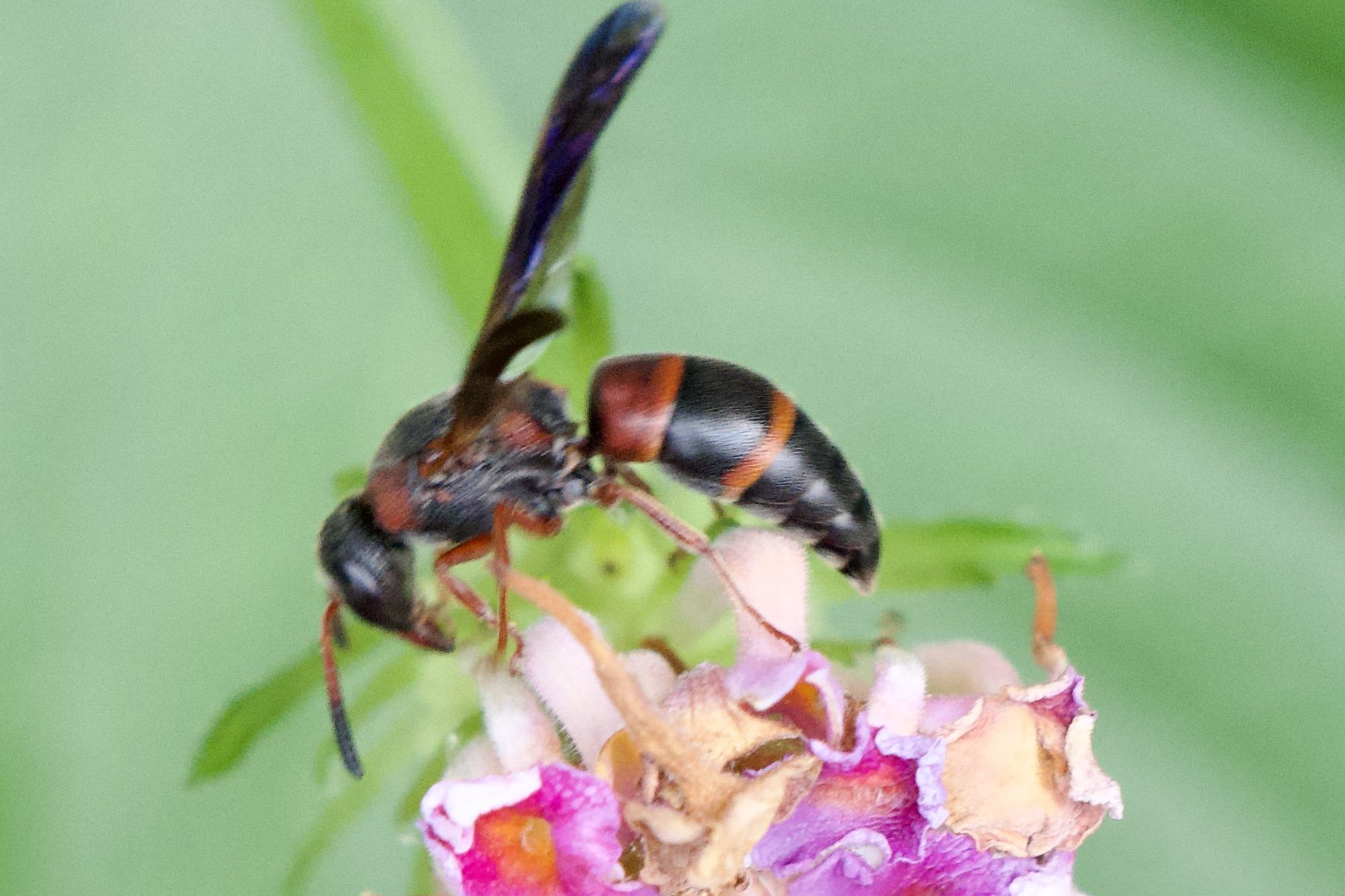
Pachodynerus erynnis, known generally as the red-marked pachodynerus or red and black mason wasp and Lantana camera. Lantanas are complex, I am not certain if this is a native to tropical US or an import. I think it is camara since I see beetles and wasps on it.
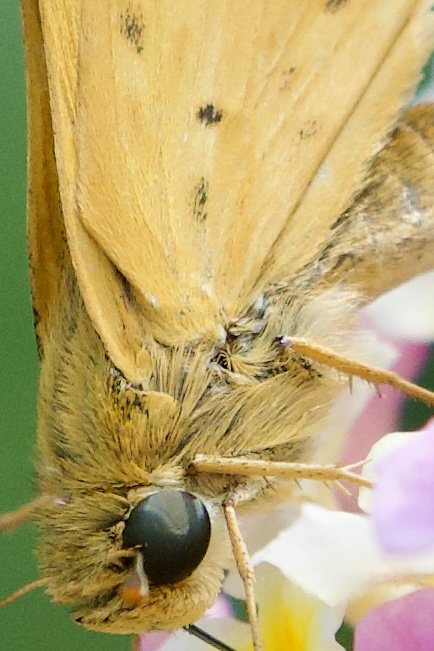
Clouded skipper on Lantana camara.


Common green June beetle and lantana camara.

Genus Pyrisitia minisa Yellow butterfly
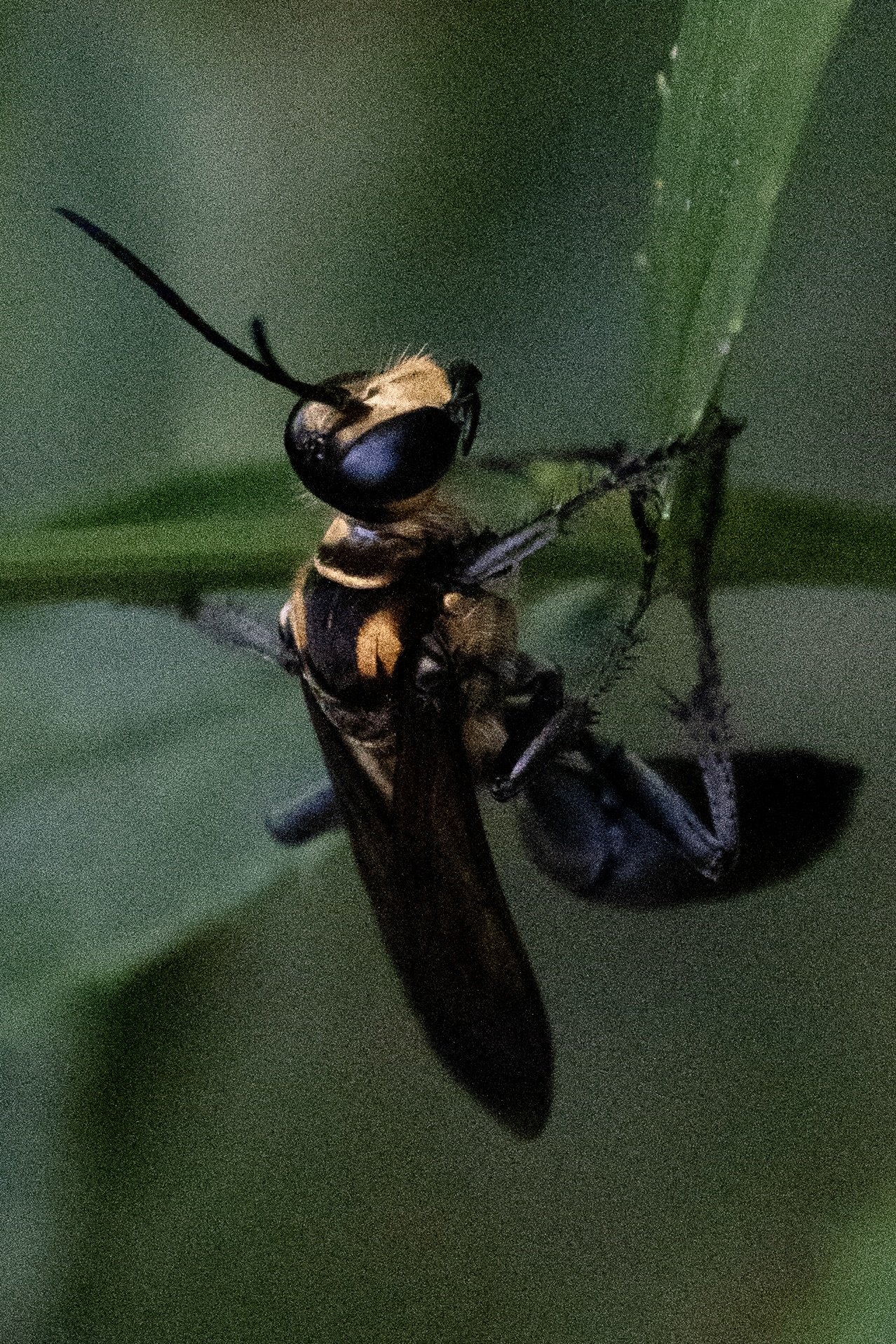
Golden-reined Digger Wasp
Despite its vivid alarm coloration, the Great Golden Digger Wasp is not an aggressive species of wasp. They tend to mind their own business and can be found sipping on flower nectar during the summer, but in the early spring, females prepare to lay eggs.
Females will dig into loose soil and create many deep tunnels. When established, she then covers them to hide their existence. A female will track a small insect and sting them to paralyze them, but not to kill them. Once the prey is immobile, she will clutch it using her antennae and mandible (mouth parts) in order to fly it back to the tunnels. While in flight with her prey, it is not uncommon to see birds like robins or tanagers attempt to steal her meal from her by chasing her until she drops it. No other known species of Digger Wasp is known to be harassed by birds in this way. If the female is successful in returning to her tunnels with her catch, she will place the paralyzed prey aside to quickly inspect a tunnel. If it looks like it's still intact, she will pull the paralyzed insect, head first, down into it. She then lays an egg on the insect, exits the tunnel, and covers it over again. She repeats this process for each tunnel. Unlike other wasps, she does not actively defend her nest. Once hatched, the wasp larvae will feed on the living, yet immobile, insect until they are developed enough to leave the tunnel lair in the summer. Eventually, the parasitism of the paralyzed insect kills it.
Scientists are studying the behavior of this unique species. Great Golden Digger Wasps seem to display a type of internal programming. If their insect prey is moved away from the tunnel while the female inspects it, she will emerge, relocate it, bring it back to the tunnel entrance and start the inspection all over again. Every female exhibited the same repetitive 'start inspection again' behavior when tested in that way.
Females have also shown that they do not keep a tally of how many insects they catch versus how many tunnels they create. If some meals are stolen by birds, they do not realize that they are short on insects compared to tunnels.
With such gorgeous orange and black coloration, mild demeanor, and interesting behaviors, the Great Golden Digger Wasp is one to admire, not destroy. Perhaps a careful observer will discover even more fascinating things about this species.
Symbiosis - the ripples
For many artists, satisfaction comes from selling their work. For me, happiness comes when others mimic my work.

A little over a year ago, I met a young couple with a commercial landscape business dept. I invited them to be part of my social sculpture water + air + citizen that took place this past winter. I shared with them the next phase of Carbon By The Yard. This spring I among many volunteers, briefly helped Maggie and Isaac install their inspiring monumental version this spring. Luckily it survived the drought and made the Chronicle.
This Novrmber 5th carbon By The Yardwhich will take place this November 5th. During the community family celebration on November 5th, the relief Carbon By The Yard will be transformed into Carbon Sink. Stay tuned to learn more.
The largest Mammal
The eating and Waste Habits of the largest mammal of the greatest numbers on a land mass have the greatest impact on all other life forms. In Texas there are 26,448,193 humans and 10,900,000 cows. Homo sapiens are the most impactful mammal.
In today's society our eating habits define some of us socially and morally. This makes the discussion of eating meat vs. a vegan lifestyle and saving the planet a loaded topic. One of the most important topics of our day triggers emotions that progress bit discussion and block minds. When I find a movie or a book that looks at the topic in a non-threatening, non emotional context I like to highlight it.
The documentary Goodbye Cows looks at the impact of the two consumption models.
If you want to take a deeper dive into the beautiful and complex relationship between ruminants the planet and humans, I recommend the book Cows Will Save The Planet. By Judith Schwartz
On a lighter note in 2015 I was invited to visit a a friends family farm that raises cattle for consumption and regeneration. My friends incorporate methods that mimic nature and manage the cattle’s movement as predators managed herds. This process builds the health of the planet’s soil and tempers climate. .
My rancher friends Lisa and John threw some healthy treats in the back of their pick-up so that I could get some cow close-up.

The photo that inspired Mooove
I had to draw the expressive cows as they contorted, licked and moooved the pick-up clean.

MOOOVE
4' X 6' c
harcoal, ink pastels,
2015
Below is the drawing. It still makes me laugh.
Rumblings - Osmosia aglaia
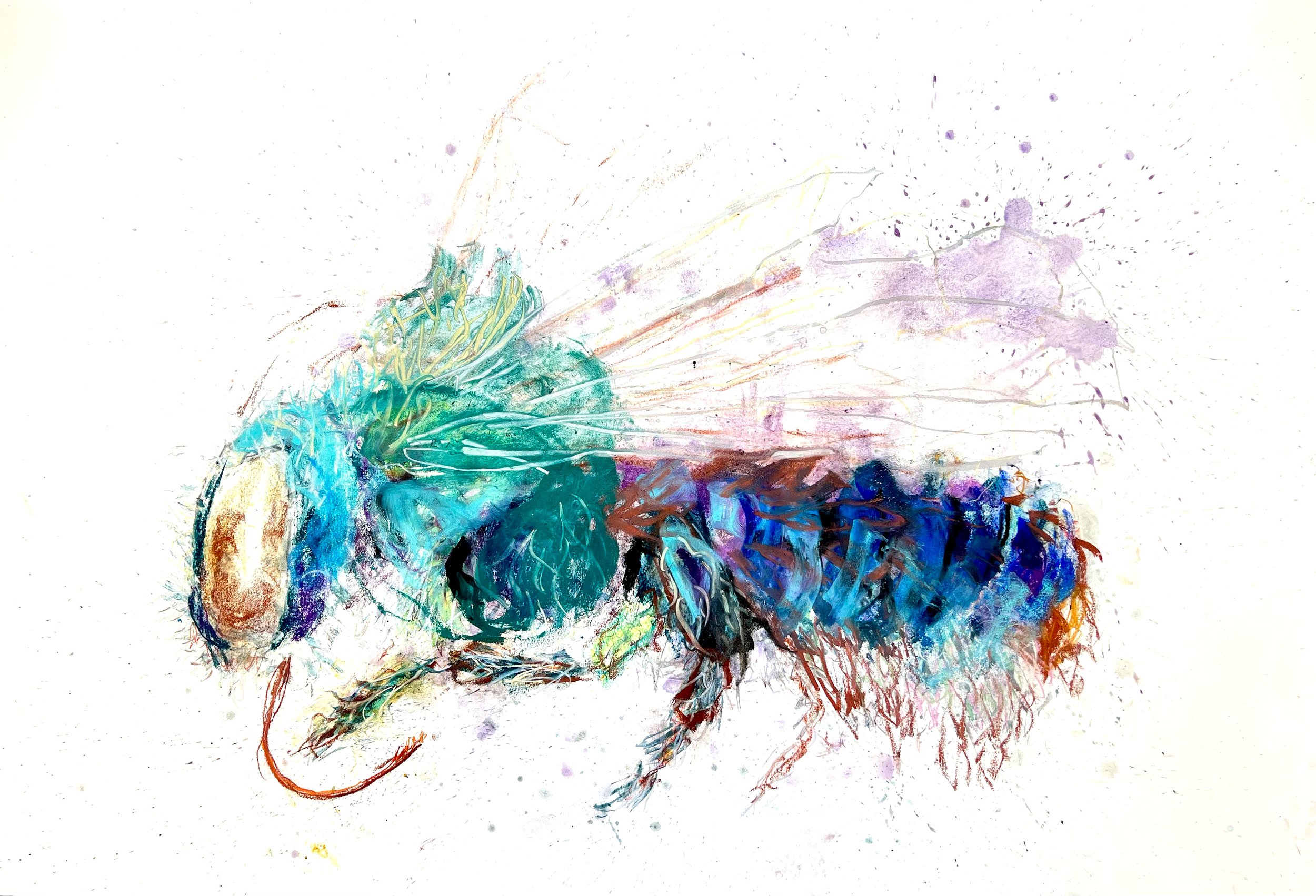
Osmosia aglaia
30"X 44”
Watercolor and pastel monotyoe
Osmia aglaia is 1/10,000 bee species. It is a N. American west coast bee, and exceptional in pollinating raspberries and blackberries. I am sad to report they are currently studied for industrialization.
Symbiosis Celebration — Social Sculpture
Symbiosis Celebration
Social Sculpture
Proposal
By
Cindee Travis Klement
Proposed to Mayor’s Office of Cultural Affairs June 8, 2022
Fall color tourism contributes $1 billion per year to North Carolina. Houston has Fall color migration,
we can cultivate it into tourism and build soil health.
—from Chemical Plants to Native Plants—
Native Wildflowers, Food, Art and Music Festival
“If you dig deep and keep peeling the onion, artists and freelance writers are the leaders in society - the people who start to get new ideas out.” — Allan Savory
In April 2021, I installed the first native plants into Lawndale's sculpture garden. Within two months, Symbiosis exploded with bountiful native blooms. Plants expected by the Ladybird Wildflower website to be one to three feet tall in Symbiosis were instead two to four feet tall. In June, the endangered native bees started returning. In the first twelve months, I have witnessed seventy new species in the space: from bird nest fungus to Red Admirals, Monarchs and skippers, skimmers, one of the bumblebees listed as endangered, Bombus pensylvanicus, treefrogs, toads and birds.
Since Hurricane Harvey, harnessing the power of public opinion to mutualistically build Houston's landscapes into healthy ecosystems has been the focus of my art practice.
In our web meeting, I explained that in my artwork, Symbiosis, sponsored by the City's Initiative Grant at the Lawndale Art Center, I integrate holistic, regenerative biological systems into an urban landscape. I was inspired to create Symbiosis because I have read that our cities are fast-forwarding evolution. If this is true, integrating holistic, regenerative biological systems into urban landscapes will fast-forward ecological recovery. In Symbiosis, I use systems thinking to find a balance between humanity and Houston's wildlife; already, since the installation began in 2021, we are seeing a return of the lower food chain, which is critical for supporting birds and other wildlife that control the insects harmful to humans.
In the systems thinking state of mind, I also realize that profit is the fuel that will change society's landscape practices to embrace the planet's ecological systems in Houston. Applying economics and industrial concepts to the work, I propose that ecotourism is an untapped resource that can strengthen our environmental and economic health. I am writing to you with a proposal to start a wildflower festival, a Symbiosis Celebration, that ultimately encourages and celebrates new mutualistic relationships between Houstonians and the planet. Through fostering symbiotic relationships that regenerate Houston's micro-ecosystems, we will move our reputation from Chemical Plants to Native Plants — we can prosper as the Green Energy City.

STIMULUS
18” X 4.5” X 10”
$1500 in large bills and passed butterflies.
Building Mutual Symbiotic Relationships to Power Ecological Recovery
I envision this festival cultivating relationships among the City of Houston, local property owners, Houston's indigenous landscape and its wildlife, soil and climate, food, restaurant, music, visual and performing arts, museums and professional sports team communities.
The following steps will contribute to building these relationships:
· The business and private property owners will need to redirect their existing landscape budgets to native plants that support our wildlife.
· These new landscape practice guidelines will align with the Mayor's Office of Sustainability and Resilience.
· New native wildflower and grass landscapes will slow rainwater, allowing it to soak in and return to the aquifer to cool the planet while sequestering carbon and storing it in the ground where it is stable, providing food and safe habitats for our indigenous wildlife.
· The approximately six hundred species of birds, four hundred and thirty species of butterflies, eight hundred species of Texas native bees, one thousand species of moths, eighteen species of dragonflies, thirty species of turtles, including two box turtles, and seventy-two species of amphibians native to Texas will expand their populations in our city.
· Houston's creatives in the food, restaurant, music, visual and performing arts, museums and professional sports industries will respond to the new mutualistic/symbiotic relationships among Houston's landowners and our unique plant and wildlife in exciting creative ways and performances during the festival.
· The City of Houston will promote, market, and support the above-described new relationships with its services infrastructure, completing the mutualistic relationship that will support Houston's economy and ecosystems.
Why Houston Can Support Ecotourism
Although Symbiosis taught me the speed with which an urban landscape can transform into a wildlife haven, it was not until I was in Fredericksburg that I realized Houston's ecology is an untapped tourist economy. When you combine Houston's rich soil, high humidity, heat and long growing seasons with the indigenous native plant landscapes supported by Houston's urban irrigated commercial and park landscapes, Houston's native plant wildflower and wildlife tourism can far exceed those of the small towns in Central Texas. Another tremendous asset is Houston's central geographic location in the bird and butterfly migration paths between the North and South American continents and our proximity to the Gulf Coast. Texas has the most butterfly species of any state in the U.S. Houston's inner city is 600 square miles; our "sprawl" is an asset to urban ecotourism.
As additional support that Houston can be an ecotourism powerhouse, I have read that one of New York City's most popular tourist attractions is The High Line's native landscaping. In North Texas, Plano also uses wildflowers and music to attract tourism dollars.
Funding
I see businesses and organizations all over the city which are starting to take advantage of the ecological benefits of native landscapes. Unfortunately, many other property (business and home) owners are unaware of the economic and environmental benefits of native plant landscaping. They spend $50-$100 per hour for weekly maintenance and $4—$12 per square foot for seasonal plantings, while also incurring high water usage and bills. Suppose the City appeals to these businesses and individuals to convert their existing non-ecological landscape budgets to native wildflower and grass landscapes. In that case, the City can promote a native plant/wildflower and wildlife, food, arts and music festival that will symbiotically support native ecological systems. The supporting businesses can profit from the tourism they generate.
When
With Houston projected to double in size by 2050, if we start now, benefits will compound. The timing of the festival should fall during one of the migration periods.
The Texas Can-Do Spirit
Systems thinking to mitigate climate through industry and the arts is a new territory — will Houstonians embrace this new field of thinking? In Texas, that depends on how you ask and present the need. In our recent history, from Katrina to hurricane Harvey, unsolicited Houstonians volunteered to help their neighbors. In 1901, wildcatters discovered Spindletop, drawing people worldwide to build a better life in unknown territory. “Wildcatter” is used to describe one that drills wells in areas not known to be producing fields. The spirit of the wildcatter is deep in our Texas Can-Do Spirit. It is in our nature to embrace a new field of wild.
The Next Step
Recently I went to a free event at the Ion; the people giving the talk are in the business of researching the economics to support new business ideas. They also create "stacks" or PowerPoint presentations to gain financial support for new ideas. Their fee is $6,000. Unfortunately, it is beyond my budget.
Is this sort of analysis provided by the Mayor’s Office of Cultural Affairs or another City of Houston office to determine the new cultural or social events that would benefit our city?
The support of the Mayor’s Office of Cultural Affairs is critical for social sculpture to transform the city from Chemical Plants to Native plants and earn the title of The Green Energy City.
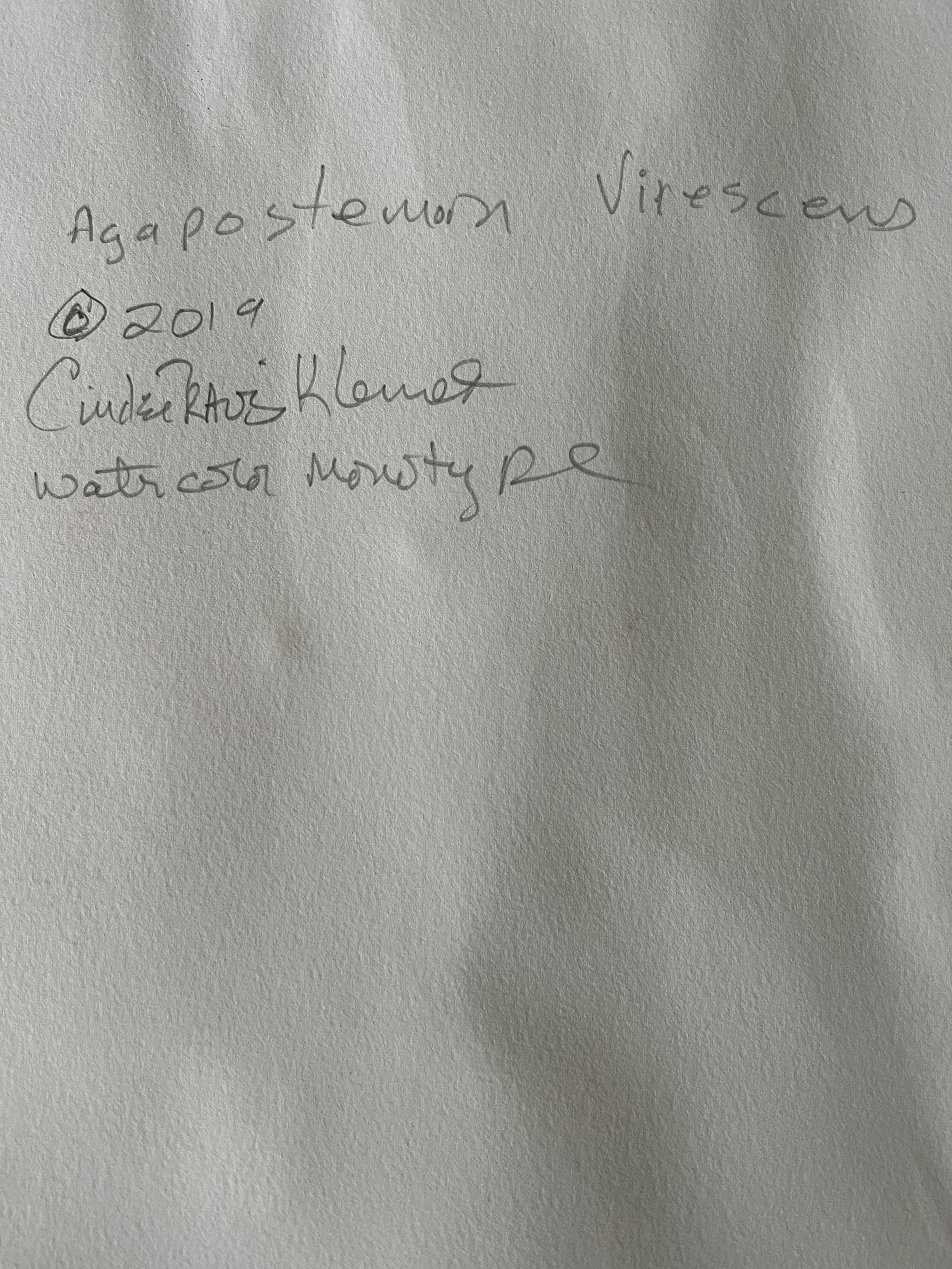
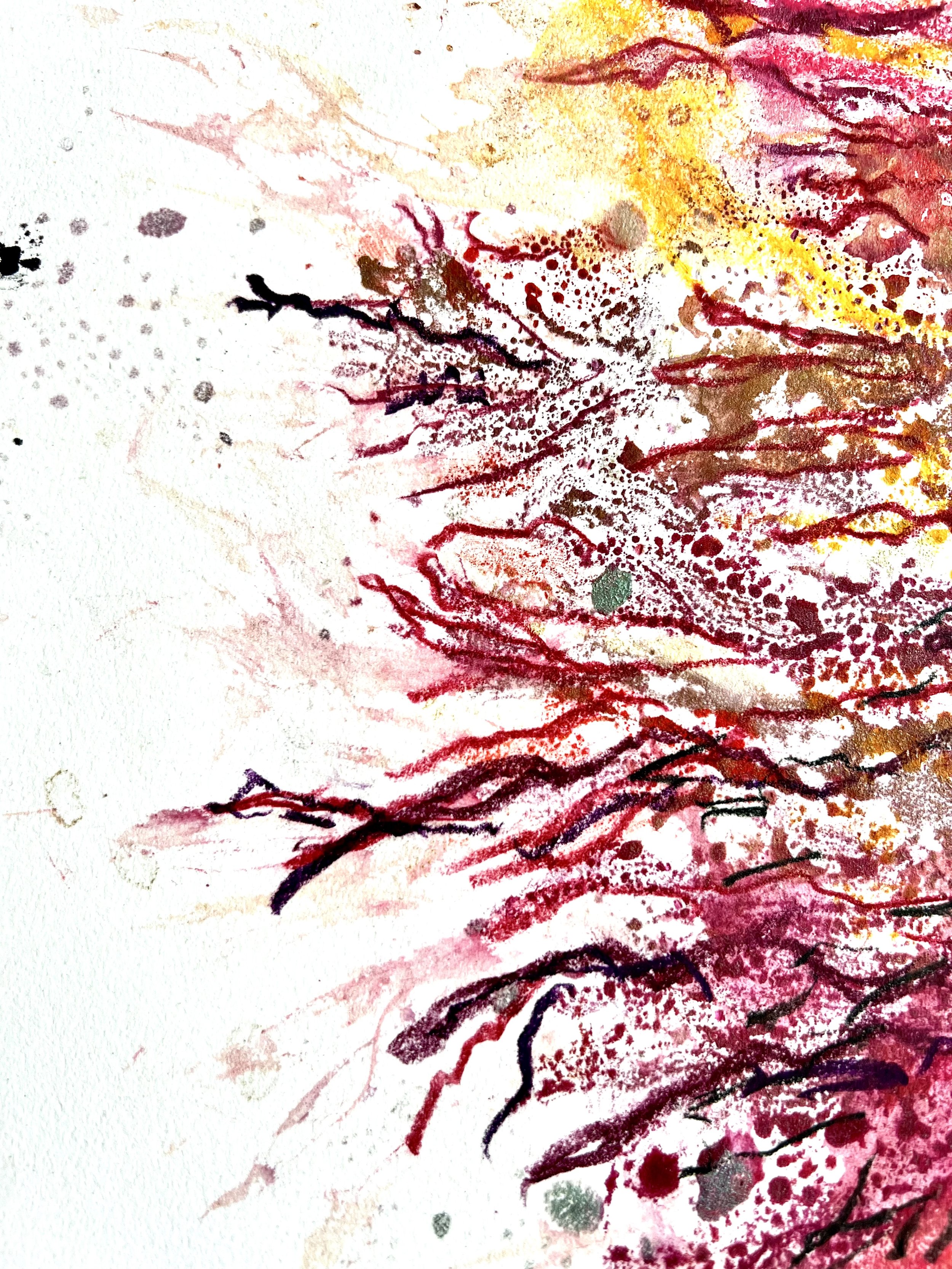
Rumblings - Agapostemen Virescens
This is part of a large body of work I started in 2019, Rumblings.
I pressed this monotype in 2019. I loved parts of it and not others. In 8/2022 with pastels I addressed the issues that we're not working on. I am pleased with the minute beast.

Agapostemen Virescens
watercolor and pastel monotype
30” X 44”
Little is known about this metallic green eye-catching Agapostemon virescens, a bicolored striped-sweat bee in the family Halictidae. It is commonly found in North America and is the official bee of Toronto. Its metallic green head and striped abdomen make it identifiable

The bicolored sweat bee is a solitary ground nesting bee. Each spring the female will dig a tunnel in an open patch of ground. Off the tunnel will be several branches. After building her nest, the female will gather pollen, take it back to her nest, form it into a ball with a little nectar and place it in one of the branches before laying an egg and sealing off that branch so each egg will have its own “room.” -.backyardecology


Monotype- leafcutter (petalcutter)

Leafcutter (petal cutter) Megachile and the Blanket flower
Watercolor and pastel monotype
30” X 44”
Leafcutter bee flying to its nest just after cutting a petal from the Texas native Gaillardia pulchella aka blanket flowers. They use the petals to protect walls and to seal their nests. In exchange for the petals, the leaf cutter pollinates the blanket flowers bloom. It is one of my favorite relationships in “Symbiosis.”


The white pedestal?
When I started in the MFAH Glassell School block program, I needed pedestals for my smaller sculptures. I made stark white cubes as I saw in museums and galleries.
Over the years, my work has transitioned to tell a specific story. I make work to reveal the beauty in diversity, the messiness in the natural world and the connections between all living things on the planet. And most importantly, I work to inspire society to step into a rhythm that will flow with the natural world and celebrate the beauty in its messiness. My work conflicts with borders that separate, clean lines that divide and sterile objects.
The white cube pedestals are a symptom of sameness, monocultures and sterile environments, a symptom of me wanting to ” look “ like I belong and fit in. A change is an imminent.
I am leting my eyes and mind play with how objects that physically support my work should look. Work that reimagines urban landscapes to balance humanity and natural systems should not be sterile cubes. What should, - what could they be?
The images below are some thoughts I am considering. .

Rocks

Bricks
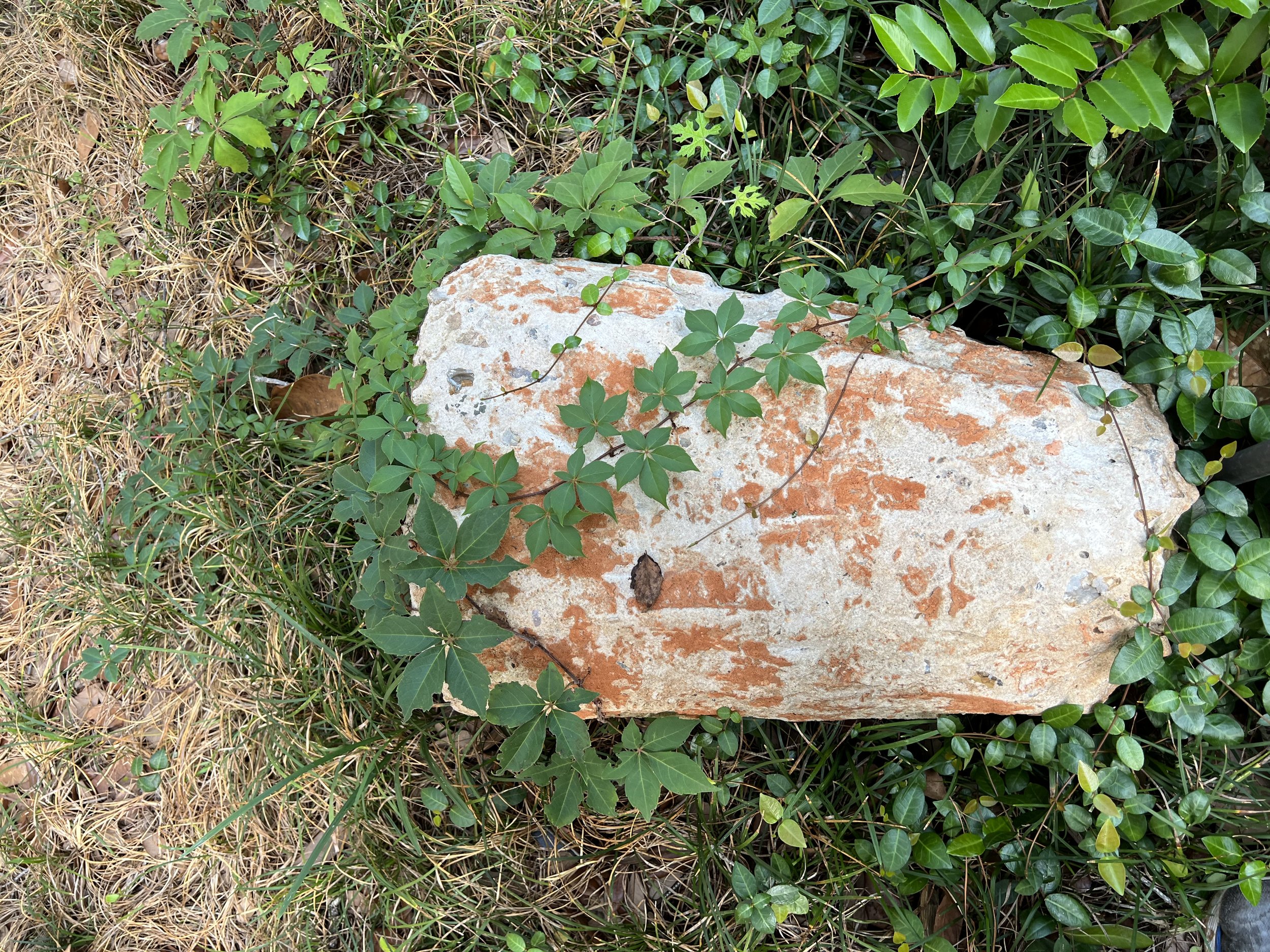
Stones or concrete.

Cracks

Dried plant material

Electrical wire

Upcycled lawn furniture.

Palm tree trunk skin

Salvaged construction site rotting root with interesting chain link necklace imbedded across her shoulders.


