
The vines are sprouting and climbing.
I have decided to make the feet in bronze, the wooden blocks are for them. I think one more day of welding.
Your Custom Text Here
The vines are sprouting and climbing.
I have decided to make the feet in bronze, the wooden blocks are for them. I think one more day of welding.

“When we hear his call we hear no mere bird. We hear the trumpet in the orchestra of evolution. He is the symbol of our untamable past, of that incredible sweep of millennia which underlies and conditions the daily affairs of birds and men.”
– Aldo Leopold on the call of the sandhill crane
During my Christmas day stroll with family and Tobi, I came across a crumbling old stump harboring an exquisite feathered creature. The majestic bird looked to be either a Whooping Crane or Sandhill crane - the two largest birds of North America.
While North America has many struggling ecosystems, it's so important that we remember the stories of hope and recovery too. The Sandhill crane is one such story - once endangered, their numbers have rebounded thanks to determined humans working to save them. Getting to know these creatures better can only inspire more hope for future environmental recoveries. I'm looking forward to learning more about the whooping cranes on my trip south this February with Curtis. If you know any other inspiring stories of environmental recovery please share them with me?
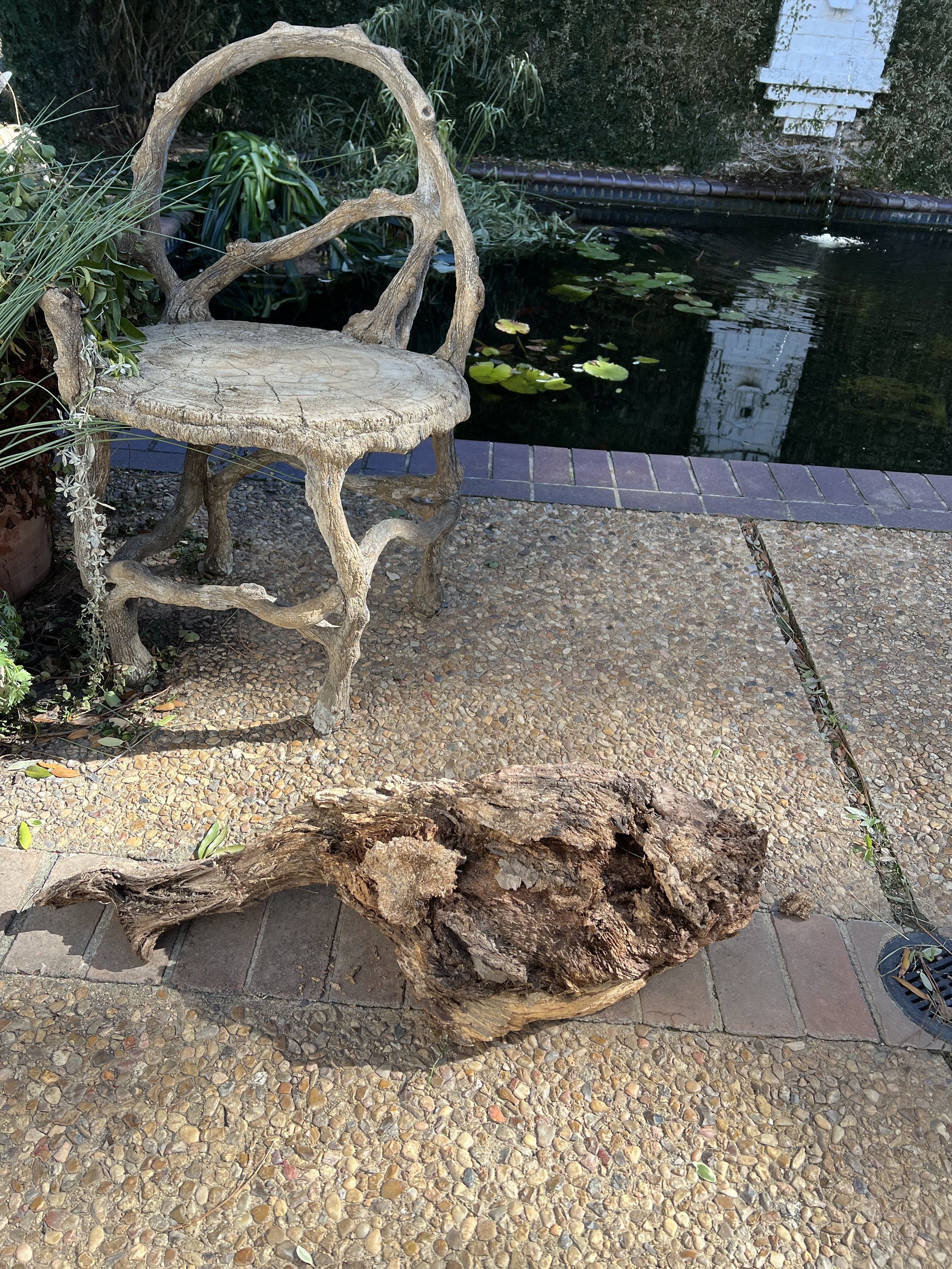
As found on Christmas day with it's natural patina.
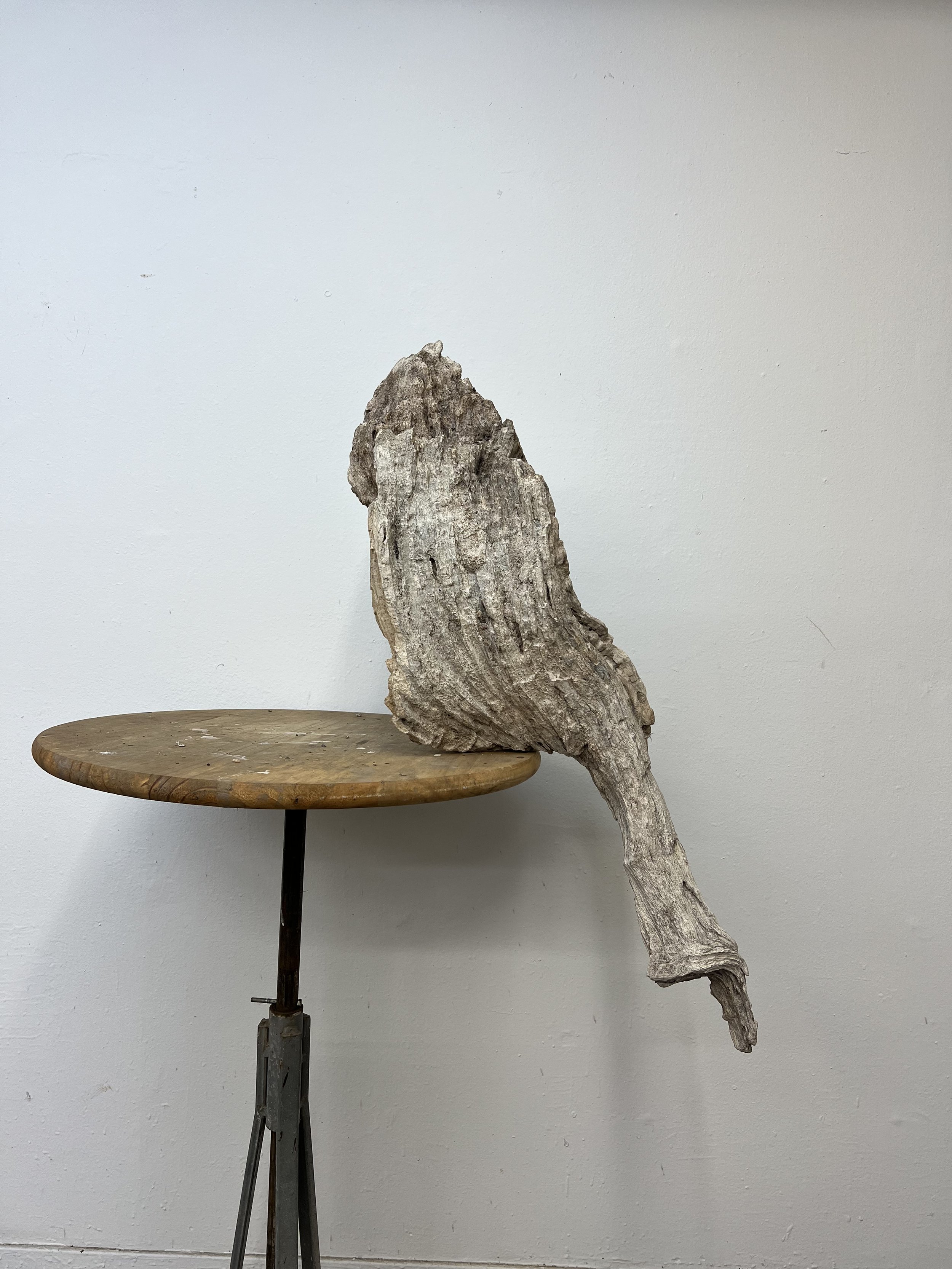
In my garage studio after giving the bark a little wash to highlight the movement in the wood.

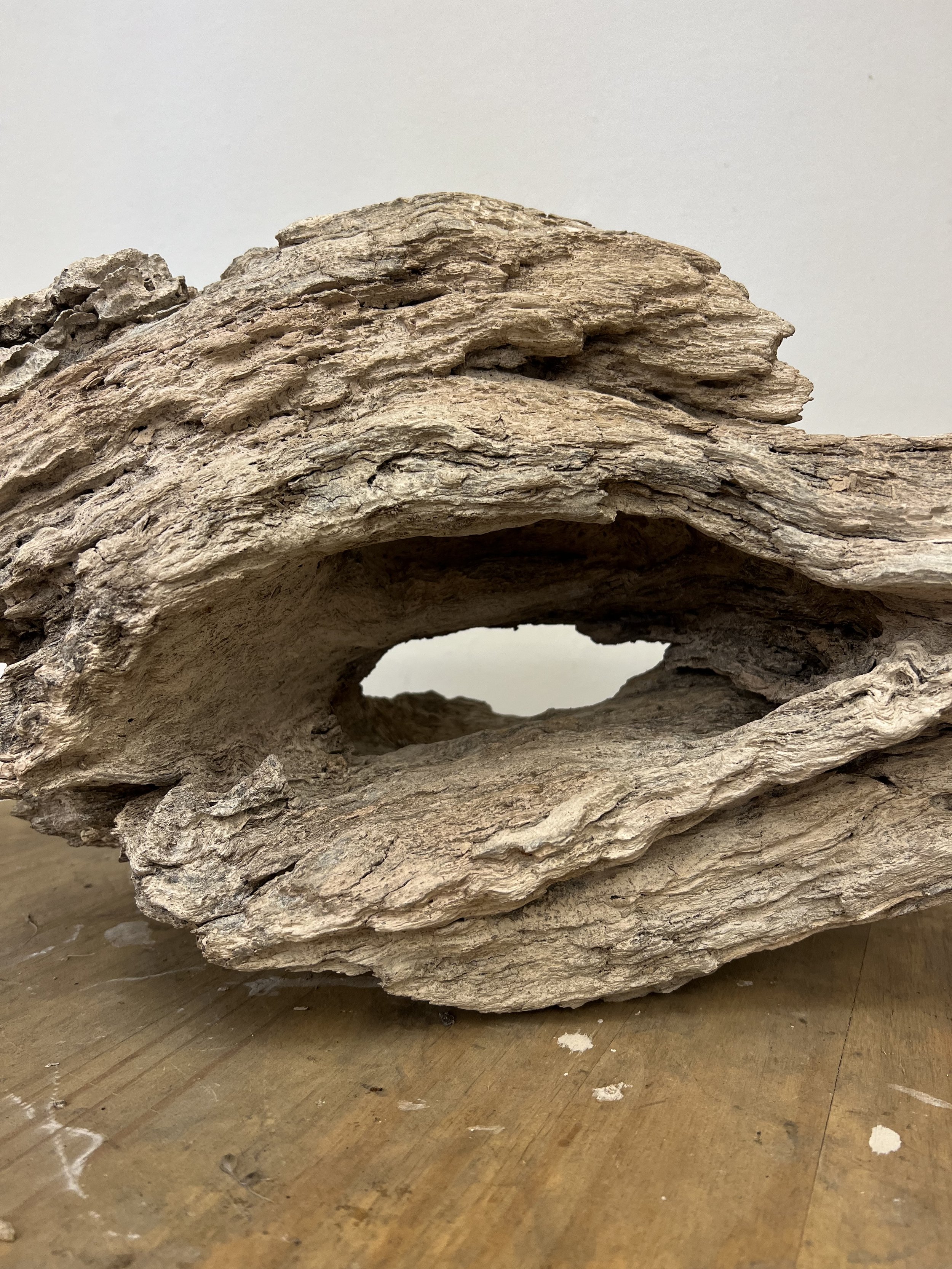
Detail
We need these stories of recovery our society needs to believe we can do this.
Humans naturally mourn the economic and surface loss of colorful flowers and green plants from a freeze. It is easy to become wrapped up in the superficial aspects. With systems thinking central to my eco-art practice, I wonder if there is an ecological purpose for a freeze. It has been a month since the freeze giving me time to watch and wonder. I have looked beyond the skin-deep perspective and discovered something beautiful about how a freeze gives life.
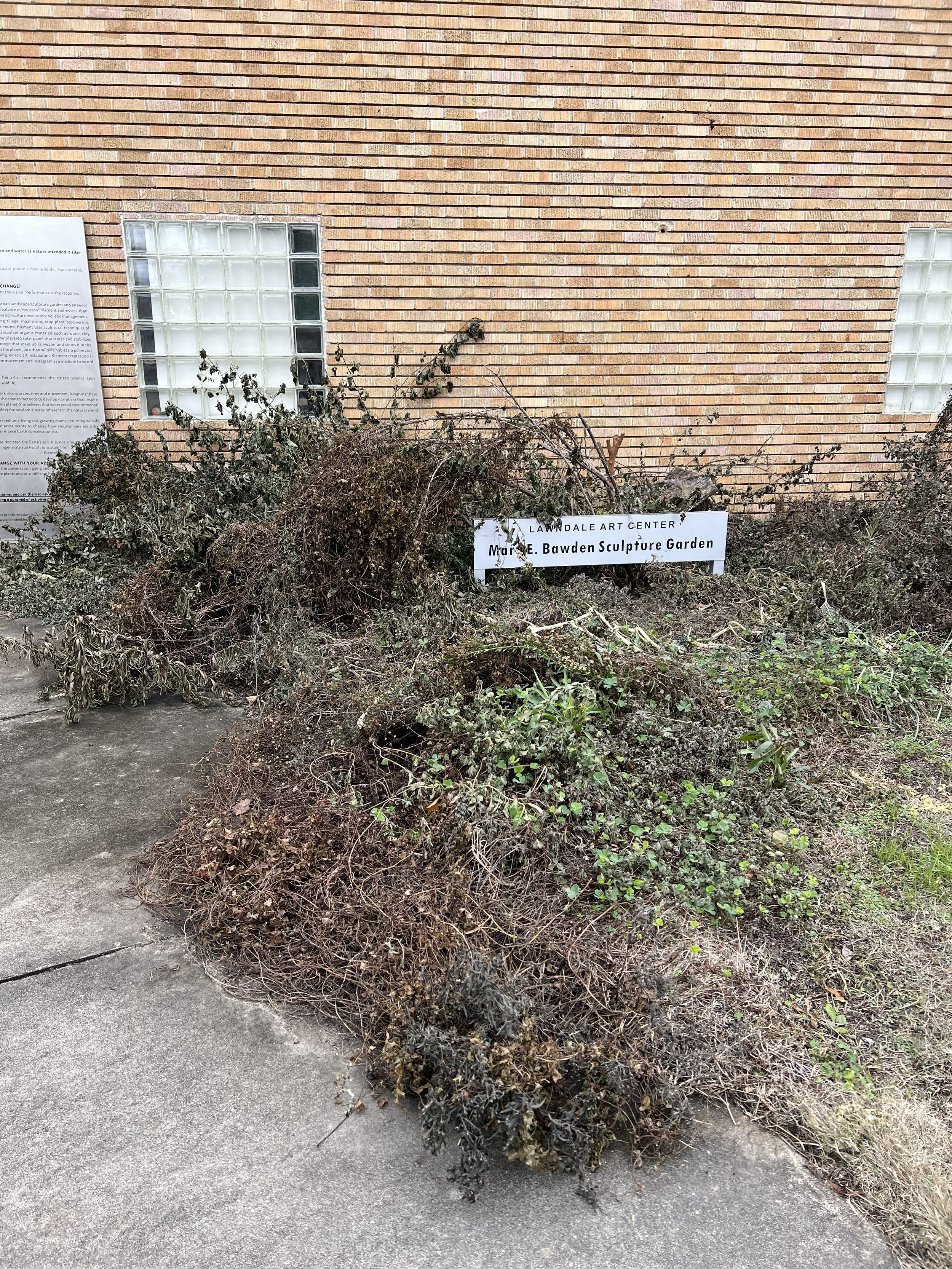
A week after the freeze, the same space is transformed into the earth tones of a 1980’s residential den.
This freeze occurred at the end of the second year since the Symbiosis installation. It was my first freeze with native plants and opened a floodgate of realizations and thoughts about freezes.
A freeze in the tropics looks and acts differently than in the northern US, but how are freezes in the tropics different than those in the Northern states? How does slimy organic matter from a freeze in the tropics impact its soil complexity? A freeze in a coastal prairie garden that has shade from a two-story building is not like a freeze in a sunny open field. Is there a relationship between the freeze and the drought, is there a relationship between seasons? For the past month, these are the questions I have taken with me when I visit Symbiosis and research on line.
What initially appears to be a destructive event can be the seed necessary for regrowth. Prairie plants are particularly delicate in these intense freezes as frozen water expands and rips apart cell walls, destroying their armature. When the thaw period eventually comes, and the water drains away, all that remains is a slimy puddle of cell slime.
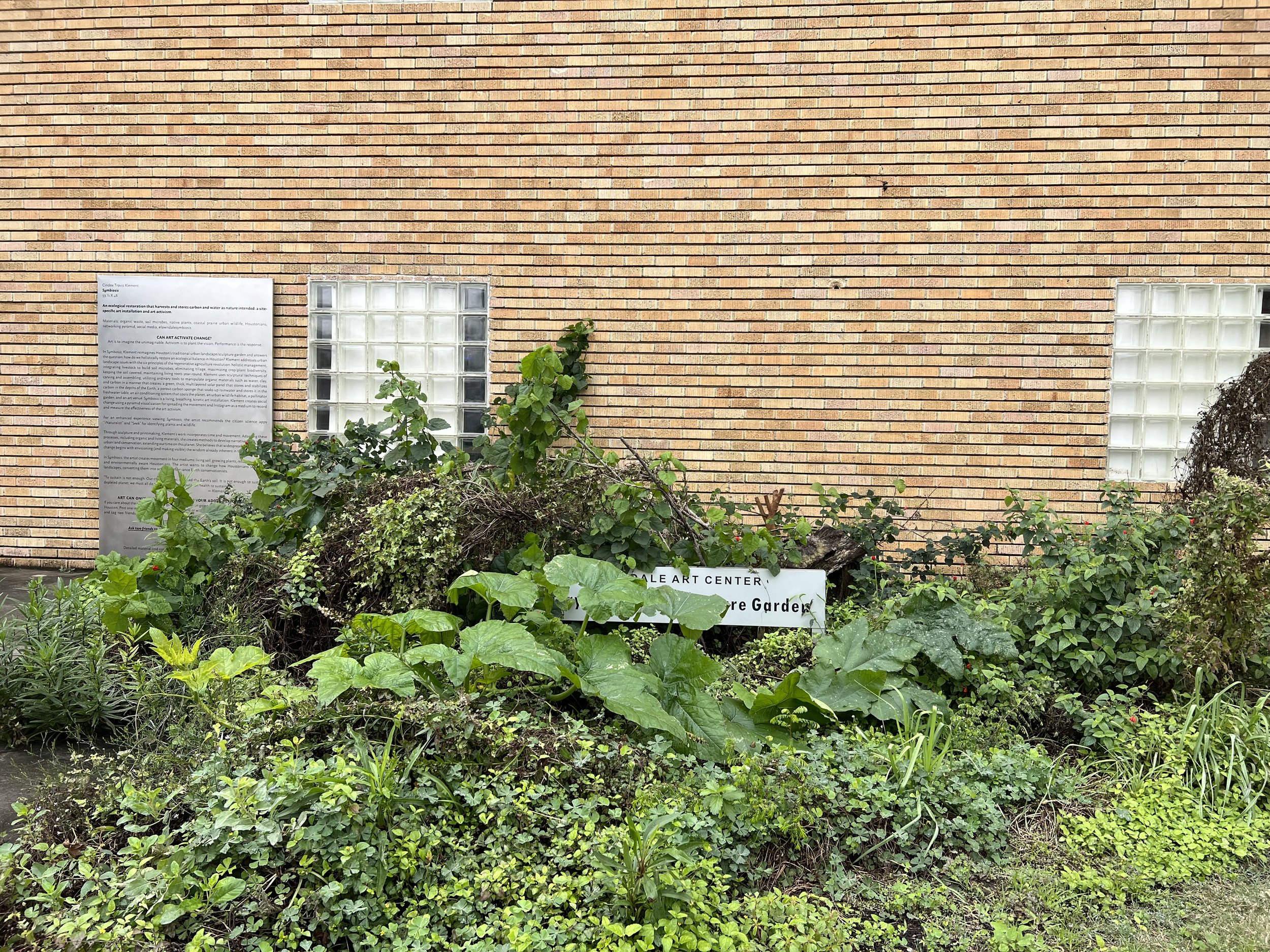
A small corner of Symbiosis before the December 2022 freeze.
These slimy puddles and decaying plants quickly milt into the soil, building its complexity and enabling it to store carbon, cooling the planet and soaking up water. When it breaks down, it provides food for microorganisms in the soil. A freeze is a quick and intense way to quickly build a large amount of living soil in the subtropics. This is a refreshing reminder of how our actions have real-world impacts. I am leaving the dead organic material to break down naturally. I am mindful of the inherent beauty of all seasons, all colors of ground cover, and the event's natural power and energy potential. Understanding and honoring freezes can improve Earth’s health for future generations. It is the fastest, most economical way to build a large quantity of soil. When it comes to soil carbon as an asset, a freeze is an economic plus.
I am not anti-freeze - instead, I'm pro-freeze!
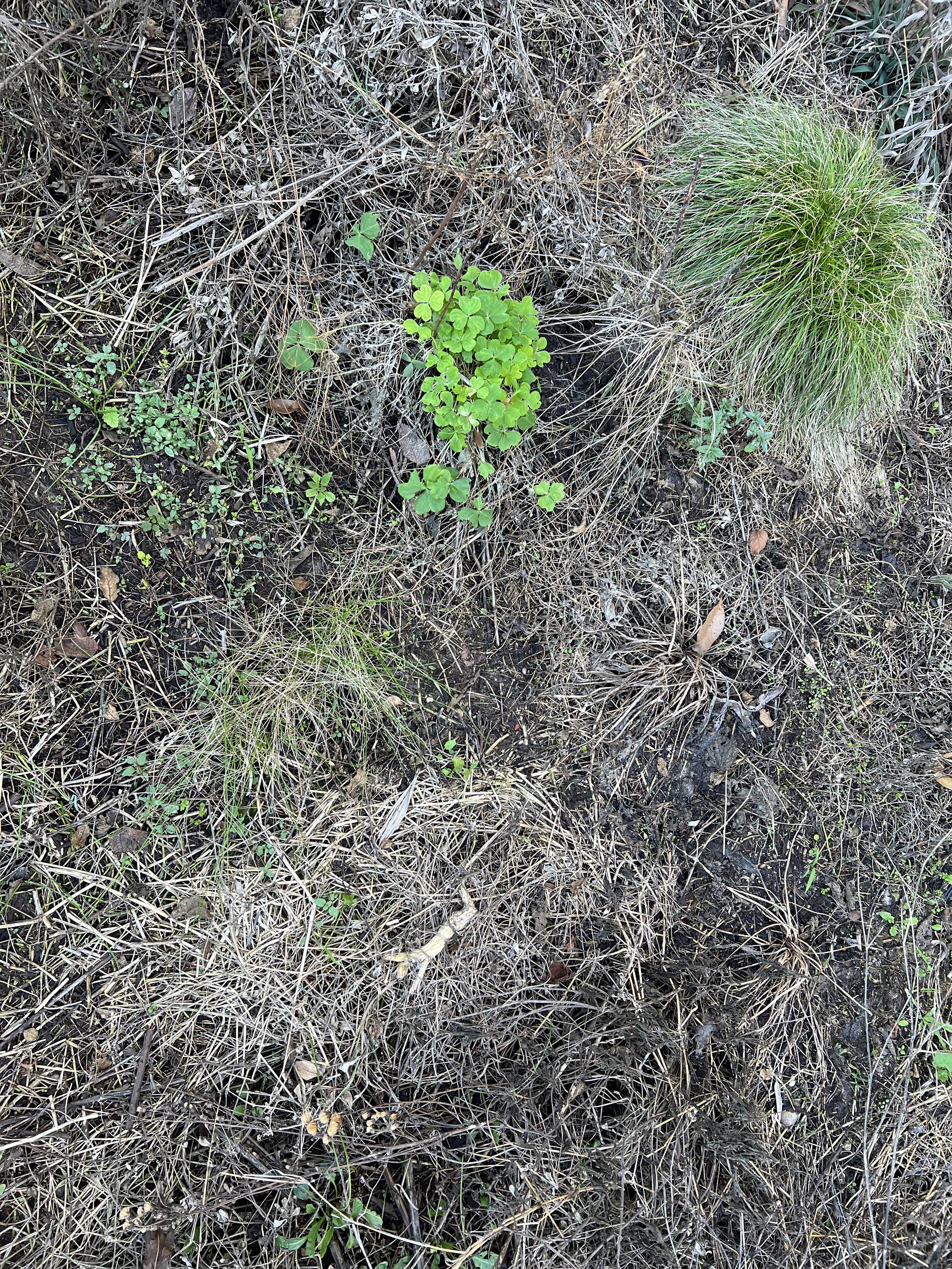
Almost two weeks after the freeze and the new growth is noticeable. . The dried plants are crumbling into soil.
I still have unanswered questions and I am hopeful they will reveal themselves through Symbiosis. Until them I walk the garden every day in complete amazement the new growth rise through the decaying material as it melts in the armature of the soil.
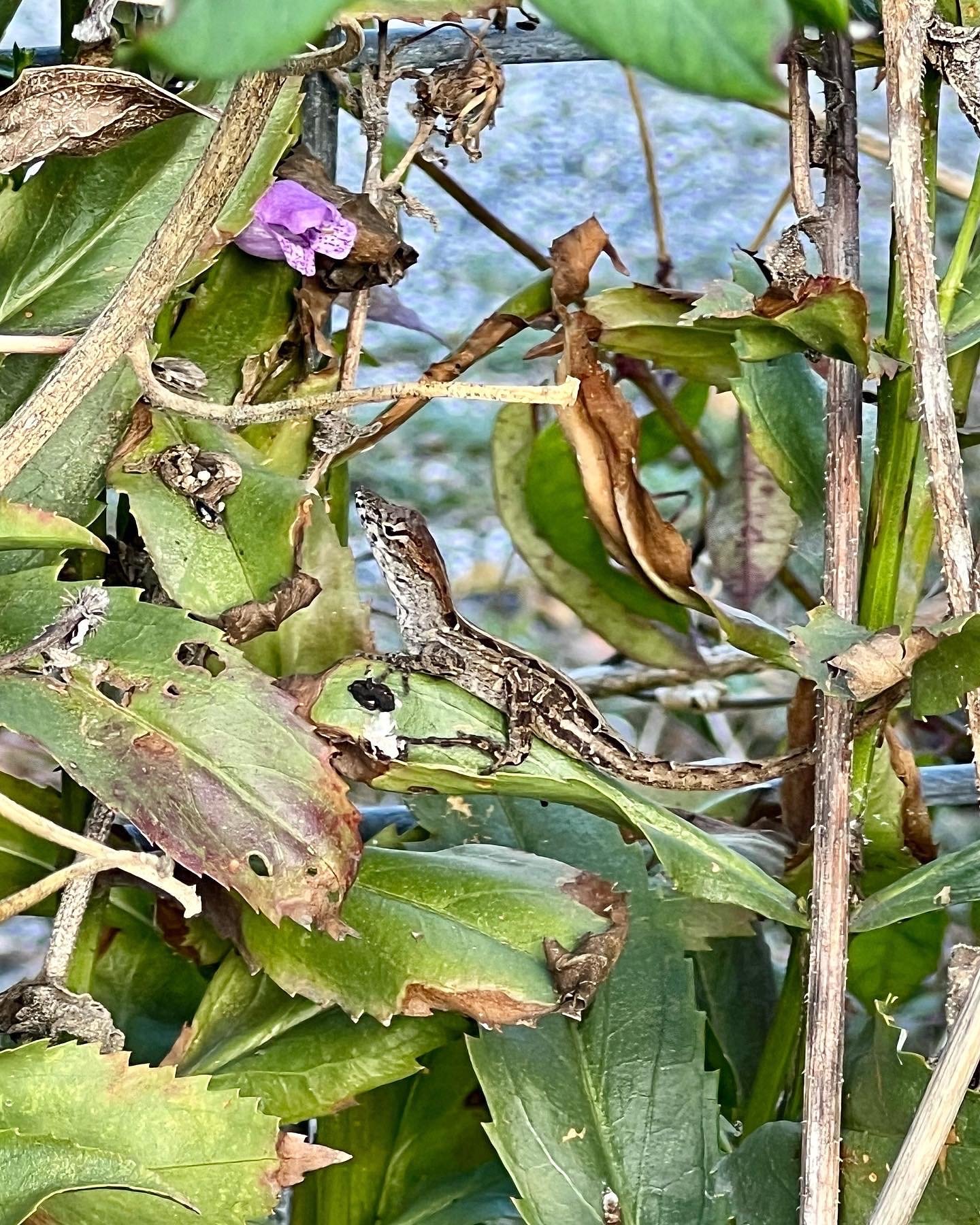
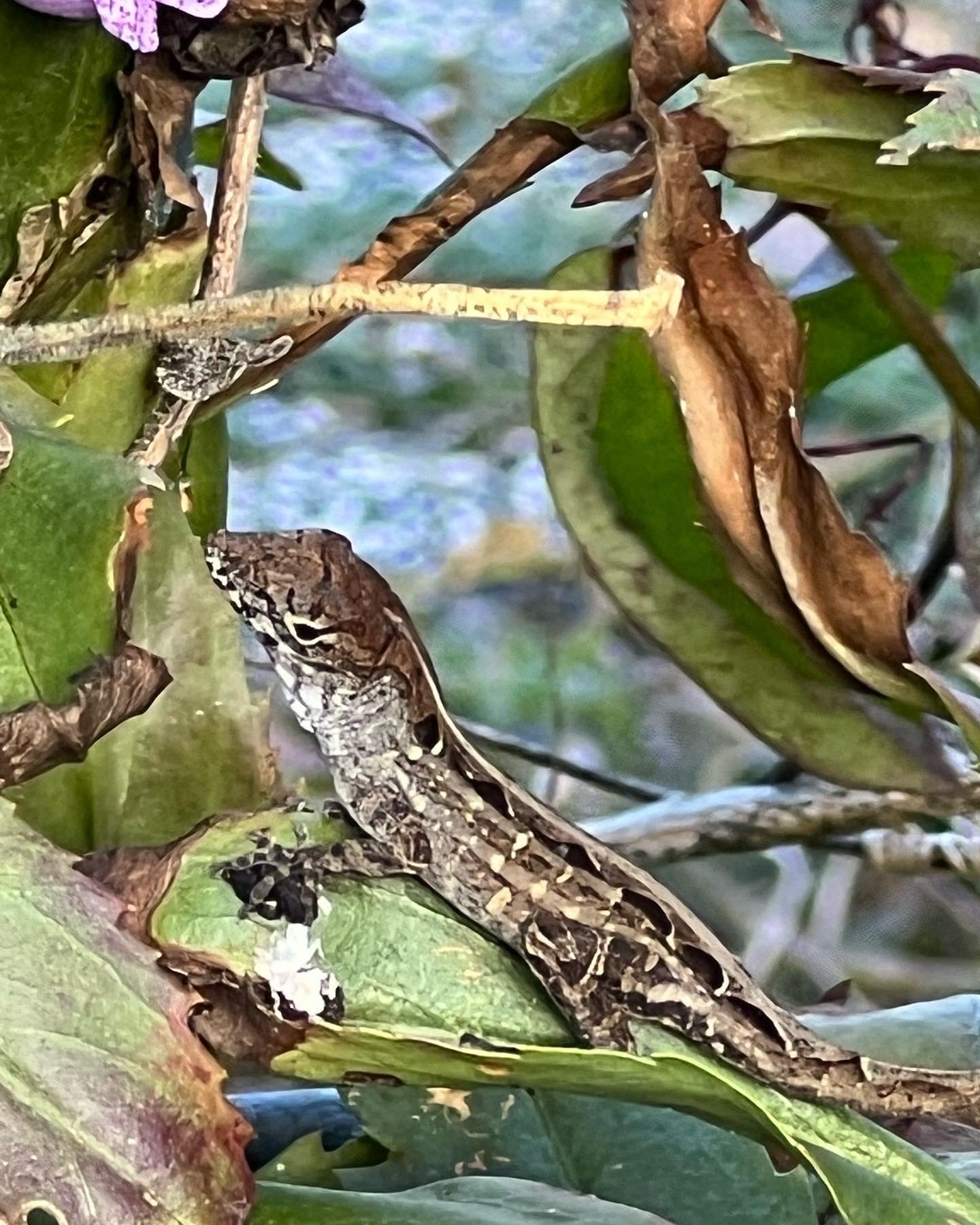
When maintaining “Symbiosis” and when I observe urban landscapes, I see the beauty in decaying plants and the tiny creatures they protect. This brown anole is a garden beneficial, keeping fire ants and other insects in check. Without camouflage, they are prey for birds, snakes, and some spiders. As an artist I find beauty through systems thinking and a balanced ecosystem.
Can you find him/her mimicking a dried, twisted leaf?

Today I started an important family piece—a wedding gift for my daughter Sage and son-in-law Cameron who married during Covid. I have not welded since finishing the bison piece June- October of 2021. Sumner welding without AC was brutal. As a result starting this piece is long over due. I wanted to work on it and enjoy the process.
Below is the first day of planning, cutting, grinding and welding.

I plan as I go. Today I am building the basic armature. In the end it will be gnarly and twisted full of worm holes..
The seat structure is inspired by the joining of two strong personalities that merge and then support each other.

Playing with the pieces and thinking about Sage and Cameron I decided to have two seating areas- think tete a tete. I am picturing the front seat for sitting and the smaller back seat for a small child to stand on and hug their parents necks. The French history is fitting the Curnod family history. I think it will be great for future family pictures.
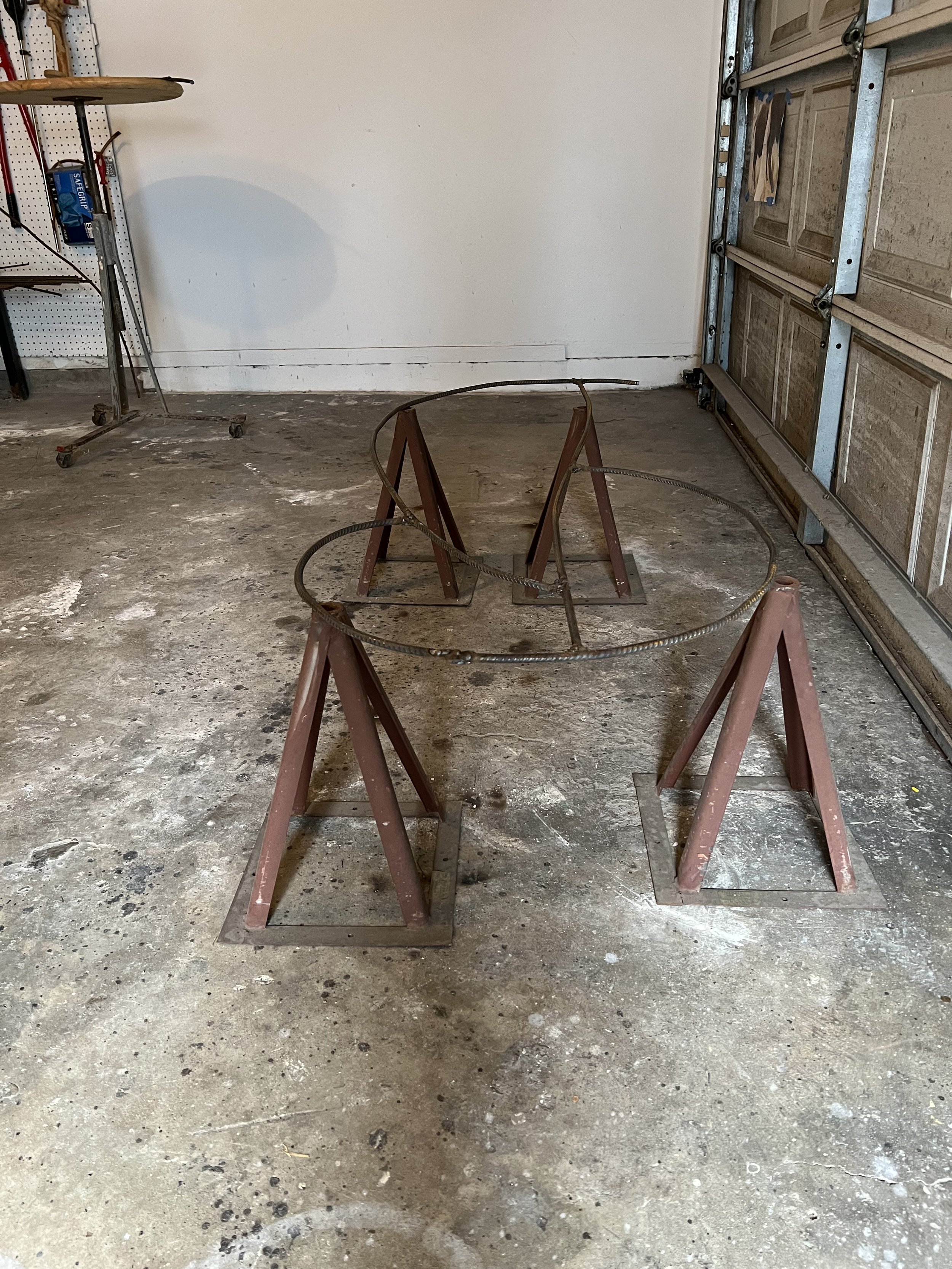
I am giving the bench a lower seating height making it climbable for small children.

Six legs should be stable enough.

Without air conditioning December welding gets my vote.
I received a spam email this summer with a bold photo of a popsicle asking, “How do you cool off in the heat of the summer?” I immediately thought about how the planet cools off. That spam email inspired these ephemeral sculptures, I used the materials mother nature uses to cool the planet.
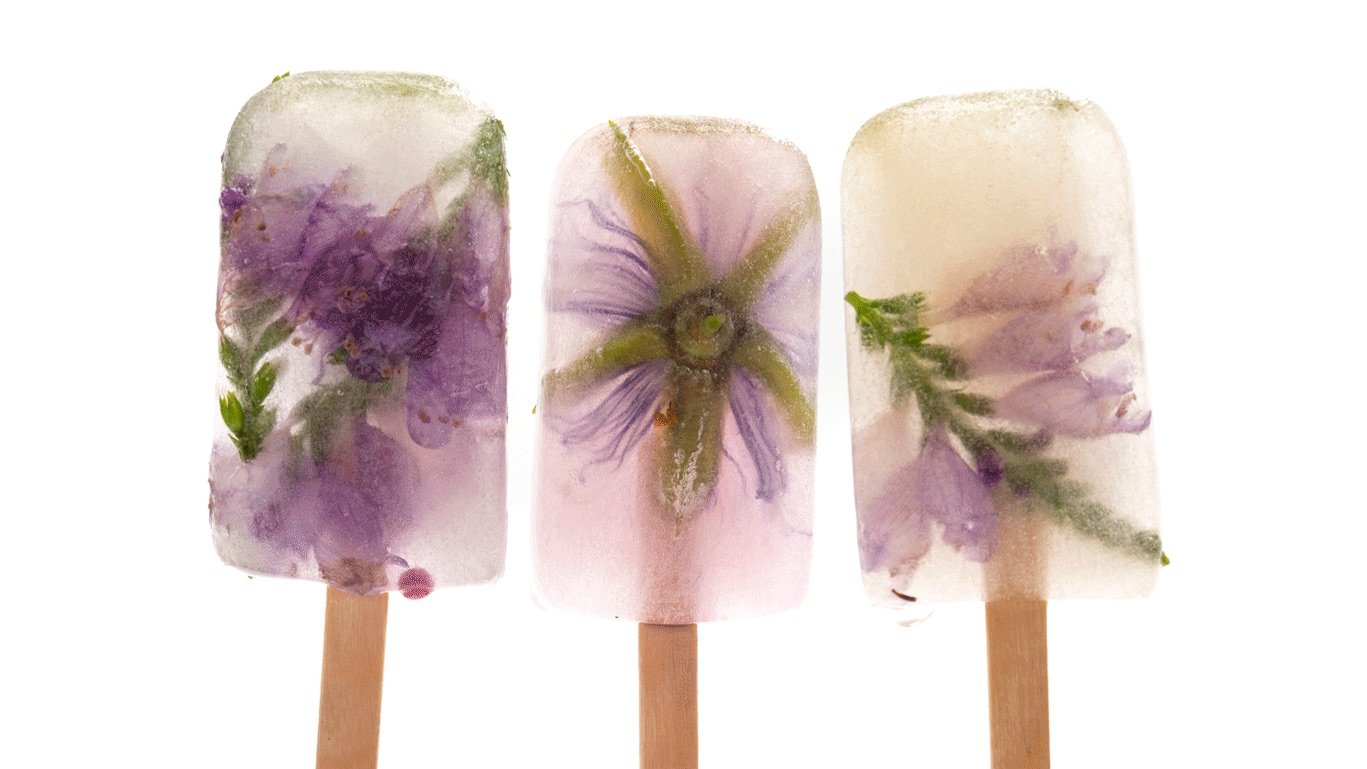
PLANET POPSICLES
6” X 1” X 12” ephemeral
Sticks, H20, Passionflower, Fall obedient plant, and American Beautyberry
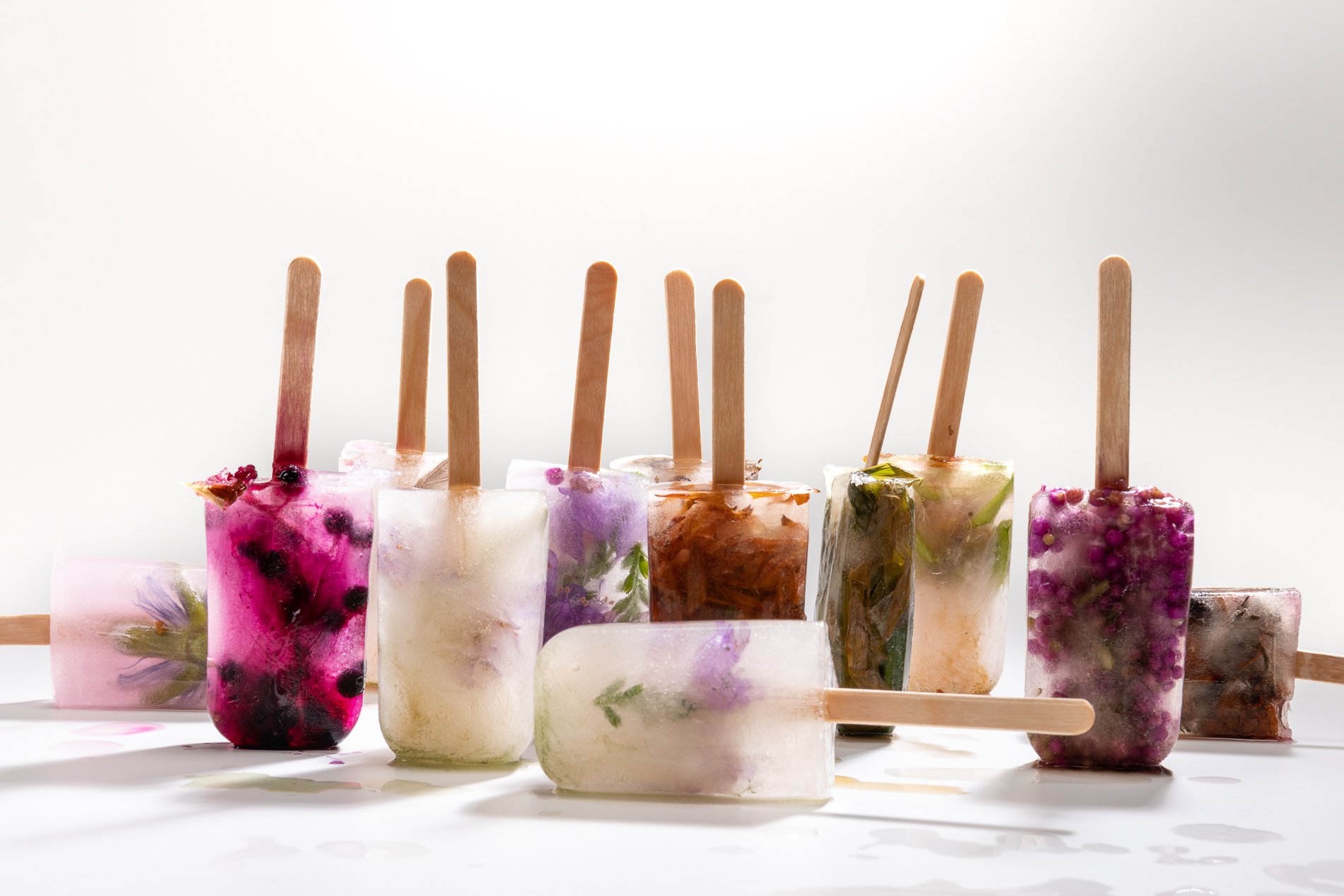
PLANET POPSICLES
6” X 6” X 24” ephemeral
Sticks, H20, Passionflower, Fall obedient plant, and American Beautyberry, Beatles, Pokeweed, Scarbs, Golden Rod, passed butterflies, and passed moths

New World Giant Swallowtail and Milkweed and the health of Monarchs. This tropical mikweed HAS to be cut down November 1. The Milkweeds are the host plants for Monarchs. They need to move south by November and won’t head south if Tropical Milkweed is available as a host.

Monarch and Climbing Hempvine. Climbing Hempvine is an aromatic delight. It reminds me if warmed sweet honey. The Monarchs agree.

Purple Coneflower and the Gulf Fritillary Butterfly.
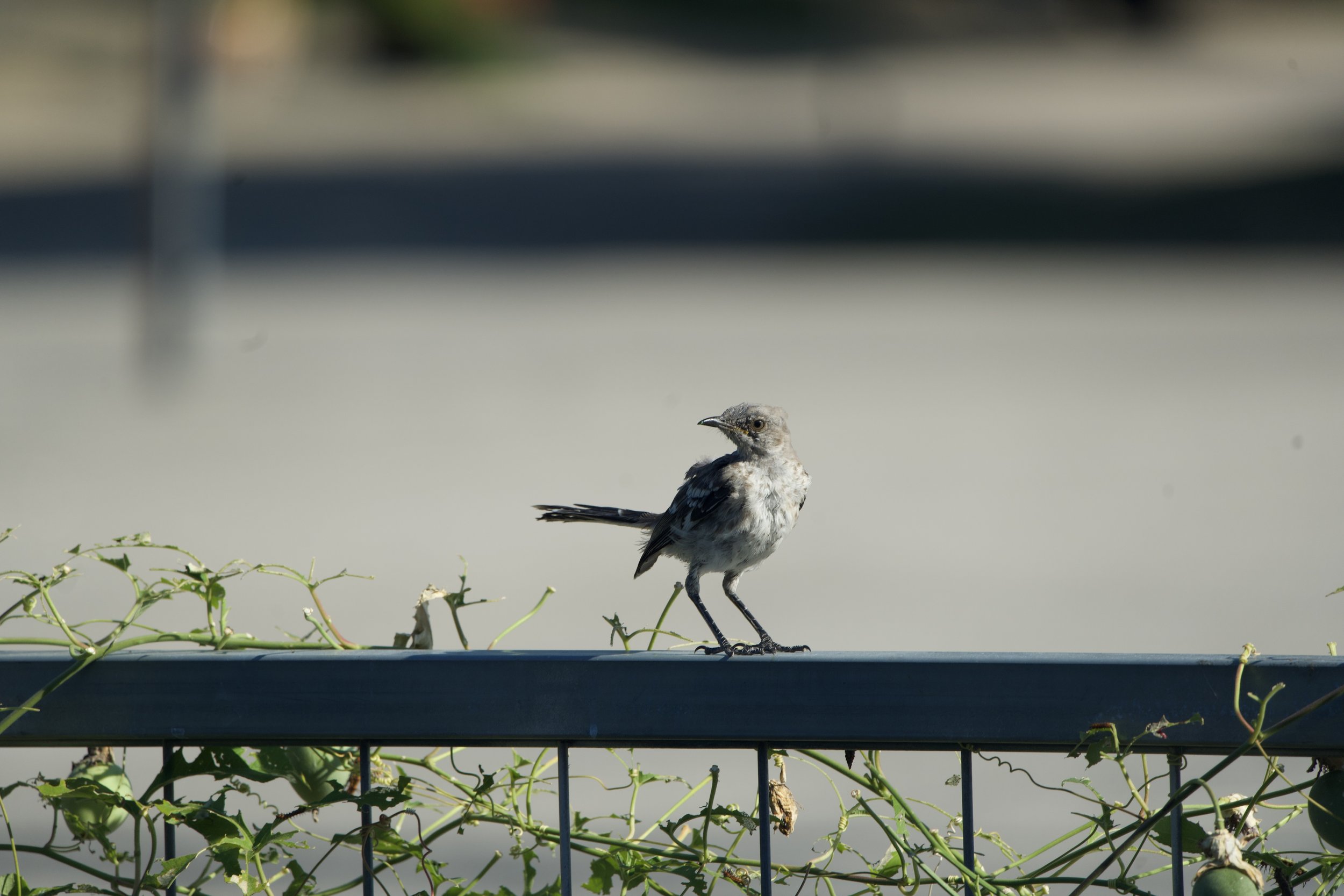
Mockingbirds and the fence. I have learned that birds need habitats with multiple elevations. The fence is a popular place for birds to look for insects and tiny toads to eat while keeping an eye on predators.

Monarch and Climbing Hempvine.

Ask upper of the Hesperiini family
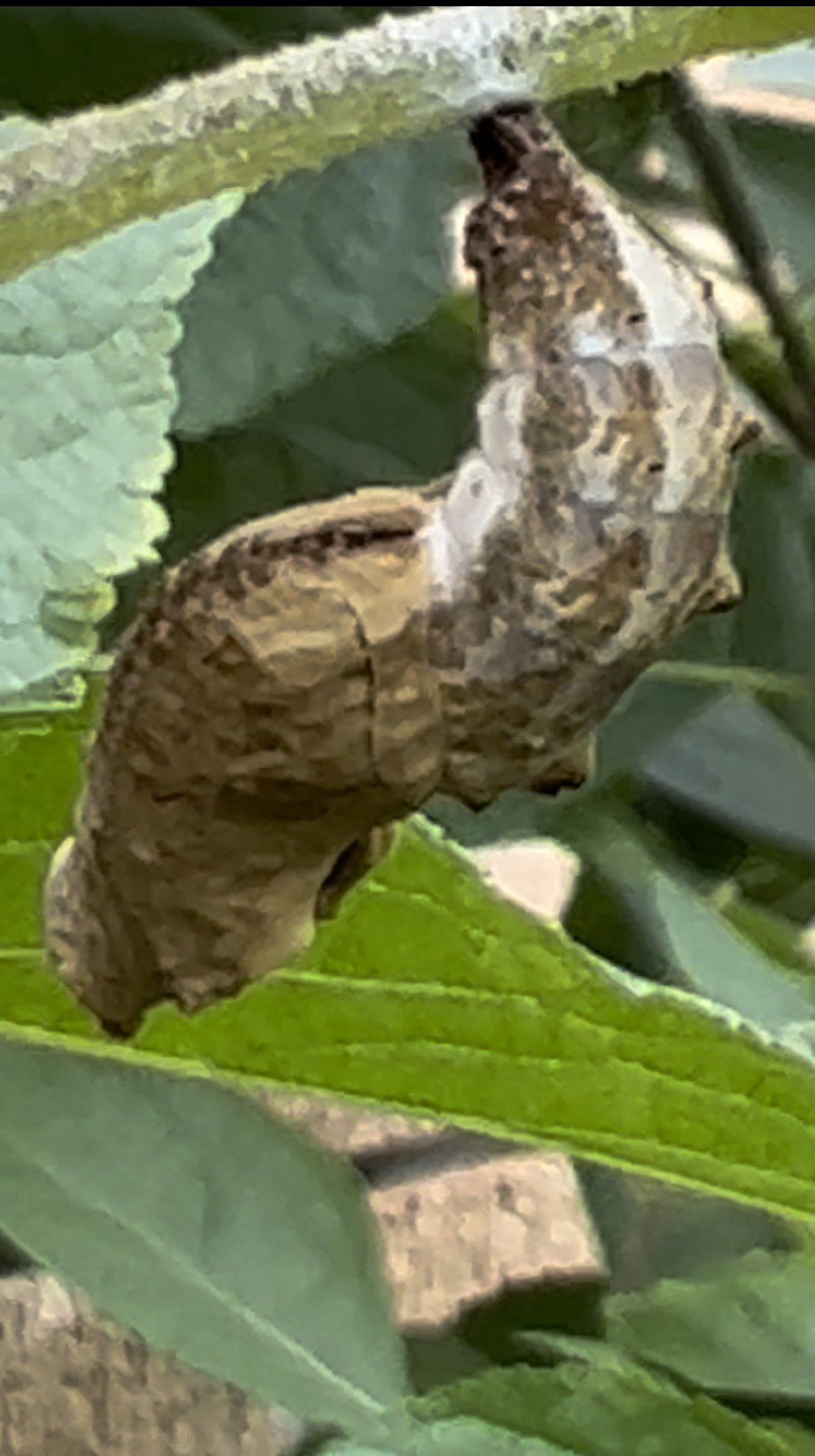
Gulf fritillaryon American beauty berry.

GulfFritillary on Marsh fkeabane pictured below.
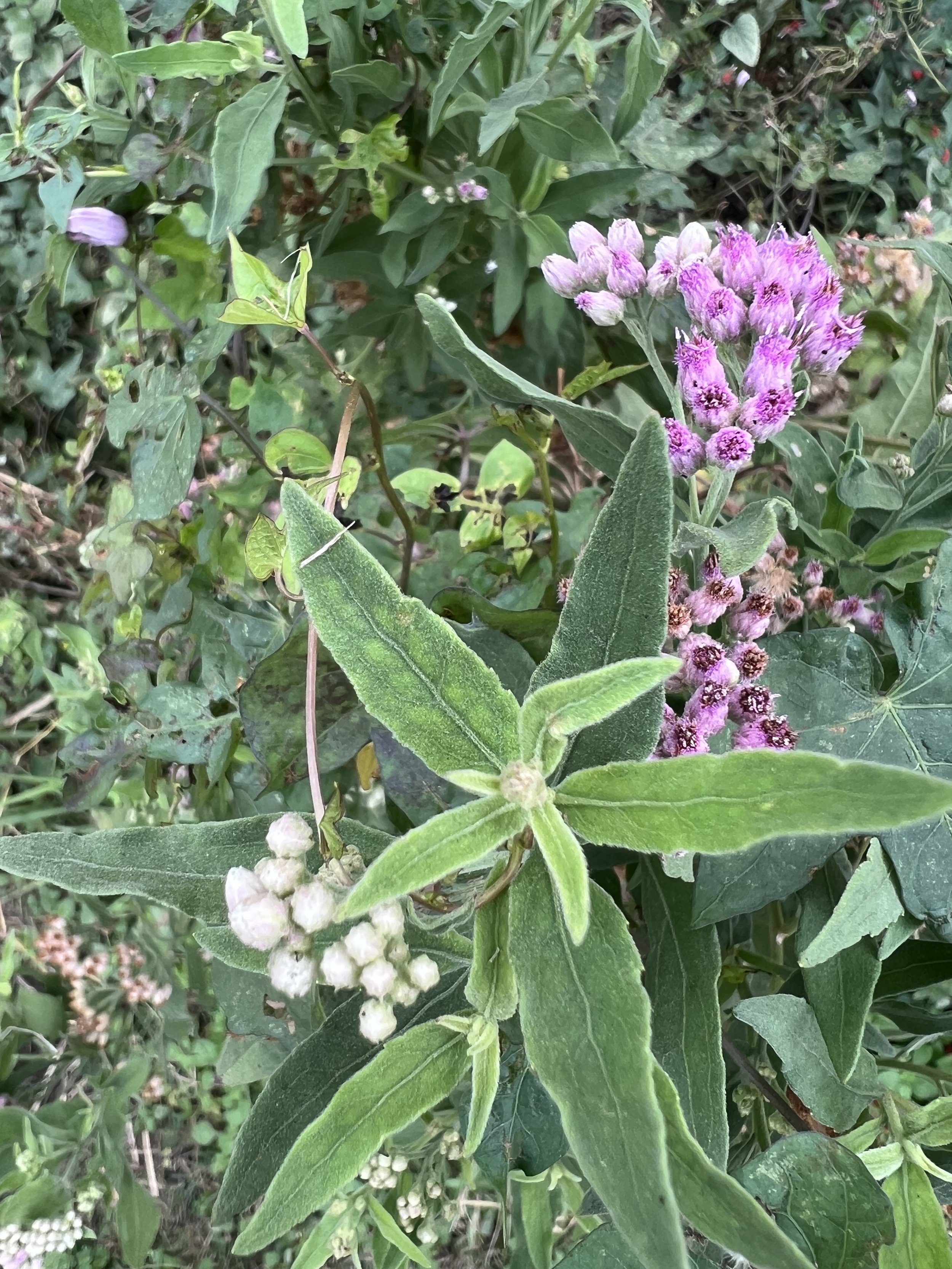
Marsh fleabane
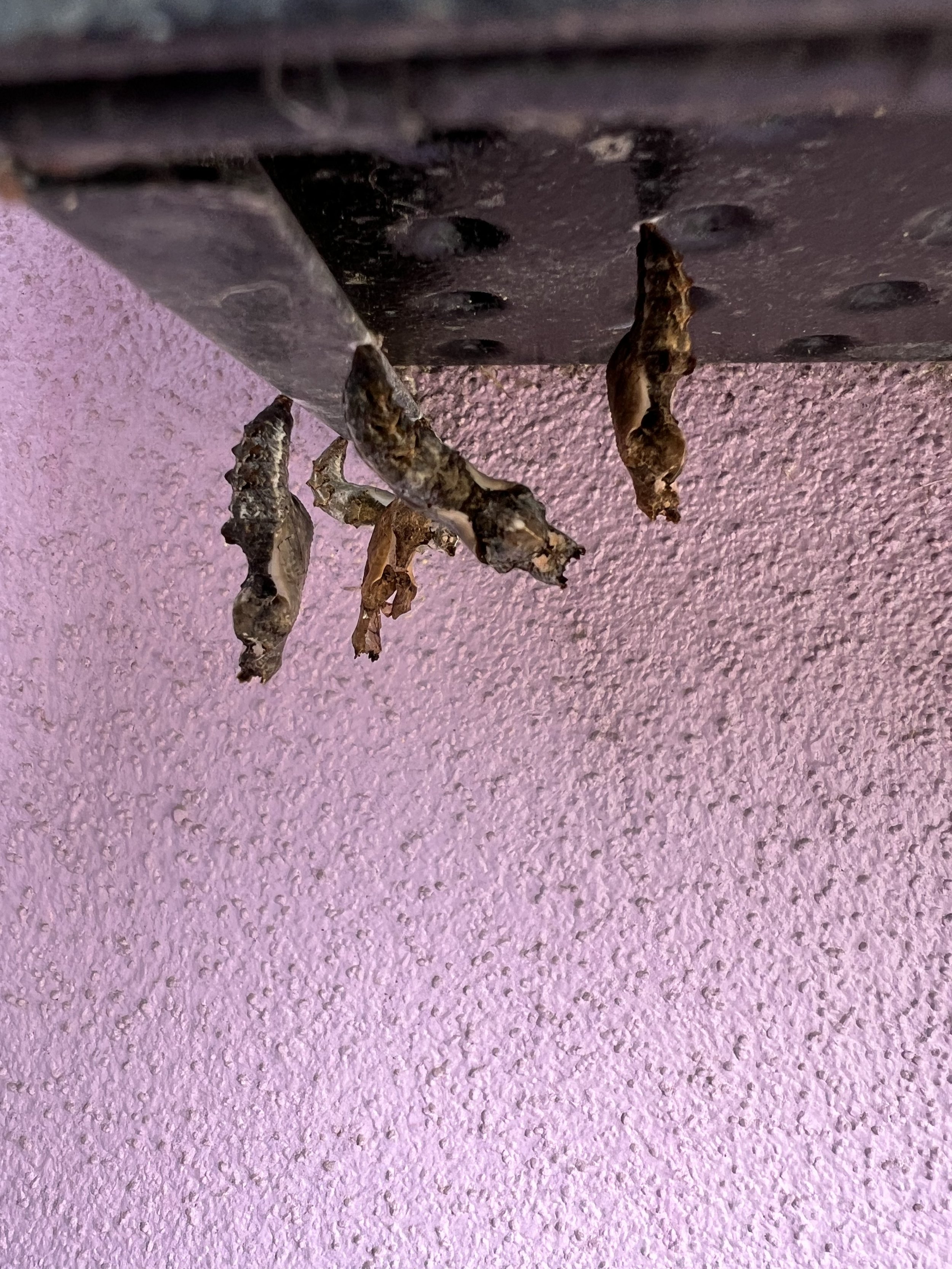
Gulf fritillary and Lawndale’s mailbox. Over a few weeks the count in the doorway climbed to over 200.

In identified mushrooms.
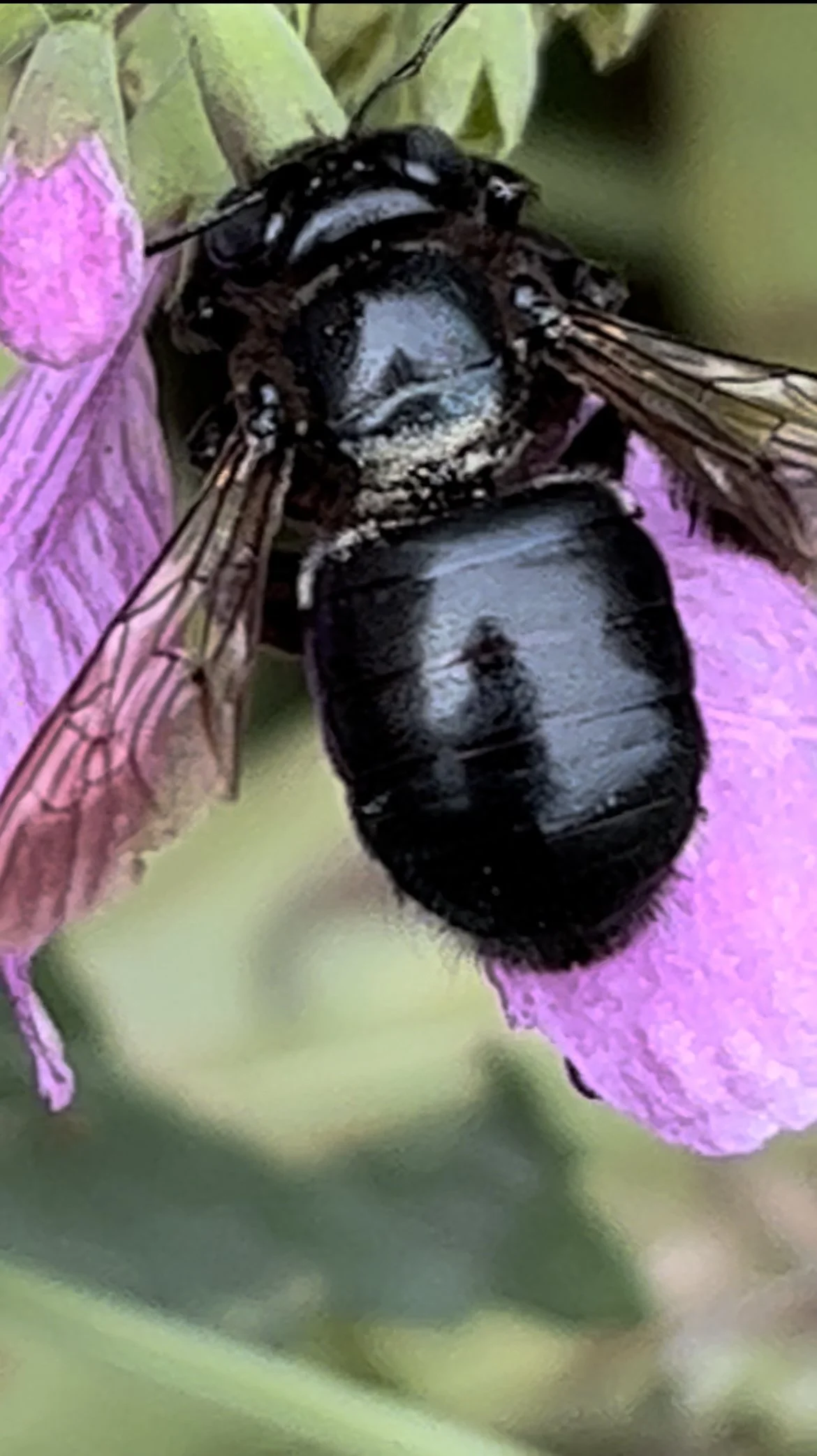
Carpenter bee

Gukf Fritillary are eating everything

How nature arranges itself
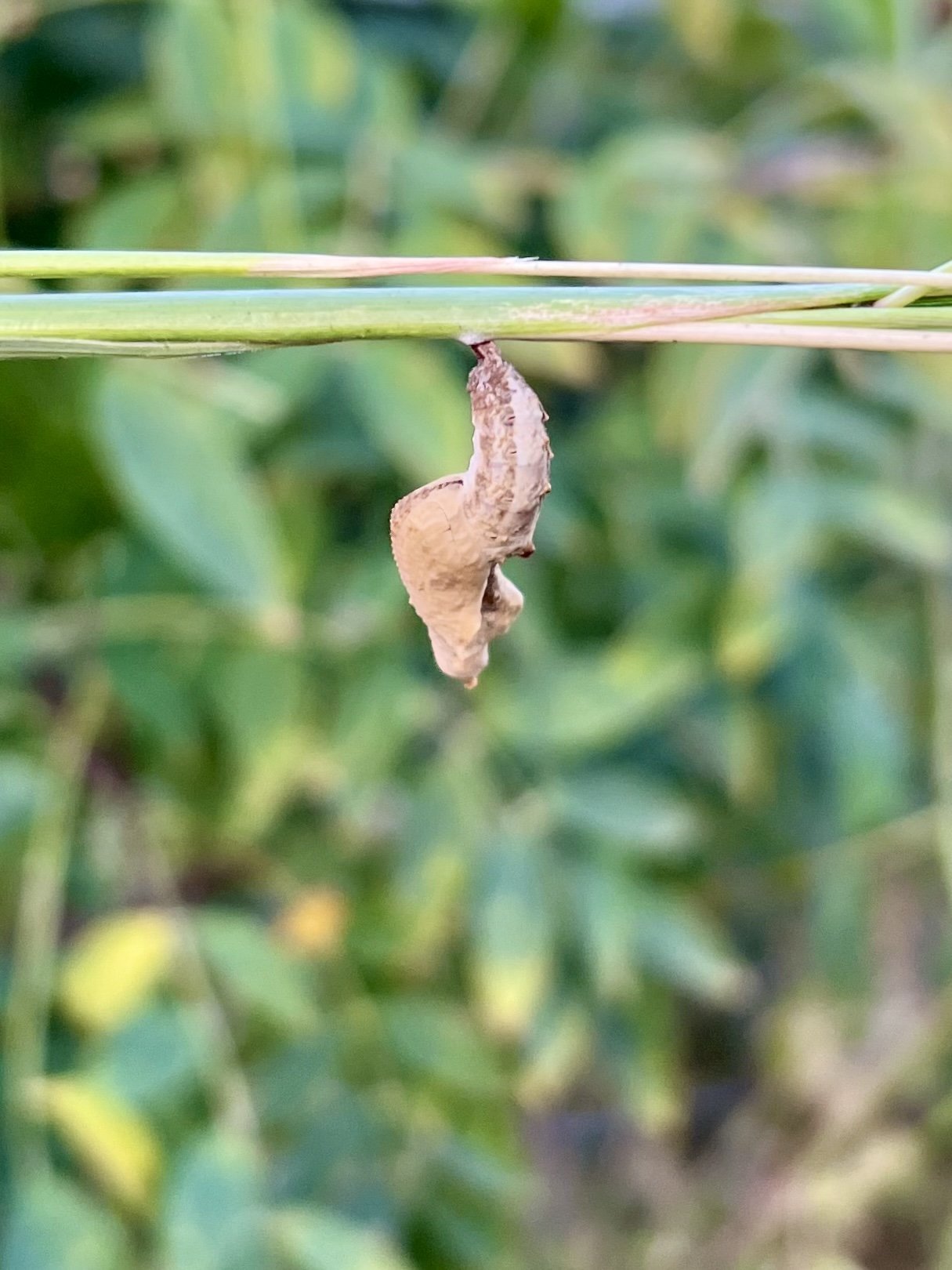
Chrysalis on crabgrass stem

Morning glory, mile a minute vine.

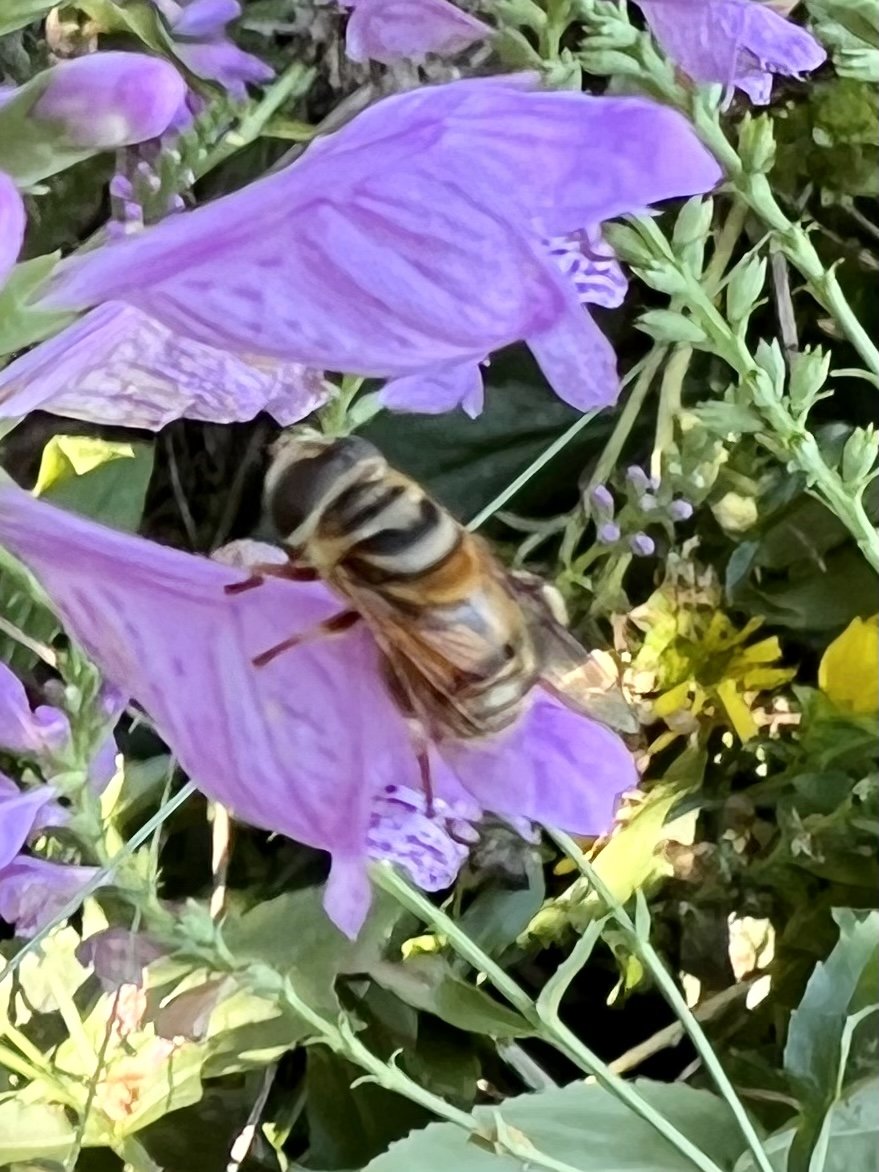
Carpenter bee and Obedient flower

The White viened pipevinesis is the host plant for the Pipelvine swallowtails. I wish I had more. The caterpillars devoures it, and then it comes back.

Cloudless Sulphur and Turkscap

Hemiargus ceraunus, it blue ceraunus,an d pasted native plants.

Monarch and Blue mist flower

Northern Mocking bird perched on the fence.

Northern Mockingbird and trough pond
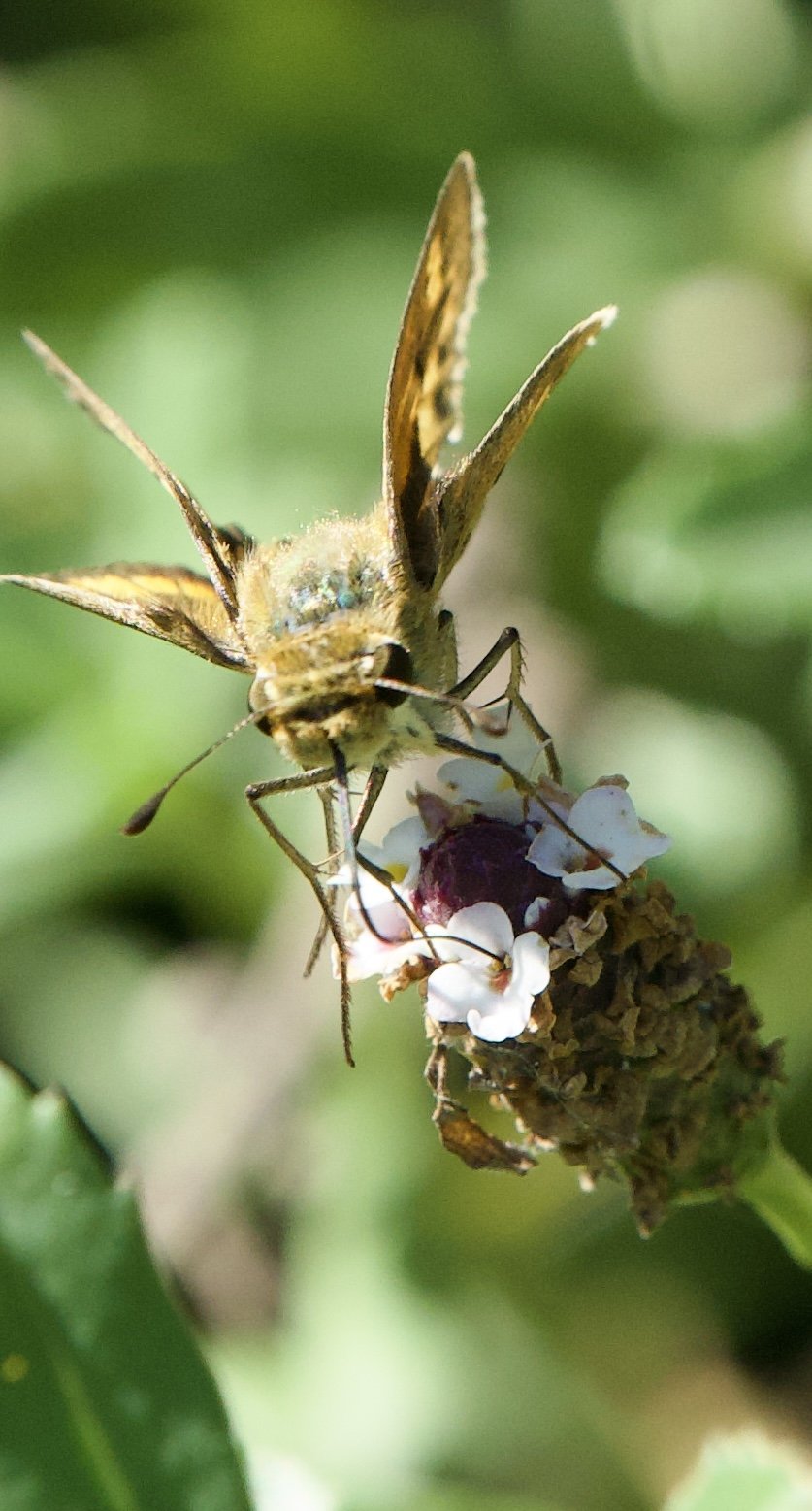
Hesperiina And Frogfruit

Pushfly and Passiflora leaf

True Sparrow stays in messy bush like spaces for safety and for a source of caterpillars

American snout butterfly
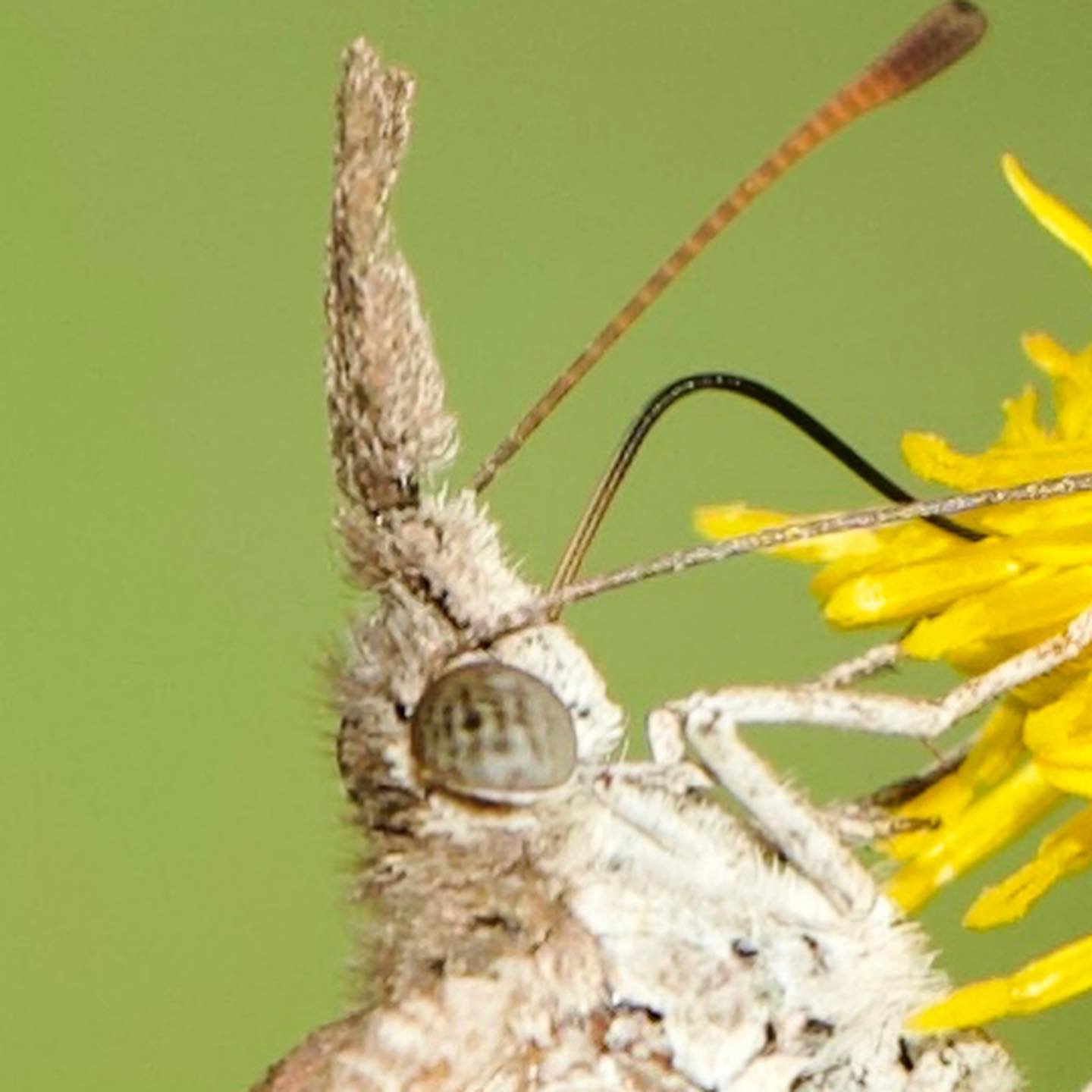

Gulf Fritillary with OE
“Ophryocystis elektroscirrha (OE) is a debilitating protozoan parasite that infects monarchs. Infected adult monarchs harbor thousands or millions of microscopic OE spores on the outside of their bodies. When dormant spores are scattered onto eggs or milkweed leaves by infected adults, monarch larvae consume the spores, and these parasites then replicate inside the larvae and pupae. Monarchs with severe OE infections can fail to emerge successfully from their pupal stage, either because they become stuck or they are too weak
to fully expand their wings. Monarchs with mild OE infections can appear normal but live shorter lives and cannot fly was well as healthy monarchs.
Although recent research shows that tropical milkweed can lower OE replication within infected monarchs (due to high levels of cardenolide toxins), this might not benefit the monarch population. In
fact, this could actually promote disease spread by allowing moderately infected
I PROJECT MONARCH
HEALTH
monarchs that otherwise would have died quickly following eclosion to live longer and spread more parasite spores.“- monarch parasites.
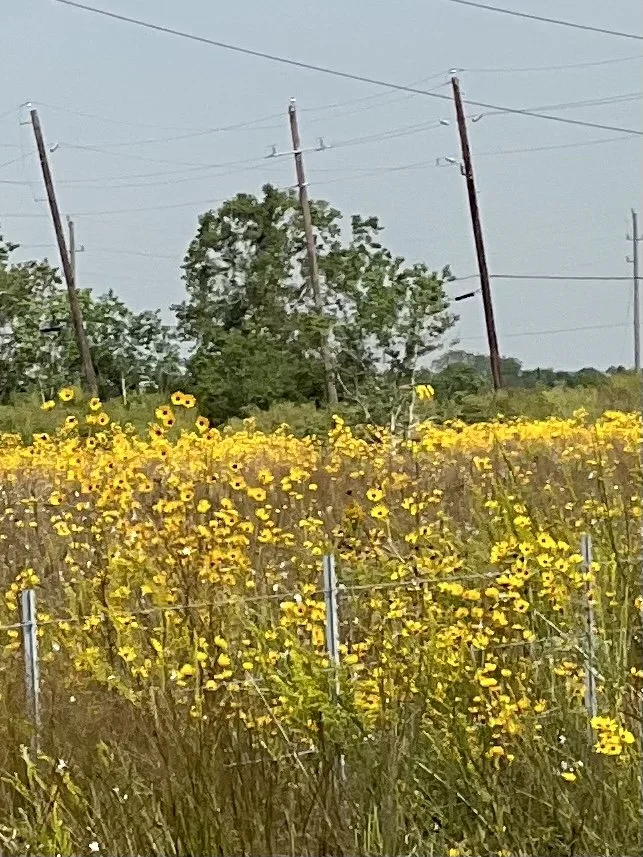
Gerhart Prairie in a drought
On October 7th, I was invited to participate in rescuing prairie plants from the Gerhart Prairie south of Houston. The Prairie, I believe, is part of the Texas Nature Conservancy. A manufacturer has a fenced-off area on the property. They will put in a road through the prairie to service the fenced-in operations. We were rescuing the plants in the designated place on the future road. Several Master Naturalists identified plants, as did Mark Morganstern of Morningstar Nursery. Mark kindly reaches out to me when free and needy plants are available.
That Saturday, I received an amazing list of the plants I rescued.
1.) Helianthus angustifolia (aka Swamp Sunflower)
this is the tall 'sunflower' plant with the very narrow leaves that have the edges rolled under.
(I think I may have inadvertently referred to this as Maximillian Sunflower, which is not what this is)
2.) Baptisia sphaerocarpa (aka Yellow Wild Indigo or Yellow False Indigo)
this plant is a small subshrub in the Fabaceae (Pea Family); it has trifoliate leaves without subending bractlets and it has bright yellow flowers borne on erect inflorescences. Its fruits are round, hence the Latin name sphaerocarpa which literally means 'round fruit'. It will bloom in the spring.
3.) Euthamia leptocephala (aka Bushy Goldentop)
This plant is in the Asteraceae (Sunflower Family) and is closely related to the goldenrods (Solidago spp.). Euthamias have round-topped inflorescences rather that the 'open-spray'-shaped inflorescences of the goldenrods. There are two species of Euthamia in our area -- the other is Euthamnia gymnospermoides (aka Texas Goldentop) -- it have longer and much narrower leaves than does E. leptocephala.
4.) Croton lindheimeri (aka Woolly Croton or Lindheimer's Hogwort)
This plant is a member of the Euphorbiaceae (Spurge Family). It has very small unisexual flowers surrounding by a yellowish tomentose hairs; the female flowers are borne near the base of the inflorescence while the male flowers are bunched near the apex of the inflorescence. This seeds of this species are an important food source for quail and dove and the plant is a larval host for several species of butterfly.
5.) Neptunia pubescens (aka Tropical Puff)
A member of the Fabaceae (Pea Family) in the Mimosoid clade (or subfamily) which means it does not have typical pea-shaped flowers. The flowers are bunched onto a round receptacle or head, each with a small inconspicuous corolla, but the numerous long stamens are quite showy. Neptunia pubescens sprawls along the ground. It is larval host plant for the ceranus blue (Hemiargus ceranus) butterfly and its seeds are consumed by many wildlife species.
6.) Lythrum alatum var. lanceolatum (aka Winged Loosestrife)
This member of the Lythraceae (Loosestrife Family) grows to be about 3-4 ft tall and produces long racemose infloresceces with smallish lavendar (pink,purple) flowers. It is a special value to native bees and is also used by hummingbirds and butterflies.
7.) Eupatorium serotinum (aka Late-flowering Boneset)
A member of the Asteraceae (Sunflower Family) which has rayless sporting only white disc florets. It is a perennial that emerges early in the year, but does not bloom until August - November. While it's flowers are small there are many of them, so that the plant is a real show-stopper in the fall. It is of special value to native bees and its nectar attracts butterflies and many other insect species and it seeds are eaten by many bird species. The plants you dug up were fairly small (maybe due to the drought this year; the species usually grows 4-5+ feet tall.
8.) Agalinis heterophylla (aka Prairie Agalinis, Prairie Geradia, False Foxglove)
This is a member of the Boraginaceae (Borage or Broomrape Family). There are several species found locally, but the most common is Agalinis heterophylla, easily distinguished by its deeply lobed calyx. It is a larval host for the Buckeye butterfly and attracts numerous insect species, including bees and bumblebees.
9.) Ludwigia octovalvis (aka Mexican Primrose Willow)
A member of the Onograceae (Evening Primrose Family), this plant likes its feet wet, so a low spot that collects water is a great place to plant it. It is fast growing and reseeds readily. It is a nectar source for butterflies and other insects and is a larval host for the water primrose hornworm moth (now there's a mouthful!).
10.) Conoclinium coelestinum (aka Blue Mist Flower)
Another member of the Asteraceae whose flowerhead do not have ray florets, but the long stigmas of the disc florets make for a showy flowerhead nonetheless. This species is NOT an annual (as I misinformed you yesterday, sometimes things stick erroneously in your mind), but rather a perennial that dies back to the ground each year and also spreads readily by seed. It attracts many late-season butterflies. It can be a bit 'bossy' as Mary Spolyar put it, but as I have found with vigorous natives a bit of pruning/thinning doesn't hurt them in the least.
I look forward to watching them thrive in Symbiosis.

The rescues

Skipper and Pokeweed


Endangered bumble bee and Salvia
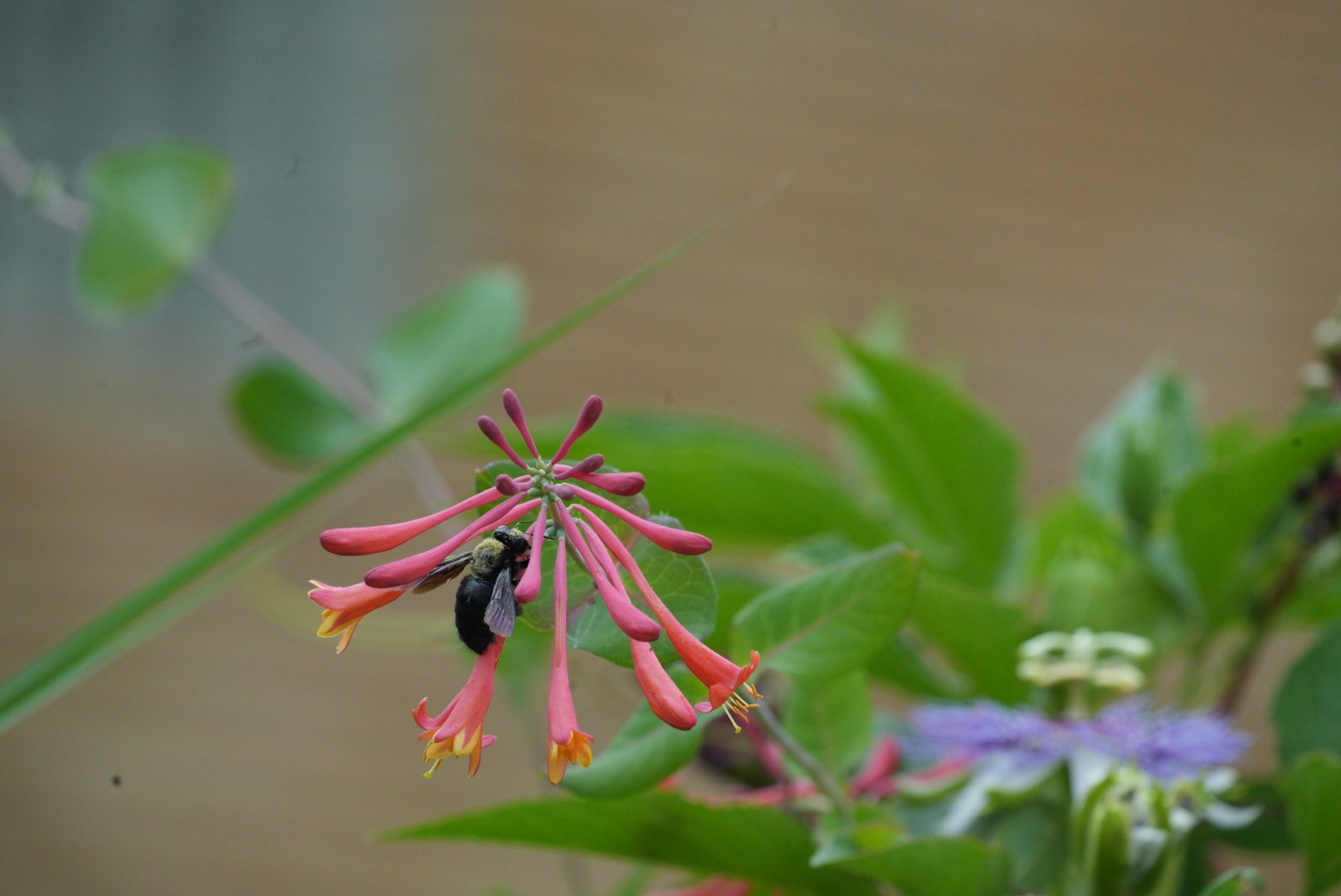
Coral honeysuckle and a native bee.
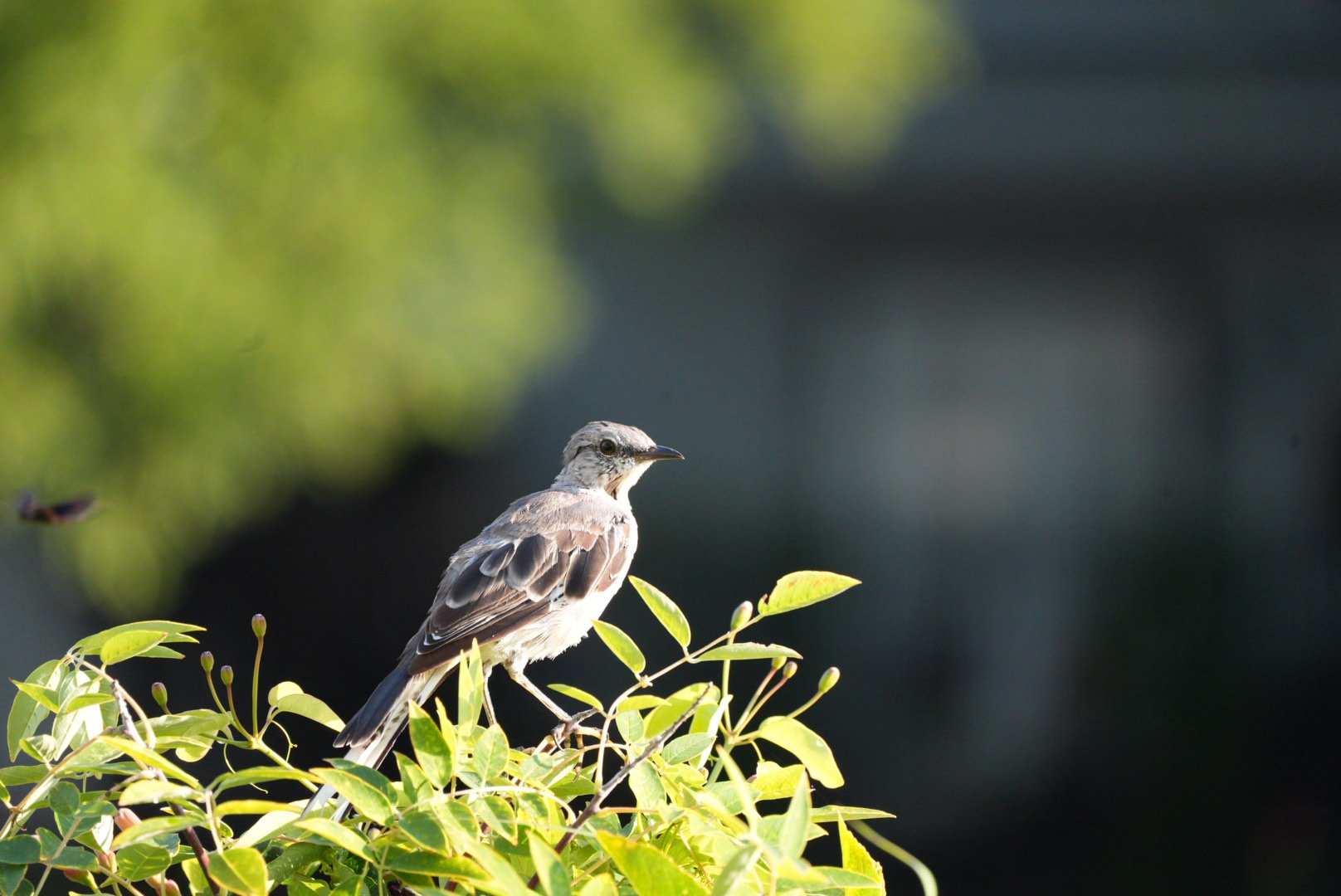
Mocking bird using an American Westeria vine as a lookout for insects to eatt.

Passiflora incarnate and carpenter bee.

Turkey tail mushrooms breakdown rotting trees recycling the nutrients.
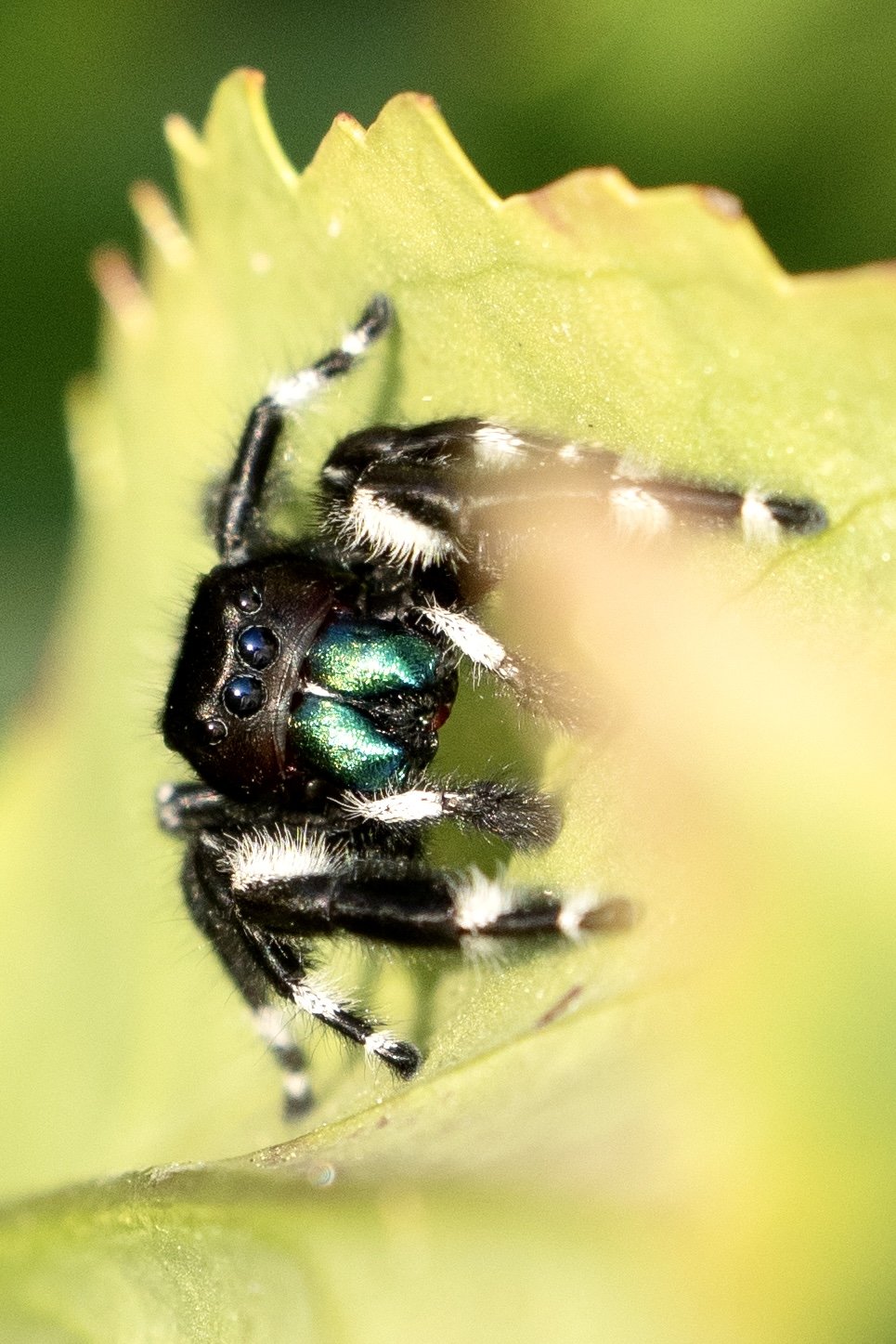
Jumping spider
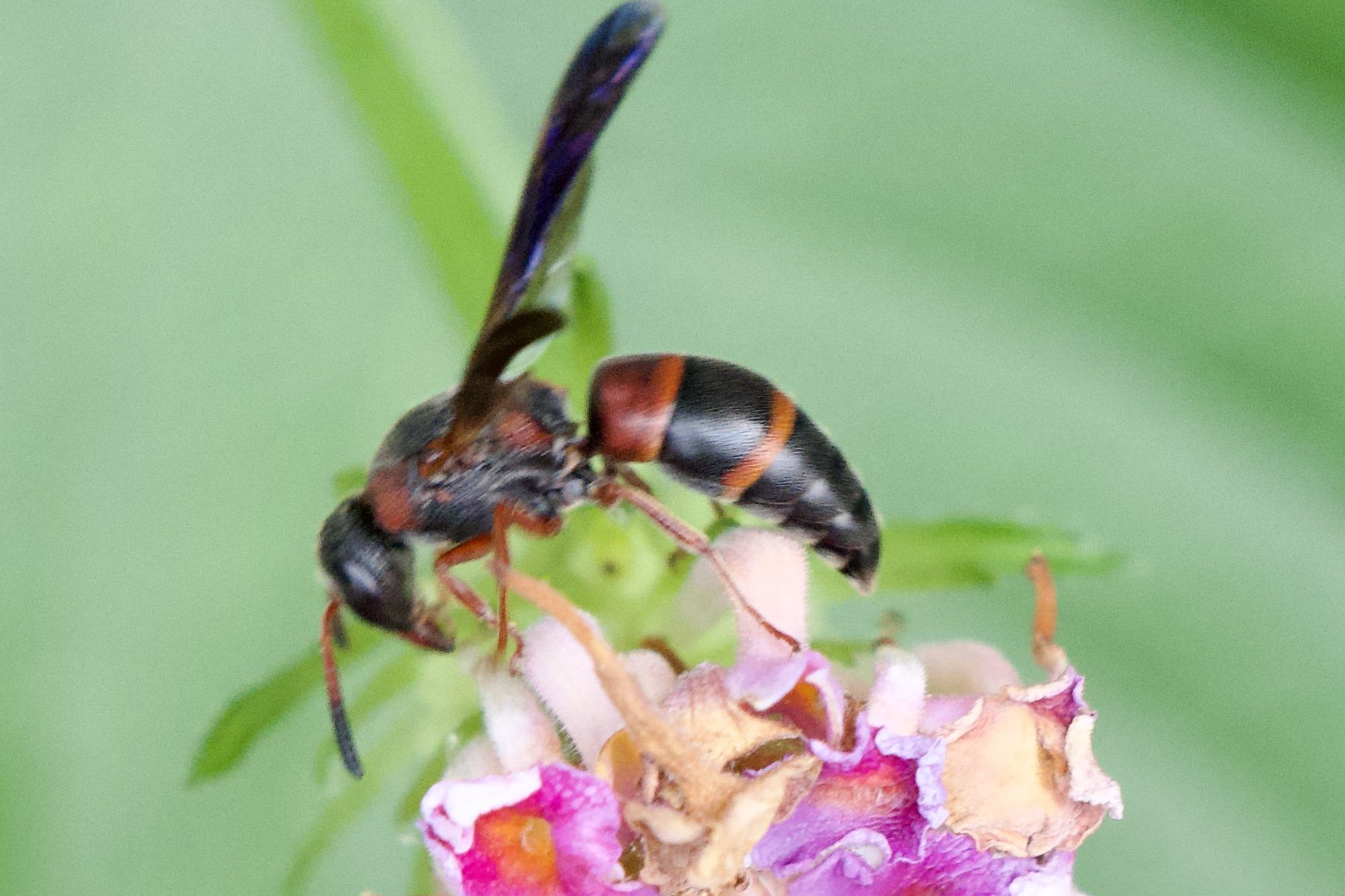
Pachodynerus erynnis, known generally as the red-marked pachodynerus or red and black mason wasp and Lantana camera. Lantanas are complex, I am not certain if this is a native to tropical US or an import. I think it is camara since I see beetles and wasps on it.
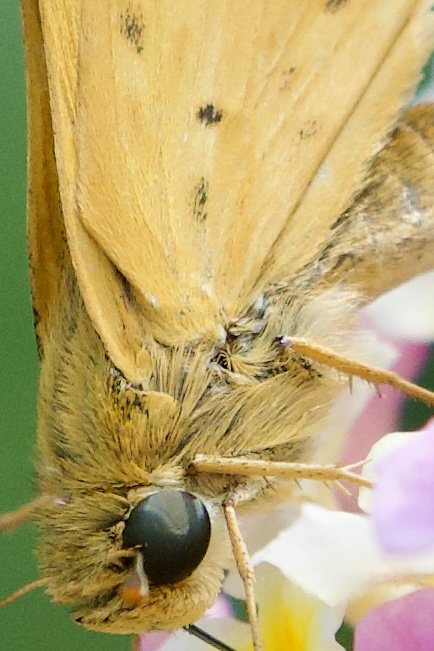
Clouded skipper on Lantana camara.


Common green June beetle and lantana camara.

Genus Pyrisitia minisa Yellow butterfly
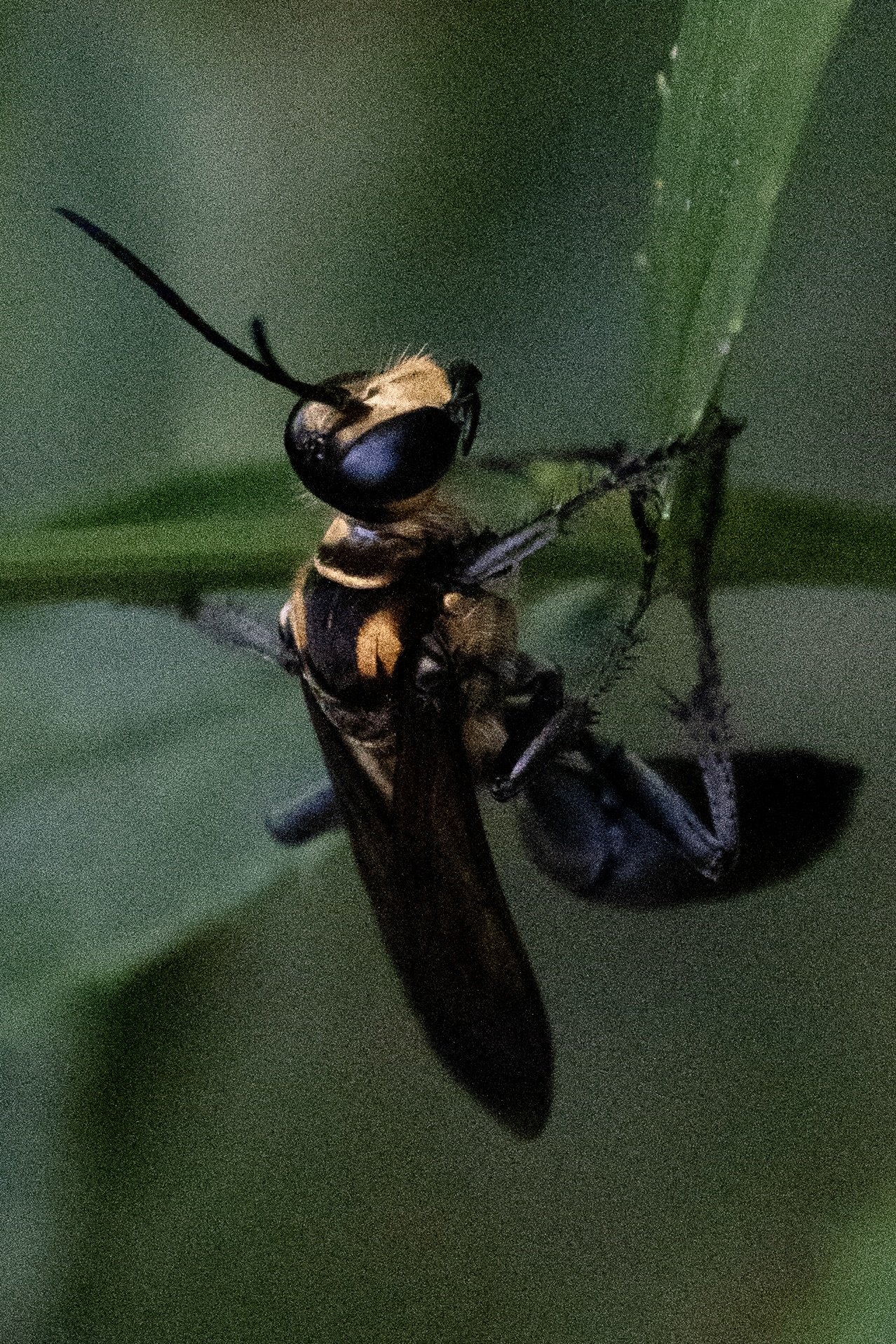
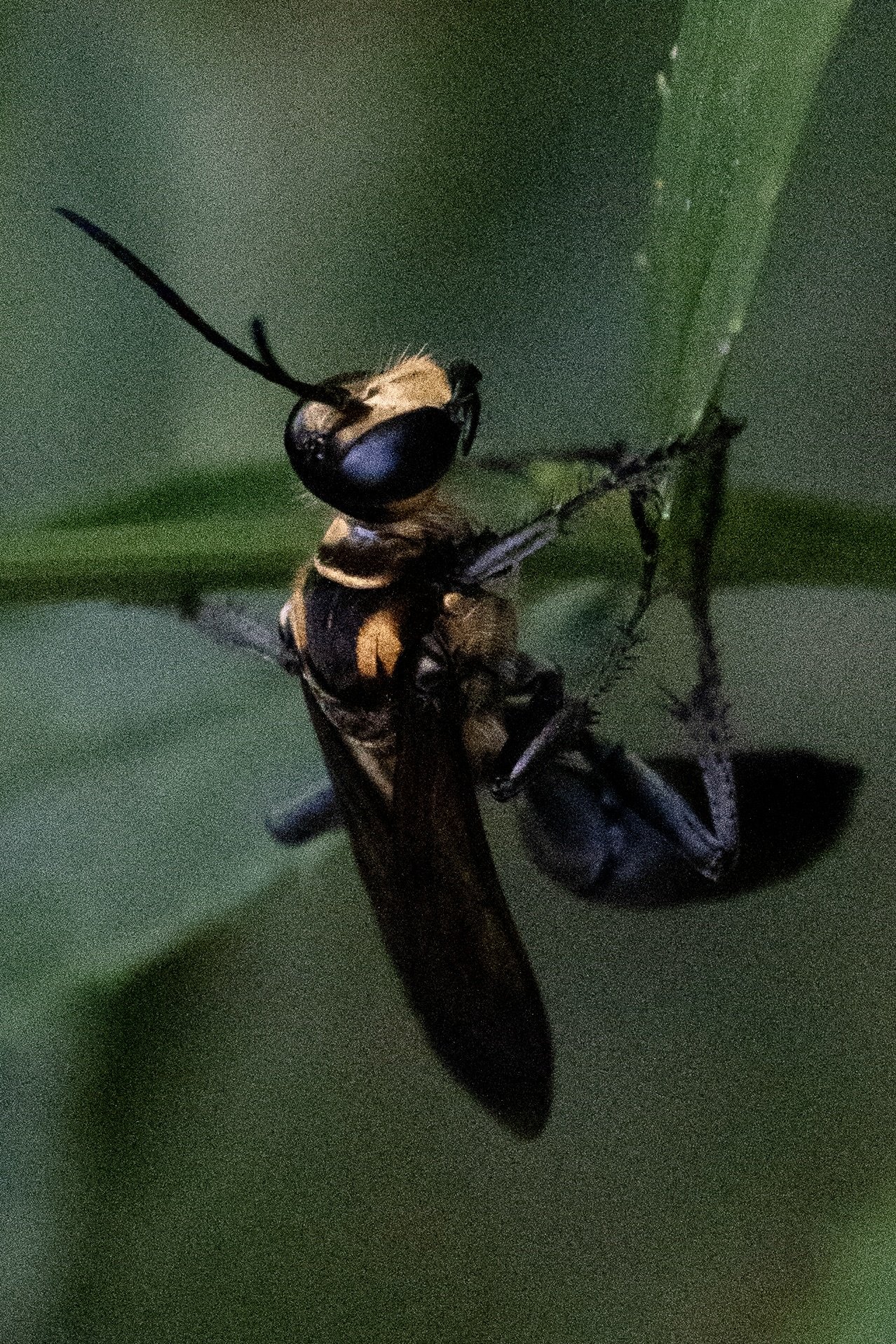
Golden-reined Digger Wasp
Despite its vivid alarm coloration, the Great Golden Digger Wasp is not an aggressive species of wasp. They tend to mind their own business and can be found sipping on flower nectar during the summer, but in the early spring, females prepare to lay eggs.
Females will dig into loose soil and create many deep tunnels. When established, she then covers them to hide their existence. A female will track a small insect and sting them to paralyze them, but not to kill them. Once the prey is immobile, she will clutch it using her antennae and mandible (mouth parts) in order to fly it back to the tunnels. While in flight with her prey, it is not uncommon to see birds like robins or tanagers attempt to steal her meal from her by chasing her until she drops it. No other known species of Digger Wasp is known to be harassed by birds in this way. If the female is successful in returning to her tunnels with her catch, she will place the paralyzed prey aside to quickly inspect a tunnel. If it looks like it's still intact, she will pull the paralyzed insect, head first, down into it. She then lays an egg on the insect, exits the tunnel, and covers it over again. She repeats this process for each tunnel. Unlike other wasps, she does not actively defend her nest. Once hatched, the wasp larvae will feed on the living, yet immobile, insect until they are developed enough to leave the tunnel lair in the summer. Eventually, the parasitism of the paralyzed insect kills it.
Scientists are studying the behavior of this unique species. Great Golden Digger Wasps seem to display a type of internal programming. If their insect prey is moved away from the tunnel while the female inspects it, she will emerge, relocate it, bring it back to the tunnel entrance and start the inspection all over again. Every female exhibited the same repetitive 'start inspection again' behavior when tested in that way.
Females have also shown that they do not keep a tally of how many insects they catch versus how many tunnels they create. If some meals are stolen by birds, they do not realize that they are short on insects compared to tunnels.
With such gorgeous orange and black coloration, mild demeanor, and interesting behaviors, the Great Golden Digger Wasp is one to admire, not destroy. Perhaps a careful observer will discover even more fascinating things about this species.
For many artists, satisfaction comes from selling their work. For me, happiness comes when others mimic my work.

A little over a year ago, I met a young couple with a commercial landscape business dept. I invited them to be part of my social sculpture water + air + citizen that took place this past winter. I shared with them the next phase of Carbon By The Yard. This spring I among many volunteers, briefly helped Maggie and Isaac install their inspiring monumental version this spring. Luckily it survived the drought and made the Chronicle.
This Novrmber 5th carbon By The Yardwhich will take place this November 5th. During the community family celebration on November 5th, the relief Carbon By The Yard will be transformed into Carbon Sink. Stay tuned to learn more.
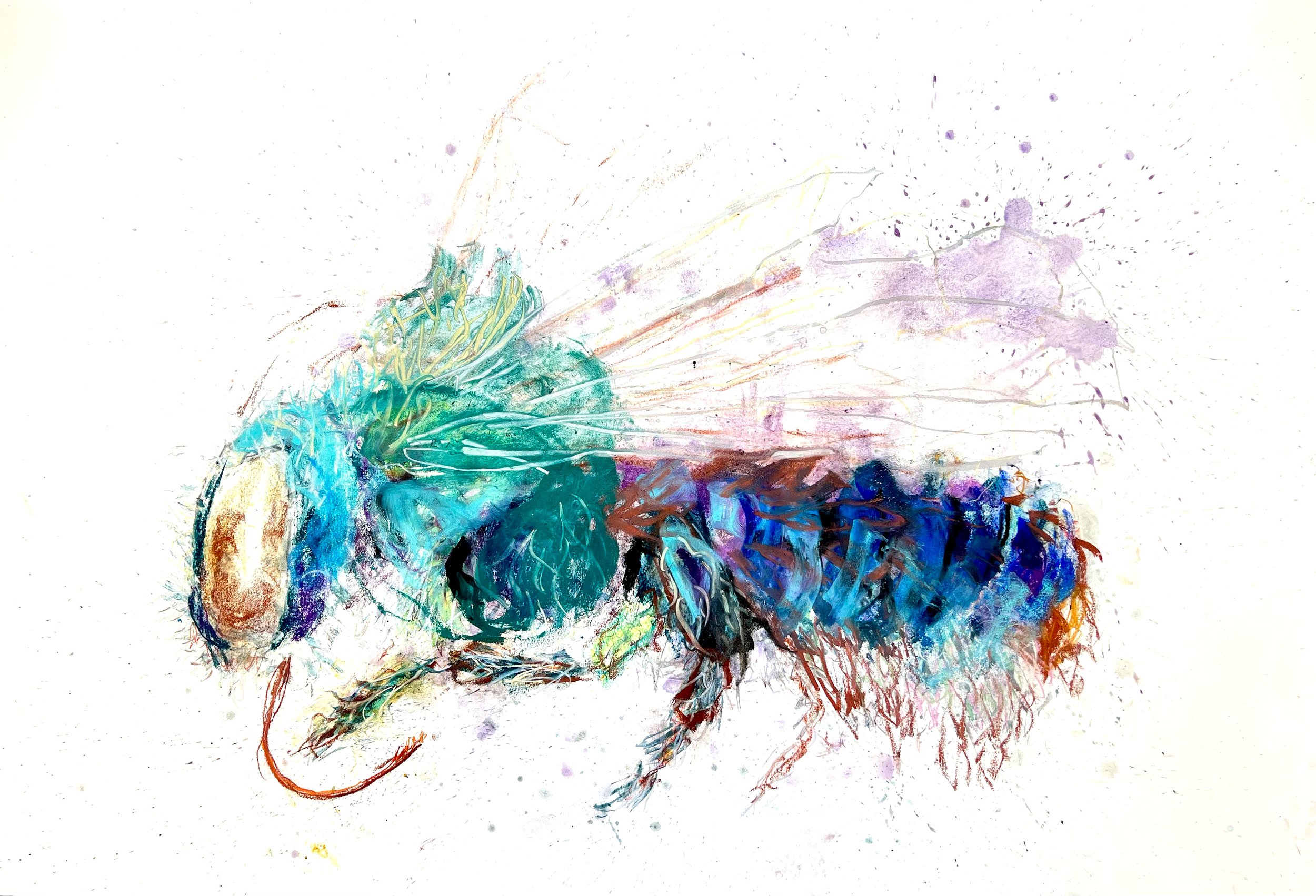
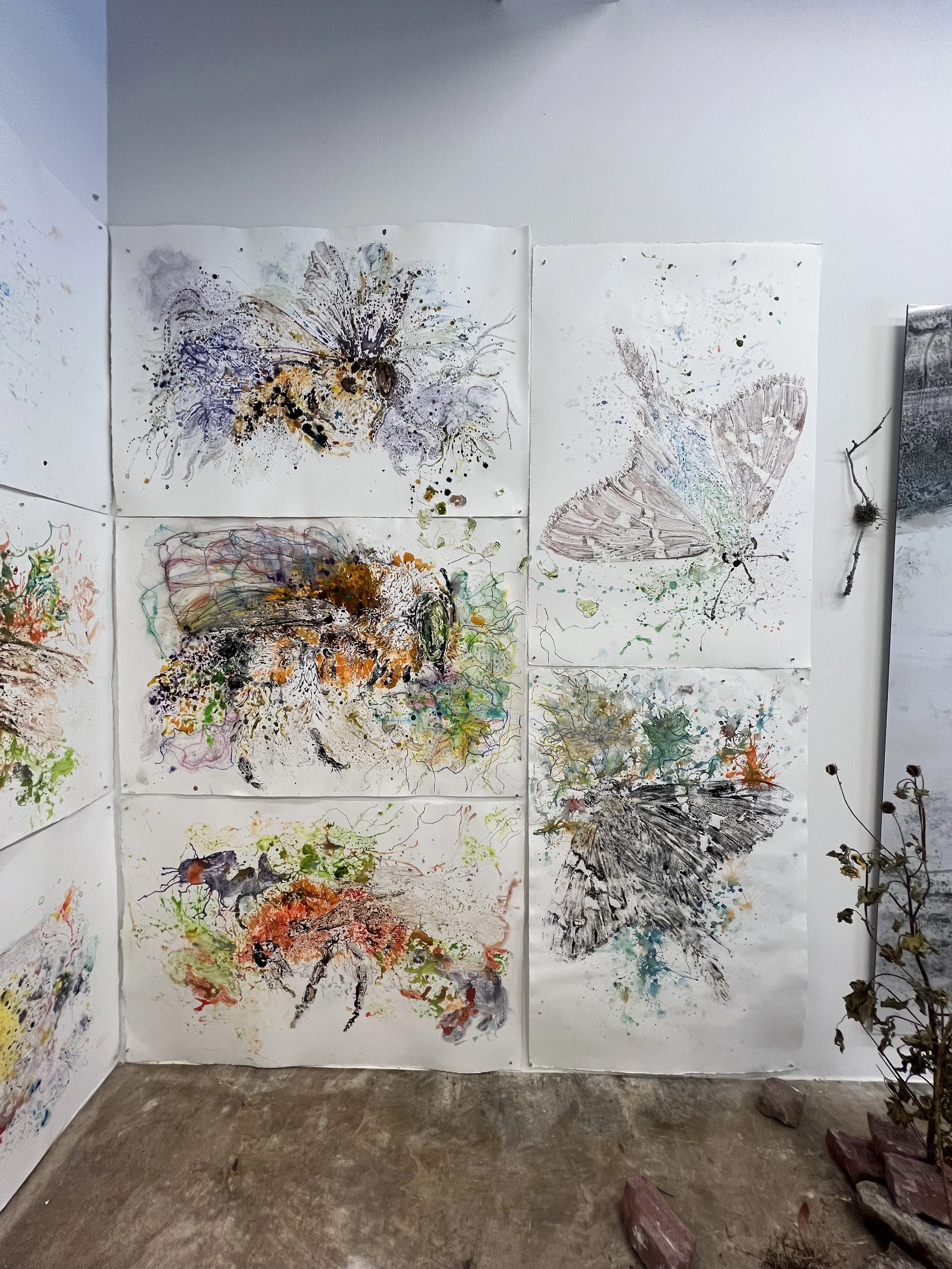
Osmosia aglaia
30"X 44”
Watercolor and pastel monotyoe
Osmia aglaia is 1/10,000 bee species. It is a N. American west coast bee, and exceptional in pollinating raspberries and blackberries. I am sad to report they are currently studied for industrialization.
Symbiosis Celebration
Social Sculpture
Proposal
By
Cindee Travis Klement
Proposed to Mayor’s Office of Cultural Affairs June 8, 2022
Fall color tourism contributes $1 billion per year to North Carolina. Houston has Fall color migration,
we can cultivate it into tourism and build soil health.
—from Chemical Plants to Native Plants—
Native Wildflowers, Food, Art and Music Festival
“If you dig deep and keep peeling the onion, artists and freelance writers are the leaders in society - the people who start to get new ideas out.” — Allan Savory
In April 2021, I installed the first native plants into Lawndale's sculpture garden. Within two months, Symbiosis exploded with bountiful native blooms. Plants expected by the Ladybird Wildflower website to be one to three feet tall in Symbiosis were instead two to four feet tall. In June, the endangered native bees started returning. In the first twelve months, I have witnessed seventy new species in the space: from bird nest fungus to Red Admirals, Monarchs and skippers, skimmers, one of the bumblebees listed as endangered, Bombus pensylvanicus, treefrogs, toads and birds.
Since Hurricane Harvey, harnessing the power of public opinion to mutualistically build Houston's landscapes into healthy ecosystems has been the focus of my art practice.
In our web meeting, I explained that in my artwork, Symbiosis, sponsored by the City's Initiative Grant at the Lawndale Art Center, I integrate holistic, regenerative biological systems into an urban landscape. I was inspired to create Symbiosis because I have read that our cities are fast-forwarding evolution. If this is true, integrating holistic, regenerative biological systems into urban landscapes will fast-forward ecological recovery. In Symbiosis, I use systems thinking to find a balance between humanity and Houston's wildlife; already, since the installation began in 2021, we are seeing a return of the lower food chain, which is critical for supporting birds and other wildlife that control the insects harmful to humans.
In the systems thinking state of mind, I also realize that profit is the fuel that will change society's landscape practices to embrace the planet's ecological systems in Houston. Applying economics and industrial concepts to the work, I propose that ecotourism is an untapped resource that can strengthen our environmental and economic health. I am writing to you with a proposal to start a wildflower festival, a Symbiosis Celebration, that ultimately encourages and celebrates new mutualistic relationships between Houstonians and the planet. Through fostering symbiotic relationships that regenerate Houston's micro-ecosystems, we will move our reputation from Chemical Plants to Native Plants — we can prosper as the Green Energy City.

STIMULUS
18” X 4.5” X 10”
$1500 in large bills and passed butterflies.
Building Mutual Symbiotic Relationships to Power Ecological Recovery
I envision this festival cultivating relationships among the City of Houston, local property owners, Houston's indigenous landscape and its wildlife, soil and climate, food, restaurant, music, visual and performing arts, museums and professional sports team communities.
The following steps will contribute to building these relationships:
· The business and private property owners will need to redirect their existing landscape budgets to native plants that support our wildlife.
· These new landscape practice guidelines will align with the Mayor's Office of Sustainability and Resilience.
· New native wildflower and grass landscapes will slow rainwater, allowing it to soak in and return to the aquifer to cool the planet while sequestering carbon and storing it in the ground where it is stable, providing food and safe habitats for our indigenous wildlife.
· The approximately six hundred species of birds, four hundred and thirty species of butterflies, eight hundred species of Texas native bees, one thousand species of moths, eighteen species of dragonflies, thirty species of turtles, including two box turtles, and seventy-two species of amphibians native to Texas will expand their populations in our city.
· Houston's creatives in the food, restaurant, music, visual and performing arts, museums and professional sports industries will respond to the new mutualistic/symbiotic relationships among Houston's landowners and our unique plant and wildlife in exciting creative ways and performances during the festival.
· The City of Houston will promote, market, and support the above-described new relationships with its services infrastructure, completing the mutualistic relationship that will support Houston's economy and ecosystems.
Why Houston Can Support Ecotourism
Although Symbiosis taught me the speed with which an urban landscape can transform into a wildlife haven, it was not until I was in Fredericksburg that I realized Houston's ecology is an untapped tourist economy. When you combine Houston's rich soil, high humidity, heat and long growing seasons with the indigenous native plant landscapes supported by Houston's urban irrigated commercial and park landscapes, Houston's native plant wildflower and wildlife tourism can far exceed those of the small towns in Central Texas. Another tremendous asset is Houston's central geographic location in the bird and butterfly migration paths between the North and South American continents and our proximity to the Gulf Coast. Texas has the most butterfly species of any state in the U.S. Houston's inner city is 600 square miles; our "sprawl" is an asset to urban ecotourism.
As additional support that Houston can be an ecotourism powerhouse, I have read that one of New York City's most popular tourist attractions is The High Line's native landscaping. In North Texas, Plano also uses wildflowers and music to attract tourism dollars.
Funding
I see businesses and organizations all over the city which are starting to take advantage of the ecological benefits of native landscapes. Unfortunately, many other property (business and home) owners are unaware of the economic and environmental benefits of native plant landscaping. They spend $50-$100 per hour for weekly maintenance and $4—$12 per square foot for seasonal plantings, while also incurring high water usage and bills. Suppose the City appeals to these businesses and individuals to convert their existing non-ecological landscape budgets to native wildflower and grass landscapes. In that case, the City can promote a native plant/wildflower and wildlife, food, arts and music festival that will symbiotically support native ecological systems. The supporting businesses can profit from the tourism they generate.
When
With Houston projected to double in size by 2050, if we start now, benefits will compound. The timing of the festival should fall during one of the migration periods.
The Texas Can-Do Spirit
Systems thinking to mitigate climate through industry and the arts is a new territory — will Houstonians embrace this new field of thinking? In Texas, that depends on how you ask and present the need. In our recent history, from Katrina to hurricane Harvey, unsolicited Houstonians volunteered to help their neighbors. In 1901, wildcatters discovered Spindletop, drawing people worldwide to build a better life in unknown territory. “Wildcatter” is used to describe one that drills wells in areas not known to be producing fields. The spirit of the wildcatter is deep in our Texas Can-Do Spirit. It is in our nature to embrace a new field of wild.
The Next Step
Recently I went to a free event at the Ion; the people giving the talk are in the business of researching the economics to support new business ideas. They also create "stacks" or PowerPoint presentations to gain financial support for new ideas. Their fee is $6,000. Unfortunately, it is beyond my budget.
Is this sort of analysis provided by the Mayor’s Office of Cultural Affairs or another City of Houston office to determine the new cultural or social events that would benefit our city?
The support of the Mayor’s Office of Cultural Affairs is critical for social sculpture to transform the city from Chemical Plants to Native plants and earn the title of The Green Energy City.
This is part of a large body of work I started in 2019, Rumblings.
I pressed this monotype in 2019. I loved parts of it and not others. In 8/2022 with pastels I addressed the issues that we're not working on. I am pleased with the minute beast.

Agapostemen Virescens
watercolor and pastel monotype
30” X 44”
Little is known about this metallic green eye-catching Agapostemon virescens, a bicolored striped-sweat bee in the family Halictidae. It is commonly found in North America and is the official bee of Toronto. Its metallic green head and striped abdomen make it identifiable

The bicolored sweat bee is a solitary ground nesting bee. Each spring the female will dig a tunnel in an open patch of ground. Off the tunnel will be several branches. After building her nest, the female will gather pollen, take it back to her nest, form it into a ball with a little nectar and place it in one of the branches before laying an egg and sealing off that branch so each egg will have its own “room.” -.backyardecology



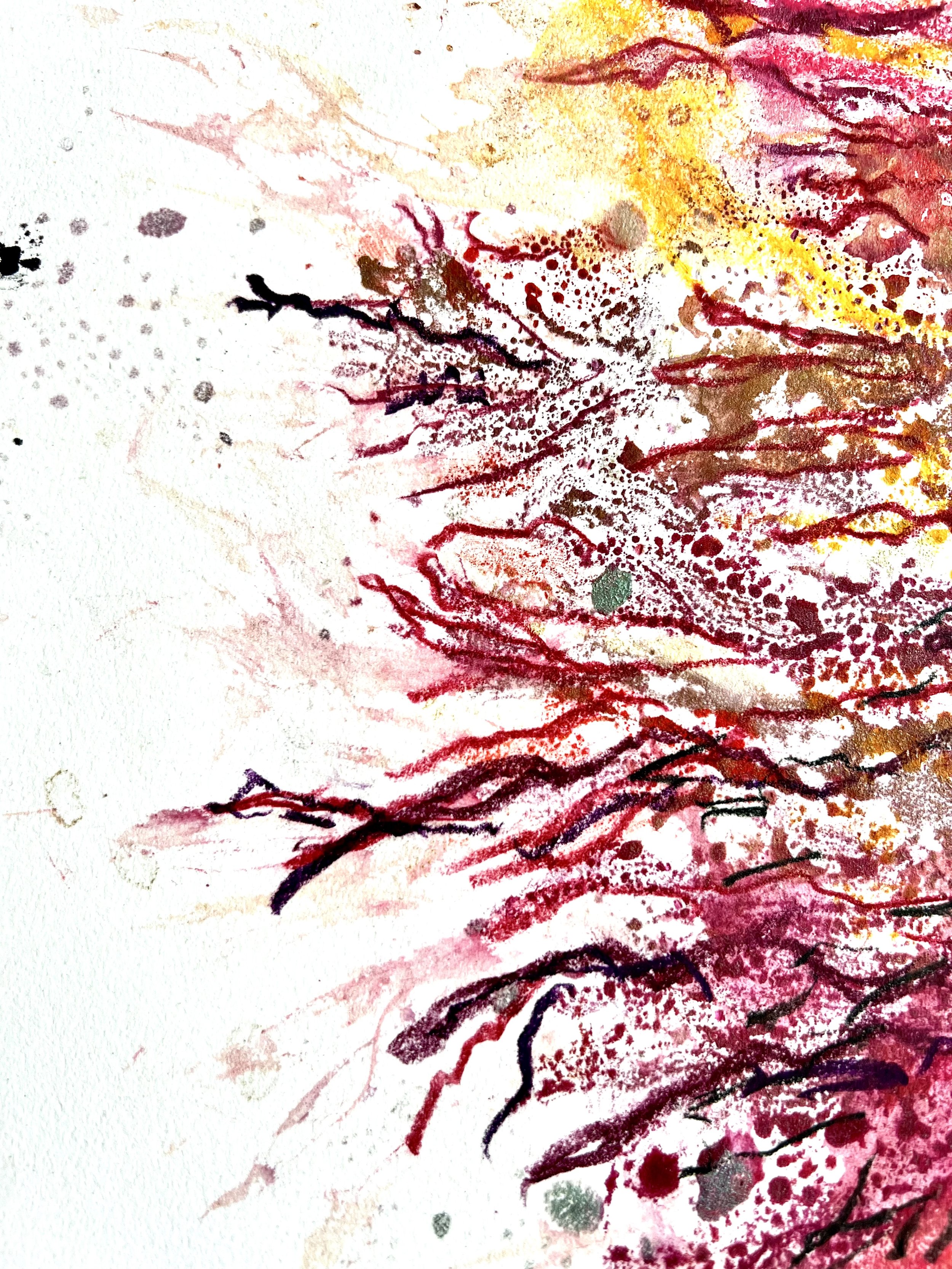
Leafcutter (petal cutter) Megachile and the Blanket flower
Watercolor and pastel monotype
30” X 44”
Leafcutter bee flying to its nest just after cutting a petal from the Texas native Gaillardia pulchella aka blanket flowers. They use the petals to protect walls and to seal their nests. In exchange for the petals, the leaf cutter pollinates the blanket flowers bloom. It is one of my favorite relationships in “Symbiosis.”


When I started in the MFAH Glassell School block program, I needed pedestals for my smaller sculptures. I made stark white cubes as I saw in museums and galleries.
Over the years, my work has transitioned to tell a specific story. I make work to reveal the beauty in diversity, the messiness in the natural world and the connections between all living things on the planet. And most importantly, I work to inspire society to step into a rhythm that will flow with the natural world and celebrate the beauty in its messiness. My work conflicts with borders that separate, clean lines that divide and sterile objects.
The white cube pedestals are a symptom of sameness, monocultures and sterile environments, a symptom of me wanting to ” look “ like I belong and fit in. A change is an imminent.
I am leting my eyes and mind play with how objects that physically support my work should look. Work that reimagines urban landscapes to balance humanity and natural systems should not be sterile cubes. What should, - what could they be?
The images below are some thoughts I am considering. .

Rocks

Bricks
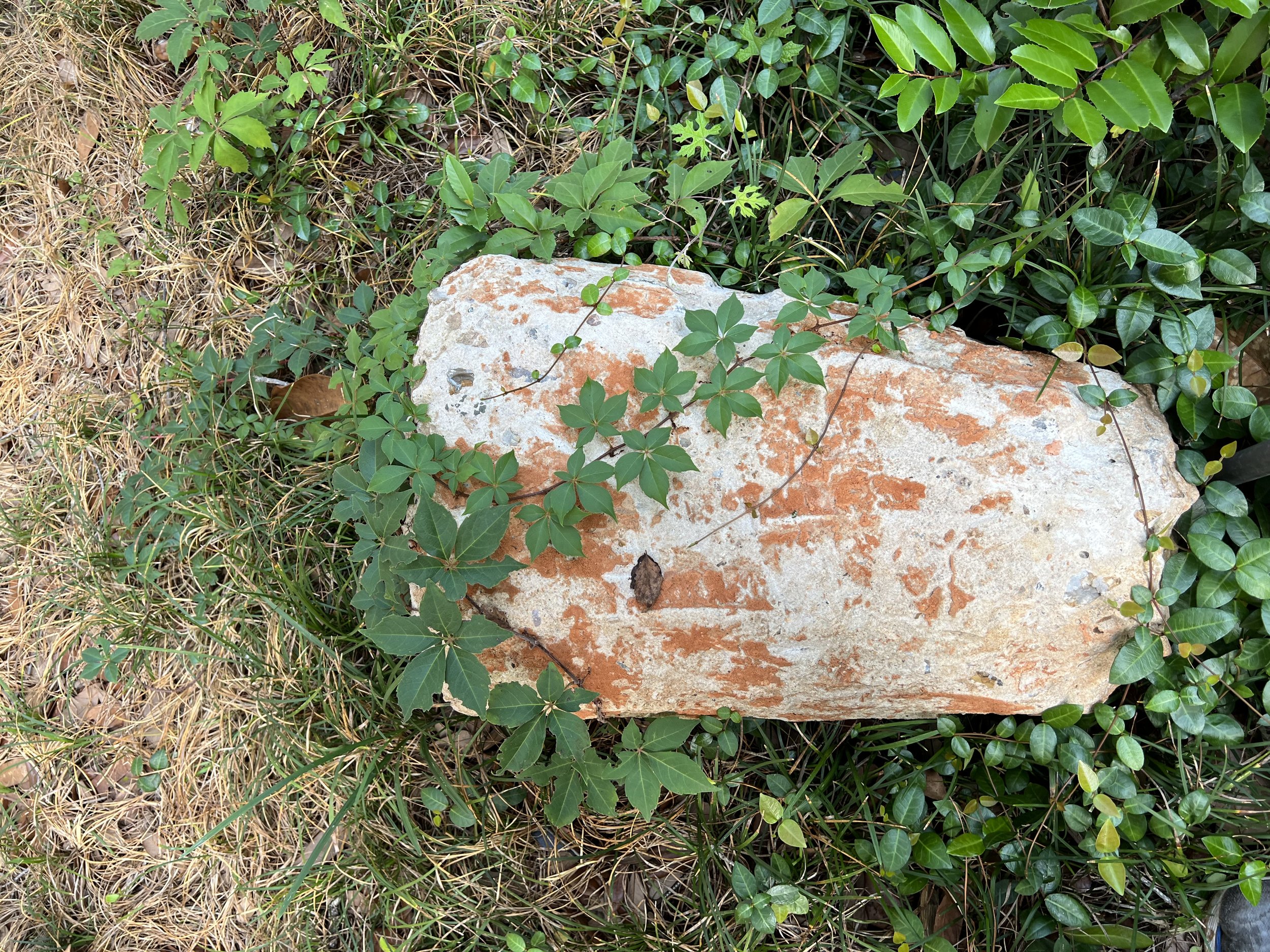
Stones or concrete.

Cracks

Dried plant material

Electrical wire

Upcycled lawn furniture.

Palm tree trunk skin

Salvaged construction site rotting root with interesting chain link necklace imbedded across her shoulders.


Orange blister beetle and Ratibida columnifera
prairie cone flower. The beetle eats problem insects.

Gulf fritillary butterfly's mating and green anole ruins the mood.

Xylocopa virginica, the Eastern carpenter bee has evolved to the exact height to Maximize pollinating Passiflora incarnation. This relationship is one of my favorites in Symbiosis.
Soaking wet American bumble bee (endangered bee) using a Missouri ironweed leaf as an umbrella.
black mud daubersa, is a solitary wasp. This female his hunting for caterpillars to provision her mud nest. Plants recognize the vibrations of caterpillars chewing. This causes the plant to send out pheromones to attract wasp to keep the caterpillars down. She seems frantic.

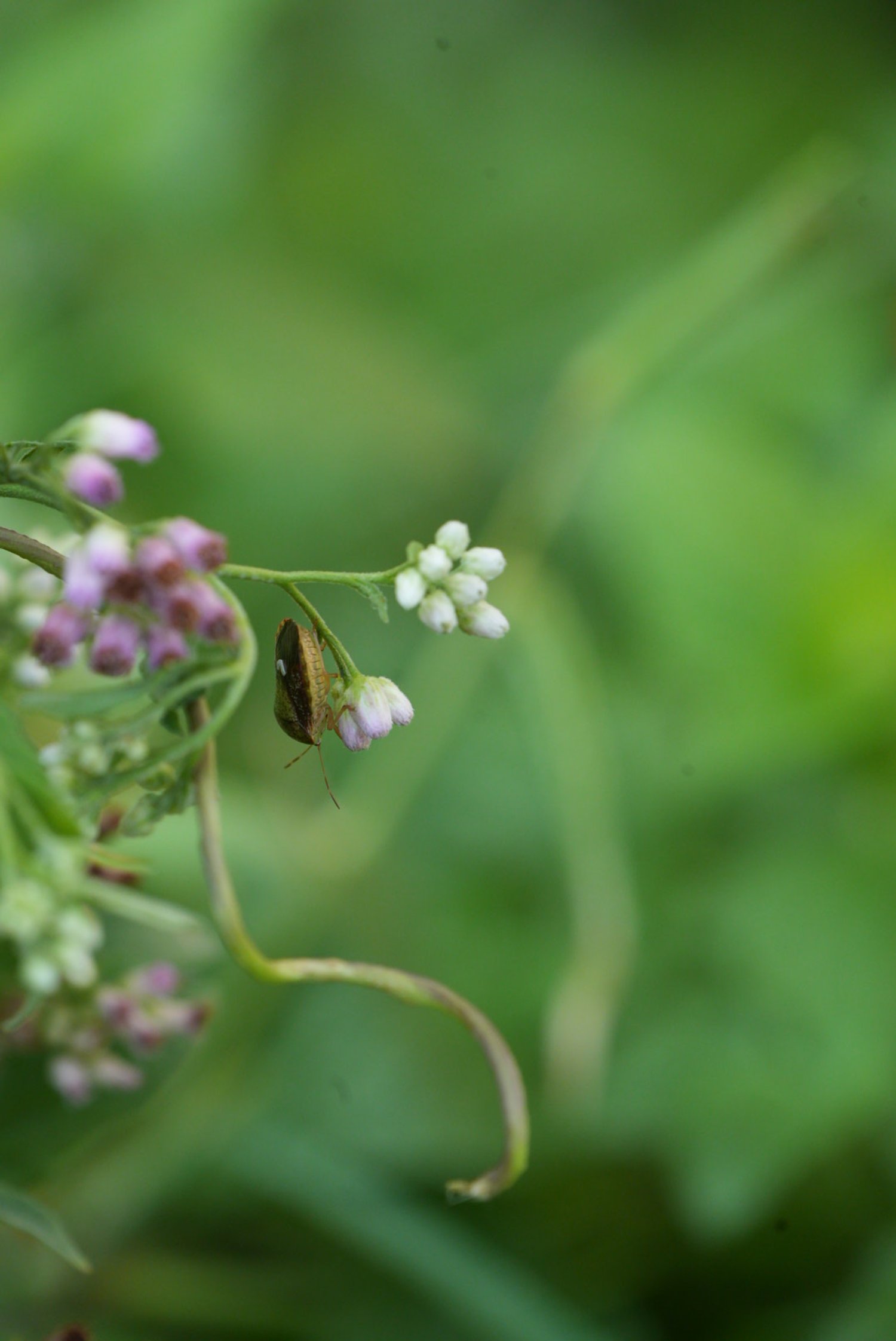
Ascra bifida, exploring crabgrass and Marsh Fleabane (both volunteer plants) hunting for moths, caterpillars, harmful beetles, aphids and other pests. They are valued citizens in “Symbiosis”. Oddly there is very little online about this sweetheart of a stink bug.

American Mockingbird and American beauty berry.

On the left side of the image perched atop the dead olive tree a Mockingbird searches for insects. Camaflouged by the orange trick background a juicy dragonfly flies into to the upper right corner of the frame and catches the alert Mockibgbirds attention.
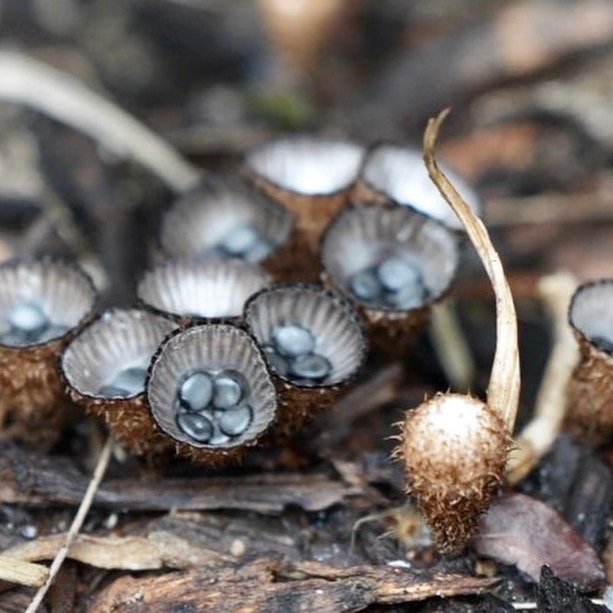
Cyathus stercoreus
Dung-loving birds nest fungus also known as splash cups.
Cyathus stercoreus
Dung-loving birds nest fungus also known as splash cups.
When a raindrop hits the cup's interior, the peridioles are ejected into the air tearing open the purse. In the lower part of the purse, the coiled funicular cord expands. The peridioles, followed by the sticky funicular cord and basal hapteron, land on a nearby plant stem or stick. Flying through the air, the line wraps around the plant's stem. The peridiole remains attached to the vegetation. In a natural setting, a grazing animal may eat it and later deposit it in that animal's dung to continue the life cycle. This amazing amazing creature breaks down dung, and captures raindrops.

Brown Anole


The ESTERN CARPENTER BEE AND PASSIFLORA INCARNATA
A dragonfly lays eggs in the still water of a trough pond. Her nymphs keep the mosquito larvae in check and are protein for the Texas mosquitofish.
I saw a blue swallowtail flitting across the garden, looking for a suitable host plant for her eggs. Below are images of Eggs under the same leaves the following days. This post will be ongoing. As I see Pipevine Swallowtails, I will document them here.

Swallowtail laying eggs under a white vein Morning glory leaf. 8/13 2:29

Full view of blue swallow tail 8/13

Swallowtail caterpillars eggs . 8/13 3:57

8/14 5:04

8/14

8/14
8/17 10:19
A two-year-old can be feisty, or would it be more like a rebellious teenager coming into its sexuality?
April of 2021, I started installing the plant material in “Symbiosis.” Seeing, hearing and smelling the transformation has been a gift. This past spring marked the first anniversary. This post celebrates the relationships and natural systems I have documented from the first anniversary through mid-August.
Keep in mind that in the summer of 2020, when I agreed to install a site specific living sculpture, I went every day to observe the space. Sitting and looking — observational research is a big part of my work.
How did it function in the ecosystem? The mowed nonnative zoysia turf grass was neat within its “borders.” The nonnative shrubs and plants were in aligned rows amongst compressed dirt and it was static. As the summer days warmed the bare spaces, the rising heat never created any movement in the garden. It was designed in rows and easy to maintain with gas-powered mowers and edgers. The first soil test revealed that the garden was void of life. The lower food chain of earthworms and grubs was absent. That explained why the birds flew by without landing. There was nothing for them to forage or seek shelter from predators. It did not soak up much water and sequestered little carbon. Lawndale’s Sculpture Garden was a dysfunctional plot of earth. It was green but not part of the coastal prairie ecosystem.
In a sea of Midtown asphalt and groomed properties in April of 2021, I questioned; would any wildlife find the small space? Failure was possible.
Nature was undeniably resilient in year one. Symbiosis was a living sculpture, a functioning part of the coastal prairie and the New World. The installation was not land art; it was a living ecosystem. It regenerated life.
On Mother’s day after the first big rain, the pond was full of white green treefrog eggs. The relationship between amphibians and clean water and important in building the lower food chain and keeping it in balance. for more details see the post Symbiosis — Green Treefrog Eggs.

Cricotopus rests on the Lawndale Art Centers building. This image is symbolic of a nonprofit art institution’s commitment to it's relationship with the natural world. Hopefully it will inspire others.
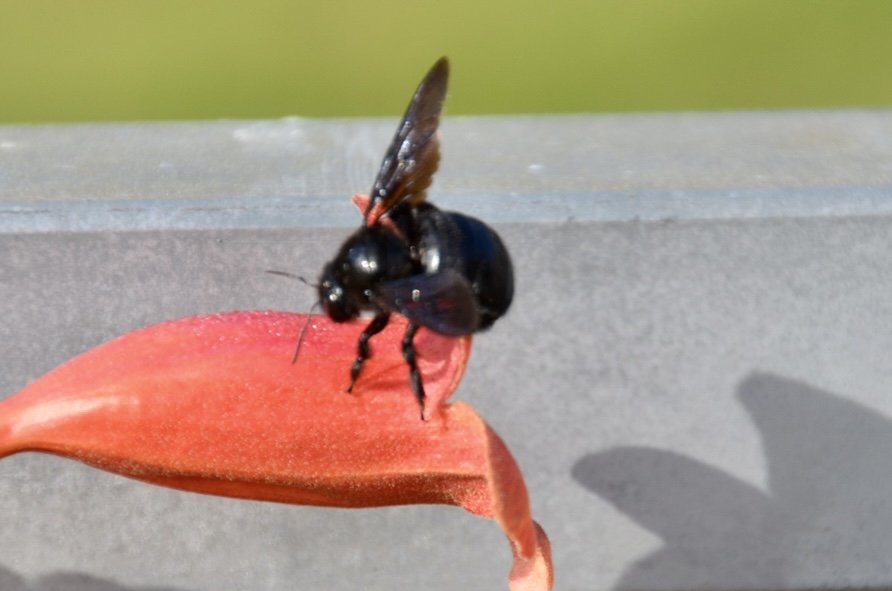
Large carpenter bee on a trumpet vine bloom.
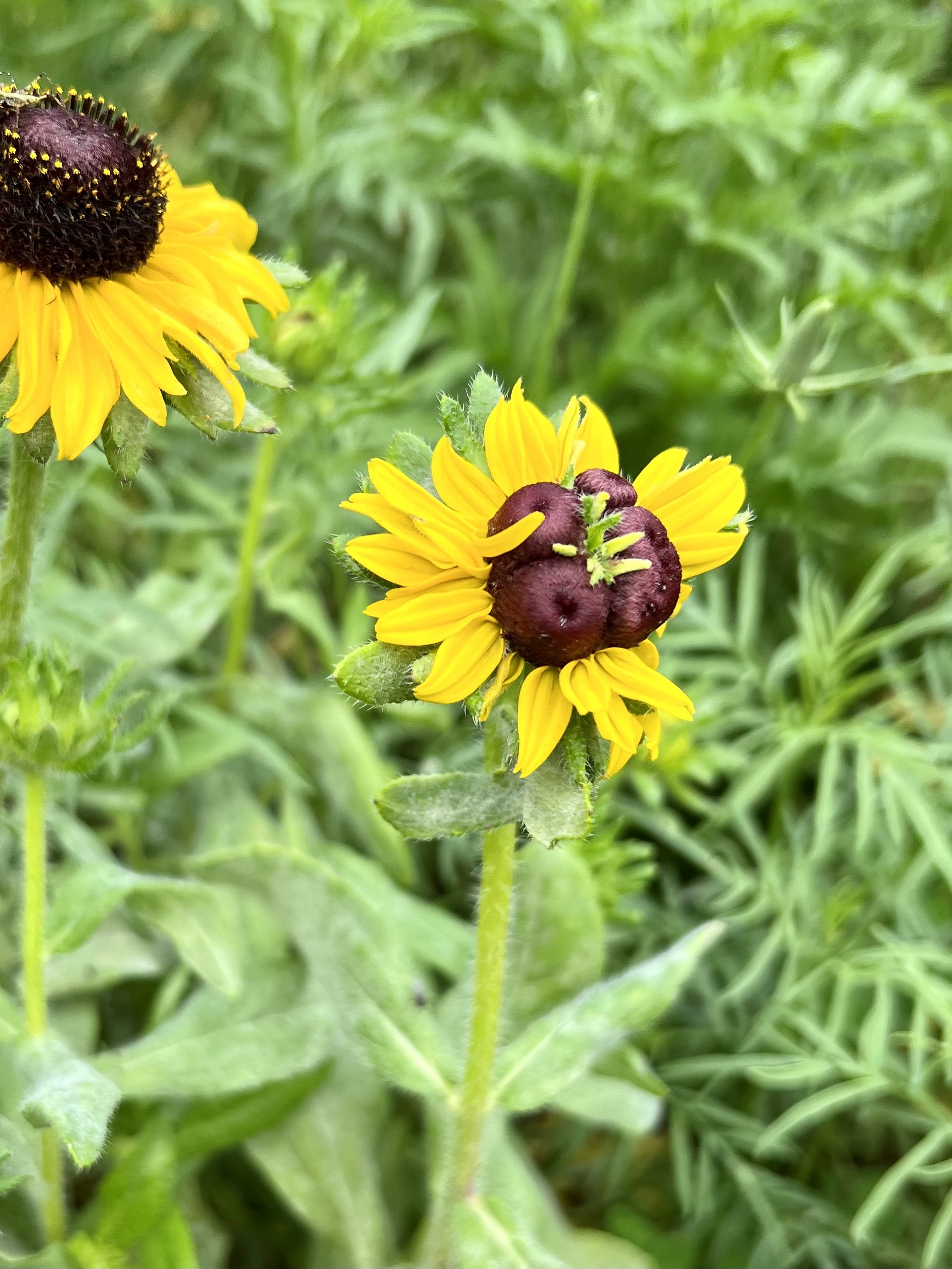
Mutation of a rudbeckia hirta. A reminder that being different is beautiful.
the chemical free trough pond provides a habitat for toads to mate and leave their eggs. The tadpoles in return eat algae keeping the water clear and mosquito larvae. #social sculpture.

White-striped longtail enjoying a Rudebeckia hirta bloom.

Anole asserts his dominance on the trunk of a dead olive tree.
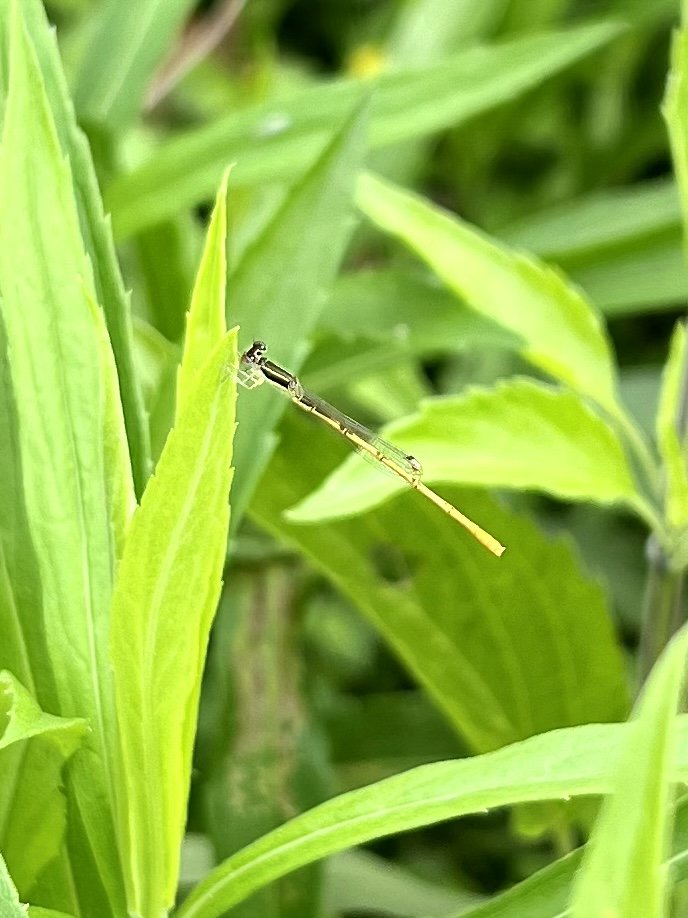
Ischnura hastata Citrine forktail on a frogfrut leaf.

Blue dock beetle enjoying the nutrition of a volunteer plant.

Spilosoma Virginia on a Rosinweed sunflower leaf.

Cricotopus Non biting midge on Rosinweed leaf.
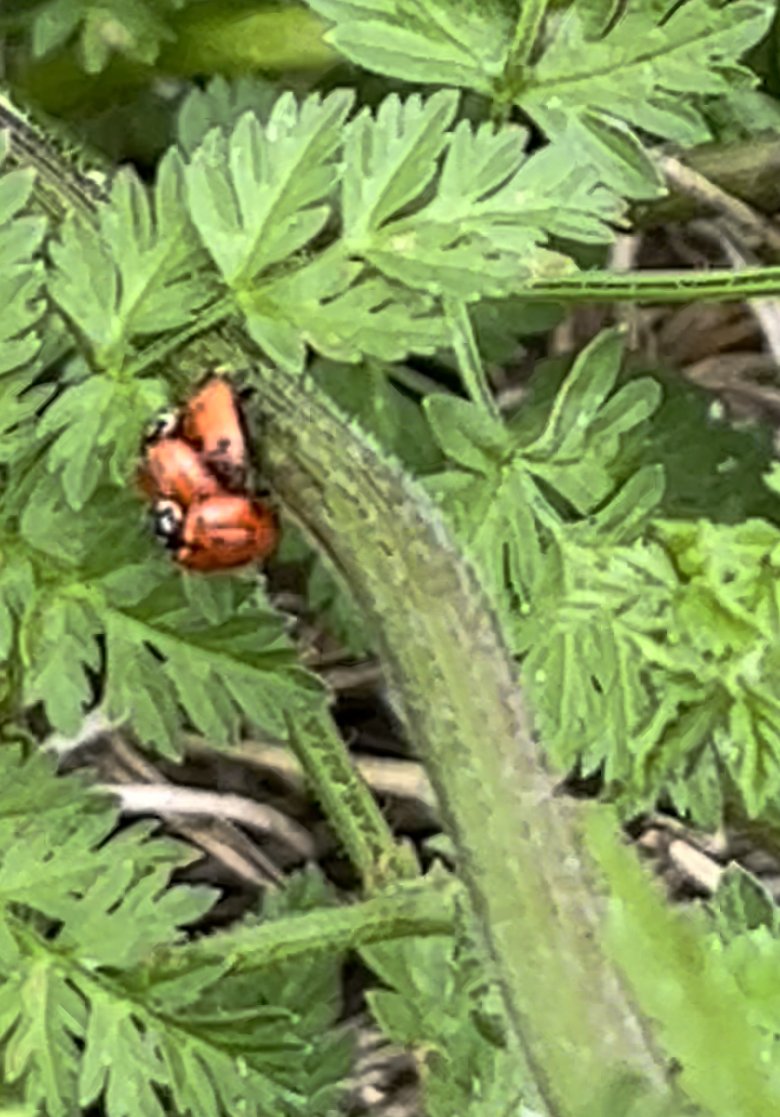
Hippodamia convergens convergent lady beetle, on a volunteer plant.

unknown - But interesting
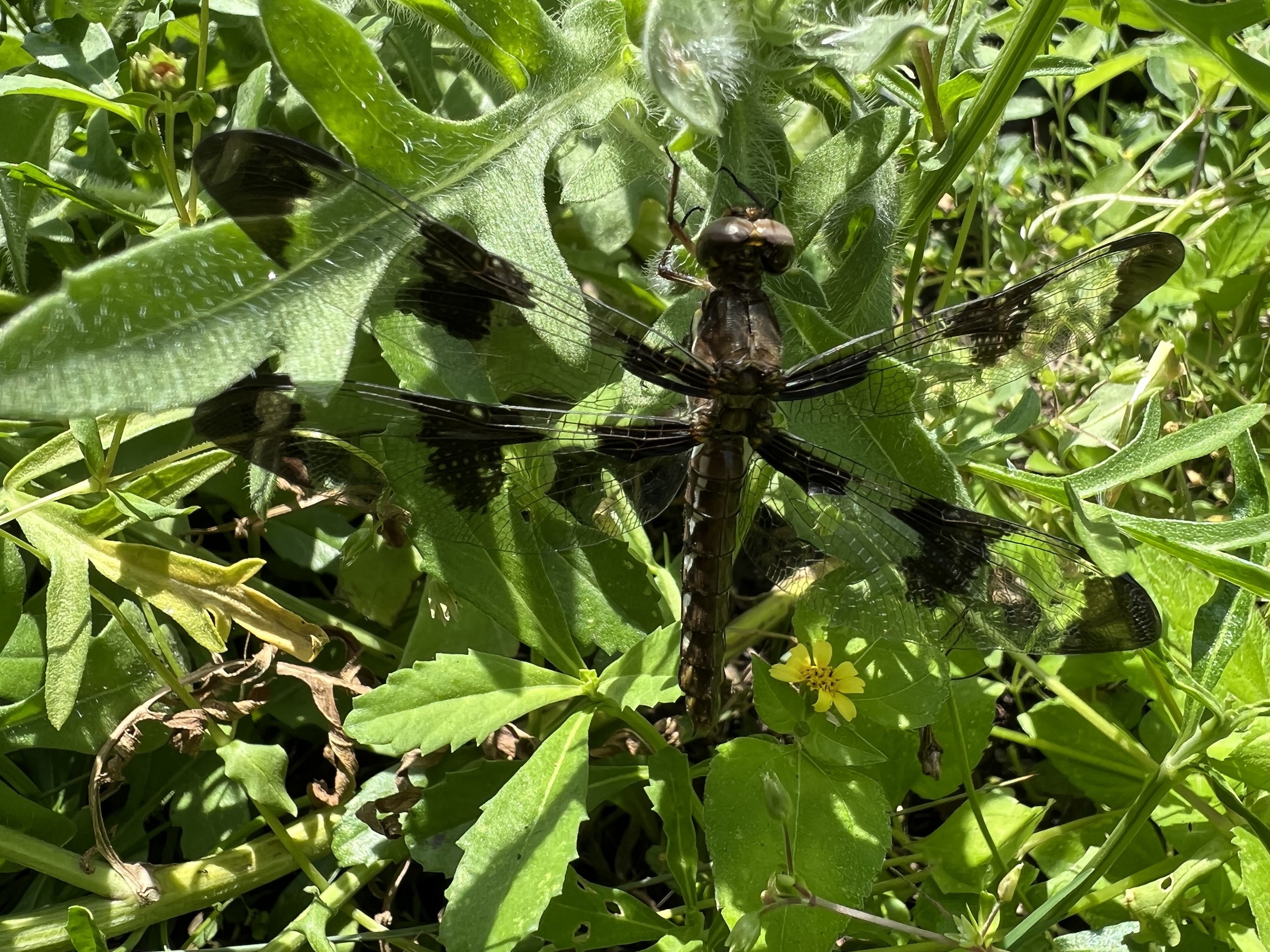
Celithemis fasciata and frogfruit.

Native bee _________ and Rosinseed sunflower.

Repipta taurus , Red bull assassin bug and painted blanket leaf.

Dolba hyloeus pawpaw sphinx and fall bedient plant
the perfect match a native carpenter bee’s body has evolved over the ages to fit the Passiflora incarnata perfectly.

Libellulidae- skimmer and docks. I often find skimmers perched on this past dried docks. They have a strong bond.

Mother Mockingbird feeding juvenile a tiny toad.

Juvenile Mockingbird perched on the manmade fence.

great blue skimmer (is a dragonfly) and the spent thimble flower.

2 Leafcutter bees mating.

2 Leafcutter bees mating and a spent painted blanket bloom.

Atalopedes campestris (called sachem in the United States and Canada) is a small grass skipper butterfly and frog fruit.

Another view

Hemiargus_ceraunus and frogdruit.

Umbrella paper wasp and spent sunflower.
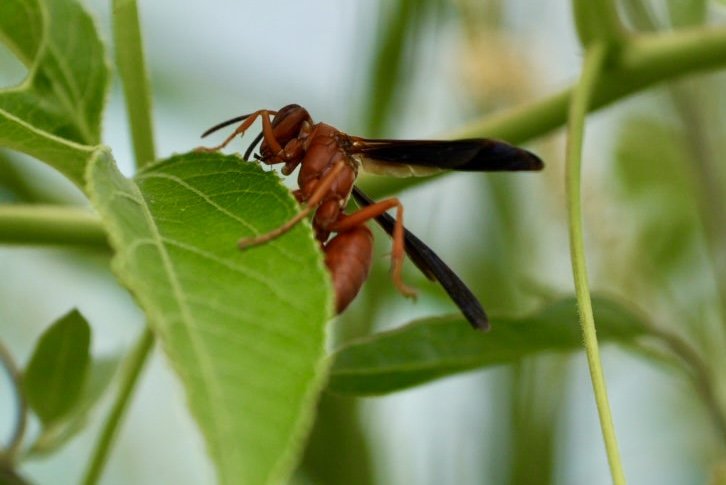
Paper wasp and passion flower. PLANTS CALL WASPS TO THE RESCUE WITH AN AROMA THE INSECTS LOVE. This is a special relationship.

More (green eyed) leaf cutter bees mating again on spent painted blanket bloom.

Male Eastern Carpenter bee- check out those big green eyes and fall obedient plant.

Sphex Digger wasp. On passiflora incarnata

Obscure Bird Grasshopper shaded by the leaves of Turks cap.

A pipevine swallowtail or Blue swallowtail laying eggs on a dried leaf of a red salvia. .
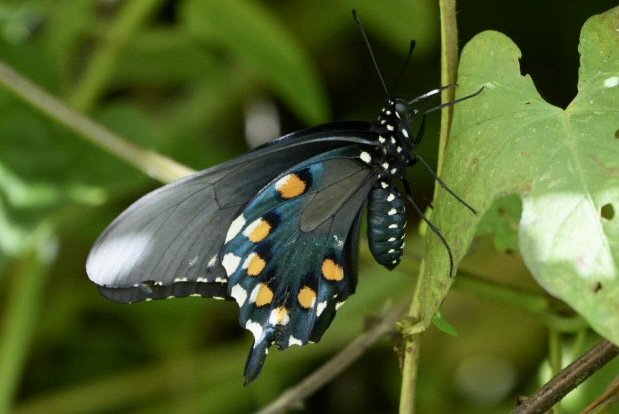
Battus philenor, the pipevine swallowtail or blue swallowtail and a morning glory vine.

Gulf fritillery butterfly and a passiflora incarnate

Dolba hyloeus (pawpaw sphinx) is a moth of the family Sphingidae and a fall obedient bloom.
Follow up post coming soon

Female common Whitetail skipper and a dried stem of a Rosin weed sunflower.

Leafcutter native bee and frogfruit.

Spiderweb that and dew . Does the quenching dew lure prey into the spiders web. I see a relationship between the spider and Earth’s closed water system.
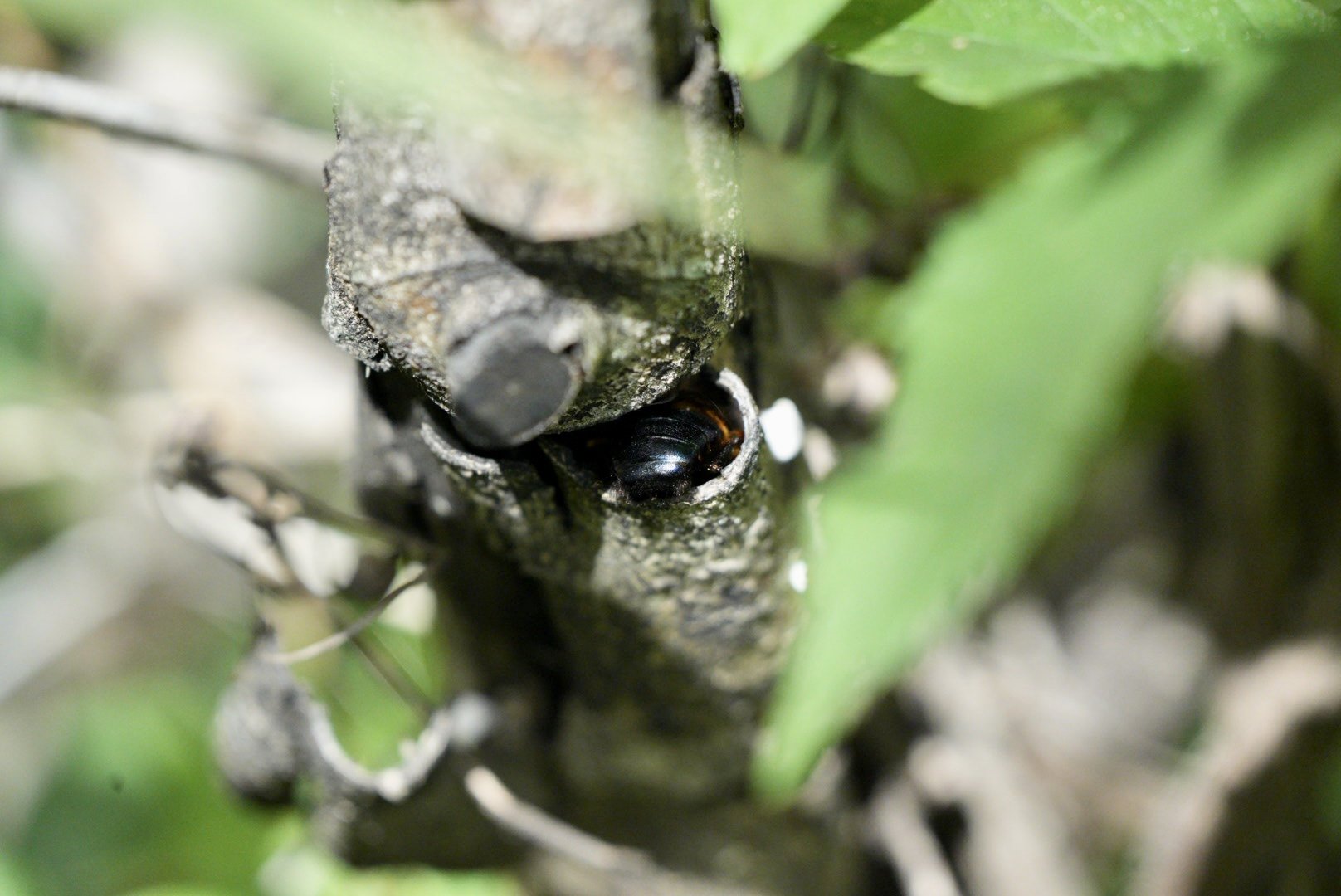
Eastern carpenter bee and a rotting tree.
Eastern carpenter bee building a nest in a rotting wood.
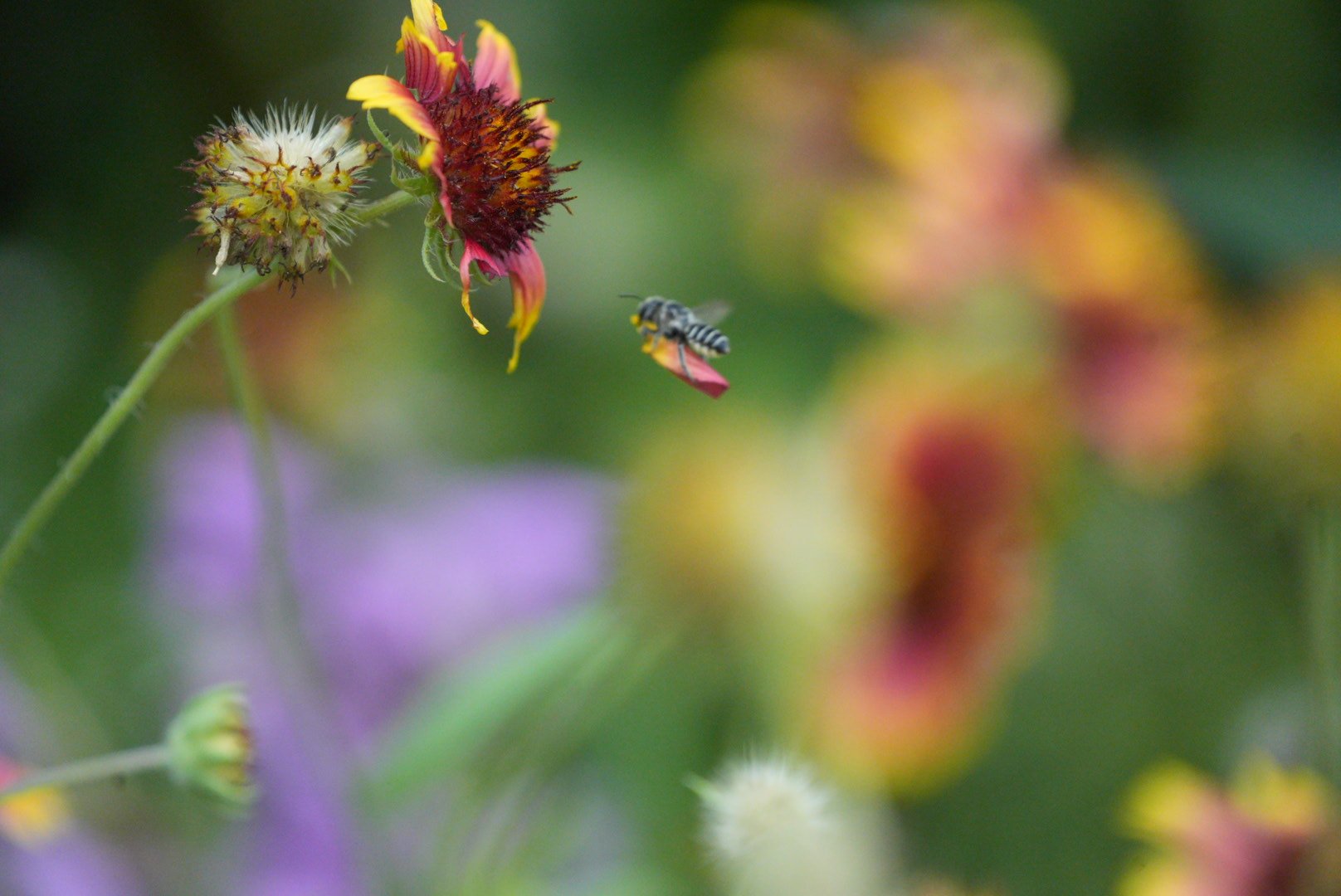
Leafcutter bee and blanket flower.
Leafcutter bee with a petal of a blanket flower Gaillardia pulchella. They use the petals to build their nests.
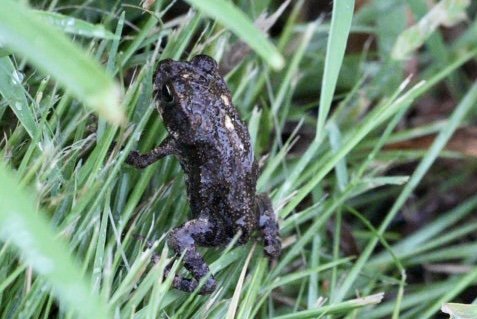
American toad And Earth’s closed water system.
American toad out for a stroll during the rain.

Plushback fly and Salvia azure.
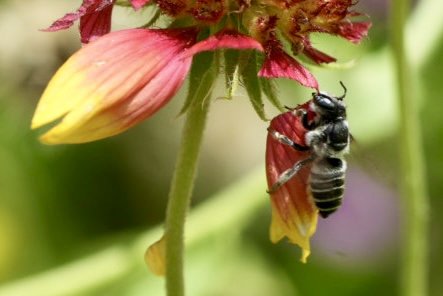
Another species of leadcutter bee cutting a bllanket flowr petal.

Swallowtail butterfly and white veined morning glory.
Swallowtail butterfly depositing an egg on white veined morning glory. Follow up post coming soin.

Jumping spider and fall obedient plant.

Plushback fly and blue salvia

The relationship between rainwater or dew and plants is a crucial part of any ecosystem. In this case the few is is on a stem of crabgrass. If you run your fingers down the stem you will notice the texture that slows water from running off it's surface too fast.
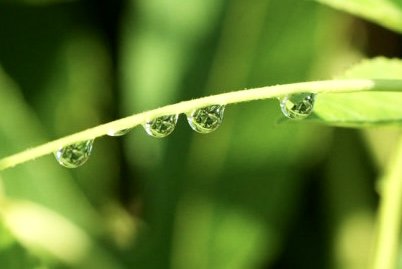
Dew and stems

Carpenter bee and Salvia azure
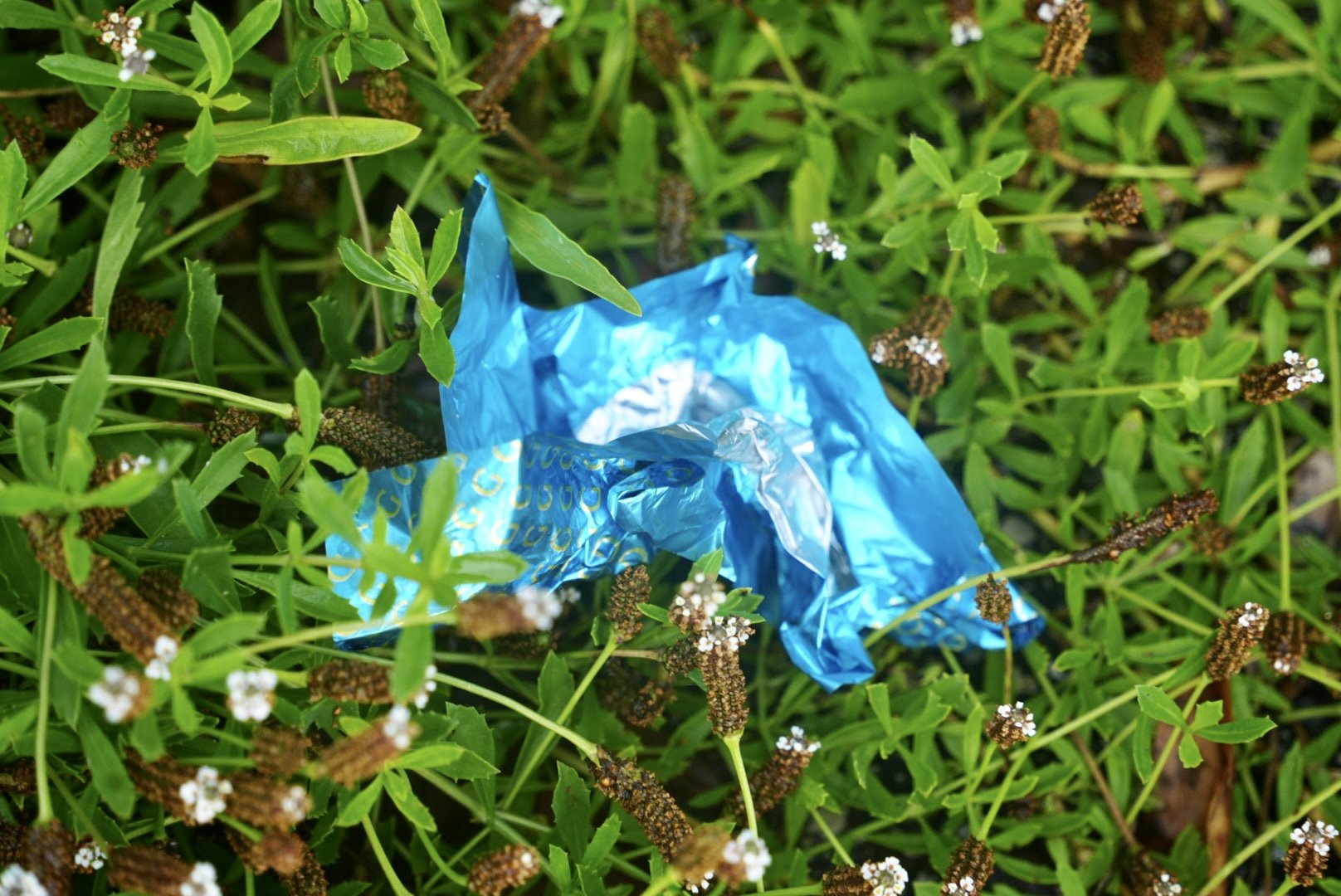
I have noticed that plant material on the edges of symbiosis stops garbage from blowing from the convenience store. I see this as another way plants are in partnership with our various ocean.

Anole safely camouflaged in the chaotic lines of the vines mixed with a diversity of plant stems.
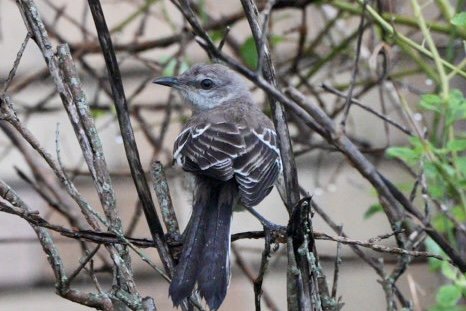
Juvenile mocking bird on a dead olive tree branch. I saw about six of them hiding in the American beautyberry after the rain. Now that the installation is a year old, it is getting height and layers. This added heights provides the birds with more protection, berries and perches for hunting small prey.

Stink bug on American beauty very.

Carpenter bee getting a back rub wile collecting nectar and pollen on a purple passion flower.
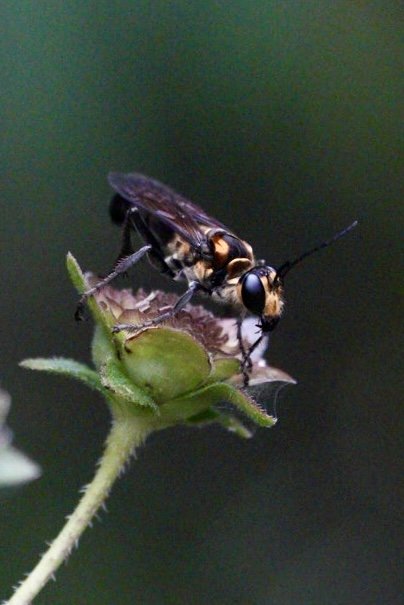
Sphex habenus, Golden-reined Digger Wasp and Rosin weed sunflower.
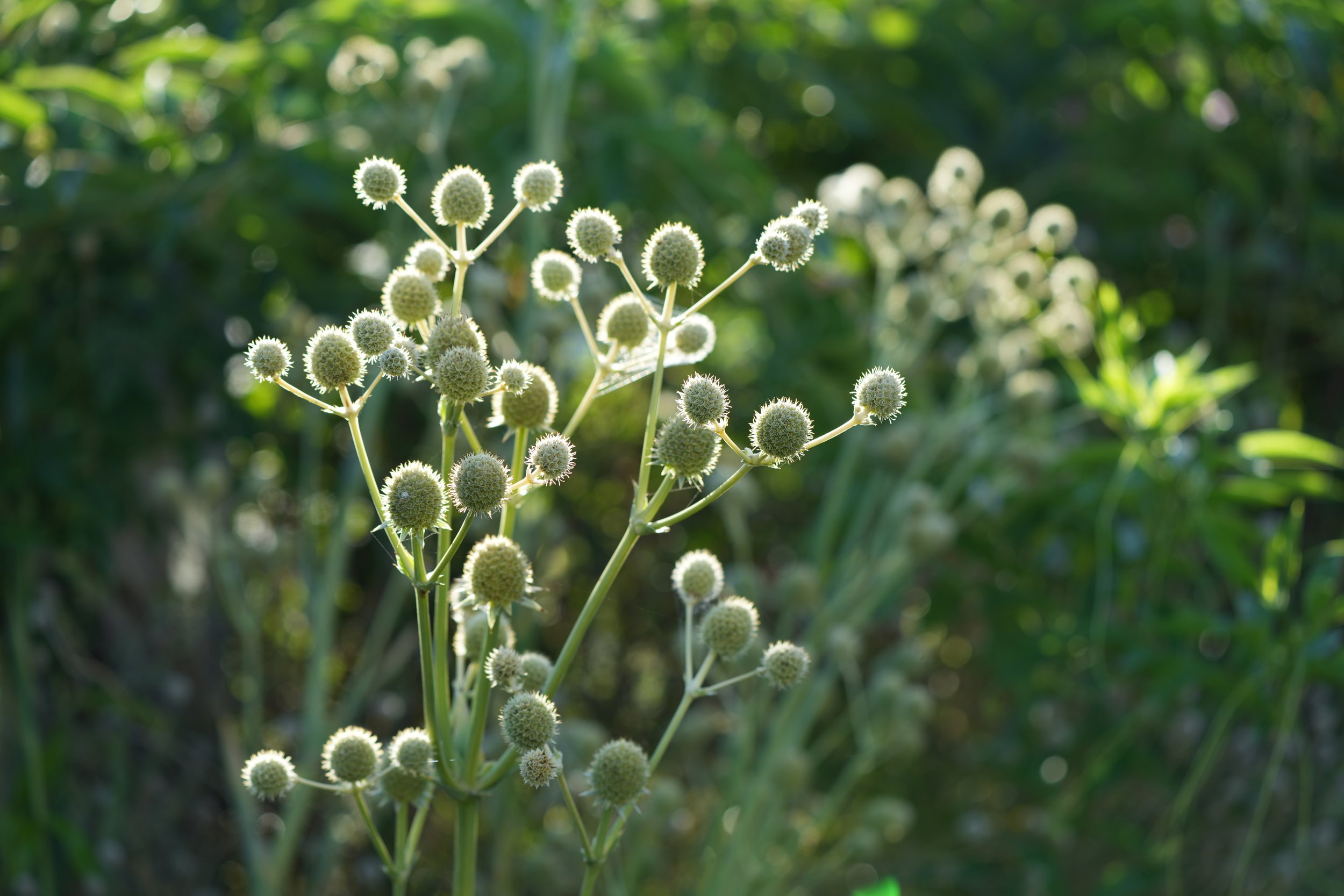
Sunlight nesting in Rattlesnake master.

?
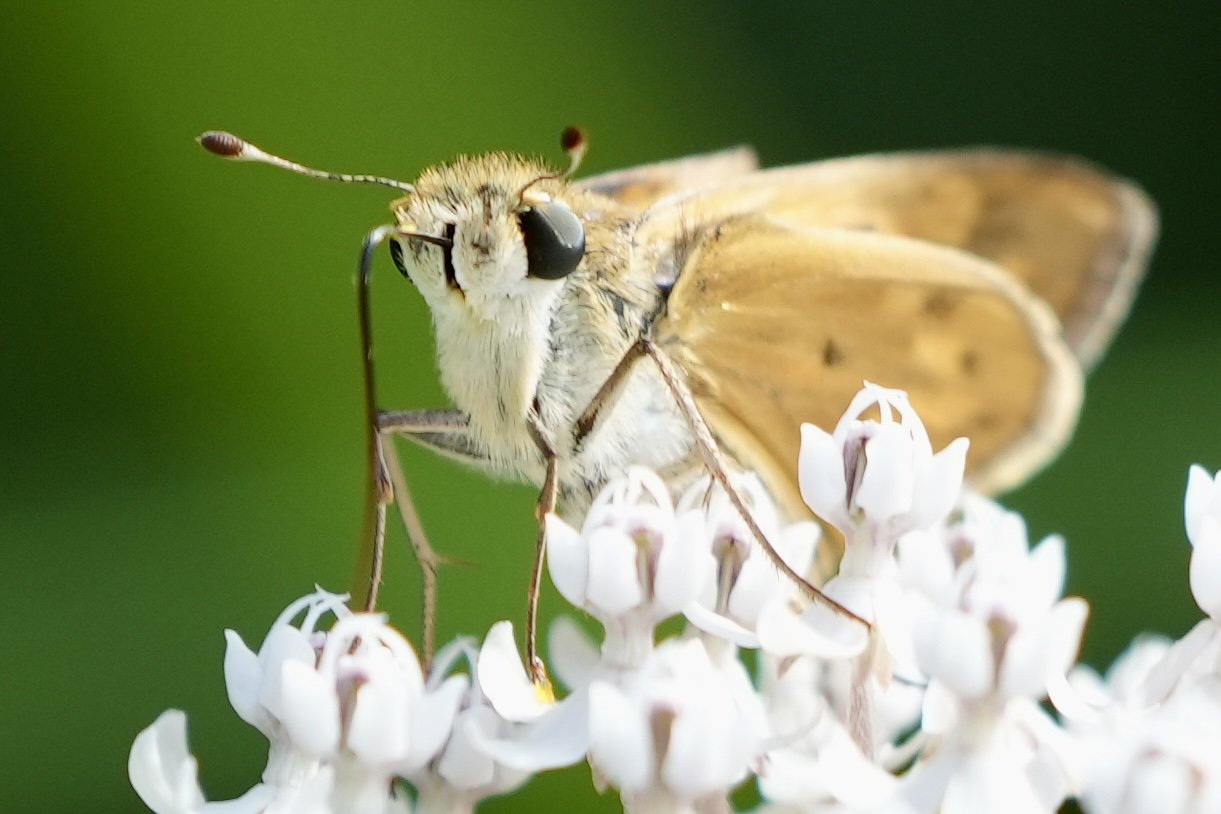
Subtribe Hesperiina And milkweed.

Subtribe Hesperiina And frogfruit

? Bee on Rattlesnake master

roseate skimmer and fall obedient plant.

Skipper on bloom less salvia stem.

New World Checkered skipper and everybody’s buddy frog fruit.
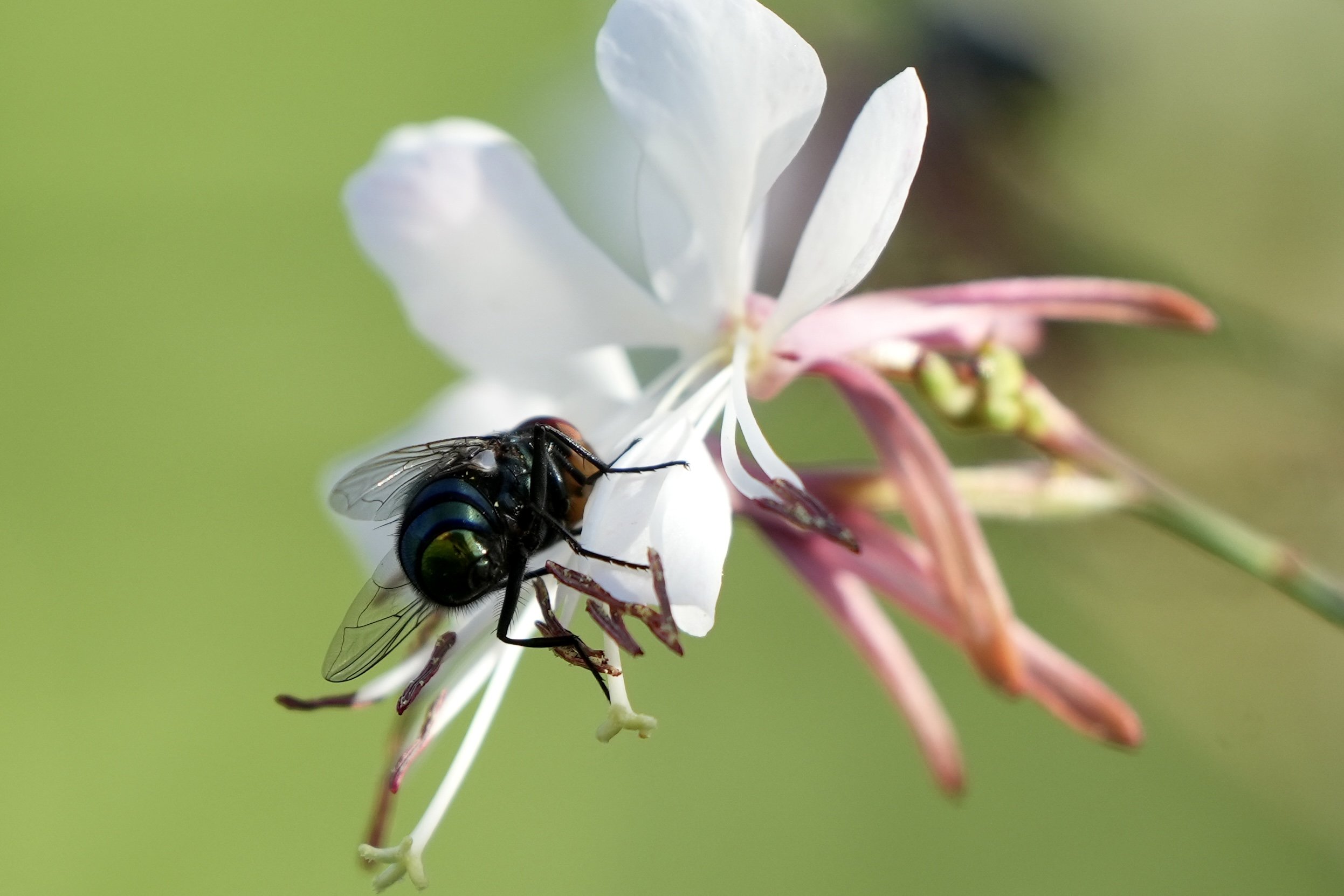
Sor ies of fly sleeping in butterfly faea Bush.
All living and nonliving matter are connected in form or system. Through my work on “Symbiosis,” I have witnessed the power of holistic management, also called systems thinking. I can see that Changing our decision making process to consider whole systems and connectedness is the solution to our environmental and social issues. Changing how society thinks is the driving force in my art.
With this new awareness I am inspired to consistently reflect it in my work. I have decided to rethink “Rumblings,” which began as a collection of monotypes of 50 of the 10,000 bee species. It wasa mono crop of bees. However, you can’t separate the interconnection between bees, humans, or other living organisms and the earth's natural systems. We are all part of the living planet Earth. I will start applying systems thinking to all my installations. “Rumblings ” will celebrate the relationships among a diversity of species up and down the food chain. I will weave into these pieces the relationships that whisper of Earths biological processes and Physical and chemical Elements. The connections can be obvious or subtle, they can be unmeasurable or invisible. This will be fun.

Quisque iaculis facilisis lacinia. Mauris euismod pellentesque tellus sit amet mollis.